In this story
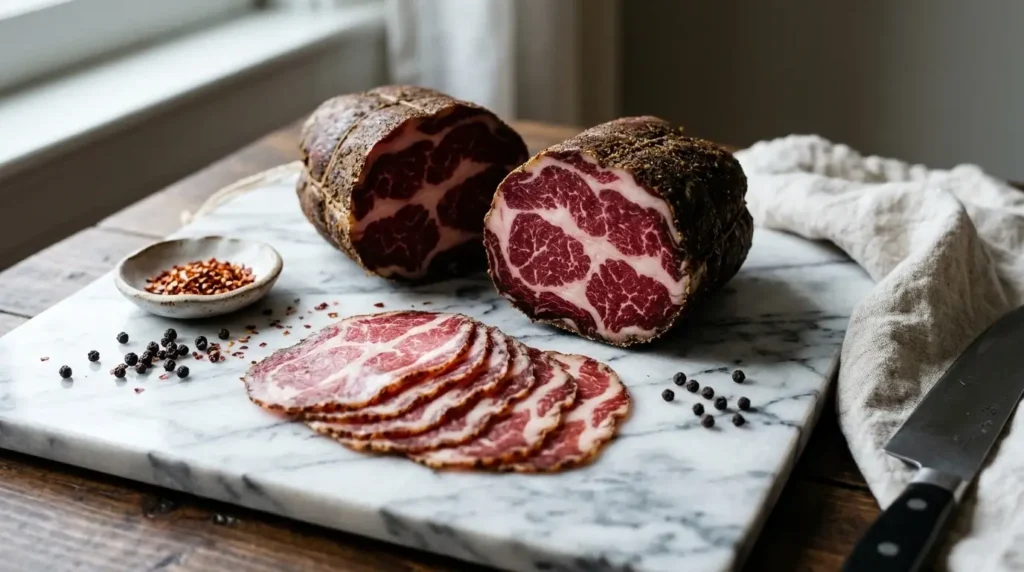
Capicola is cured pork neck. The muscle that runs from the back of the pig’s head along the top of the shoulder is salted, seasoned, wrapped and hung until it firms into a dark red cylinder streaked with fat. Italy calls it capocollo in the south and coppa in the north, American delis spell it capicola, and in parts of New Jersey and New York it is ordered as gabagool, a word that sounds nothing like any of them.
Video: How Capocollo (Gabagool) Is Made In Italy, from the Insider Food YouTube channel (Regional Eats)
The cut
Head and neck
The Italian name describes the meat: capo means head and collo means neck. The Parma rules specify the muscle beside the neck vertebrae, running into the first vertebrae of the chest. Unlike a ham from the hind leg, the piece is a long, narrow muscle, and it is cured whole and sliced into rounds.
Two regions hold European protection for their versions, and their rules show how differently the same cut can be treated.
Coppa di Parma
Northern, steamed and mild
The EU registration document for Coppa di Parma PGI, published as a single document under Council Regulation 510/2006, sets the terms. The production area covers the provinces of Parma, Modena, Reggio Emilia, Mantova and Pavia, plus riverside towns along the Po. The pigs are heavy pigs, averaging 160 kilograms live and at least nine months old at slaughter, and the cut is the muscle beside the neck vertebrae, never frozen.
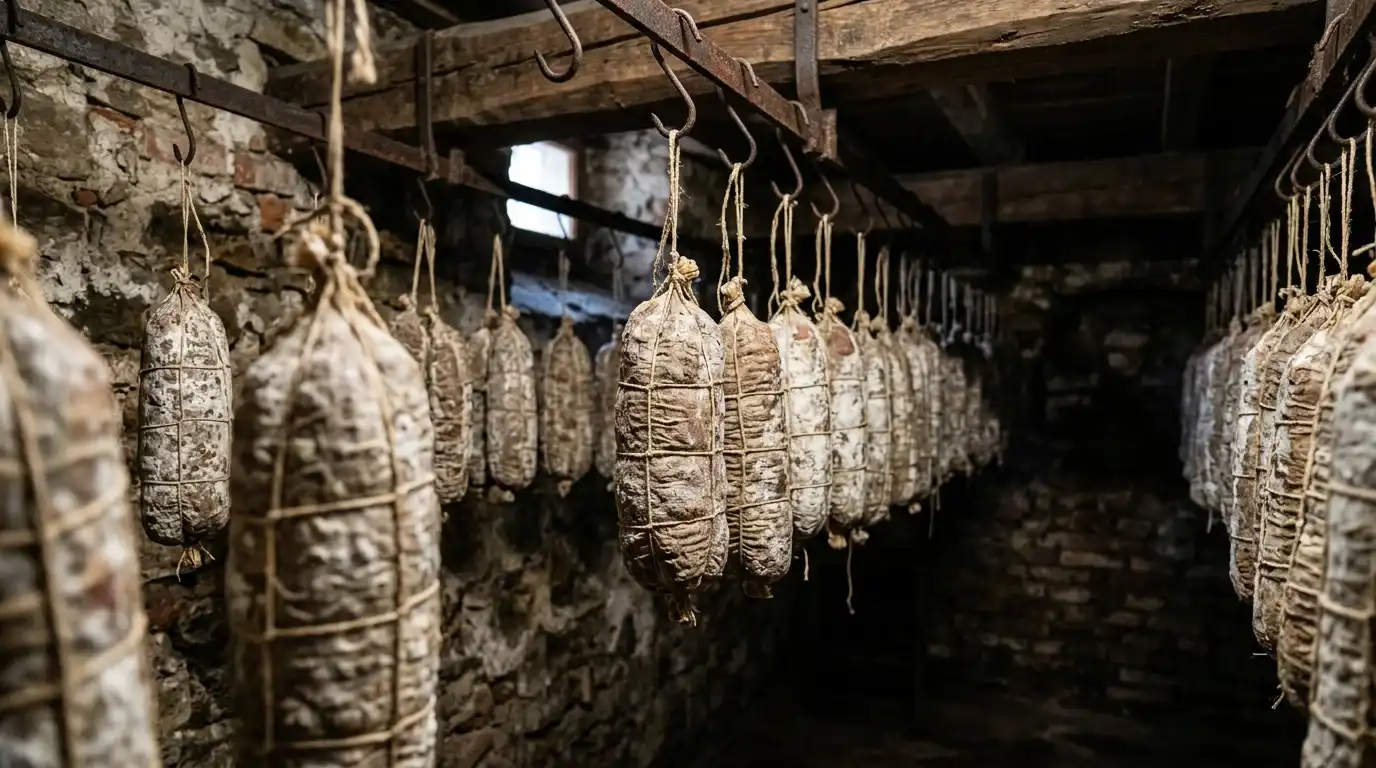
Salting lasts six to 14 days. The coppa goes into natural casing, is tied with twine or netting, and then goes through a step unusual among cured meats: steaming for eight to ten hours, followed by at least 15 days of drying. Total maturation runs 60 to 90 days depending on weight, never less than 60. The finished piece is an uncompressed cylinder 25 to 40 centimeters long and at least 1.3 kilograms.
The same document lays out the paper trail. Late seventeenth-century records call the product bondiola. A 1723 inventory required anyone joining Parma’s guild of pork curers, the lardaroli, to own a stock of sausages and bondiole, and court contracts from the mid-1700s record coppe and bondiole delivered to the table of Duke Ferdinand.
Capocollo di Calabria
Southern, peppered and longer aged
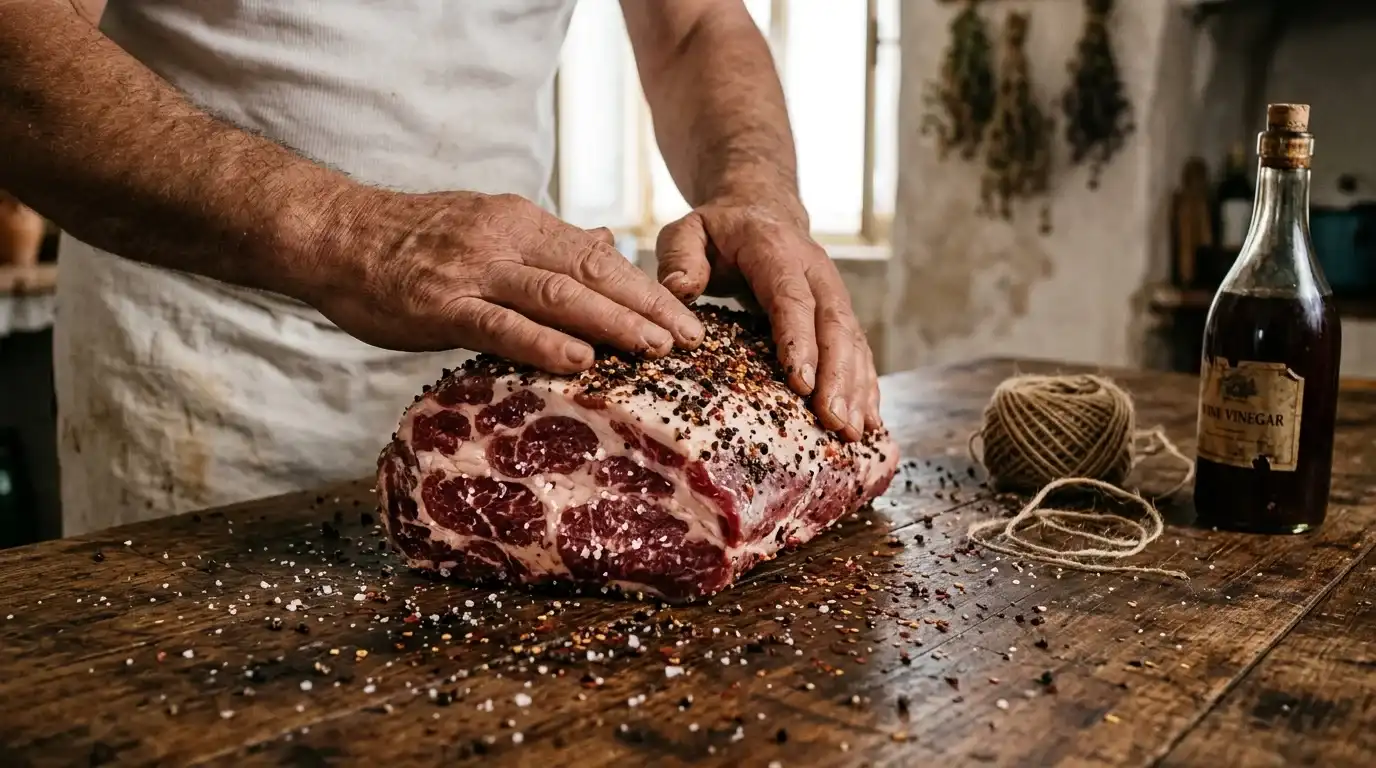
At the other end of the country, Calabria’s consortium of protected salumi describes a different method on its Google Arts & Culture page. Capocollo di Calabria DOP must come from pigs raised and slaughtered in Calabria, fed mainly on barley, field beans, corn, acorns and chickpeas. The deboned meat is dry-salted or brined for four to ten days, washed with water and wine vinegar, pressed and seasoned with black peppercorns, keeping a three-to-four-millimeter layer of fat to hold moisture.
It is wrapped in the pig’s diaphragm membrane rather than intestine, tied with natural twine and seasoned for at least 100 days from salting. Red chile, the consortium notes, affects the color and heat.
How capicola became gabagool
A Neapolitan word in New Jersey
The American pronunciation is the more famous story. Atlas Obscura’s explainer on the Italian New Jersey accent, updated in 2018, asked linguists why a word spelled capicola comes out as gabagool.
The answer starts with geography. Fred Gardaphe of Queens College told the magazine that roughly 80 percent of Italian Americans descend from southern Italy, carried by ships from southern ports to New York and New Orleans. Their families spoke regional languages, not the standardized Italian that took hold in Italy after unification, and those dialects were preserved in American neighborhoods while they changed at home.
Ann Marie Olivo-Shaw, a sociolinguist who studied Italian Americans on Long Island, described the shared southern traits that turn capicola into gabagool. Final vowels weaken to a soft “uh” or vanish. The “o” sound rises toward “oo.” Voiceless consonants become voiced, so the hard “c” turns into a “g” and the “p” softens toward a “b.” Run capicola through those changes and the result is close to gabagool. Mariapaola D’Imperio, an Italian linguist at Aix-Marseille University, said the dialects that produced those habits are fading in Italy itself: “Dialects do still exist, but they’re spoken mainly by old people.”
The television effect
HBO’s The Sopranos, set among Italian Americans in northern New Jersey, put the pronunciation in front of a national audience, and Atlas Obscura opens its explainer with a scene from the show in which the word comes up at the family table.
Capicola in a sandwich
Mild, hot and warmed
American producers sell capicola mild or hot, the hot version coated in red pepper. On a cold Italian sandwich it shares the bread with other cured meats GrillCheesy has covered, Genoa salami and mortadella, and Chicago’s giardiniera is a common relish for the combination. Warmed in a pressed sandwich, it pairs with a melting cheese such as Fontina. For the other great Italian cured pork, see the guide to prosciutto.
Whole coppa is sold by American producers as well as Italian ones. Volpi, a St. Louis salumi maker, sells both styles:
- Volpi Dry Cured Coppa – approx. 2 lb: a whole piece of mild dry-cured coppa for slicing at home. See it on Amazon (affiliate link)
- Volpi Dry Cured Spicy Coppa: the hot version, coated in red pepper. See it on Amazon (affiliate link)
Video: The Perfect Grilled Cheese with Coppa and Red Onion Jam Recipe presented by Volpi Foods, from the volpifoods YouTube channel
As an Amazon Associate I earn from qualifying purchases. A commission may be earned if you buy through this link, at no extra cost to you.

Frequently asked questions
What is the difference between capicola and coppa?
They are the same cut, cured pork neck. Coppa is the northern Italian name, capocollo the southern one, and capicola the common American spelling.
Why do people say gabagool?
It is a southern Italian dialect pronunciation of capicola, preserved by immigrants in New York and New Jersey: final vowels drop, “o” rises toward “oo,” and “c” and “p” soften to “g” and “b.”
How long is capicola aged?
Coppa di Parma PGI must mature at least 60 days; Capocollo di Calabria DOP at least 100 days from salting.
Is capicola the same as prosciutto?
No. Prosciutto is cured hind leg; capicola is cured neck and shoulder, with more fat marbled through the meat.
Sources
- “Coppa di Parma” PGI single document, Council Regulation (EC) No 510/2006: https://www.gob.mx/cms/uploads/attachment/file/245728/IT_Coppa_di_Parma.pdf
- Consorzio Salumi di Calabria, “Salumi di Calabria,” Google Arts & Culture: https://artsandculture.google.com/story/ZQVxQ3QNmBMA8A
- Atlas Obscura, “How Capicola Became Gabagool: The Italian New Jersey Accent, Explained” (updated October 25, 2018): https://www.atlasobscura.com/articles/how-capicola-became-gabagool-the-italian-new-jersey-accent-explained