


In this story
Okonomiyaki is a savory pancake of wheat batter and shredded cabbage cooked on a teppan, the flat iron griddle, then brushed with a thick brown sauce. The name is usually glossed as “grilled as you like it,” and two cities claim the dish in very different shapes. In Osaka, everything is stirred into the batter before it hits the iron. In Hiroshima, the cook builds it in layers, with a crêpe at the bottom and a bed of noodles in the middle.
Video: History of Hiroshima-style Okonomiyaki, from the Hiroshima Trivia YouTube channel
Before the name
Tea snacks, children’s treats and one-coin Western food
Japan’s government magazine Highlighting Japan laid out the long ancestry in an August 2017 feature. The earliest precursor it names is funoyaki, a flour crêpe credited to the sixteenth-century tea master Sen no Rikyu and served with green tea in Kyoto more than 400 years ago. Later came moji-yaki, letters and pictures drawn in batter on a griddle, and dondon-yaki, a sweet street snack for children.
The closer relative arrived in the Taisho period, between 1912 and 1926. Issen yoshoku, which translates roughly as one-coin Western food, became popular in Kyoto: a batter cake with green onion and Worcestershire sauce, close enough to the modern dish that the magazine calls it the nearest ancestor. By the 1930s, the magazine says, the dish had taken the name okonomiyaki.
Osaka style
Batter, cabbage and the sauce on top
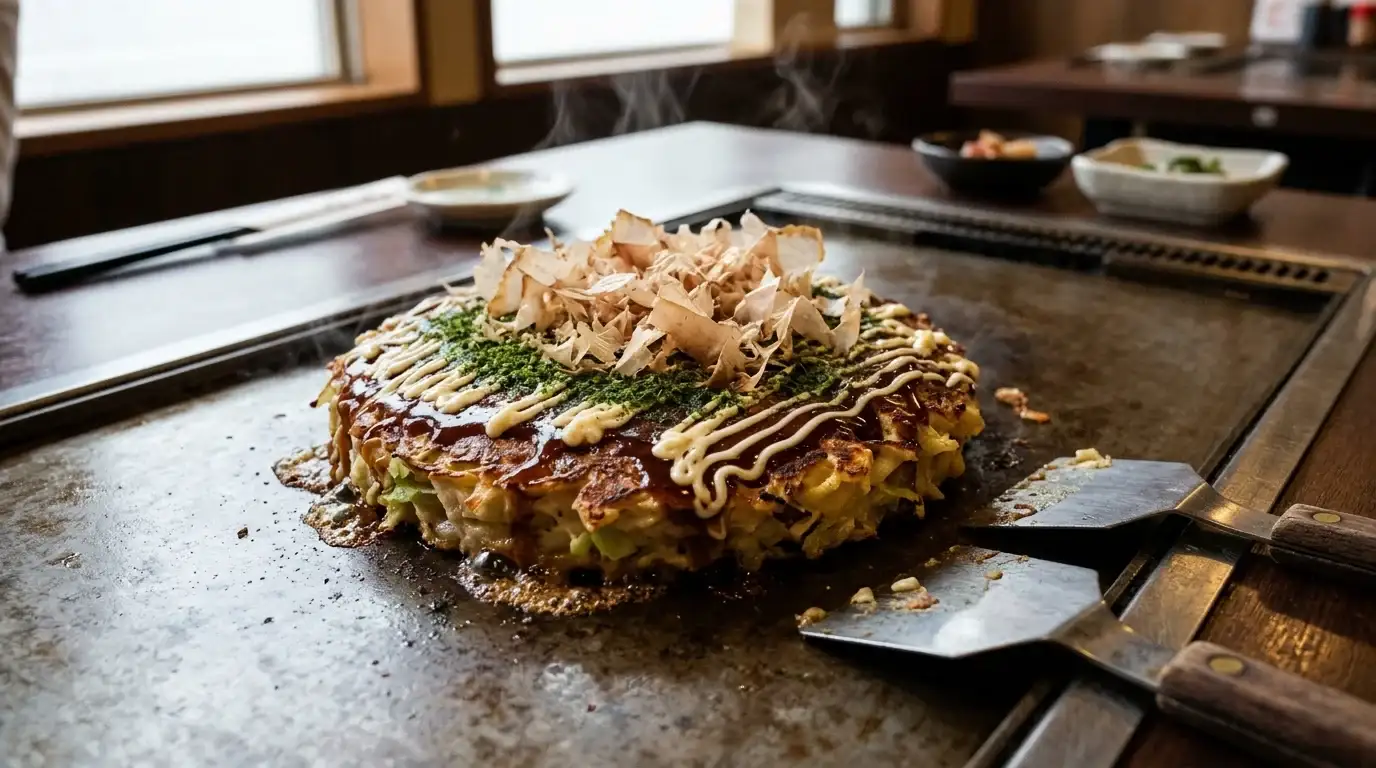
Osaka’s version is the one most people outside Japan know. The same Highlighting Japan piece describes a batter of flour, eggs, grated naga-imo yam, finely chopped cabbage and dashi, mixed together with the fillings and cooked as one thick round. Pork belly, squid or octopus go on or in, and the finished cake gets okonomiyaki sauce, thin squiggles of mayonnaise, dried bonito flakes and aonori seaweed powder.
The article profiles Osaka-Boteju, which it calls the city’s oldest okonomiyaki restaurant, opened in the 1950s when the dish first became widely popular. Boteju was the first place in Osaka to cook okonomiyaki on a griddle in front of customers. Its chief executive, Hisao Miyahara, estimated about 5,000 okonomiyaki shops in Osaka alone, though a 2014 government survey cited in the same piece counted 2,850 okonomiyaki or takoyaki places. His view of what separates one shop from the next was short: “The secret is in the sauce.”
Hiroshima style
Built from the ruins
Hiroshima’s okonomiyaki is tied to the city’s recovery after the atomic bombing of August 1945. An English text prepared by the City of Hiroshima for the Japan Tourism Agency’s database in 2019 describes issen yoshoku as a children’s snack that residents adapted, with whatever ingredients were at hand, while rebuilding their lives immediately after the war. Stalls and small restaurants, many run by war widows according to that text, spread across the city and helped the local economy recover.
The Hiroshima Peace Media Center, the Chugoku Shimbun’s archive, fills in the economics. Kenichi Hosoi, dean of business administration at the Hiroshima University of Economics, credits the spread mainly to wheat flour from US aid, and notes that the demand supported local makers of sauce, noodles and iron griddle plates. Early versions were topped with dried bonito and tempura crumbs; noodles came later, added to make the dish more filling, and stayed.
The same archive also complicates the widow story. Many Hiroshima okonomiyaki shops carry “chan” in their names, and some theories tie that to widows running them. In many cases, the paper found, the names came from the owner’s nickname or a daughter’s name.
From the square to Okonomimura
The stalls clustered in Shintenchi. The Rei-chan stall, started around 1955 in Higashi-Shintenchi by Nobuto and Toshie Yamashiro, first sold amazake and oden and added okonomiyaki around 1957. By the 1960s, Nishi-Shintenchi Square was packed with stalls. In October 1965 the city banned food stalls from the square, and many vendors moved into Okonomimura or the Hiroshima Station building. Okonomimura, the tourism text notes, is now a three-story building of okonomiyaki counters that keeps a 1960s feel.
National fame came in 1975, according to the Peace Media Center, when the Hiroshima Toyo Carp won their first Central League pennant and the city began steering school trips to Okonomimura. The number of shops peaked at about 2,000 and now sits around 1,300 in the prefecture.
How it is built
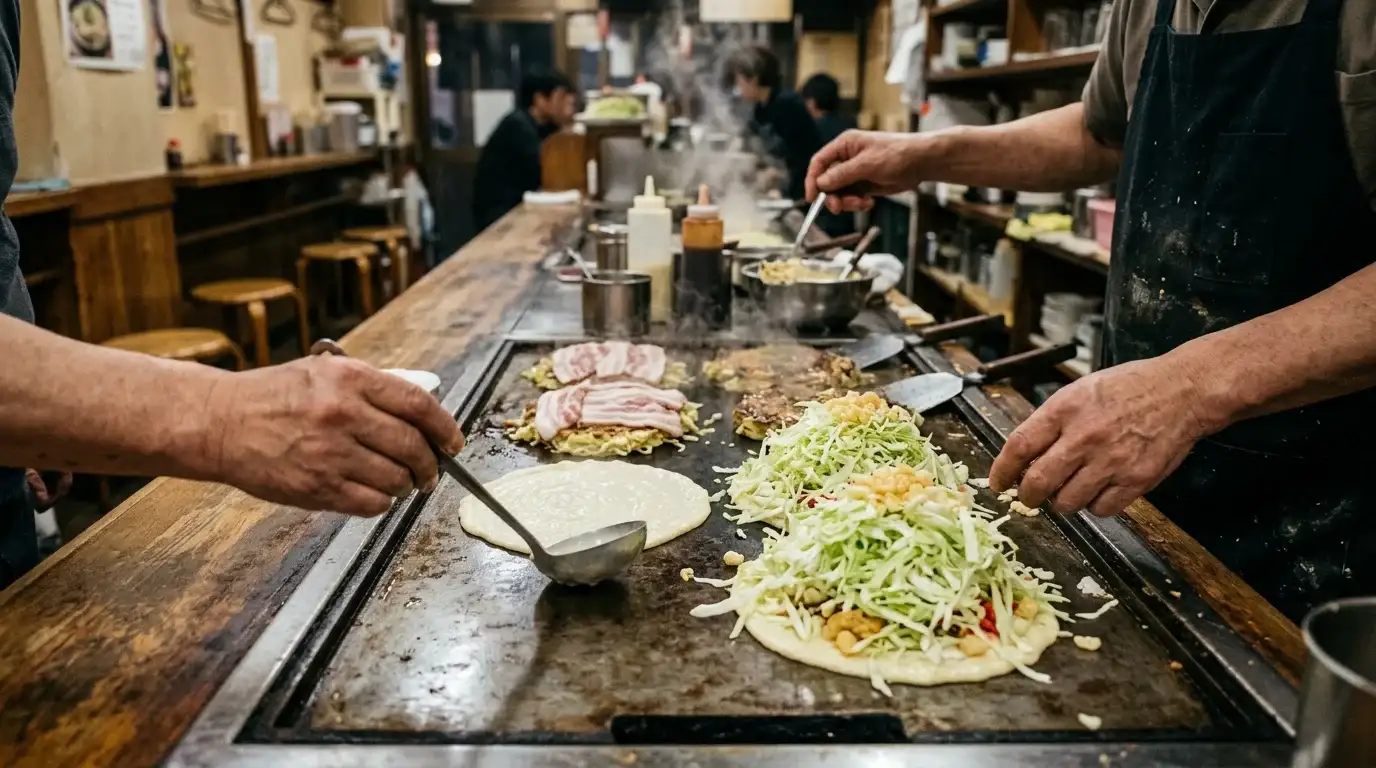
The order is the signature. The tourism text describes a thin batter base with the ingredients built up in layers rather than mixed in, and cabbage piled much higher than in other regional styles. The Peace Media Center lists the layers of today’s version: a flour-and-water batter on the iron plate, shredded cabbage, pork and noodles, an egg broken and cooked on top, and a thick, sweet sauce to finish.
The sauce
Otafuku, 1952
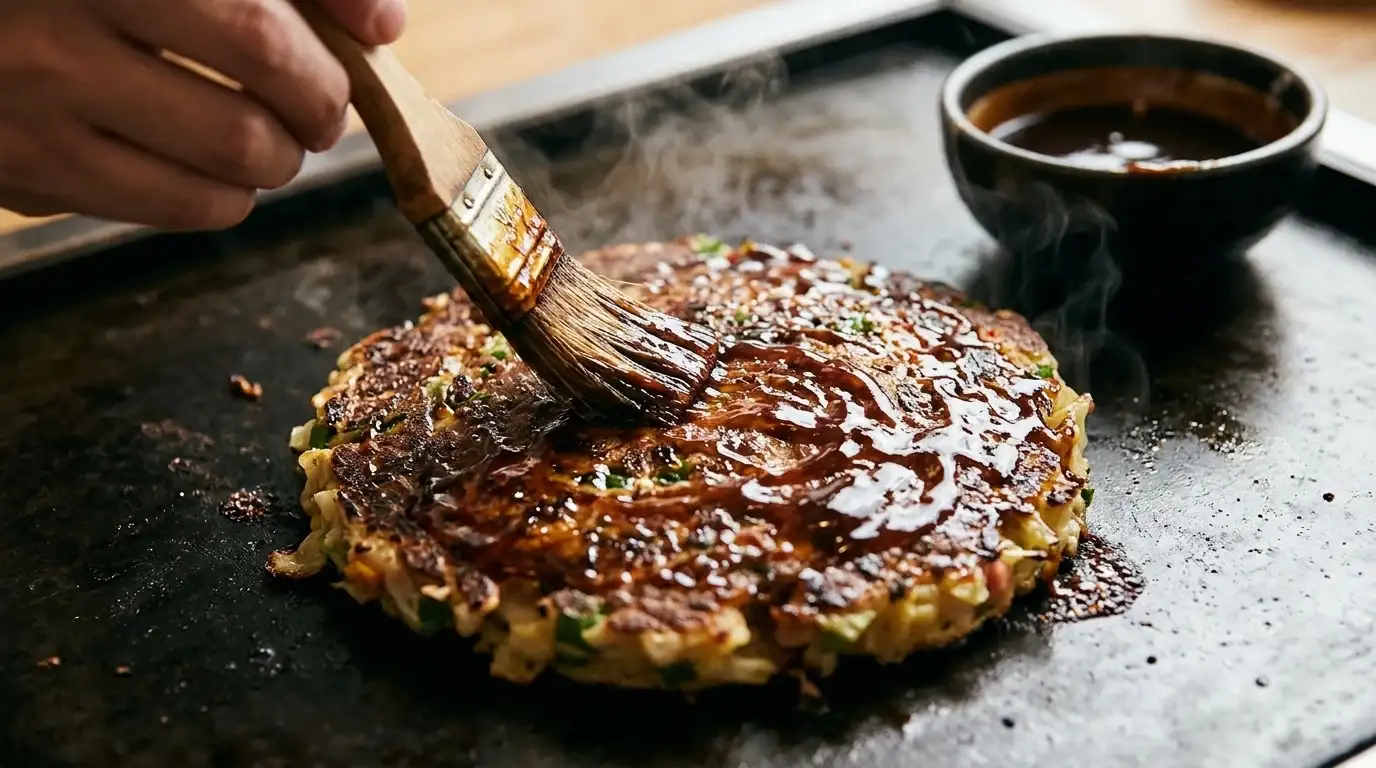
Okonomiyaki sauce is sold as its own product, and one of its makers grew up alongside the Hiroshima stalls. Otafuku’s company history records vinegar brewing from 1938, the destruction of Hiroshima in 1945, the start of sauce production in 1950 and the first sales of a dedicated okonomiyaki sauce in 1952. In 1975, the timeline notes, the company began using dates and changed its name to Otafuku Sauce Co., Ltd.; it opened an okonomiyaki training center in Tokyo in 1987 and the Wood Egg Okonomiyaki Museum in Hiroshima in 2008. The Peace Media Center records a shop owner’s daughter recalling her father urging sauce makers to add more apples and onions.
- Otafuku Okonomi Sauce, Vegan Japanese Topping (17.6 Ounces): the Hiroshima company’s thick, sweet sauce made for okonomiyaki. See it on Amazon (affiliate link)
Video: How to Make Okonomiyaki using Otafuku Okonomiyaki Kit, from the Otafuku Foods YouTube channel
As an Amazon Associate I earn from qualifying purchases. A commission may be earned if you buy through this link, at no extra cost to you.
Okonomiyaki on an American griddle
Same iron, different pancake
Okonomiyaki is griddle food first. The teppan it cooks on is the same kind of flat iron plate as a diner flat-top, and GrillCheesy’s history of teppanyaki covers how that plate became a restaurant stage in its own right. The same surface turns out diner hash browns and the pressed smash burger, and the guide to seasoning a flat-top griddle covers keeping that surface ready.
Frequently asked questions
What does okonomiyaki mean?
Roughly “grilled as you like it.” The dish took the name by the 1930s.
What is the difference between Osaka and Hiroshima okonomiyaki?
Osaka style mixes cabbage and fillings into the batter and cooks it as one cake. Hiroshima style layers a thin crêpe, a tall pile of cabbage, pork, noodles and a flattened egg.
What is okonomiyaki sauce made of?
A thick, sweet brown sauce. Otafuku, a Hiroshima company, first sold a dedicated okonomiyaki sauce in 1952.
Why is okonomiyaki important in Hiroshima?
After the 1945 atomic bombing, cheap flour-based stalls fed residents rebuilding the city, and the dish became a symbol of its recovery.
Sources
- “Washoku: Okonomiyaki,” Highlighting Japan, Government of Japan (August 2017): https://gov-online.go.jp/eng/publicity/book/hlj/html/201708/201708_12_en.html
- City of Hiroshima, “Hiroshima Okonomiyaki,” Japan Tourism Agency multilingual database (FY2019): https://www.mlit.go.jp/tagengo-db/en/R1-00502.html
- Hiroshima Peace Media Center (Chugoku Shimbun), article on the history of Hiroshima-style okonomiyaki (undated): https://www.hiroshimapeacemedia.jp/?p=131732
- Otafuku Sauce Co., “Our History”: https://otafuku.co.jp/e/history


