In this story
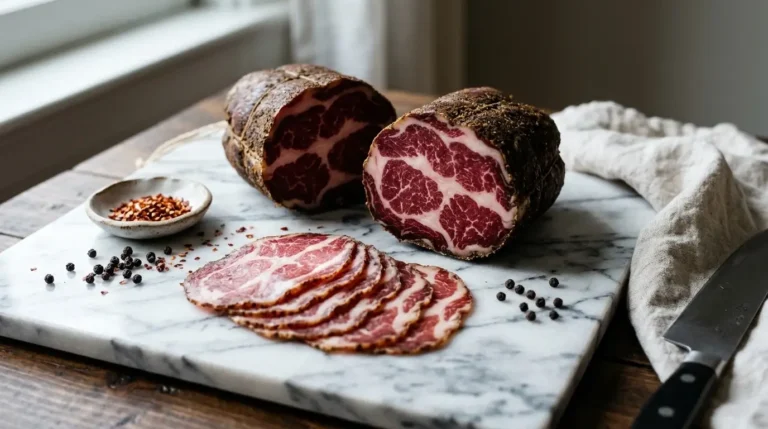
Prosciutto crudo is a raw hind leg of pork, salted and hung until it dries into something that can be sliced so thin the light comes through it. Italy makes many versions, but two carry most of the reputation abroad: Prosciutto di Parma, from the hills of Emilia-Romagna, and Prosciutto di San Daniele, from a single town in Friuli. Both are protected designations of origin. Both use nothing but pork and sea salt. They still end up as different hams, and the difference can be seen before a single slice is cut.
Video: How Italian Parma Ham Is Made, from the Insider Food YouTube channel (Regional Eats)
Pork and salt, nothing else
The Parma rule
The Consorzio del Prosciutto di Parma states the core rule plainly: the only ingredients its production specifications allow are pork and salt. No colorings, preservatives, nitrites or nitrates. The hams come from the rear haunches, and curing is controlled so each leg absorbs only enough salt to preserve it. A trimmed ham loses more than a quarter of its weight to moisture along the way, which is where the flavor concentrates.
The consortium traces the craft to Roman times, citing Cato the Censor’s description of air-cured ham from the Parma area, and links the word “prosciutto” to the Latin for “dried.” The modern consortium itself was founded in 1963 by 23 producers. Slicing and packaging of the ham also have to take place in the Parma region, the consortium says, so pre-sliced Prosciutto di Parma is cut where it was cured.
How a leg becomes Parma ham
Two salts, a long rest and a horse-bone needle
A consortium exhibit on Google Arts & Culture walks through the process. Production has to happen in a defined zone of the province of Parma, no higher than 900 meters above sea level, between the Enza and Stirone rivers. Fresh legs rest for 24 hours in refrigeration to firm up, then are trimmed into Parma’s rounded shape, losing about 24 percent of their weight.
Salting comes in two passes. The parts covered by rind get moist salt and the lean parts get dry salt. After about a week the legs are cleaned, lightly salted again and refrigerated for another 15 to 18 days. Then they rest for 60 to 80 days in a chamber where they must, in the exhibit’s word, “breathe” while the salt spreads evenly through the muscle.
After washing and drying, the hams hang on wooden racks in ventilated rooms, with windows opened or closed according to the humidity. Exposed meat is rubbed with lard. Before branding, inspectors push a needle carved from horse bone into several points of the muscle and smell it. Only hams that pass get the five-pointed crown.

The 2023 rule changes
Longer curing, heavier legs, less salt
The rules are not frozen. In October 2023 the consortium announced changes that applied to fresh legs entering production from September 4 of that year. The minimum curing period rose from 12 to 14 months, the minimum leg weight rose from 7 to 8.2 kilograms, and a maximum of 12.5 kilograms was set. The upper salt limit fell from 6.2 percent to 6 percent, and the consortium said producers had already cut salt by about 10 percent in recent years without changing the taste.
Other changes touched the animals. Approved pig genetics were revised to favor the heavy Italian pig, some imported feed was replaced with local produce, and the breeding area was widened to include Friuli-Venezia Giulia. The consortium put employment at 3,000 people making the ham in the Parma province and about 50,000 across the wider supply chain.
San Daniele: the guitar and the trotter
A single town, a pressed leg
Prosciutto di San Daniele comes from one municipality, San Daniele del Friuli, in the foothills of the Prealps. Its consortium, established in 1961, counted all 31 producers as members in a 2018 institutional profile. That document describes the town as sitting at 252 meters, where cold winds off the Carnic Alps meet warm Adriatic air, with the Tagliamento River helping to steady temperatures.
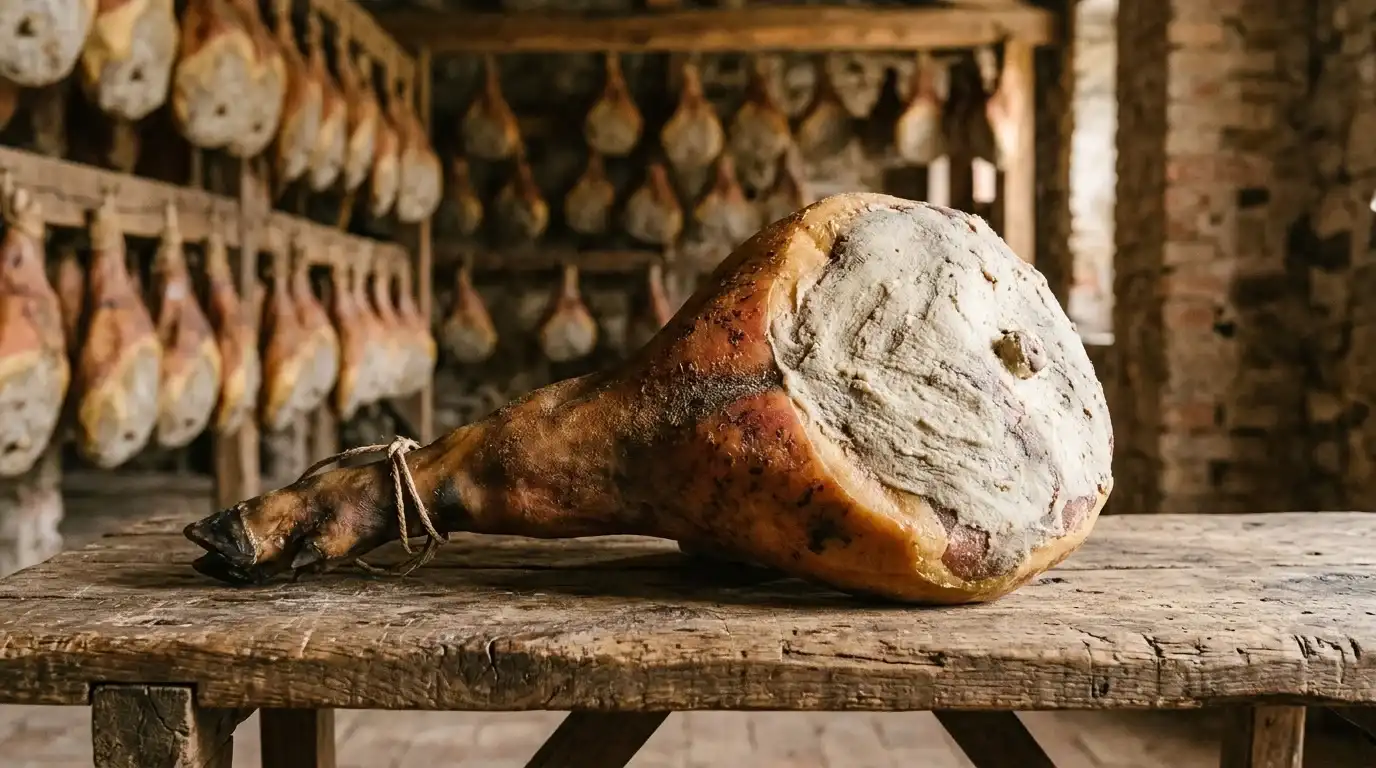
The process diverges from Parma in two visible ways. San Daniele hams keep the trotter, which the consortium says helps moisture drain during curing. They are also pressed after salting, a stage the consortium describes as exclusive to San Daniele, which pushes the salt deeper and gives the leg its characteristic guitar shape. Salting lasts a number of days equal to the leg’s weight in kilograms. The hams then rest until the fourth month, are washed and dried, and get a coating of rice flour and pig fat over the parts not protected by rind. Maturing runs to the end of the 13th month, and only then does the brand go on, with a two-digit number under the trotter identifying the producer.
Production in 2017, according to the same profile, came to 2,645,116 hams.
Twenty years without it
The American import ban
For a stretch of the late twentieth century, real Italian prosciutto could not legally be bought in the United States. Perishable News, marking the 30th anniversary in 2019, describes a 20-year ban that kept Prosciutto di Parma out of the country for all of the 1970s and most of the 1980s, until it was lifted in October 1989. During the ban, American producers made prosciutto from American hogs, dried in warehouses in states like Virginia and Missouri.
The return made news. The same article quotes the Chicago Tribune’s 1989 coverage, which compared the ham to luxury goods and priced it at more than $20 a pound.
Today prosciutto sits in the deli case beside its Emilia-Romagna neighbor mortadella, sliced to order.

Frequently asked questions
What is the difference between Parma and San Daniele prosciutto?
San Daniele keeps the trotter, is pressed into a guitar shape and matures at least 13 months in San Daniele del Friuli. Parma has a rounded shape, no trotter and a 14-month minimum under the 2023 rules.
What are the ingredients in Prosciutto di Parma?
Only pork and salt, with no nitrites, nitrates or preservatives, according to the Parma consortium.
Was prosciutto banned in the United States?
Imports of Prosciutto di Parma were banned for about 20 years until October 1989.
How long is Prosciutto di Parma aged?
At least 14 months for legs entering production since September 4, 2023. The earlier minimum was 12 months.
Sources
- Consorzio del Prosciutto di Parma, “Prosciutto di Parma PDO”: https://www.prosciuttodiparma.com/en_UK/prosciutto/pdo
- Consorzio del Prosciutto di Parma, “Parma Ham Consortium Announces New Production Rules” (October 2, 2023): https://www.prosciuttodiparma.com/en/news/parma-ham-consortium-announces-new-production-rules/
- Consorzio del Prosciutto di Parma, consortium page: https://www.prosciuttodiparma.com/parma-ham-consortium/
- Consorzio del Prosciutto di Parma, “Prosciutto di Parma” exhibit, Google Arts & Culture: https://artsandculture.google.com/exhibit/prosciutto-di-parma/gQedrgsN
- Consorzio del Prosciutto di San Daniele, “How to recognize San Daniele ham”: https://prosciuttosandaniele.it/en/the-ham/how-to-recognize-it/
- Consorzio del Prosciutto di San Daniele, institutional profile (2018): https://www.prosciuttosandaniele.it/wp-content/uploads/2020/01/CPSD-CS-Istituzionale-2018-EN-1.pdf
- Perishable News, “U.S. Celebrates the 30th Anniversary of the Return of Prosciutto di Parma” (October 25, 2019): https://perishablenews.com/deli/u-s-celebrates-the-30th-anniversary-of-the-return-of-prosciutto-di-parma/