In this story
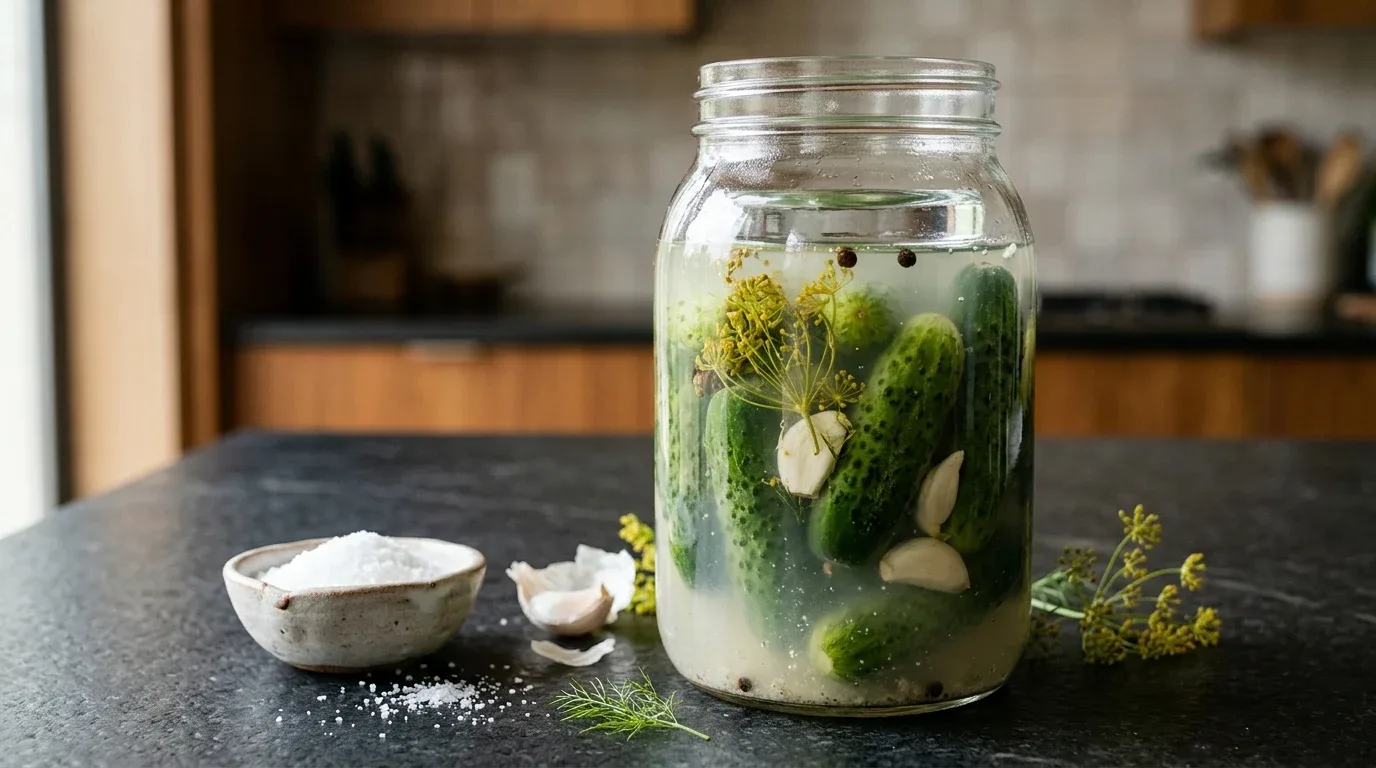
A half-sour pickle is a cucumber pulled from its brine partway through fermentation. It stays bright green, snaps when bitten and tastes of salt, garlic and fresh cucumber with only a light tang. Leave the same cucumber in the same barrel for months and it becomes a full sour. New York’s Jewish delis sell both, usually side by side, and the difference between them is mostly a matter of time.
Video: We Tried Pickled Everything At One Of New York City's Last Remaining Pickle Shops, from the Insider YouTube channel
Salt water, garlic and a calendar
Half-sour, full sour, kosher dill
The categories are defined by how long the cucumber sits. A 2012 Jewish Telegraphic Agency report by Josh Lipowsky laid out how New York picklers draw the lines. A half-sour sits in a saltwater brine with garlic and spices; at The Pickle Guys on the Lower East Side, that means about two weeks. A full sour starts in the same basic brine and stays much longer, at least three months at The Pickle Guys and at least 45 days at United Pickle in the Bronx. The kosher dill adds dill to the garlic brine and, at United Pickle, cures at least ten days.
The word kosher in kosher dill, the JTA notes, refers to the traditional New York Jewish style of preparation rather than to dietary law. Some brands carry kosher certification too; Guss’ half-sours, for instance, are listed as OU Kosher. The name itself came from the method.
What happens in the barrel
Lactic acid does the work
These pickles contain no vinegar. Their sourness comes from fermentation. Gizmodo’s 2017 look at pickle science by Ryan F. Mandelbaum described the process with help from Cornell University’s Northeast Center for Food Entrepreneurship. Fresh vegetables go into a brine of at least 2.25 percent salt by weight, lactic acid bacteria ferment them, and within a few weeks they produce enough lactic acid to keep harmful bacteria out. After about three months, the flavor reaches full sour.
Elizabeth Sullivan, a process authority at the Cornell center, explained that fermentation preserves food in a particular sense. It does not keep vegetables fresh; it is, in her words, “a method of keeping it from making you sick.” A half-sour is pulled before that process runs its course.

Temperature and time at home
The University of Minnesota Extension’s page on fermenting produce gives 68 to 72°F as the ideal range. Above 78°F the ferment risks going too fast and spoiling; below 60°F it slows or stalls. The extension’s standard ferment runs three to four weeks, or five to six weeks in a cooler room, and a finished batch has stopped bubbling and reached a pH of 4.6 or lower. Salt for the brine must be free of iodine, which can interfere with fermentation. Refrigeration stops the process, and refrigerated fermented produce keeps for up to nine months.
Those numbers mark the line between a home half-sour and a properly finished pickle. A half-sour pulled early has not been through the full cure the extension describes, so it belongs in the refrigerator from the start.
Pickle Alley
Essex Street, 1897
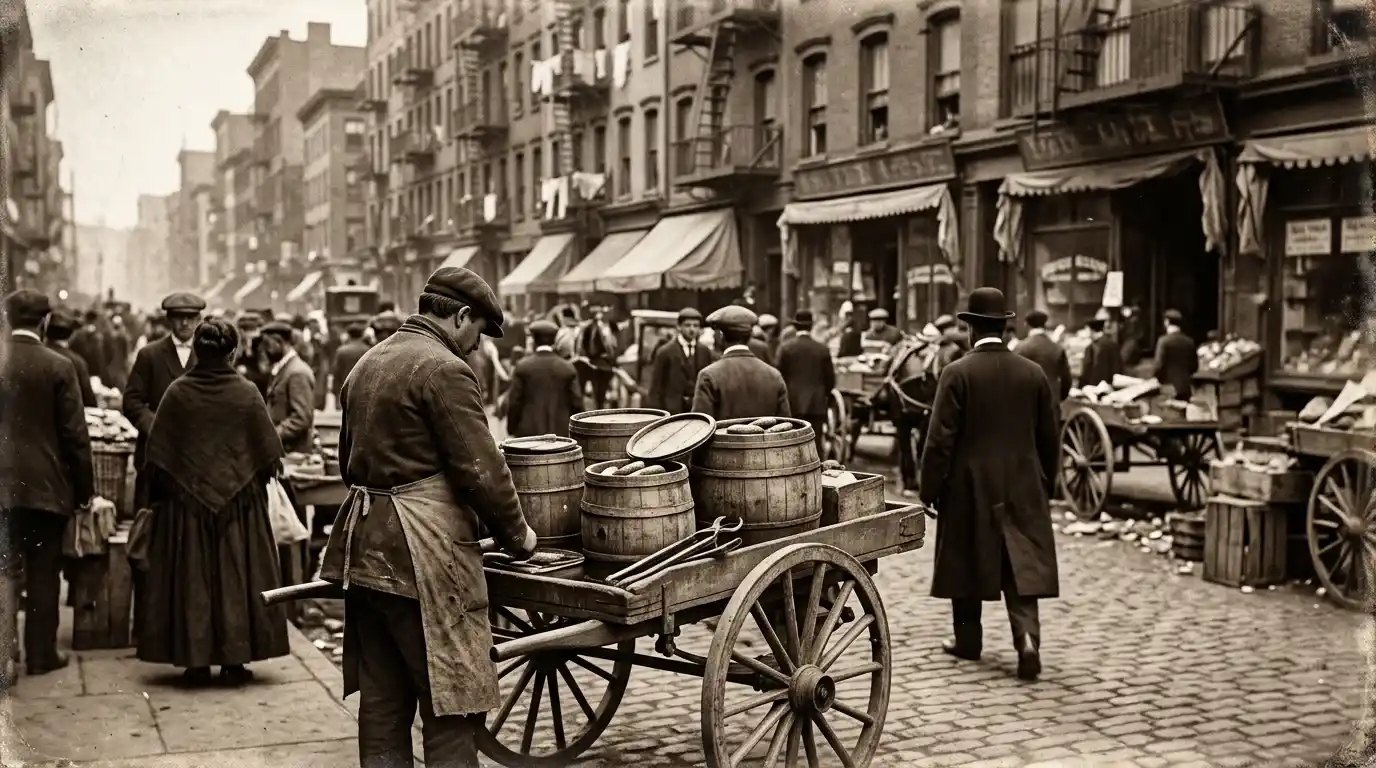
The New York pickle trade grew out of immigration. The JTA traces lacto-fermentation back more than 2,400 years to China and its arrival in Eastern Europe in the 1500s; Jewish cooks there made the garlic-heavy style their own, and immigrants arriving in New York in the late nineteenth and early twentieth centuries brought it with them.
Gizmodo interviewed Stephen Leibowitz of United Pickle, which it called the oldest continuously operating pickle company in New York. His grandfather, Max Leibowitz, opened the first pickle stand on Essex Street in 1897, working from a recipe he had copied at the grocery where he worked and adding garlic and spices. By the 1960s, Leibowitz said, several hundred pickle companies were operating in New York and the Lower East Side was lined with stands.
Who was first is disputed
The best-known name on the street was Guss’. According to Leibowitz, Isidor Guss founded his shop in 1920. The company’s own listing on Goldbelly, where Guss’ pickles ship nationally, tells it differently: Izzy Guss launched the business as a pickle stand in 1897, which would make it, as the listing claims, the country’s oldest family-owned pickle company. The two accounts cannot both be right, and neither source documents its date.
What happened later is less disputed. The JTA reported that Guss’ lost most of its foot traffic after September 11, 2001, and closed its Lower East Side shop, and that United Pickle, its longtime supplier, bought the name. The Pickle Guys, opened by Alan Kaufman shortly after Guss’ closed, became the last pickle store on Essex Street, selling more than 30 pickled products. Kaufman told the JTA that for the immigrants who made them, pickles taste “like home.”
The half-sour beside a sandwich
On the side of the plate
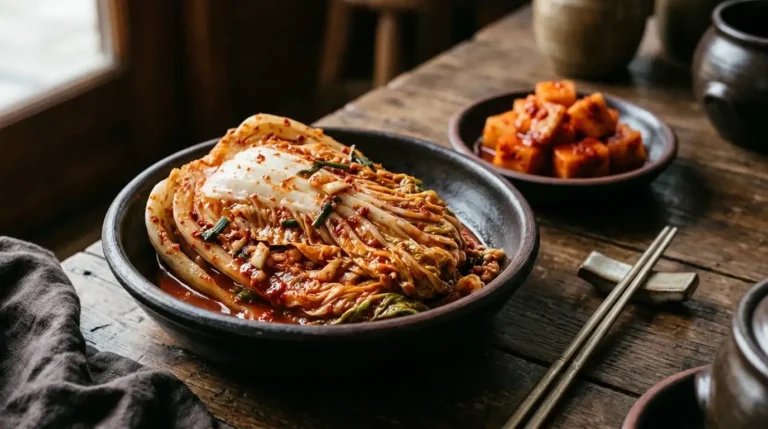
In a New York deli the pickle arrives as a side, set beside the sandwich rather than inside it. GrillCheesy has covered the rest of the brined family that ends up next to or on sandwiches: German sauerkraut, Korean kimchi, Chicago’s giardiniera, and the dill spear that is one of the seven toppings on a Chicago-style hot dog.
Home picklers working in mason jars use weights to hold cucumbers down in the brine:
- 4-Pack of Fermentation Glass Weights with Easy Grip Handle for Wide Mouth Mason Jars: glass discs that hold vegetables under the brine in a wide-mouth jar. See it on Amazon (affiliate link)
As an Amazon Associate I earn from qualifying purchases. A commission may be earned if you buy through this link, at no extra cost to you.
Frequently asked questions
What is the difference between half-sour and full-sour pickles?
Time in the brine. A half-sour is pulled after about two weeks; a full sour stays 45 days to three months or more, depending on the maker.
Are half-sour pickles made with vinegar?
No. They are fermented in salt water with garlic and spices; the sourness comes from lactic acid made by bacteria.
Why do half-sour pickles need refrigeration?
They are pulled before fermentation finishes, and refrigeration stops the process.
What does kosher dill mean?
A pickle brined with garlic and dill in the traditional New York Jewish style. The name refers to the method, not necessarily to kosher certification.
Sources
- Josh Lipowsky, “Popularized in America by Jews, pickles pack a punch,” JTA (July 8, 2012): https://www.jta.org/2012/07/08/united-states/popularized-in-america-by-jews-pickles-pack-a-punch
- Ryan F. Mandelbaum, “How Pickles Got Caught Up in the Latest Health Fad,” Gizmodo (January 23, 2017): https://gizmodo.com/how-pickles-got-caught-up-in-the-latest-health-fad-1791126835
- University of Minnesota Extension, “How to make fermented pickles”: https://extension.umn.edu/preserving-and-preparing/how-make-fermented-pickles
- Guss’ Pickles, “NY Half Sour Pickles – 1 gallon,” Goldbelly listing: https://www.goldbelly.com/guss-pickles/ny-half-sour-pickles-1-gallon