In this story
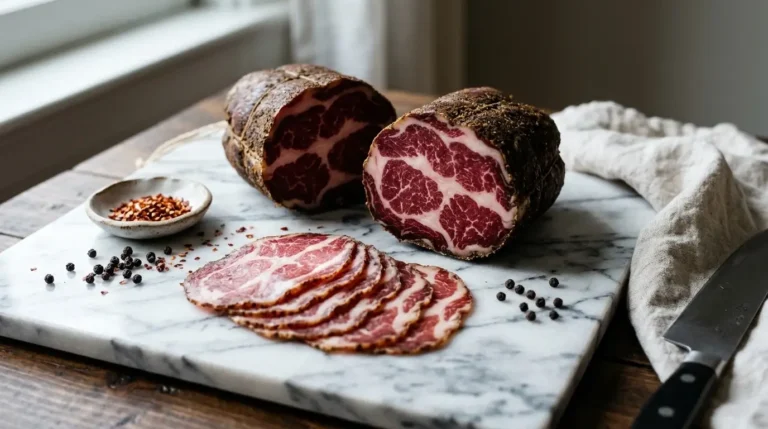
Genoa salami is the soft, mild, garlicky salami sliced thin at nearly every Italian American deli counter in the United States. It is pork, usually, with garlic, pepper and a little wine, fermented and dried until it can be sliced and eaten without cooking. The name points to Genoa, the port city on the Ligurian coast. The salami Genoa’s own hills are known for is a different thing, and the American product is defined less by geography than by a number in a federal labeling rule.
Video: Salami Making, How to Make Everything: Preservatives, from the How To Make Everything YouTube channel
What “Genoa” means on an American label
A moisture-to-protein ratio
In the United States, “Genoa” names a style rather than a birthplace. A fact sheet originally published by the National Pork Board and the American Meat Science Association, written by Kelly Karr Getty of Kansas State University, explains how federal inspectors tell dry sausages apart. Dry sausages generally finish with a pH of 5.0 to 5.3 and a moisture-to-protein ratio below 2.3 to 1. For Genoa salami, the fact sheet says, the Food Safety and Inspection Service requires an MPR of 2.3 to 1, which makes it an exception among salamis such as hard salami, held to 1.9 to 1.
In plain terms, Genoa salami is allowed a little more moisture relative to its protein than hard salami is.
The same fact sheet places Genoa salami among the best-known dry sausages, with dry salami and pepperoni, that trace their origins to Italy.
The American recipe
Pork, garlic, pepper and wine
The recipe is simple. Penn State’s Berkey Creamery, which sells a Genoa salami, describes its product as pork seasoned with garlic, salt, black pepper, whole peppercorns and dry red wine, and calls the flavor “very mild with hints of red wine.” The same listing describes Genoa salami as commonly believed to have originated around Genoa, a careful phrasing that leaves the question open.

The salami Genoa actually makes
Salame di Sant’Olcese
The hills behind Genoa have their own salami, made in the village of Sant’Olcese and the nearby Orero area of Serra Riccò, in the Val Polcevera. A 2005 study in the Italian journal Ingegneria Alimentare. Le Carni, by A. Sangiuolo of Liguria’s environmental protection agency and G. Orefice of the Genoa health authority, defines salame genovese as a mixed sausage of beef and pork with a medium grain and visible pieces of fat, lightly smoked and given a short ripening. It has a soft texture and a mildly smoky aroma, and its color runs from bright to dark red.
The authors counted only three artisanal producers at the time: two in Sant’Olcese, Cabella and Parodi, and one in Orero. The Parodi business is old. A 2022 article in Gazzetta del Gusto by Marco Benvenuto traces it to the mid-1800s, when Luigi Parodi, born in 1830, began making the salame, and says his son Federico formally organized the company in 1908.
The differences with the American product are plain on paper. The Ligurian salami uses beef as well as pork and is lightly smoked; the American Genoa that Penn State’s creamery describes is pork, seasoned with garlic and wine. Whether the American style descends directly from Sant’Olcese is not documented in these sources.
How a dry salami cures
Acid, salt and lost water
Every dry salami relies on the same process. Getty’s fact sheet lists the steps: grind or chop the meat, blend it with salt, curing agents and spices, add lactic acid bacteria, ferment under conditions that favor them, and then dry the sausage, with smoking or heating depending on the product. As the bacteria work, they produce lactic acid and lower the pH. Drying then removes 25 to 50 percent of the moisture, leaving water activity of roughly 0.85 to 0.91.
Together, acidity, salt and dryness make the sausage hostile to dangerous bacteria. The stakes are real: the fact sheet recounts a 1994 outbreak of E. coli O157:H7 linked to a dry, fermented pork and beef salami sold at deli counters, mostly in Washington state. Afterward, federal regulators required sausage makers to validate that their process achieves a five-log reduction of E. coli O157:H7.

Genoa at the deli counter
Sliced to order beside its Italian neighbors
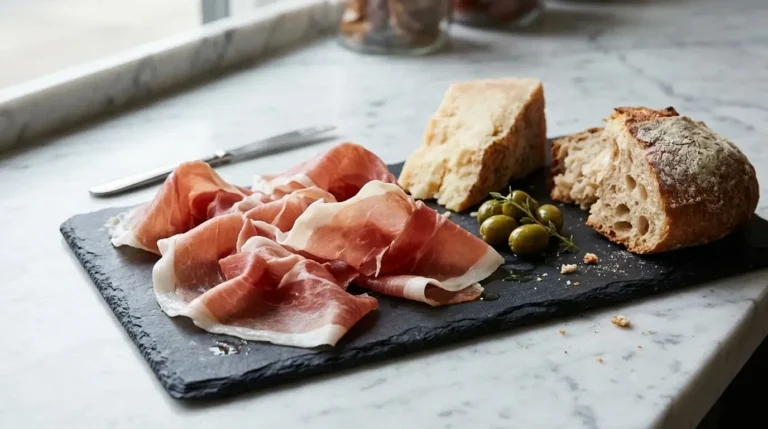
Genoa salami is sold the way most cured Italian meats are sold in American delis: whole in the case and sliced to order. It sits beside mortadella and prosciutto, two meats with protected Italian origins that GrillCheesy has covered separately. Unlike those, Genoa salami’s identity in the United States comes from a labeling rule rather than a place, which is why the same name can appear on salamis made in very different ways.

Frequently asked questions
Is Genoa salami from Genoa?
Not exactly. In the United States, Genoa names a style defined by a federal moisture-to-protein ratio. The salami made near Genoa, Salame di Sant’Olcese, is a smoked pork-and-beef sausage.
What is the difference between Genoa salami and hard salami?
USDA policy allows Genoa salami a moisture-to-protein ratio of 2.3 to 1, compared with 1.9 to 1 for hard salami, so Genoa may hold slightly more moisture.
What is in Genoa salami?
Typically pork seasoned with garlic, salt, pepper, whole peppercorns and wine.
Is Genoa salami raw?
It is uncooked but cured. Fermentation lowers its pH and drying removes moisture, which together make it safe to eat without cooking.
Sources
- Kelly Karr Getty, “Dry and Semi-Dry Fermented and Direct Acidified Sausage Validation,” National Pork Board/American Meat Science Association fact sheet, via Extension: https://swine.extension.org/dry-and-semi-dry-fermented-and-direct-acidified-sausage-validation
- Penn State Berkey Creamery, “Salami Genoa”: https://creamery.psu.edu/genoa-salami
- A. Sangiuolo and G. Orefice, “Salame genovese: historic and organoleptic characteristics and evolution of the microbial flora,” Ingegneria Alimentare. Le Carni (2005), via FAO AGRIS: https://agris.fao.org/search/fr/records/6472447e2c1d629bc9794eae
- Marco Benvenuto, “Nasce Riserva Orso, il salame al miele,” Gazzetta del Gusto (April 15, 2022): https://gazzettadelgusto.it/cibo/riserva-orso-il-nuovo-salame-al-miele-del-salumificio-parodi/