In this story
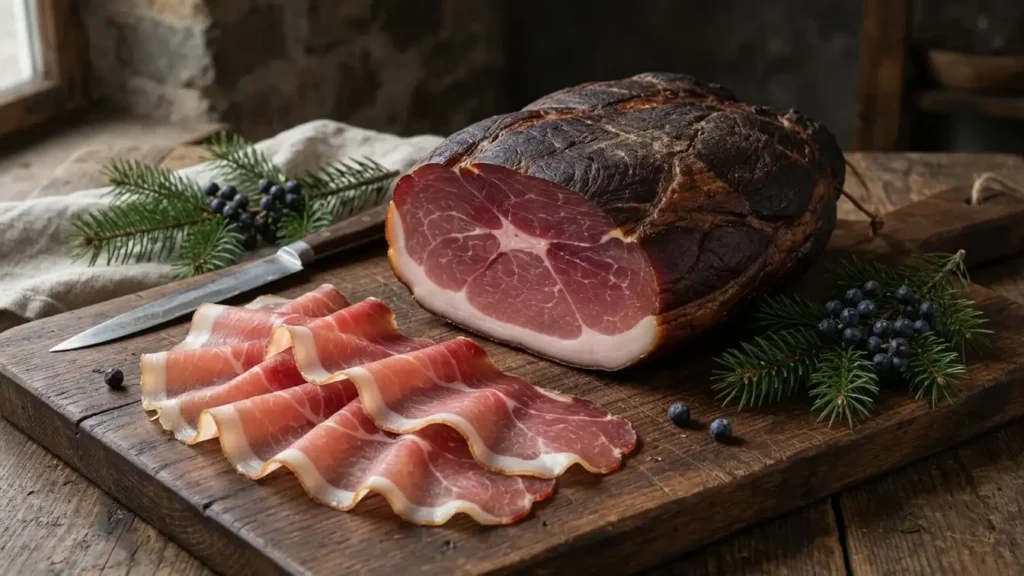
Black Forest ham names two different foods. In Germany, Schwarzwälder Schinken is a raw, boneless ham from the hind leg, rubbed with salt and spices, cold-smoked over fir from the Black Forest and dried until the outside turns nearly black. In an American deli case, the same English words usually sit on a cooked, sliced lunch meat with a dark edge. One is protected by European law. The other has never needed permission.
Video: How to make Black Forest ham, from the SWR Handwerkskunst YouTube channel
What the EU rules require
Dry cure, no brine needle
Since 1997, Schwarzwälder Schinken has been a protected geographical indication in the European Union, a date Adler Schwarzwald, one of the region’s oldest producers, records on its company history page. The rules were rewritten in 2012 and 2013, and the amendment application published in the Official Journal, OJ C 274 of September 11, 2012), sets out how the ham has to be made.
The ham is cut from the hind leg, trimmed and boned, then dry-cured: salt and each producer’s own spice blend go on the outside, with no brine injected into the muscle. The 2012 text dropped the words “by hand,” so spreading machines are now allowed, and it replaced a fixed two-week cure with “several days.” A white rim of fat is part of the definition. Only rump off-cuts may lack it, and a ham trimmed of its fat may not carry the name at all.
Fir smoke, cold
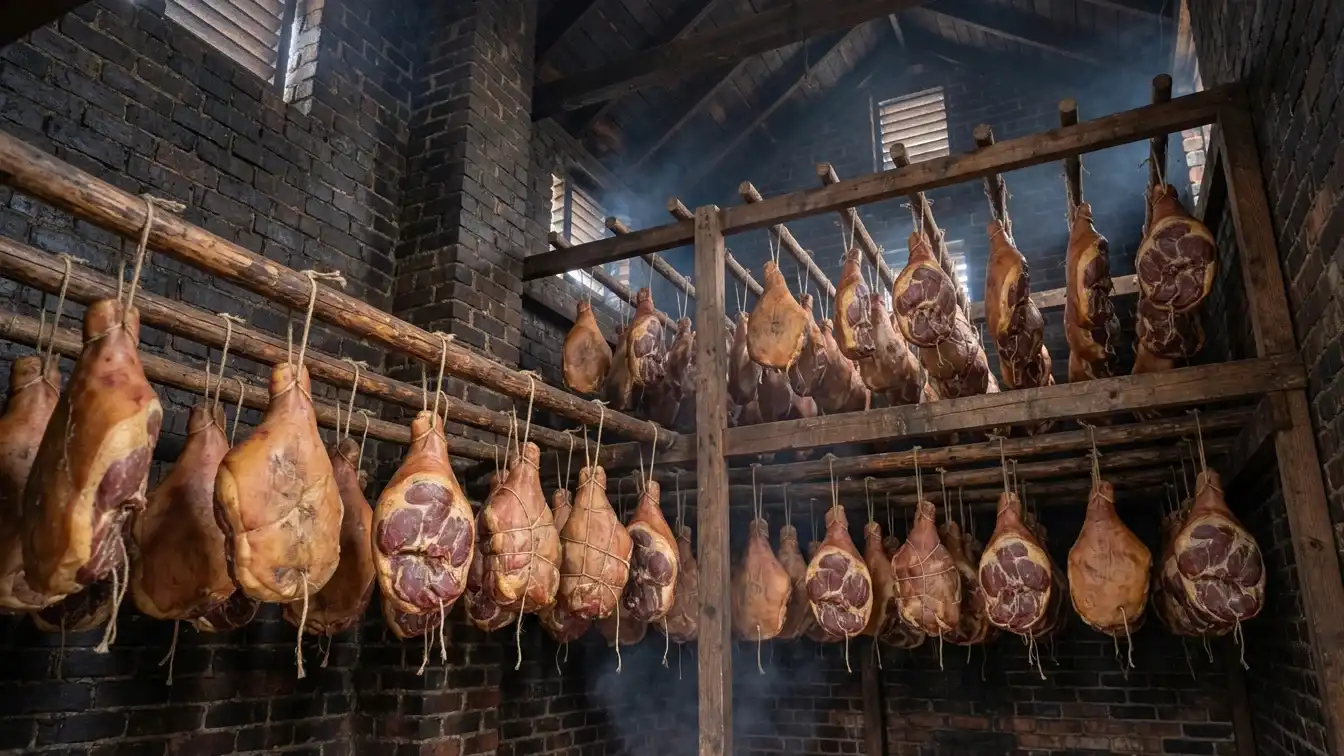
The smoke is where the name comes from. The specification calls for fir wood or fir sawdust from the Black Forest, burned in brick chimneys or smoking chambers at 20 °C to about 30 °C, a temperature low enough that the meat is flavored and dried rather than cooked. In the document’s own words, the ham “is thoroughly smoked for at least a week over fir wood and sawdust from the Black Forest.”) After smoking, it matures for several weeks in climate-controlled rooms, until it reaches a degree of dryness of about 25 percent.
The European Commission approved those amendments in Implementing Regulation (EU) No 561/2013 of June 14, 2013.
The smoke towers
Turned top to bottom
The producers’ association, the Schwarzwälder Schinken Verband, describes the smoking stage on its English site. The hams hang in tall smoke towers at around 25 degrees Celsius for several days and are turned from top to bottom as they go. The smoke comes from burning native conifer wood and smoldering sawdust. The association sums up the product as boneless raw ham, cured in a spice mixture, smoked and matured, with a taste it calls highly aromatic and spicy.
Where it must happen
The geography is strict. The specification requires every step, from inspecting the uncured ham to the finished product, to take place inside the Black Forest, an area bounded on the west by the B3 highway between Basel and Karlsruhe. That is why the name stays with the place rather than the recipe.
A family name on the label
Bonndorf, 1920 onward
Adler’s own timeline gives a short commercial history. In 1920, Michael and Margarethe Adler took over an inn and a meat shop in Bonndorf. The company dates its distance selling of Black Forest smoked products to the 1950s, and its timeline credits Peter Adler in 1959 as the first to bring Black Forest ham to market. That is the company’s own account, and no independent source checked here confirms or disputes it. The same timeline lists the first self-service pack of sliced Black Forest ham in 1975.
The German ham reached American shelves under its own name much later. A June 2016 Perishable News report on Adler’s U.S. launch said the company spent two years meeting U.S. import requirements before selling nationally through a Michigan distributor. The company described its hams as smoked for about three weeks over green pine twigs, sawdust and Black Forest fir.

The American version
Same name, cooked meat
In the United States, Black Forest ham is a style name rather than a protected one. An American version, The Takeout noted, can still have the black exterior and smoky, salty taste without coming anywhere near Germany.
Applegate’s sliced Black Forest ham, for example, is described on its Amazon listing as fully cooked, ready-to-eat deli meat, slow smoked for a sandwich. Boar’s Head’s SmokeMaster Beechwood Smoked Black Forest Uncured Ham is smoked with beechwood imported from Germany, and the product page notes that it contains a 7 percent seasoning solution. Beech is a deciduous tree, a wood the German specification excludes, and an added solution is the opposite of a dry cure with no brine.
Neither breaks any rule. Both are sold in a market where the name is free to use, a gap The Takeout’s January 2025 explainer traced to U.S. law, which does not follow the EU’s regional designation.
A trade dispute over a ham
Who owns the words
That gap became a negotiating point. When the EU pressed the United States to respect its protected food names during talks on the Transatlantic Trade and Investment Partnership, Modern Farmer reported in April 2014 that Black Forest ham was one of the names on the table. Jaime Castaneda, head of the Consortium for Common Food Names, argued against the push, telling the magazine that “The term ‘Black Forest ham’ is primarily an American creation” and that the names belong to whoever built the markets.
Canada reached a compromise first. An August 2015 analysis republished by the World Economic Forum explained that under the EU-Canada trade agreement, Canadian producers kept the right to use English and French translations of some protected terms, Black Forest ham among them, while the German name stayed reserved. In the U.S., the English name remains open to any producer.

On bread
Thin, raw and at room temperature
German producers sell Schwarzwälder Schinken whole or sliced very thin. Freyberger, one Black Forest maker, suggests it on its product page sliced wafer-thin on buttered sourdough. Raw and dried, it sits in the same family as prosciutto and capicola rather than boiled ham. A loaf like the ones in GrillCheesy’s guide to sourdough bread gives it a crust to work against, and sauerkraut or half-sour pickles bring the acid. For a melted sandwich, it can be layered under an Alpine cheese such as raclette.
The American cooked version is built for the deli counter instead: sliced, stacked on a kaiser roll, served cold or warmed on a griddle.
- Applegate, Natural Uncured Black Forest Ham Sliced, 7oz: a fully cooked, sliced American-style Black Forest ham for sandwiches. See it on Amazon (affiliate link)
Video: BLT sandwiches with Applegate Naturals Black Forest ham, from the VioletAmethystgirlFashion YouTube channel
As an Amazon Associate I earn from qualifying purchases. A commission may be earned if you buy through this link, at no extra cost to you.
Sources
- Official Journal of the European Union, C 274, amendment application for Schwarzwälder Schinken (2012): https://eur-lex.europa.eu/legal-content/EN/TXT/?uri=CELEX:52012XC0911(01)
- Commission Implementing Regulation (EU) No 561/2013: https://eur-lex.europa.eu/eli/reg_impl/2013/561/oj/eng
- Schwarzwälder Schinken Verband: https://schwarzwaelder-schinken-verband.de/en
- Adler Schwarzwald, About us: https://www.adlerschwarzwald.de/en-gb/about-us/
- Perishable News, Adler Introduces Its Award-Winning Black Forest Schinken To US (2016): https://perishablenews.com/?p=140215
- Boar’s Head, SmokeMaster Beechwood Smoked Black Forest Uncured Ham: https://boarshead.com/beechwoodham
- The Takeout, Is Black Forest Ham Really All That Different From The Regular Kind? (2025): https://thetakeout.com/1766017/what-difference-black-forest-ham
- Modern Farmer, The Champagne of Meats (2014): https://modernfarmer.com/2014/04/champagne-meats-now-europe-wants-black-forest-ham-back/
- World Economic Forum, Why Europe and the US are locked in a food fight over TTIP (2015): https://www.weforum.org/stories/2015/08/why-europe-and-the-us-are-locked-in-a-food-fight-over-ttip/
- Freyberger, Schwarzwälder Schinken: https://www.mf58.de/en/products/schwarzwaelder-schinken-kaufen