In this story
Potato salad comes in two families that barely resemble each other. One is warm, sharp with vinegar, loosened with broth and often finished with bacon fat. The other is cold, creamy and bound with mayonnaise, usually with egg and pickle folded in. Both trace back to Germany, and the line between them runs roughly north to south across that country before it crosses the Atlantic.
Video: The History & Global Variations of Potato Salad (Kartoffelsalat), from the Food Storian YouTube channel
Two salads from one country
The north-south split
Potatoes reached Europe in the sixteenth century, and early potato salads there were typically dressed with vinegar and spices, according to a 2022 Tasting Table explainer by Vanessa Nix Anthony. The article describes the southern German styles, from Swabia, Baden and Bavaria, as served warm with vinegar, broth, onions and mustard. Bavarian versions often add red onion, bacon and its grease, a little sugar and sometimes pickles.
Northern Germany went the other way. The Berliner Kartoffelsalat in the same article is served cold and dressed with mayonnaise, frequently cut with sour cream or cream, then studded with hard-boiled egg and pickles. Karen Lodder, the German food writer quoted in the piece, put the divide plainly: “Northern Germans tend to use mayonnaise, while Southern Germans stand by vinegar.”
That northern style is close to what most American cookouts call potato salad. The southern one survives in the United States mostly under its own label, “German potato salad,” as if the mayonnaise version had no German parent at all.
Why the warm version uses broth
Dressing a hot potato
The southern method depends on timing. A German grocery site, Knuspr, lays out the Bavarian sequence: waxy potatoes cooked in their skins, then peeled and sliced while still hot. Hot broth goes over the warm slices along with vinegar, salt, pepper and sugar, and the starch soaks it up. Oil comes last, only once the broth is absorbed, because oil added earlier would coat the slices and keep the liquid out. Onions are softened in the hot broth first. The finished salad is glossy and moist rather than creamy.
The cold northern salad works in reverse. The same page notes that mayonnaise salad also starts with waxy potatoes, but they must cool completely, since heat would break the mayonnaise emulsion. Gherkins, a splash of pickle brine, hard-boiled egg and herbs bring the acid and crunch that mayonnaise lacks on its own.

The jar that made the American version
A Columbus Avenue deli
No source pins down who first put mayonnaise on potatoes in the United States, and Tasting Table says as much. The likeliest force behind its spread is a German immigrant named Richard Hellmann. An NPR segment marking the brand’s centennial in 2013 tells the story: Hellmann arrived in New York in 1903, opened a deli on Columbus Avenue in 1905 and sold mayonnaise made from his wife’s recipe, at first scooped from the wooden bowls used to weigh butter.
He made two versions and marked the better one with a blue ribbon. Hellmann’s Blue Ribbon Mayonnaise was trademarked in 1913, and by the late 1920s the company was producing three tons an hour. A West Coast maker, Best Foods, merged with Hellmann’s in 1932, which is why the same product is sold under two names on either side of the Rockies.
Tasting Table connects that history back to the salad. Hellmann came from northern Germany, the region of the cold mayonnaise style, and the company still promotes its own original potato salad recipe. Jarred mayonnaise in every grocery store made the creamy version the easy one to make, and the easy version became the default.
The mayonnaise myth
What actually spoils a picnic salad
Potato salad carries a reputation as the dish that sends people home sick from cookouts, and the blame usually lands on the mayonnaise. Food scientists have been pushing back on that for decades.
A 1977 review in the Journal of Food Protection by Richard B. Smittle found that commercial mayonnaise and salad dressing are hostile to food pathogens because of the acetic acid in them. Major US producers used roughly 0.3 percent acetic acid in mayonnaise and about 0.9 percent in salad dressing, levels the review describes as effective against Salmonella and Staphylococcus. Its conclusion ran against popular belief: adding mayonnaise to salads and sandwiches slows spoilage and pathogen growth rather than adding to it.
Twenty years later, food scientists at the University of Georgia and the University of Wisconsin tested the idea directly. A 1997 UGA report on the work describes chicken and ham salads made with commercial mayonnaise and then inoculated with Salmonella. Bacterial numbers dropped right after inoculation, did not rise under refrigeration for up to 24 hours, and grew relatively little after five hours at room temperature. More mayonnaise meant slower growth. Michael Doyle, who headed UGA’s food safety center, summed it up: “Mayonnaise reduces the rate at which these bacteria can grow.”
The potato is the risk
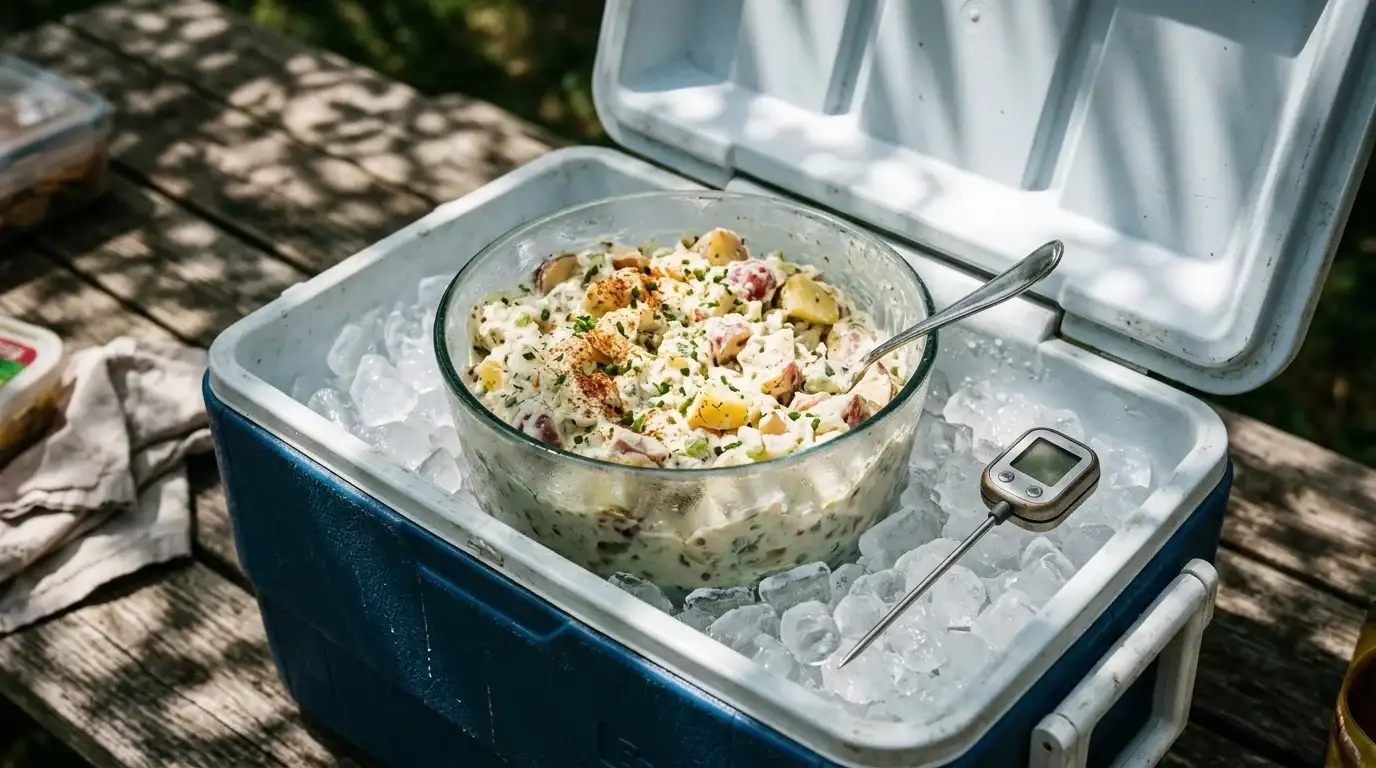
None of this makes potato salad safe to leave in the sun. Ben Chapman, a food safety researcher at North Carolina State University, told NC State News in 2018 that when potato salad does cause illness, Staphylococcus aureus or Clostridium perfringens is usually responsible. Staph often lives on people’s faces and noses and reaches food on unwashed hands; raw chicken on the same cutting board can spread other pathogens. The deciding factor is temperature. Bacteria multiply when the salad is held above 41°F, and Chapman notes that above 90°F, pathogen numbers can rise tenfold in about an hour.
Chapman makes one exception for the mayonnaise itself. Store-bought mayonnaise is acidified, but many homemade recipes lack enough acid to stop pathogens. Pasteurized eggs and extra vinegar or lemon juice lower that risk, and refrigeration still matters.
The warm German salad has its own logic here. It is dressed with vinegar from the start and traditionally eaten soon after it is made, which keeps it from sitting for hours in the zone the researchers warn about.
Potato salad beside a sandwich
The deli plate
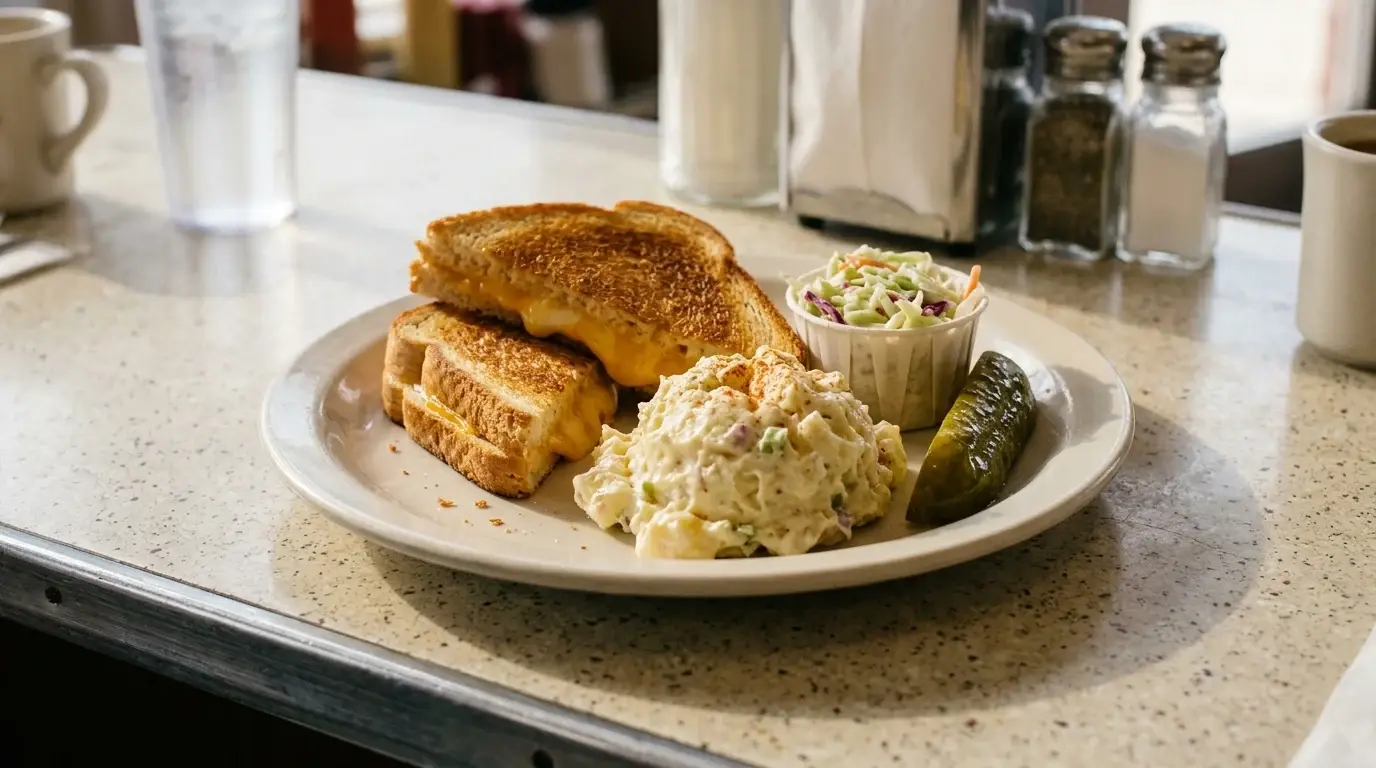
In American delis and diners, potato salad is less a dish than a side that rides on the plate next to a sandwich, along with coleslaw and a pickle. It fills the same role as potato chips and French fries beside a burger or a melt, and diner kitchens that run hash browns in the morning often turn the same potatoes into salad later in the day.
The two traditions suit different sandwiches. The cold mayonnaise version pairs with deli meats and grilled cheese, where its creaminess matches the bread and cheese. The warm vinegar version cuts through richer, fattier food, which is why it shows up beside bratwurst and fried cutlets in southern Germany.
Frequently asked questions
What is the difference between German and American potato salad?
Southern German potato salad is served warm and dressed with vinegar, broth, onion and mustard, often with bacon. American potato salad is usually cold and bound with mayonnaise, closer to the northern German Berliner style.
Does mayonnaise make potato salad go bad faster?
Not commercial mayonnaise. Its acetic acid slows bacterial growth. The usual causes of illness are bacteria from hands or cross-contamination, multiplying in salad kept above 41°F.
Who invented American potato salad?
No single inventor is documented. Richard Hellmann’s jarred mayonnaise, sold from 1905 and trademarked in 1913, likely helped make the creamy style standard.
Why is German potato salad dressed warm?
Warm potato slices absorb the hot broth and vinegar. Oil is added only after the broth soaks in.
Sources
- Vanessa Nix Anthony, “What Makes German Potato Salad Different From American?,” Tasting Table (July 13, 2022): https://www.tastingtable.com/926829/what-makes-german-potato-salad-different-from-american
- Knuspr.de, “Bayerischer Kartoffelsalat vs. Mayo-Kartoffelsalat: Der große Vergleich” (undated): https://www.knuspr.de/thema/bayerischer-kartoffelsalat-vs-mayonnaise
- Bonny Wolf, “Mayonnaise Turns 100,” NPR (2013): https://www.npr.org/transcripts/197229890
- Richard B. Smittle, “Microbiology of Mayonnaise and Salad Dressing: A Review,” Journal of Food Protection 40(6), 1977, via AGRIS: https://agris.fao.org/search/en/records/65dfde5b4c5aef494fe60e8b
- “UGA Scientists Find Mayonnaise Makes Meat Salads Safer,” University of Georgia CAES (November 3, 1997): https://fieldreport.caes.uga.edu/news/uga-scientists-find-mayonnaise-makes-meat-salads-safer/
- Matt Shipman, “It’s Not the Mayonnaise: Food Safety Myths & Summertime Food,” NC State News (May 24, 2018): https://news.ncsu.edu/?p=476265