


In this story
A Chicago-style hot dog is an all-beef frank in a steamed poppy seed bun, topped with yellow mustard, bright green relish, chopped onion, tomato, a dill pickle spear, sport peppers and a shake of celery salt. Chicagoans call that load “dragged through the garden.” The one thing missing is ketchup, and the omission is enforced with more conviction than any of the seven toppings that made the cut.
Video: Vienna Beef: The Chicago hot dog tradition that's lasted over 130 years, from the FOX 32 Chicago YouTube channel
The seven toppings
What goes on, and in what spirit
A WTTW News explainer from March 2025 sets the baseline: “A true Chicago dog must be all-beef, nestled in a steamed poppy seed bun.” The station reads the toppings as a map of the city’s immigrant history. It credits the bun to Poland; the frank, pickle spear and mustard to Jewish and German cooks; the onions and tomatoes to Italy and possibly Greece; the relish to England, though its neon color is a Chicago addition; the sport peppers to the Deep South or Mexico; and the celery salt to Lakeview, once a major celery-growing area of the city.
Other accounts assign some of those parts differently. Food historian Bruce Kraig, interviewed by Time Out Chicago in 2008, called the sport peppers and relish essentially giardiniera, the Italian pickled mix. In that telling, celery salt stood in after Chicago’s celery production fell off in the 1920s, and the poppy seed bun was Jewish in origin, brought to hot dog stands by Rosen’s bakery after World War II. The broad picture holds across both: a German sausage dressed by Greek, Italian, Jewish and Mexican hands.
The peppers point to a third route. The University of Chicago Magazine, in a spring 2024 survey of the city’s street food by David Hammond, relays Kraig’s view that peppers probably came north from Mexico on the railroad built in the 1870s.
Vienna Beef and the 1893 World’s Fair
Two brothers-in-law on the Midway
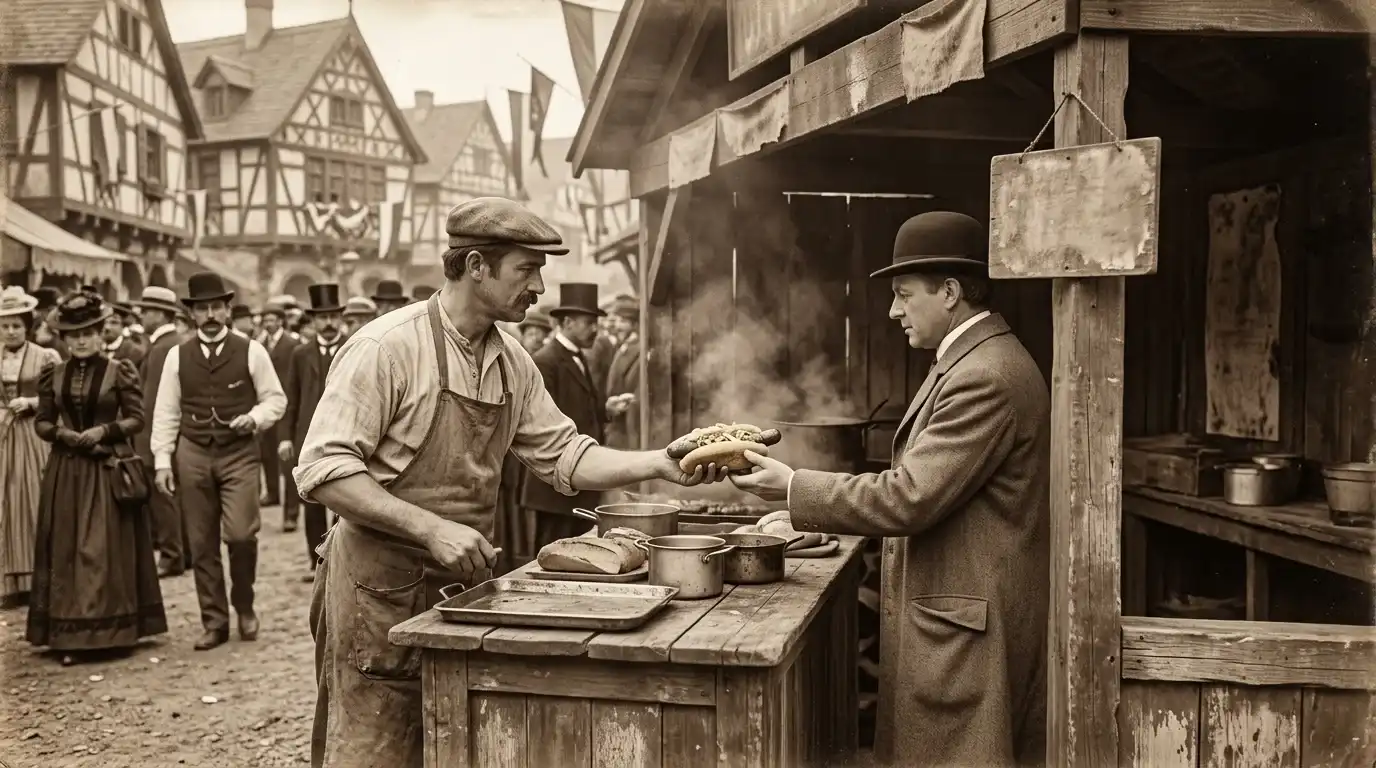
The frank has a fixed starting point. At the 1893 World’s Columbian Exposition, Austro-Hungarian brothers-in-law Emil Reichel and Samuel Ladany sold beef sausages topped with mustard and onions at a stand in “Old Vienna,” part of the fair’s Midway Plaisance. WBEZ’s Curious City reported in 2018 that the sausages sold well enough for the pair to stay and open a small factory and storefront on Halsted Street, the Vienna Sausage Company.
That company became Vienna Beef. Its marketing vice president, Tom McGlade, told WBEZ that roughly 90 percent of Chicago’s more than 1,000 hot dog stands sell its sausages; the figure comes from the company, not an independent count. McGlade credited the later shape of the Chicago dog to Depression-era demand for cheap meals, beef from the Union Stockyards and immigrant communities adding condiments such as tomatoes.
Maxwell Street and the Depression sandwich
A contested birthday
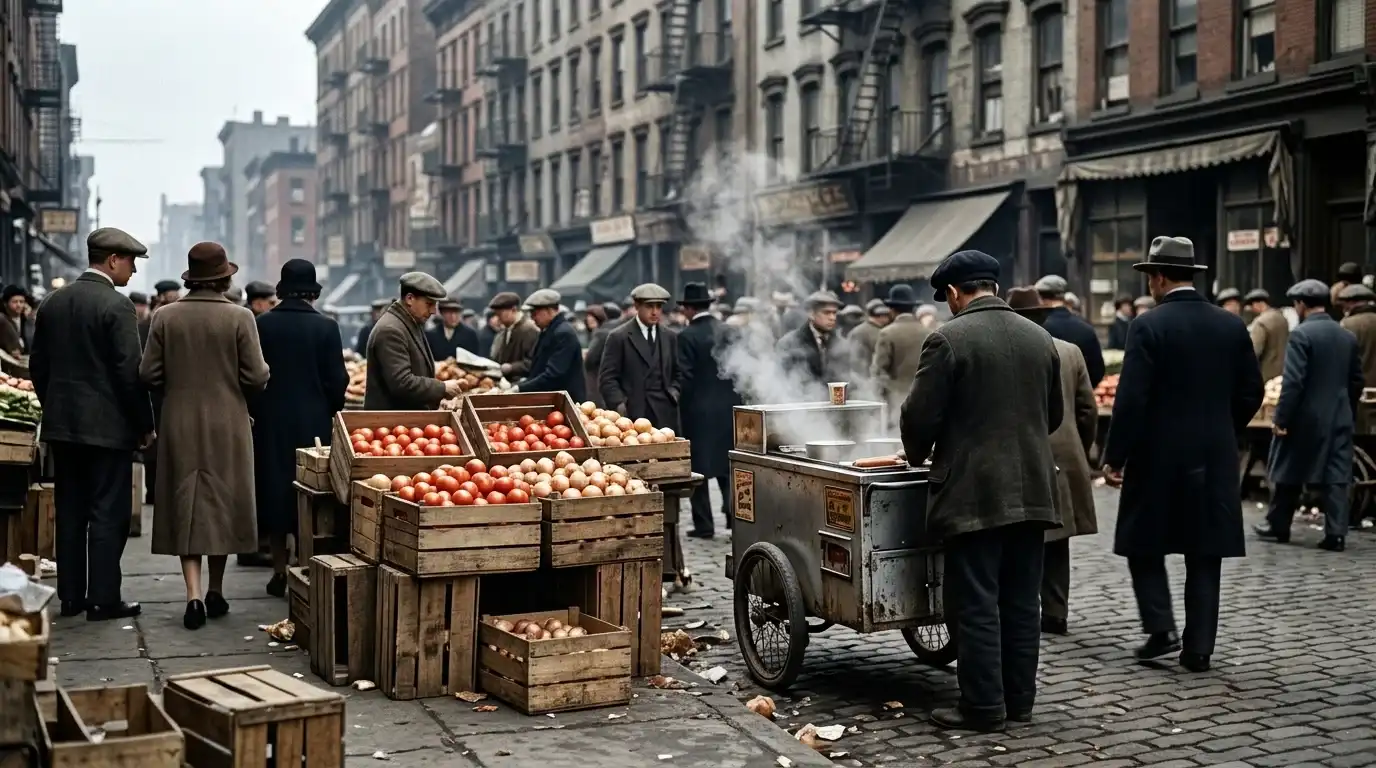
Where the seven toppings first came together is less settled than where the frank came from. The University of Chicago Magazine places the likely birthplace at Maxwell Street Market, an open-air market that started in the 1870s in a neighborhood of European immigrants, where Greek and Italian produce vendors may have supplied the tomatoes and onions.
One stand claims the invention outright. Time Out Chicago reported that the earliest offering from Fluky’s Maxwell Street stand was called the “Depression Sandwich” and reportedly sold for a nickel in 1929. Kraig, quoted in the same piece, traced the pile of toppings to “competition among Greek and Italian vendors” trying to add value during the Depression.
Kraig himself has since drawn the timeline out further. In an October 2024 WGN report by Gabriel Castillo, he described the pre-war favorite as the “Depression dog,” dressed with mustard, onions, pickled peppers and sometimes piccalilli, an early relish. He noted a 1928 newspaper complaint that ballpark vendors left the piccalilli off. On the fully dressed version, he was direct: “In my opinion, the fully loaded garden on a bun is a post-WWII phenomenon.” After the war, the same report says, Vienna Beef helped set up stands and promoted the Chicago-style dog through its signs and imagery.
So the record supports two readings. A loaded hot dog was sold on Maxwell Street during the Depression; the standardized seven-topping build may be a postwar product that the sausage maker helped fix in place. The plainer Depression dog survives at a few stands, including Gene and Jude’s and Red Hot Ranch, according to Kraig.
The ketchup rule
Taste, not law
Ketchup on a Chicago dog draws a reaction out of proportion to a squeeze bottle, and plenty of stories circulate to explain the taboo. Bob Schwartz of Vienna Beef told Time Out Chicago that those stories are legend. His explanation was flavor: ketchup’s sweetness and acidity clash with the other toppings.
The rule is custom, not regulation. Kraig’s account of the plainer Depression dog shows the build itself has shifted over the decades, and the seven-topping version is the one now held up as standard.
Building one at home
Parts that travel
The two specialty components are the neon relish and the sport peppers, both sold in jars under the Vienna name. Celery salt is a standard spice-rack item. The rest is ordinary grocery stock: an all-beef frank, a poppy seed bun steamed until soft, yellow mustard, chopped white onion, tomato wedges and a dill spear.
- Vienna Chicago Style Relish (12 oz.), Sport Pepper (12oz.) Pack of 2: one jar of the bright green relish and one of the small pickled peppers used on Chicago stands. See it on Amazon (affiliate link)
- Vienna Chicago Style Sport Peppers 16oz (4 Pack): the peppers alone, in larger jars. See it on Amazon (affiliate link)
- McCormick Celery Salt, 4 oz: the finishing seasoning shaken over the top. See it on Amazon (affiliate link)
Video: Vienna Sport Peppers – 12 oz bottle, from the SammyLu Reviews YouTube channel
As an Amazon Associate I earn from qualifying purchases. A commission may be earned if you buy through this link, at no extra cost to you.
The sport peppers sit in the same pickling family as Chicago giardiniera, and the city’s sandwich culture runs on that brine. For the other half of the category, GrillCheesy has covered the contested origin of the hamburger, the smash burger and Minneapolis’s cheese-stuffed Jucy Lucy.

Frequently asked questions
What are the seven toppings on a Chicago-style hot dog?
Yellow mustard, green relish, chopped onion, tomato, a dill pickle spear, sport peppers and celery salt, on an all-beef frank in a steamed poppy seed bun.
Why is there no ketchup on a Chicago hot dog?
Vienna Beef’s Bob Schwartz told Time Out Chicago the stories behind the ban are legend; the practical reason is that ketchup’s sweetness clashes with the other toppings.
Who invented the Chicago-style hot dog?
No single inventor is documented. Fluky’s on Maxwell Street claims a nickel “Depression Sandwich” from 1929, while historian Bruce Kraig places the fully loaded version after World War II.
What brand of hot dog is used in Chicago?
Vienna Beef, founded by Emil Reichel and Samuel Ladany after the 1893 World’s Fair, says its franks are sold at about 90 percent of the city’s stands.
Sources
- WTTW News, “WTTW News Explains: What’s the Story Behind Some of Chicago’s Famous Foods?” (March 10, 2025): https://news.wttw.com/2025/03/10/wttw-news-explains-what-s-story-behind-some-chicago-s-famous-foods
- Time Out Chicago, “The 7 toppings of the Chicago hot dog” (June 29, 2008): https://timeout.com/chicago/food-drink/the-7-toppings-of-the-chicago-hot-dog
- David Hammond, “City of big sandwiches,” The University of Chicago Magazine (Spring 2024): https://mag.uchicago.edu/arts-humanities/city-big-sandwiches
- Katherine Nagasawa, “From Vienna Beef To PBR: Five Food And Drink Legacies Of The 1893 World’s Fair,” WBEZ (2018, updated 2019): https://www.wbez.org/stories/from-vienna-beef-to-pbr-five-food-and-drink-legacies-of-the-1893-world-s-fair/d44833c9-c4cb-4343-b3c7-90055b2da0ea
- Gabriel Castillo, “The ‘Depression dog’: What came before the Chicago-style hot dog,” WGN via AOL (October 25, 2024): https://www.aol.com/depression-dog-came-chicago-style-204058152.html


