In this story
The best-known story about the potato chip is almost certainly wrong. It goes like this: in 1853, at Moon’s Lake House in Saratoga Springs, New York, a diner sent back his fried potatoes as too thick. The cook, George Crum, sliced the next batch paper-thin and fried them hard to spite him, and the customer loved them. In some tellings the diner is Cornelius Vanderbilt. Historians have taken the story apart piece by piece. A recipe for thin fried potato slices was printed in England decades earlier, Crum never claimed the invention himself, and Vanderbilt was added to the tale more than a century later. What survives is the name Saratoga chips, and the chip’s long partnership with the sandwich.
Video: The Accidental Invention of the Best Snack Food Ever, from the Great Big Story YouTube channel, which tells the Saratoga legend
The legend at Moon’s Lake House
A cook, a picky customer and a spite-fried potato
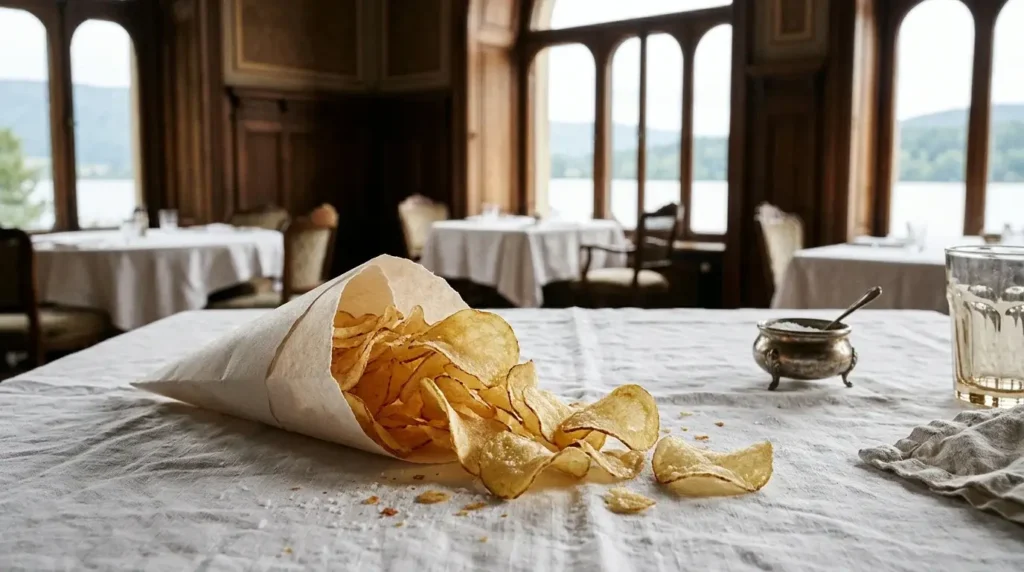
The story has been printed so often it reads like fact. Britannica’s entry still repeats the outline: George Crum, born George Speck in 1824, was cooking at Moon’s Lake House in 1853 when a customer sent back fried potatoes as too thick; Crum fried thinner slices until crisp, other diners wanted them and the restaurant began serving them as Saratoga chips. Crum later opened his own restaurant nearby.
The legend found its most famous phrase in 1976. HISTORY reports that American Heritage magazine nicknamed Crum the “Edison of Grease” that year. The Potato Chip/Snack Food Association put up a historical marker honoring him near the site the same year, according to JSTOR Daily. The marker was later stolen.
The trouble is in the documentation. Folklorists William S. Fox and Mae G. Banner traced the story’s growth in 1983, and JSTOR Daily summarizes what they found: Moon’s Lake House was credited with the chip in the mid-1800s, the first known mention of Crum in connection with it came in 1885, and Vanderbilt first appeared in an advertisement about 120 years after the supposed invention. The same article notes that the Moon family did not even buy the Lake House until 1854.
Everyone who got the credit
Obituaries gave the chip to at least three different people
Crum was not the only claimant. HISTORY’s Greg Daugherty lists several people credited in print over the decades:
- George Crum (died 1914). His obituaries mostly ignored the chip or said only that he was “said to have” invented it. Historian T.J. Stiles told HISTORY there is no truth to the Vanderbilt tale.
- Catherine Wicks (died 1917). Crum’s sister, who worked alongside him and died at 103, was described in her obituary as “said to be the originator of the potato chip.”
- Hiram S. Thomas (died 1907). His obituaries called him the inventor of Saratoga chips, though he ran Moon’s Lake House in the 1890s, about forty years after the chips supposedly appeared.
- Emeline Jones. A celebrated cook for wealthy households in New York and Washington, she worked briefly at the Lake House under Thomas and is unlikely to have been there at the start.
The most intriguing name has no surname. JSTOR Daily quotes an 1849 New York Herald report from the Lake House praising a cook called Eliza for her fried potatoes: “Who would think that simple potatoes could be made such a luxury!” That predates the Crum story by four years. HISTORY reports that Stiles reads it as evidence the Lake House’s chips came before Crum and Wicks, though nothing more is known about Eliza.
The 1817 recipe that came first
An English doctor printed thin-fried potatoes decades before Saratoga
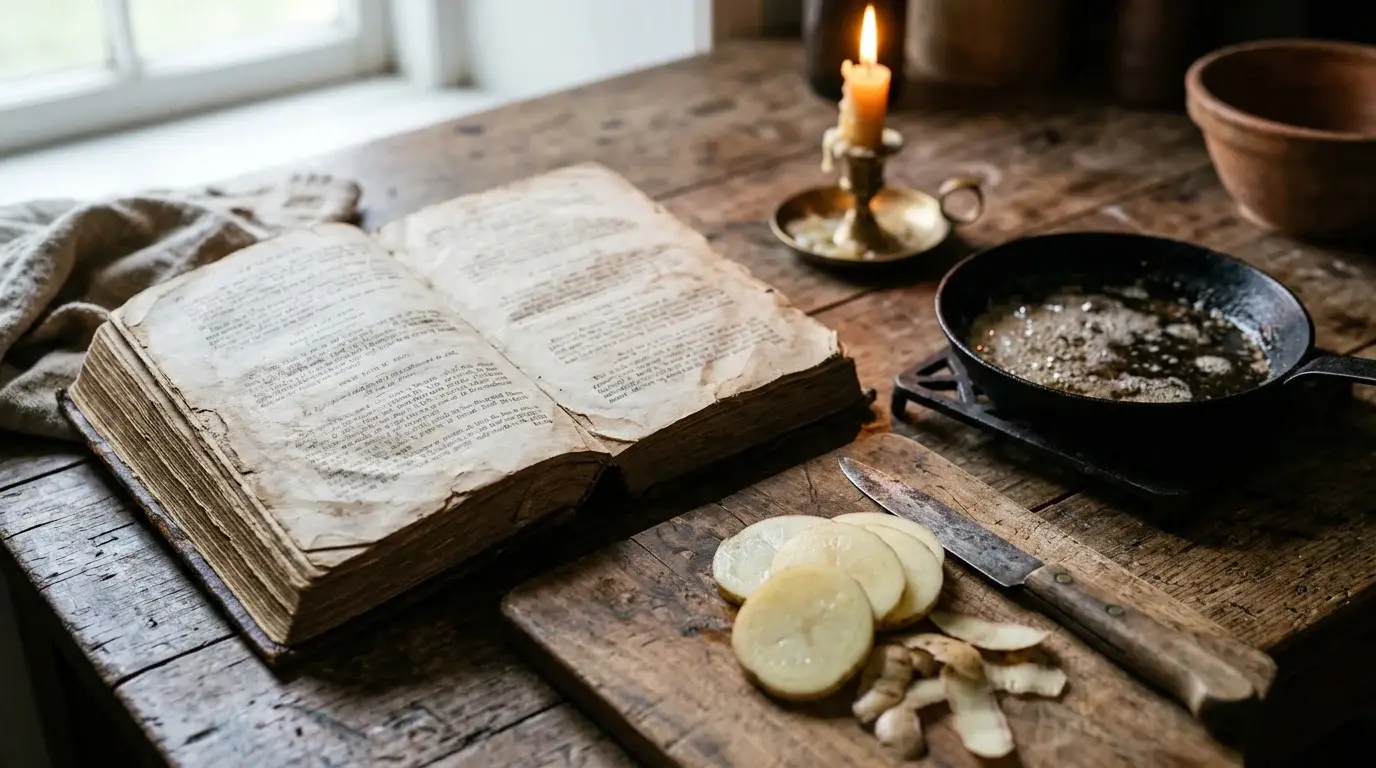
Whatever happened at Saratoga, it was not the first potato chip. HISTORY points to William Kitchiner, an English doctor whose cookbook The Cook’s Oracle first appeared in 1817 and included a recipe for thin fried potato slices. Later editions titled it “potatoes fried in slices or shavings.”
Kitchiner’s book traveled. HISTORY notes it was published in both Britain and the United States, and American cookbooks of the 1820s and 1830s carried versions of the same recipe. Daugherty’s conclusion is the one most food historians reach: the potato chip was probably invented by no single person, and possibly not first in the United States at all.
That does not make the Saratoga connection meaningless. The chips became associated with Saratoga Springs, served at its resort restaurants and named after the town. Smithsonian magazine reports that when Crum opened his own place near Saratoga in 1860, a basket of potato chips sat invitingly on every table, and JSTOR Daily reports historian Dave Mitchell’s conclusion that while the true origin is likely unknowable, it was Saratoga that made them popular. As with the competing claims to the hamburger, the place that popularized a food and the place that invented it are not necessarily the same.
From barrels to bags
A California entrepreneur solved the stale-chip problem in 1926
For decades, chips were a fragile, local product. Britannica explains that in the late 1800s entrepreneurs began founding companies to sell chips in grocery stores, where they were kept in barrels or glass containers and were often stale and broken by the time a customer reached the bottom.
The fix came from Laura Scudder. Britannica describes her as a California businesswoman, trained nurse and lawyer who in 1926 developed a method to fuse two pieces of waxed paper into a bag to keep the chips fresh. Britannica traces the line from her bag to cellophane and then glassine packaging.
Production caught up at the same time. Britannica notes that the mechanical potato peeler and the continuous fryer arrived in the 1920s, allowing chips to be made in far larger quantities. In the late 1930s, Herman Lay’s company became the first to successfully market a branded chip across the United States.
Marketing finished the job. Smithsonian notes that Scudder’s bags carried a freshness date and the boast “the Noisiest Chips in the World.” When Lay’s became the first national potato chip brand in 1961, it hired Bert Lahr, the Cowardly Lion of The Wizard of Oz, as its first celebrity spokesman, delivering the line “Betcha can’t eat just one.” The same article puts American consumption at about 1.85 billion pounds a year, roughly 6.6 pounds per person.

How chips ended up next to the sandwich
A sealed bag made chips portable enough for a lunch counter
The sealed bag changed where chips could go. Britannica’s account makes the point by contrast: barrel chips went stale and broke, and Scudder’s bag kept them fresh. A barrel belonged to a grocery store. A small sealed bag could sit by a register, go into a lunch box or land on a plate next to a sandwich, alongside the pickle spear and a scoop of coleslaw.
The pairing makes sense on the plate as well. A deli sandwich is soft and rich. Chips bring salt and crunch, and a sharp flavor such as salt and vinegar or dill pickle does some of the same work as the pickle beside it. Britannica lists the seasoned styles that followed the plain salted chip, among them barbecue, sour cream and onion, cheddar cheese, vinegar and spicy.
Some eaters go one step further and put the chips inside the sandwich, a layer of crunch under soft fillings. Pittsburgh’s Primanti Bros. built its reputation on the same move with French fries, as GrillCheesy’s coleslaw history describes.

Frequently asked questions
Who invented potato chips?
No one can be identified. William Kitchiner printed a recipe for thin fried potato slices in England in 1817, decades before the Saratoga Springs legend.
Did George Crum invent the potato chip?
The evidence says no. Crum never claimed it, the first known link between him and the chip dates to 1885 and Vanderbilt was added to the story about 120 years after 1853.
Why are they called Saratoga chips?
They became associated with the resort restaurants of Saratoga Springs, New York, especially Moon’s Lake House, in the 19th century.
Who invented the potato chip bag?
Laura Scudder, a California businesswoman, developed a sealed waxed-paper bag in 1926 to keep chips fresh.
Sources
- Britannica, “Potato chip”: https://www.britannica.com/topic/potato-chip
- Greg Daugherty, “Who Invented the Potato Chip?,” HISTORY (February 3, 2021): https://www.history.com/articles/who-invented-potato-chip-saratoga
- Smithsonian, “The Curious History of the Potato Chip”: https://www.smithsonianmag.com/arts-culture/curious-history-potato-chip-180979232/
- April White, “The Potato Chip Origin Myth,” JSTOR Daily (May 4, 2017): https://daily.jstor.org/story-invention-potato-chip-myth/