In this story
French onion soup is onions cooked down until deep brown and simmered in broth, then topped with bread and grated cheese and set under the broiler. The broth is old. The bread-and-cheese lid is the Paris part, and it came from the cafés that fed the porters and night crowds of Les Halles, the city’s central food market, in the nineteenth century.
Video: French Onion Soup from 1651, from the Tasting History with Max Miller YouTube channel
Onion soup before the cheese
Taillevent to La Varenne
Onion soup is far older than the gratinée. Shane Mitchell, writing in Saveur in February 2020, traced it back to the Roman Empire and noted that it was treated as peasant food until the fourteenth century, when a version of sautéed onions in pea broth appears in Le Viandier de Taillevent. In 1651, François Pierre La Varenne recorded potage à l’oignon in Le Cuisinier françois.
None of those early soups carried a rich meat broth or a cap of melted cheese. They were onions, liquid and bread, the kind of dish that could feed a household on very little.
Two royal legends
Louis XV, Stanislas and an empty cupboard
The French soup has an origin story attached, and it comes in two versions. Emily Monaco, in a February 2018 VICE history of the dish, recounted the first: King Louis XV returned from a hunt to find nothing in the lodge but onions, butter and Champagne, and made soup from them.
The second credits his father-in-law. Stanislas Leszczynski, the deposed king of Poland who became duke of Lorraine, supposedly tasted onion soup at an inn in Champagne and insisted on learning the recipe. Alexandre Dumas published a soupe à l’oignon à la Stanislas in his Grand Dictionnaire de cuisine of 1873, naming the inn as La Pomme d’Or in Châlons-en-Champagne, according to Saveur, which repeats the story without vouching for it.
Neither legend survives the older evidence. Monaco points out that Taillevent’s fourteenth-century cookbook already contains an onion soup, centuries before either king.

The belly of Paris
Les Halles and the gratinée
The version known worldwide took shape around a market. Les Halles was founded in 1135 under King Philippe-Auguste, VICE reported, walled off from the neighboring Saints-Innocents cemetery. After the cemetery’s remains were moved to the Catacombs in the early nineteenth century, the market grew into what Émile Zola called the belly of Paris, the title of his 1873 novel Le Ventre de Paris.
The restaurants surrounding it, among them La Poule au Pot, Chez Baratte and Au Pied de Cochon, turned the old soup into something new by adding a heavy layer of grated cheese and sliding the bowls under the broiler. The result, the gratinée des Halles, fed market porters at breakfast and revelers on their way home. Saveur describes the brasseries and soup stalls of the late nineteenth century serving it with vegetable, chicken or beef broth, sometimes finished with Cognac or wine, under a lid of Comté.
The market itself left in the 1970s, moving to Rungis outside the city. Au Pied de Cochon stayed, and Monaco reported it as one of the few Paris restaurants open around the clock, serving 150 to 200 bowls of onion soup a day.

The onions take the time
Caramelization and browning
The flavor of the soup is mostly the flavor of the onions, and that depends on browning them slowly. America’s Test Kitchen explains the chemistry in its technique guide to caramelizing onions. Two reactions run at once. Caramelization breaks the onions’ sugars into hundreds of new flavor, color and aroma compounds. Maillard browning, the reaction between amino acids and sugars, adds a second layer of savory flavor.
Water is the obstacle. Moisture has to evaporate before the surface can brown, which is why the classic method, low heat and frequent stirring, takes more than an hour and a quarter by ATK’s count. The test kitchen’s faster version starts the sliced onions covered over high heat with a little water and oil, so steam softens them quickly; then the lid comes off, the heat drops, and the onions are pressed against the pan, left to brown, scraped and stirred, again and again. A pinch of baking soda at the end raises the pH, which speeds browning and softens the onions further. The whole process takes about half an hour.
Bread, cheese and the crock
The finish is the part Les Halles added: a heavy layer of grated cheese and a trip under the broiler, which calls for bowls that can take direct heat.
- LE TAUCI Ceramic French Onion Soup Bowls with Handles, 22 OZ, Set of 4: oven-safe ceramic crocks with handles, sized for a broiled bowl of soup. See it on Amazon (affiliate link)
Video: LE TAUCI French Onion Soup Crocks with Handles 22 Ounce Ceramic Soup Bowls Review, from the Webrep YouTube channel
As an Amazon Associate I earn from qualifying purchases. A commission may be earned if you buy through this link, at no extra cost to you.
Soup beside a sandwich
Bread in the bowl
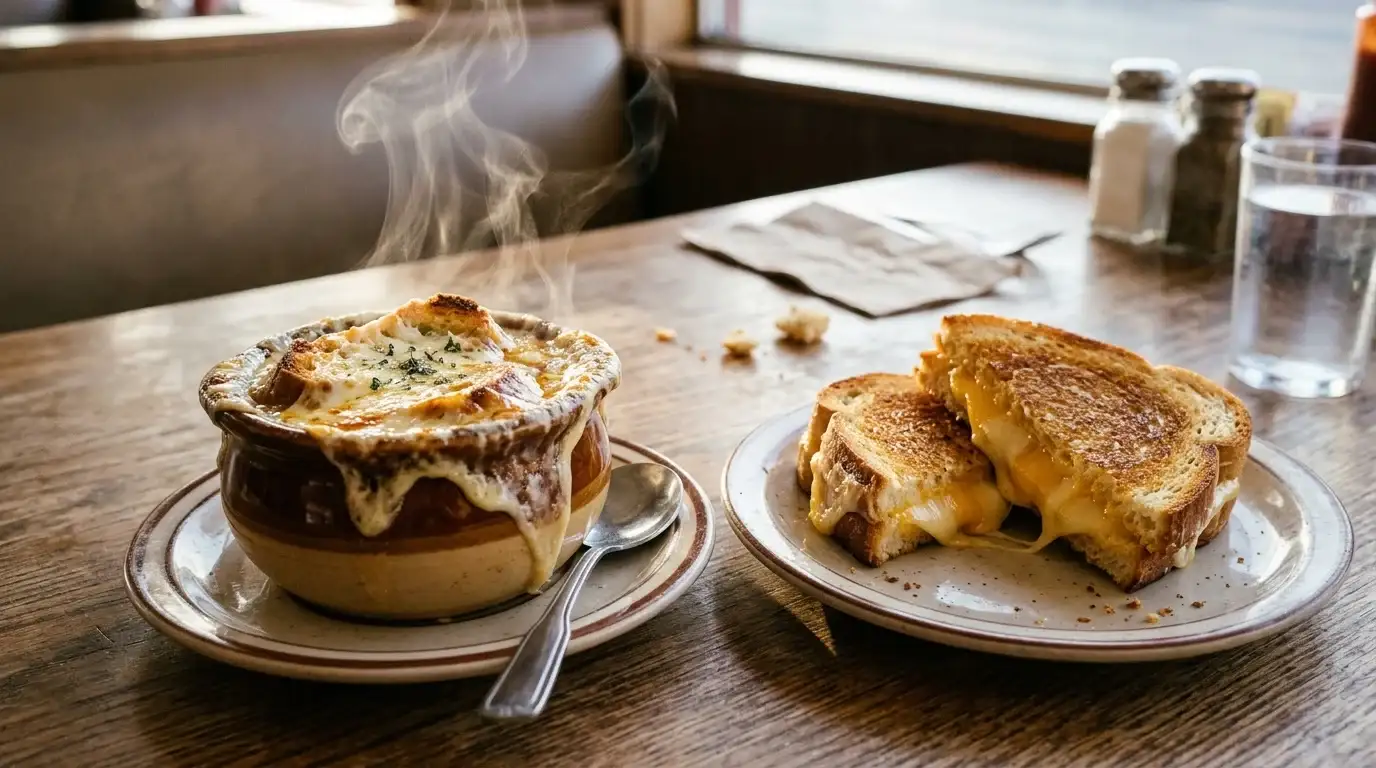
Onion soup and bread have always traveled together, from the bread in the medieval versions to the toast under the cheese. GrillCheesy’s other sides, coleslaw and potato salad, cover the cold half of that menu. For the cheese on top, the guide to Parmigiano Reggiano covers another protected European cheese, and sourdough and pain de mie cover the breads that end up floating on it or toasted beside it.
Frequently asked questions
Where did French onion soup originate?
Onion soups appear in French cookbooks from the fourteenth century on. The cheese-topped gratinée des Halles came from the restaurants around Paris’s Les Halles market in the nineteenth century.
Did Louis XV invent French onion soup?
No. The story of the king making soup from onions, butter and Champagne is a legend; onion soup appears in Taillevent’s Viandier centuries earlier.
Why do onions take so long to caramelize?
Their water has to evaporate before browning starts, and both caramelization and Maillard browning need time. The classic low-heat method takes more than an hour.
What cheese goes on French onion soup?
Saveur notes Comté as the preferred cheese for the Paris gratinée.
Sources
- Shane Mitchell, “My Father’s French Onion Soup,” Saveur (February 27, 2020): https://www.saveur.com/story/food/fathers-french-onion-soup
- Emily Monaco, “The Curious History of French Onion Soup, Paris’s Timeless Hangover Cure,” VICE (February 26, 2018): https://vice.com/en/article/the-curious-history-of-french-onion-soup-pariss-timeless-hangover-cure
- America’s Test Kitchen, “How to Quickly Caramelize Onions”: https://www.americastestkitchen.com/articles/7584-how-to-caramelize-onions-quickly