In this story
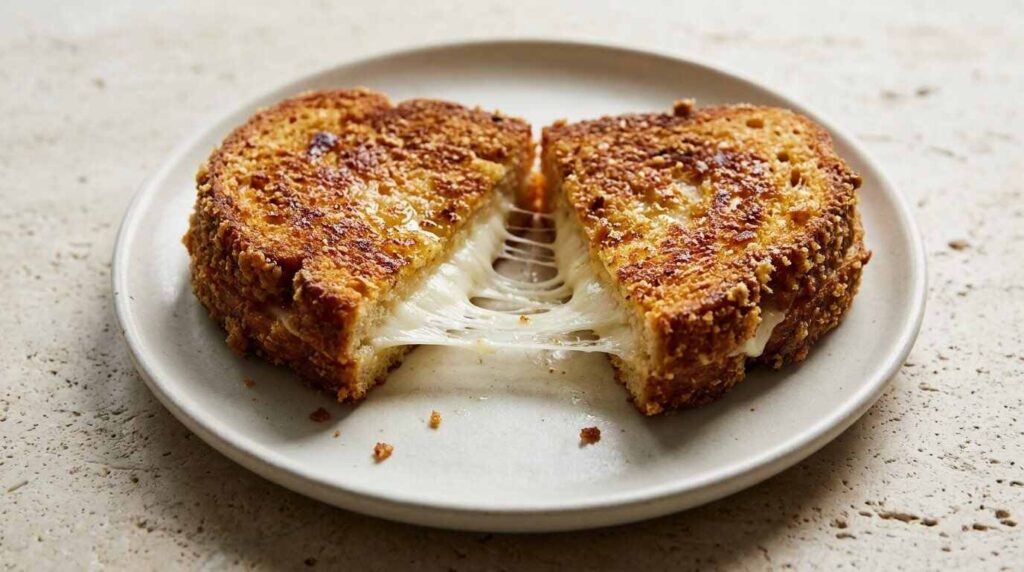
Mozzarella in carrozza is a sandwich of sliced bread and mozzarella that is sealed, dipped in egg, and fried until the crust turns crisp and the cheese runs. The name translates literally as “mozzarella in a carriage,” and Italian sources agree on that much while disagreeing on nearly everything about where the carriage came from. Italy Magazine calls it “a poor dish born in Campania in the early 19th century,” built to use up stale bread and leftover mozzarella.
Video: MOZZARELLA IN CARROZZA di Andrea Aprea — from the GialloZafferano YouTube channel
Where the Dish Comes From
Campania gets the credit, Rome keeps the habit
Most written accounts place the birth of mozzarella in carrozza in Campania, the region around Naples where buffalo-milk mozzarella is made. An Italian-language piece on Sapere Sapori repeats the early-1800s date and refers to “la ricetta originale napoletana,” an original Neapolitan recipe that calls for stale casereccio bread and buffalo mozzarella. The page cites only a general bibliography credit to a dairy trade source and gives no named document behind the date.
A food-history item for the translators’ network TermCoord also dates the dish to the beginning of the nineteenth century and describes it as “a recovery recipe to reuse ingredients such as stale bread and leftover mozzarella.” A food52 roundup of fried cheese sandwiches goes further and says the dish is said to have been invented in Naples in the 1800s.
The dating is not settled. Gambero Rosso International writes that Lazio, and Rome in particular, has long claimed the dish, while saying it seems to have been born in Campania. Its account reaches back to the medieval countryside, where mozzarella that had traveled slowly arrived slightly sour and was tucked between slices of stale bread so it would not be wasted. That is several centuries earlier than the 1800s accounts, and none of the sources provide a recipe text from either period.
Rome’s relationship to the dish is better documented in practice than in origin. Food writer Katie Parla, in the Roman cookbook excerpt on her site, writes that the sandwich has roots in Campania but that Romans have “fully claimed it as their own.” She places it among the fried snacks sold at Rome’s rosticcerie and friggitorie.
Why It Is Called a Carriage
Four explanations, none of them proven
The name has produced more theories than the sandwich has ingredients. The Italian page on Sapere Sapori lists several. One holds that the two slices of bread form a sort of coach around the cheese. Another describes the melted cheese stretching into strings that seem to guide the bread carriage. A third calls itself the more historical: milk carried by carriage curdled from the constant jolting and arrived as cheese. The fourth points to carriage wheels, which were round, in an era when the bread slices were round as well.
Italy Magazine names the milk-transport story as the most accredited explanation and treats the round bread as the second theory. Tasting Table, by contrast, says the mozzarella pulls into strands that look like horse reins and cites that image as the source of the name, which matches the reins theory in the TermCoord item. Nigella Lawson’s site makes a more modest observation, noting that the phrase “in a carriage” does not really explain the dish and only hints that the cheese is contained.
None of the pages trace the phrase to a dated menu, cookbook or dialect source, so the carriage remains a matter of folk etymology.
How the Sandwich Is Made
Dry cheese, stale bread and a sealed edge
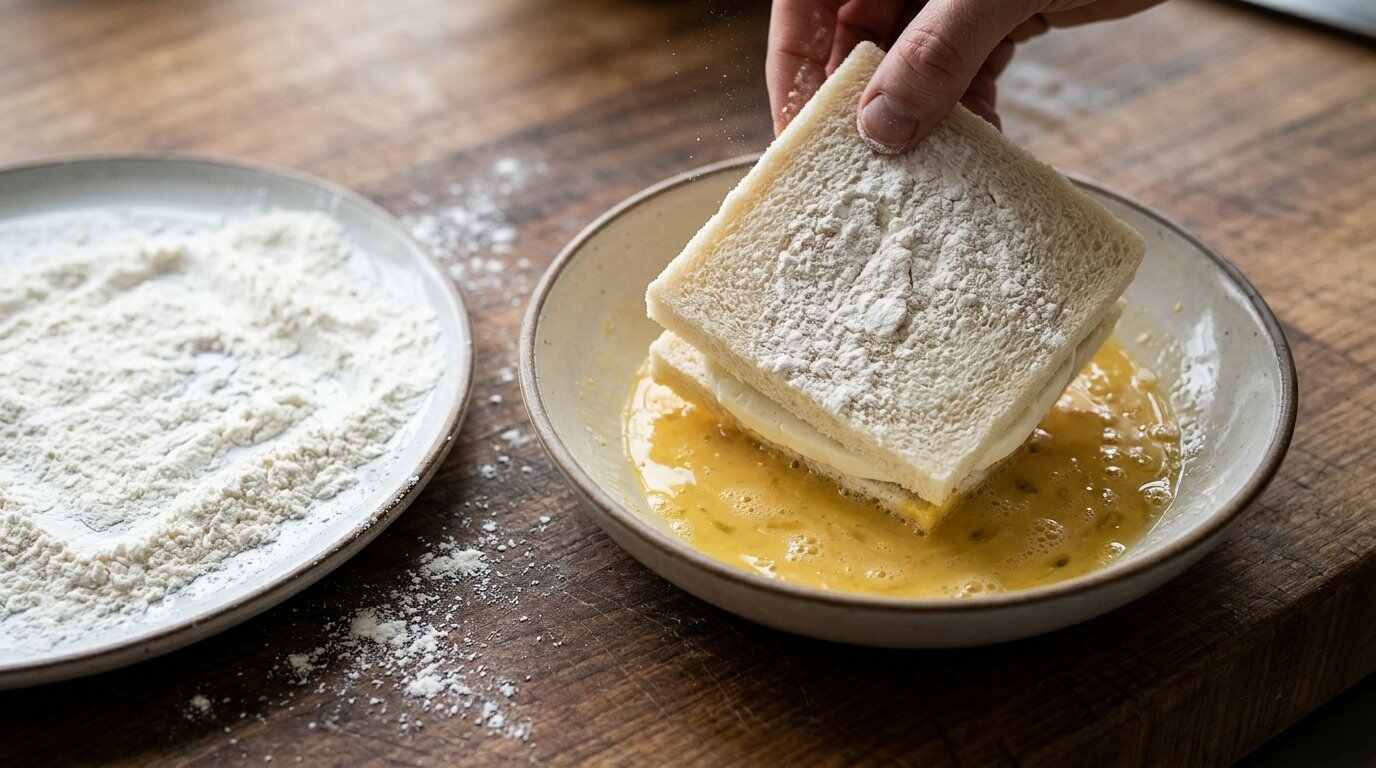
The method is consistent across sources even where the details differ. Mozzarella is sliced and laid between two slices of bread, the edges are pressed shut, the sandwich is coated, and it is fried in hot oil. Because mozzarella holds water, several sources deal with moisture first. Gambero Rosso International gives a recipe that refrigerates the mozzarella for at least a day so it dries and firms. Tasting Table suggests draining the cheese well or using low-moisture mozzarella.
The bread varies. The Sapere Sapori recipe specifies stale casereccio, a rustic country loaf, with soft sliced pan carré accepted as a substitute, and it removes the crust and cuts the slices about a centimeter thick. Tasting Table lists pane pugliese and pane toscano as traditional breads and says that sliced white pan carré is now the most common, with crusts traditionally trimmed.
Sealing is the step that keeps the cheese in the pan and out of the oil. The Italy Magazine recipe flours the bread, especially the edges, and seals them by hand. The Sapere Sapori version coats the edges in flour and then water for the same reason.
The coating is where recipes split. Several patterns appear in the sources:
- Flour, then beaten egg, as in the Gambero Rosso recipe, which pours an egg and milk mixture over floured sandwiches and fries them in olive oil.
- Flour, egg and breadcrumbs, as in the Italy Magazine recipe.
- Milk, then flour, then egg, which is the order in Nigella Lawson’s recipe. A commenter on that page insists that the traditional Italian version uses flour, egg and breadcrumbs instead of milk, a claim the page itself does not verify.
- Egg and milk, then breadcrumbs, with a second round of both for extra crunch, in Parla’s Roman recipe.
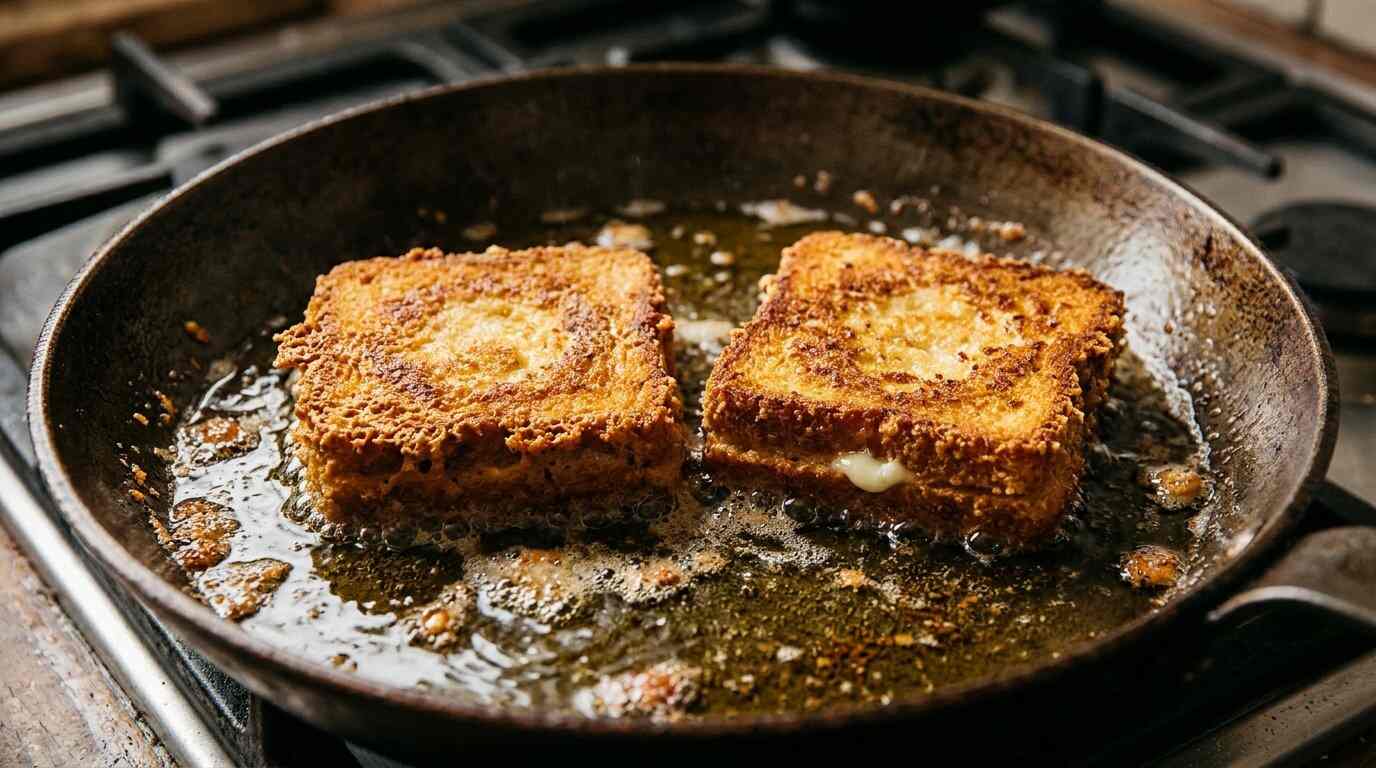
Tasting Table gives frying guidance of around 325 degrees Fahrenheit, about two minutes per side, with a short rest before cutting. The Sapere Sapori page underlines that the oil must be “davvero molto caldo,” really very hot.
Anchovy, Ham and Other Variations
The filling changes with the city
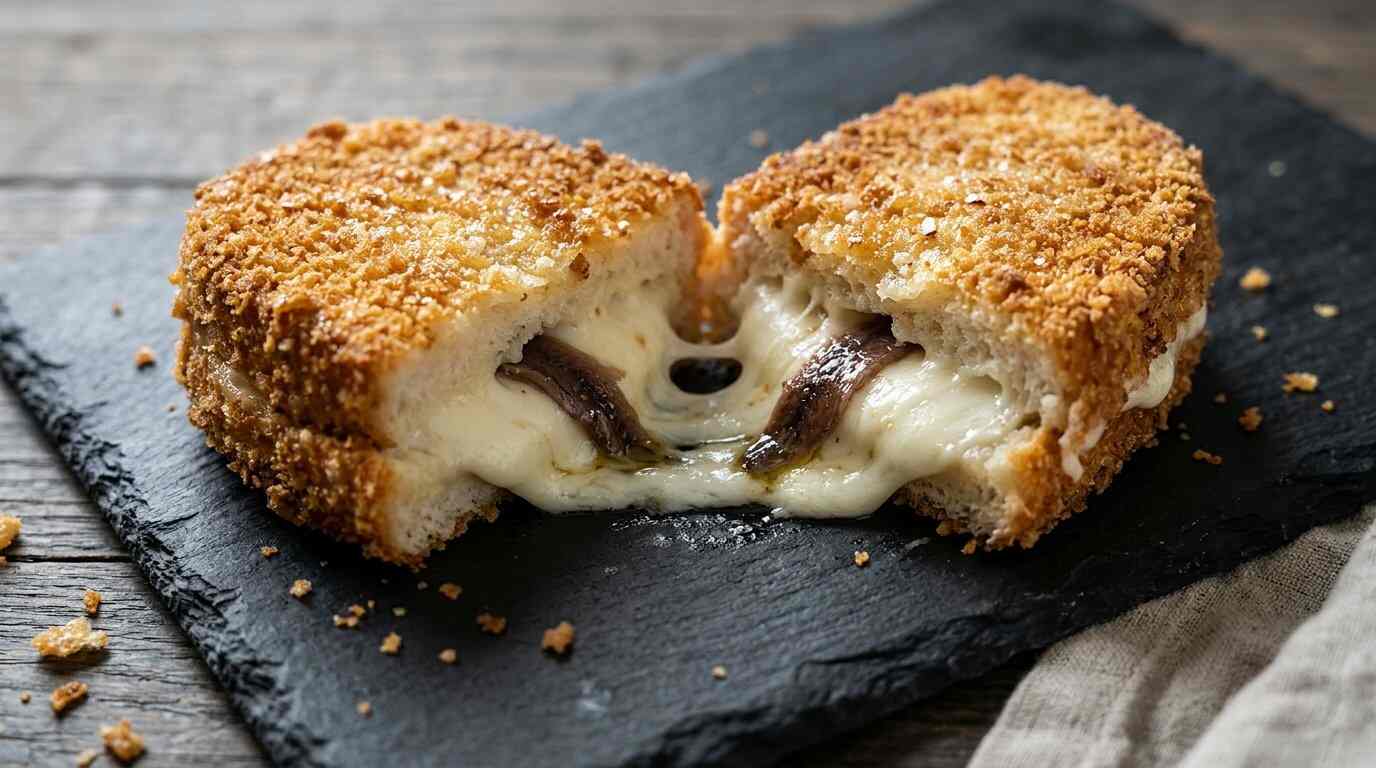
The original Neapolitan sandwich uses mozzarella di bufala, according to Gambero Rosso International. The Roman version typically swaps in fiordilatte, the cow’s-milk mozzarella, and may add anchovies or cooked ham. Gambero Rosso says a similar version appears in Venetian cooking, and Tasting Table agrees that the anchovy and ham additions are common in Venetian bacari.
Parla’s Roman recipe is specific about the anchovy. It calls for two fillets per sandwich, layered with the mozzarella before the sandwich is closed, then salted and peppered.
A sauce sometimes accompanies the sandwich. Blue Jean Chef’s air-fryer adaptation pairs the triangles with a warm puttanesca sauce that is built on anchovy, garlic, tomato, olives and capers, and it describes the dish as “basically a breaded and fried grilled cheese sandwich.” That recipe is an American home-cook adaptation using panko and an air fryer, not a traditional preparation. Tasting Table mentions a homemade tomato dipping sauce in some traditional Campanian versions.
Other regional spins turn up in the TermCoord item. In Messina, in Sicily, a version adds béchamel sauce to the breading for extra creaminess. The same item says the dish traveled to what is now the Czech Republic and Slovakia, where smažený sýr or vyprážaný syr, fried cheese, is made with a slice of Edam, Niva or Hermelín that is breaded and fried and often served with potatoes, fries or a side salad.
How It Differs From Grilled Cheese
Egg, oil and a crust that forms in the pan
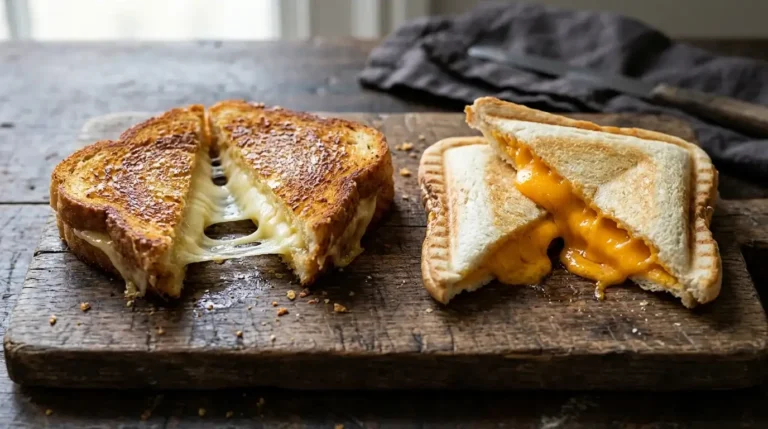
The grilled cheese sandwich is pan-toasted bread around melted cheese. Mozzarella in carrozza shares that basic structure and little else.
The bread is dipped in egg, which Tasting Table compares to French toast technique, and the sandwich is shallow-fried or deep-fried instead of griddled. Tasting Table credits that method with the crisp exterior. Nigella Lawson’s site describes the contrast in its method line, saying the sandwich is coated and fried in hot oil until crisp and golden on each side.
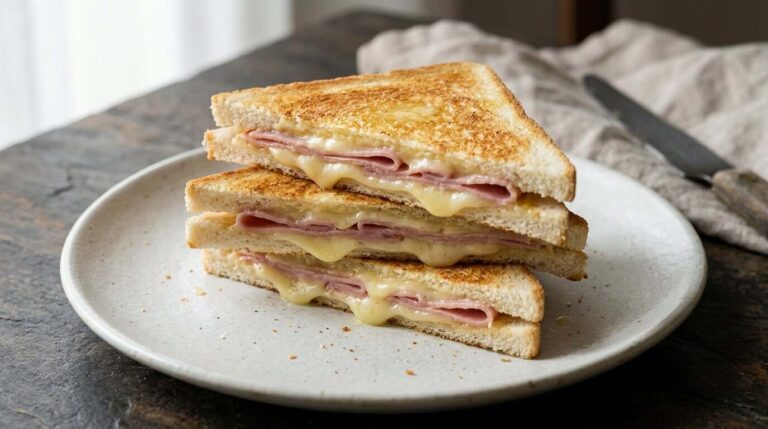
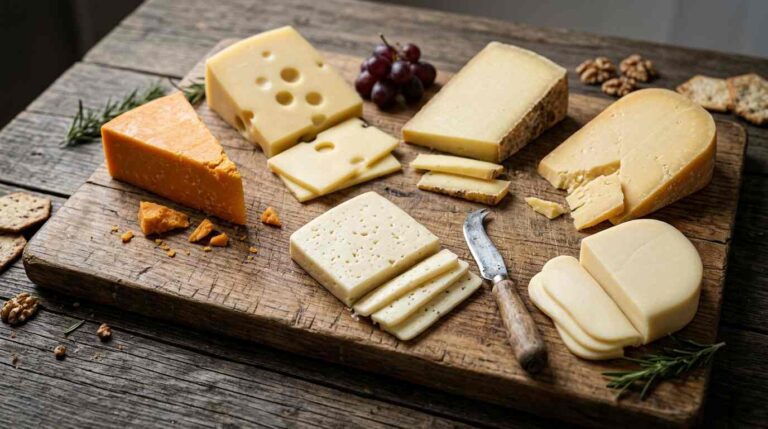
The cheese is different too, and so is the bread. The grilled cheese history and the discussion of the best bread for grilled cheese cover the American choices. The egg-dipped, fried approach has a closer relative in the Monte Cristo sandwich, and the ham-and-cheese layering in the Roman and Venetian versions echoes the croque monsieur.
Tasting Table frames the difference through local habit: Italians reach for anchovies and prosciutto where Americans reach for peanut butter or similar fillings.
In Film and Art
A father, a son and two sandwiches
The sandwich has a small place in Italian film history. In Vittorio De Sica’s 1948 Bicycle Thieves, Antonio treats his son Bruno to two mozzarelle in carrozza and a bottle of wine at a trattoria during the search for a stolen bicycle. Gambero Rosso International reads the scene as a brief escape from hardship and quotes Antonio’s line in translation, “Go on, eat, don’t think about it.” TermCoord adds that the characters order two portions, which is a full meal for them and a small appetizer for the other diners.
The dish also gave its name to a piece of art. The Sapere Sapori page notes a 1970 installation by Gino De Dominicis titled Mozzarella in carrozza, though it says nothing more about the work.
Common questions
What does mozzarella in carrozza mean?
The name translates literally as “mozzarella in a carriage.” Italian sources agree on that much and disagree on where the carriage came from. The Italian page on Sapere Sapori lists several theories, including one that the two slices of bread form a coach around the cheese.
How is mozzarella in carrozza made?
Mozzarella is sliced and laid between two slices of bread, the edges are pressed shut, the sandwich is coated in egg, and it is fried in hot oil. Because mozzarella holds water, several sources deal with moisture before frying.
What is the difference between the Neapolitan and Roman versions?
According to Gambero Rosso International, the original Neapolitan sandwich uses mozzarella di bufala. The Roman version typically swaps in fiordilatte, the cow’s-milk mozzarella, and may add anchovies or cooked ham.
Sources
- Italy Magazine, “Great Foods of Italy: Mozzarella in Carrozza” — https://www.italymagazine.com/dual-language/great-foods-italy-mozzarella-carrozza
- Gambero Rosso International, “How to make the perfect Roman mozzarella in carrozza” — https://www.gamberorossointernational.com/?p=478593
- Gambero Rosso International, “Mozzarella in carrozza in Bicycle Thieves” — https://www.gamberorossointernational.com/?p=392171
- Tasting Table, “Italy’s Deep-Fried Take On The Grilled Cheese” — https://tastingtable.com/1246122/mozzarella-in-carrozza
- Sapere Sapori, “La mozzarella in carrozza” — https://saperesapori.substack.com/p/la-mozzarella-in-carrozza
- TermCoord, “I-ATE Food Term of the Week: Mozzarella in carrozza” — https://termcoord.eu/?p=52742
- Katie Parla, “Mozzarella in carrozza” (Rome cookbook excerpt) — https://cookbooks.katieparla.com/cookbooks/rome/p/mozzarella-in-carrozza
- Food52, “The best cheese sandwiches are deep fried” — https://food52.com/blog/14683-the-best-cheese-sandwiches-are-deep-fried
- Blue Jean Chef, “Mozzarella en Carrozza with Putanesca Sauce” — https://bluejeanchef.com/recipes/mozzarella-en-carrozza
- Nigella Lawson, “Mozzarella in Carrozza” — https://www.nigella.com/recipes/mozzarella-in-carrozza
- YouTube, GialloZafferano, “MOZZARELLA IN CARROZZA di Andrea Aprea” — https://www.youtube.com/watch?v=HupY44XNqqs
Keep reading
- Cheese Toastie vs Grilled Cheese: What Is the Difference?
- Grilled Cheese vs Melt: Where Dictionaries, Cooks and Menus Draw the Line
- Best Cheese for Grilled Cheese: Which Ones Melt and Why
More in this section: Grilled Cheese guide.