In this story
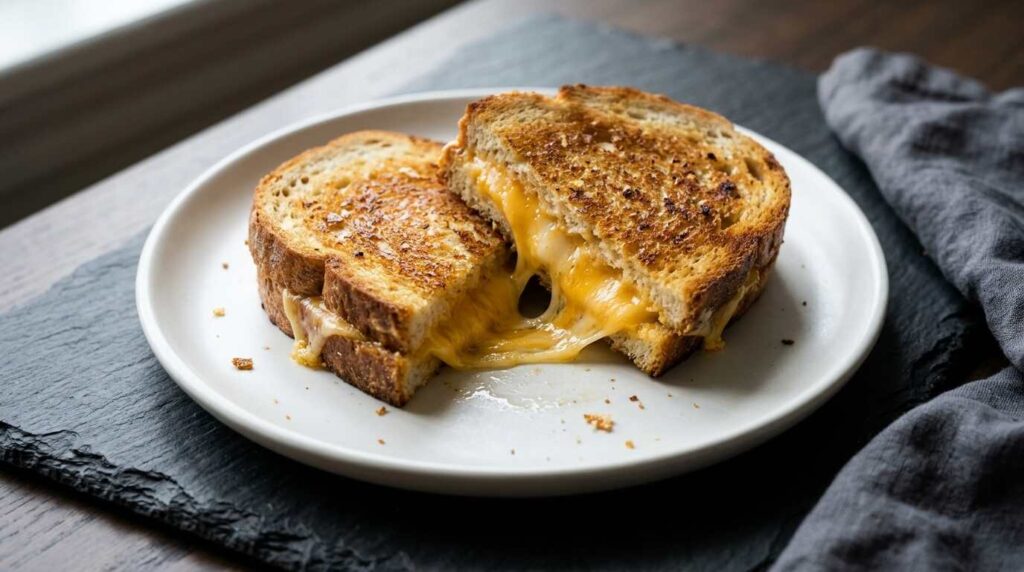
A grilled cheese and a melt are both hot sandwiches built around melted cheese, and no authority has fixed the boundary between them. Merriam-Webster defines a grilled cheese as a sandwich with cheese “and sometimes additional ingredients,” and a melt as “a sandwich with melted cheese.” Read literally, one definition swallows the other. Cooks, food writers and menus sort the two by different tests: added meat, open or closed construction, how the bread is toasted, and the heat source.
Video: Grilled Cheese vs Melt Cheese – AMAZING RANT! YOU HAVE BEEN DOING IT WRONG ALL YOUR LIFE! | The Sixth League
What the dictionary says
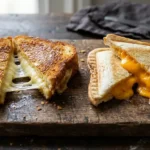
Merriam-Webster’s entry for grilled cheese reads: “a sandwich with cheese and sometimes additional ingredients (such as bacon or tomato).” The entry gives 1926 as the first known use of the term and describes the sandwich as usually cooked on a griddle or in a frying pan until the cheese melts and the bread toasts.
Its entry for melt has a sandwich sense that reads “a sandwich with melted cheese,” illustrated with a tuna melt. No date is given for that sense on the page. Bacon is allowed in the first definition, and a tuna melt is the example for the second. The two entries therefore overlap on every sandwich that holds cheese plus one more ingredient, and the dictionary assigns no rule for choosing between them.
The melt as the larger category
One camp treats “melt” as the umbrella and grilled cheese as a member of it. The Potato Rolls company’s blog calls a melt “any type of hot sandwich that contains melted cheese,” with other ingredients optional, and describes a grilled cheese as a specific sandwich most often made with cheese, bread and butter. Its own recipes use a narrower sense of the word, limiting “melts” to open-faced sandwiches with melted cheese.
Delighted Cooking, a food-information site, uses a similar frame. It says a melt includes cheese melted by grilling, toasting or baking, and it lists the grilled cheese, patty melt, tuna melt and panino as variants. In its comparison the grilled cheese takes almost any bread and is pan-fried in an iron skillet with butter or margarine or toasted in an oven, while the tuna melt is grilled in butter or margarine or baked with butter brushed on the bread. The same page describes an open-faced grilled cheese, served with lettuce and tomatoes on top, as a variation of the basic sandwich.
Under this framing, adding tuna or beef does not change the category at all. It changes the sandwich’s name.
The melt as a grilled cheese with additions
A second camp treats a melt as a grilled cheese plus something. The Cheese Scientist, a cheese-focused site, published a post by Jonah Kincaid on May 7, 2024, that describes a melt as “similar to a Grilled Cheese, but with additional ingredients.” In its account a melt typically adds meat, vegetables or sauces and uses heartier bread. It states that a grilled cheese uses toasted bread while a melt uses fresh, untoasted slices, and that “a Melt is usually broiled in the oven or cooked in a skillet.” It also says a grilled cheese is often served with a dip, whereas “a Melt is usually enjoyed as is.”
The post cites no outside sources and gives no history, so these distinctions are the author’s rather than a documented convention. They also conflict with the dictionary: Merriam-Webster’s own example of a grilled cheese includes bacon or tomato, which the Cheese Scientist would assign to the melt.
Open-faced or closed
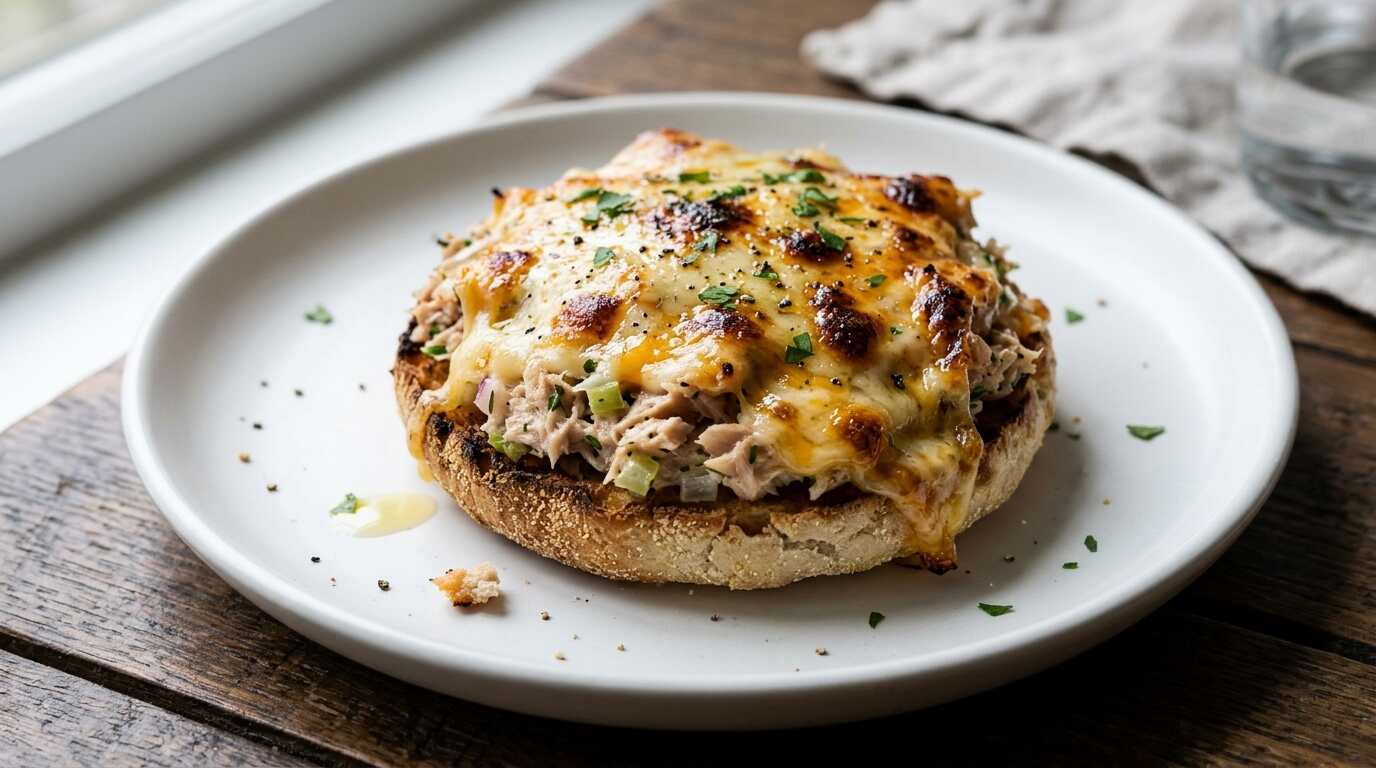
Construction is the test that appears most often in practice, and it divides even the cooks who agree on everything else. Food52’s article on the tuna melt describes two styles. The homestyle version is open-faced: tuna salad on an English muffin, with cheese broiled until “bubbly, melted, and browned.” The writer credits it with a higher ratio of tuna salad to bread and notes that direct heat over the cheese makes it very melty, though it can burn. The diner version is closed and griddled, “much like a grilled cheese,” with bread greased with mayo or butter. It has double the golden, crusty edges, and “the cheese goes from sandwich star to supporting role.” The article does not pick between them and ends by saying that disagreement among cooks and correctness are not mutually exclusive. A reader comment on the page argues that restaurant or diner style is the open-faced one, which the article’s own description contradicts.
Open-faced cheese sandwiches have a long record. Food Timeline, a food-history reference, quotes a 1934 Washington Post article describing “Open-face sandwiches of chreeese and tomato grilled” (the misspelling is in the source), and a 1936 recipe from Watkins that instructs the cook to “place sandwich in broiler, brown on both sides.” Both predate any use of “melt” found in the sources checked here.
When each name appeared
Food Timeline places modern grilled cheese in the 1920s, when “affordable sliced bread and inexpensive American cheese hit the market.” It lists earlier cheese-and-bread recipes under other titles: “Cheese Boxes” in 1902, “Toasted Cheese” in 1915, “Cheese Dreams” in 1916 and “Toasted Cheese Sandwich” in 1929. According to the same page, recipes titled “toasted cheese” predate those titled “grilled cheese,” the term “grilled cheese” appears in American print in the 1930s, and a 1932 Los Angeles Times menu lists “Grilled Cheese” without a recipe. Merriam-Webster’s 1926 first-use date for the term is earlier than that, and the two sources are not reconciled on the page. Neither source names an inventor.
The word “melt” arrived later. Barry Popik’s etymology page for “melt,” which cites the Oxford English Dictionary, dates the sandwich sense to 1956 from the trade magazine Diner, Drive-in, whose caption read: “Taste-appealing ‘Patty-Melt’—grilled cheese and a hamburger patty.” That caption defines the new sandwich in terms of the old one. The same page cites “tuna melt” in print from at least 1966, in a novel excerpt in New Directions 55.
Chowhound’s article on the tuna melt says the sandwich’s origin is “somewhat of a mystery,” and relays food-history research that broiled and toasted tuna-and-cheese sandwiches appear in 1920s cookbooks without the word “melt.” It names The Joy of Cooking (1936) as the first cookbook to include a broiled, open-faced tuna sandwich with cheese, and that food historian Jean Anderson placed the first evidence for the actual term “tuna melt” on family-restaurant menus in the mid-1970s. That conflicts with the 1966 literary citation, and the article does not address it. The article also reports an unsubstantiated story that the tuna melt was born in 1965 at a Woolworth in South Carolina.
The patty melt, a name that settled the question
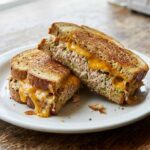
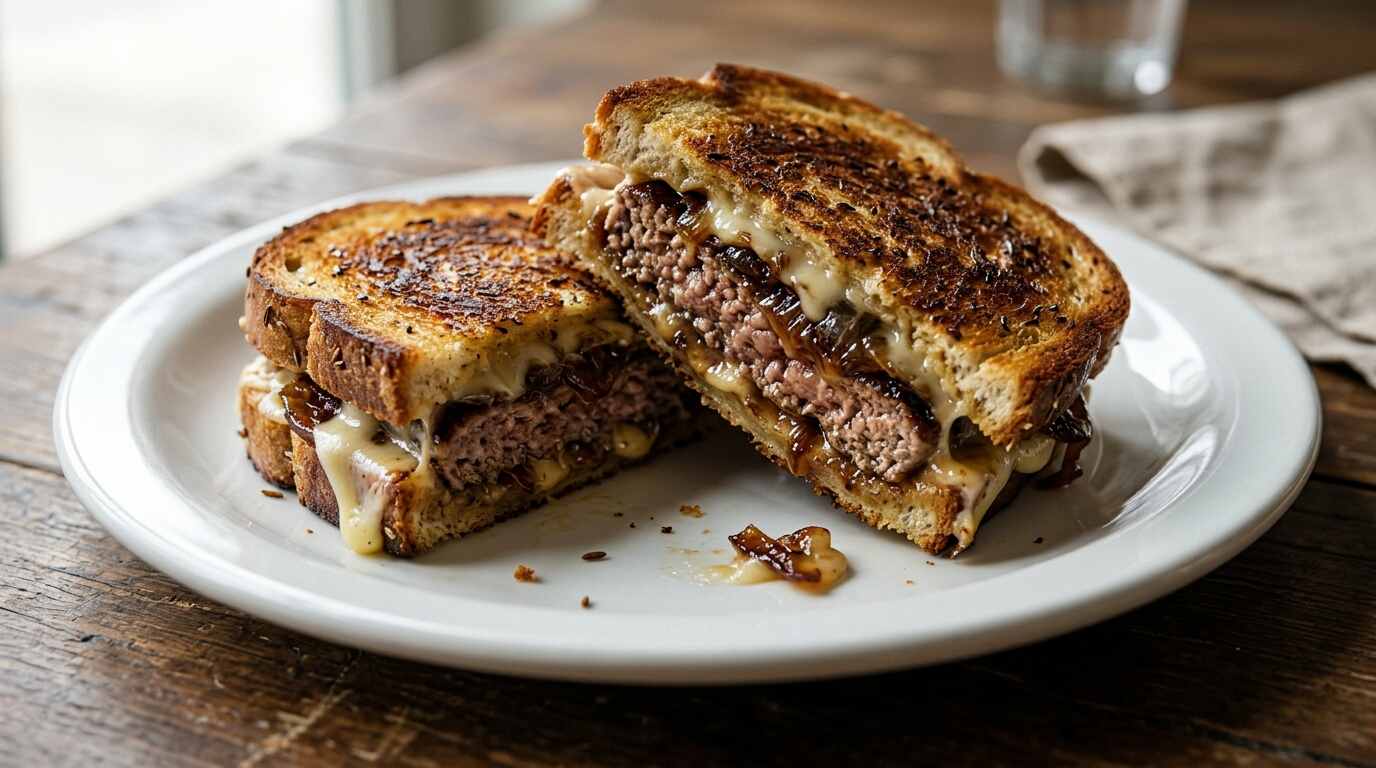
The patty melt shows how a menu name can end an argument that the dictionaries leave open. The NIBBLE, a specialty-food publication, describes it as “a fusion of a burger with a grilled cheese sandwich,” served between two slices of griddled rye bread rather than a bun. Caramelized onions sit on top of the cheese. The page says it was possibly created in 1932 by Los Angeles restaurateur William “Tiny” Naylor, while noting that other sources place it in the 1940s or between 1930 and 1959.
The Daily Meal reports that patty melt historians usually credit Tiny Naylor, whose Los Angeles diner put it on the menu in the 1950s, and that he may have invented it earlier, during the Great Depression. That article quotes fans who hold that a proper patty melt uses Swiss cheese and griddled rye, though it adds that sourdough or cheddar still count. The dates conflict across the three sources, and the 1956 printed caption is the earliest document among them.
Delighted Cooking describes the patty melt differently: a pre-fried beef patty with cheddar or American cheese, sometimes onions or mayonnaise, usually on thick white or French bread rather than rye. The NIBBLE adds that Tiny Naylor’s son, Biff, helped popularize the sandwich across the family’s restaurants and later at Du-Par’s. Sources therefore disagree on the bread, the cheese and the date, and agree only on the name.
The patty melt is closed, griddled and built on cheese between bread, which is how most cooks describe a grilled cheese. It carries the “melt” name anyway. The category is set by what the kitchen calls it.
A shared base and a disputed second ingredient
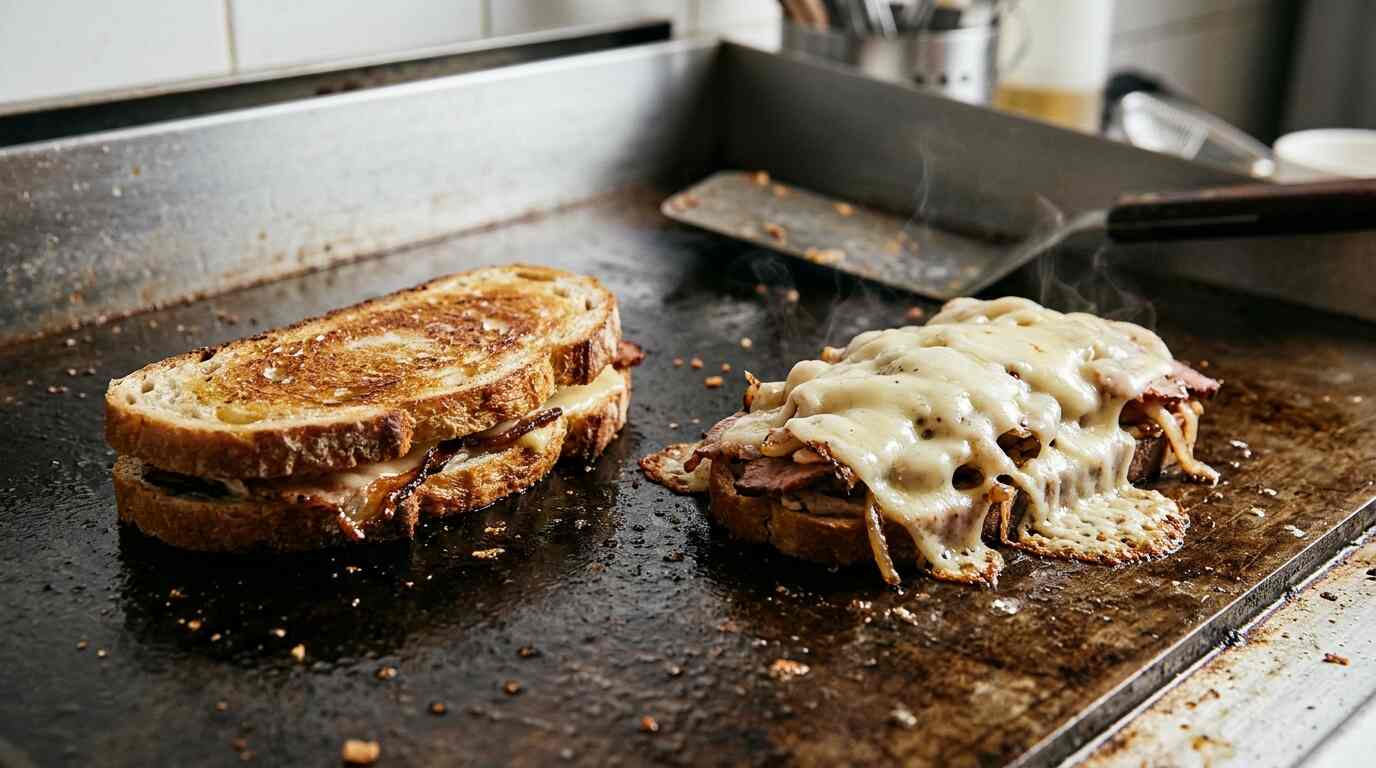
All of the sources fetched agree on a base: cheese, bread and a hot cooking surface. They disagree about what a second ingredient does. Merriam-Webster lets a grilled cheese carry bacon or tomato. The Cheese Scientist moves anything beyond cheese into melt territory, and Potato Rolls treats the grilled cheese as one kind of melt. On construction, Food52’s tuna melt can be open or closed, Delighted Cooking permits an open-faced grilled cheese, and the 1934 Washington Post example calls an open-face tomato-and-cheese sandwich “grilled.” The sources checked do not support a single rule, and the most accurate description is a spectrum with a plain, buttered cheese sandwich at one end and a meat-topped, broiled one at the other.
Sources:
- Merriam-Webster, “grilled cheese”: https://www.merriam-webster.com/dictionary/grilled%20cheese
- Merriam-Webster, “melt”: https://www.merriam-webster.com/dictionary/melt
- Potato Rolls (Martin’s), “Meltworthy Sandwich Recipes”: https://potatorolls.com/blog/meltworthy-sandwich-recipes/
- Delighted Cooking, “What Is a Melt Sandwich?”: https://www.delightedcooking.com/what-is-a-melt-sandwich.htm
- The Cheese Scientist, “Grilled Cheese Vs Melt: America’s Biggest Sandwich Debate”: https://cheesescientist.com/rants/grilled-cheese-vs-melt/
- Food52, “Is There a Right Way to Make a Tuna Melt?”: https://food52.com/blog/22848-is-there-a-right-way-to-make-a-tuna-melt
- Food Timeline, sandwiches: https://www.foodtimeline.org/foodsandwiches.html
- Barry Popik, “Melt (Tuna Melt; Patty Melt; Fatty Melt)”: https://barrypopik.com/blog/melt_tuna_melt_patty_melt
- Chowhound, “The Mysterious Origins Of The Tuna Melt”: https://www.chowhound.com/1700203/tuna-melt-origin/
- The NIBBLE, “It’s National Patty Melt Day: What’s a Patty Melt?”: https://blog.thenibble.com/2022/02/07/its-national-patty-melt-day-whats-a-patty-melt/
- The Daily Meal, “What’s The Difference Between A Burger And A Patty Melt?”: https://www.thedailymeal.com/1439496/burger-patty-melt-difference-explained
- The Sixth League (YouTube), “Grilled Cheese vs Melt Cheese – AMAZING RANT!”: https://www.youtube.com/watch?v=6jDEmNluS6I