
In this story
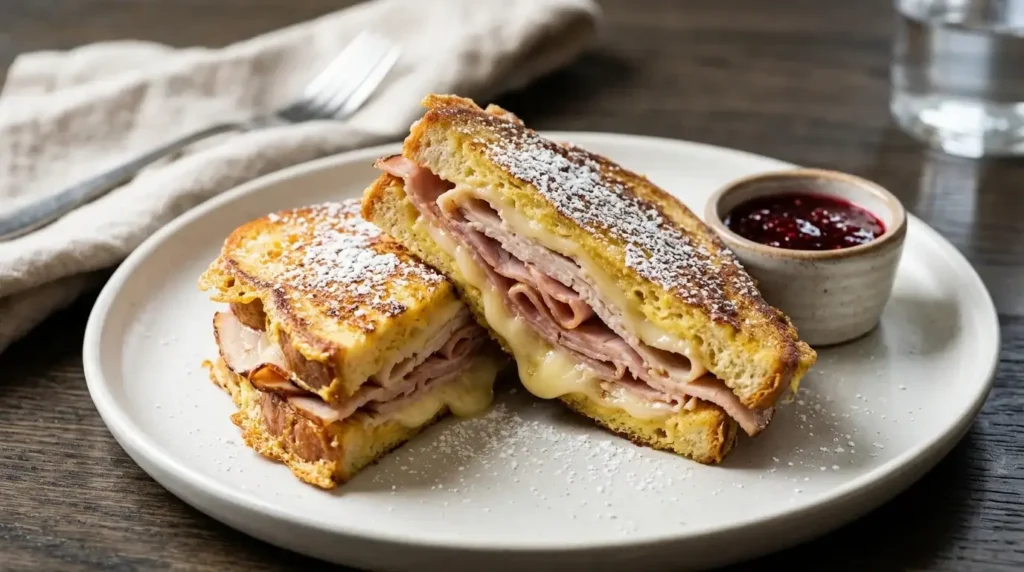
The Monte Cristo is a ham-and-cheese sandwich, usually with turkey or chicken added, that is dipped in egg or batter, fried until gold, dusted with powdered sugar and served with a pot of jam or jelly. Nobody has pinned down who first made one. The earliest printed trace is a 1923 listing in a trade journal, and the stories that put the invention in a particular hotel, city or restaurant kitchen rest on thin evidence or on none.
What the record does show is a sandwich that turned up in the American West in the 1920s, appeared in a 1949 Hollywood restaurant cookbook, and reached a mass audience when a Disneyland restaurant put it on the menu in the 1960s. Its resemblance to the French croque monsieur is obvious, but historians disagree about whether the two are actually related.
Video: How to Make a Monte Cristo, Allrecipes
The earliest print references
Researcher Barry Popik’s timeline of Monte Cristo citations begins with a January 1923 issue of The Caterer and Hotel Proprietors’ Gazette, where “Monte Cristo” appears in a list of sandwiches with a price beside it. That is a menu-style entry with no description, so it says the name existed but not what the sandwich contained.
A recipe follows in May 1924. A “Practical Recipes” column in the Los Angeles Daily Times, written by a chef named A. L. Wyman, describes a ham and cheese sandwich dipped in beaten egg and fried in butter (Popik). Food reference site CooksInfo also gives 1924 as the earliest known recipe and says it called for boiled ham and cheese.
More mentions pile up through the rest of the decade and into the next. A Fresno Bee advertisement listed Monte Cristo sandwiches in 1926. In August 1929 a reader’s recipe ran in the Los Angeles Times, and the same month the Indianapolis Sunday Star described a version of ham, cheese and chicken fried in butter. A Portland, Oregon, restaurant called the Annex listed a baked ham and Swiss Monte Cristo, French-toasted in butter, in a 1936 trade magazine, and a 1937 San Antonio newspaper column reported a postcard praising the sandwich at the Brown Derby in Hollywood (all per Popik).
CooksInfo notes that many of the early citations come from western states, including Washington, Oregon, California, Nevada and Utah, with references from Ohio, Texas, Illinois and West Virginia showing up later (CooksInfo).
Competing origin stories
No source reviewed here names an inventor. Several places and people have been proposed, and each proposal has a problem.
A hotel in Everett, Washington. The Monte Cristo Hotel in Everett served the sandwich, and some accounts credit it with the invention. Popik points out that the hotel was built in 1925, after the 1923 citation, and sees no reason to assume the sandwich started there (Popik). CooksInfo reaches the same conclusion: the sandwich probably predates the building (CooksInfo).
Southern California. Linda Stradley’s history at What’s Cooking America says no documents support the belief that the sandwich was first served in southern California in the 1950s, a date the 1923 and 1924 citations already contradict (What’s Cooking America). Los Angeles does hold the earliest recipe, though, and Popik says the name may have started there.
San Francisco. A 1964 Los Angeles Times item described the sandwich as “said to have originated in San Francisco”. Saveur adds that Helen Evans Brown’s West Coast Cook Book of 1952 also points to San Francisco (Saveur).
An Italian parent. The same Saveur article mentions a theory that the sandwich descends from the Neapolitan mozzarella in carrozza, a breaded or battered fried cheese sandwich, and that a foreign ear could have bent the name into “Monte Cristo” (Saveur). The article presents it as one idea among several, not as a documented line of descent.
The name. Popik thinks a 1922 film titled Monte Cristo probably inspired the name (Popik). Saveur says the sandwich has no link to Alexandre Dumas’s 1845 novel, the Italian island of Montecristo or a Bolivian town of the same name (Saveur), and Chowhound likewise finds very little evidence tying the name to Dumas or to the Washington ghost town of Monte Cristo (Chowhound).
The croque monsieur connection
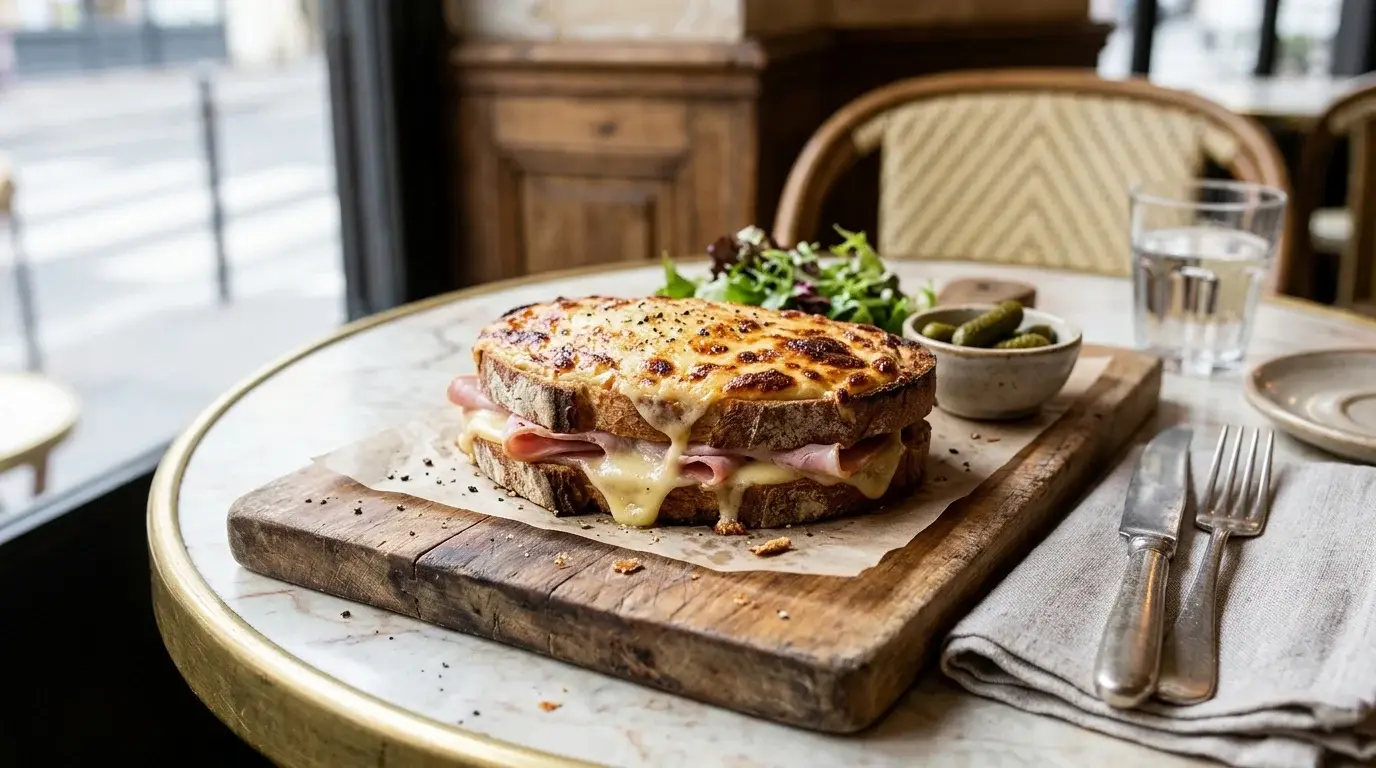
Many food writers treat the Monte Cristo as an American take on the croque monsieur. Chowhound says it “almost certainly” traces back to the French sandwich, which it describes as ham and Gruyère with béchamel that appeared in Parisian cafés around 1910, with the Monte Cristo adding the egg dip and often turkey (Chowhound). Another writer calls the Monte Cristo the diner version of the croque monsieur, with the egg-batter fry replacing the béchamel-and-broil finish (Sandwich Tribunal).
The French record is itself patchy. Popik’s page on the croque monsieur notes that the 1910 Paris café menu is reported secondhand, that the Larousse Gastronomique places the first one at a café on the Boulevard des Capucines, and that the Oxford English Dictionary dates the term in French to 1918, the year of Proust’s volume À la recherche du temps perdu that uses it. The earliest recipe on that page is in The Belgian Cook Book of 1915: rounds of bread sprinkled with grated cheese, topped with ham and fried in butter (Popik).
Not everyone accepts the link. CooksInfo rejects the croque monsieur as a precursor because its earliest American citation comes roughly twenty years after the Monte Cristo’s. It suggests instead the early-1930s American “French sandwich” and the Reuben as possible relatives (CooksInfo). Chowhound, for its part, says American cookbooks of the 1930s listed near-identical sandwiches under names such as “French sandwich” and “French toasted cheese sandwich” (Chowhound). Whether those were a bridge from Paris or a separate American invention is unresolved.
The Brown Derby recipe and Disneyland
The recipe most often quoted is from The Brown Derby Cookbook of 1949, from the Hollywood restaurant. America’s Test Kitchen calls it the earliest widely published recipe and describes the Derby’s sandwich as a triple-decker of roast chicken, ham and Swiss in a light egg custard, fried in butter in a skillet (America’s Test Kitchen). Another account of the original lists three slices of white bread with the crusts trimmed, the sandwich cut in two and held with toothpicks, and currant jelly, strawberry jam or cranberry sauce on the side (Sandwich Tribunal). Popik’s earlier citations show the Derby did not invent the sandwich, though it was clearly serving one by 1937.
Disneyland did the most to spread it. CooksInfo and Chowhound both report that the Blue Bayou and Tahitian Terrace restaurants in New Orleans Square added it in 1966 (CooksInfo, Chowhound). A news report on Disney’s release of its recipe says the sandwich was on the Blue Bayou’s original 1967 menu (KATC), and Disney’s own D23 site dates the restaurant’s opening to 1967 (D23). The sources differ by a year, and none of them explains why.
Chowhound is explicit that Disneyland was not the sandwich’s birthplace (Chowhound).
How it is made
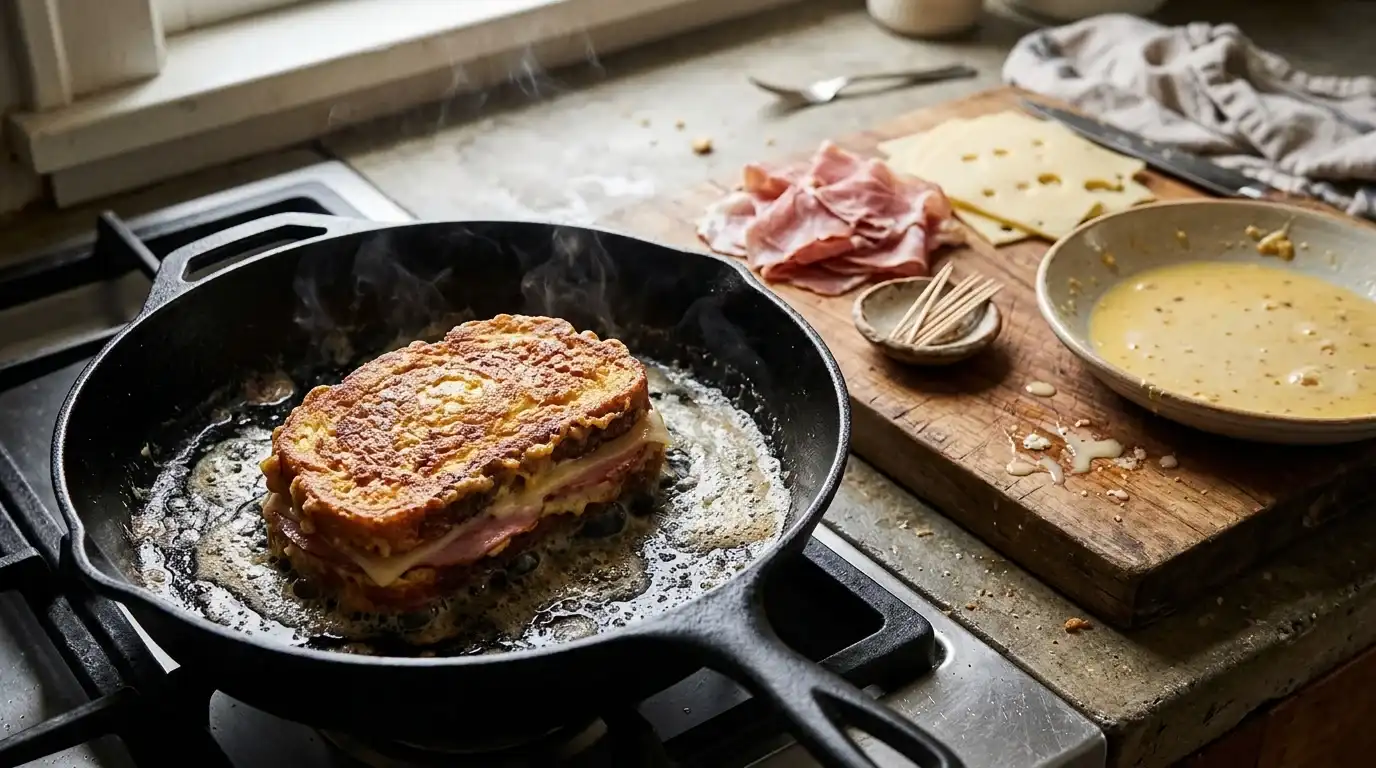
The structure is simple: two or three slices of bread, sliced ham, turkey or chicken, and Swiss cheese, assembled, held with toothpicks, coated and cooked. The differences lie in the coating and the heat.
Egg dip, pan-fried. The older method is a dip in beaten egg, sometimes thinned with milk, followed by frying in butter (CooksInfo). A recipe adapted from the Brown Derby book beats two eggs with a quarter cup of milk, butters the bread, trims the crusts and fries each cut half about two minutes per side in butter (Food.com).
Batter, fried in oil. The Disneyland style uses a thick flour batter. A published copy of the park’s recipe calls for flour, baking powder, salt, water and one beaten egg, with the sandwich cut into quarters, held with toothpicks and fried in 360°F oil until golden (The Slow Roasted Italian). Other deep-fried versions use beer or pancake batter (Wikipedia), cited here only as a pointer with no better source found.
Baked or oven-finished. A home recipe from Tastes Better From Scratch offers a baked alternative: battered sandwiches go on a greased, lined sheet at 400°F for 10 to 15 minutes, then flipped. The same recipe’s skillet route uses medium heat for about three minutes a side (Tastes Better From Scratch). America’s Test Kitchen browns turkey sandwiches in a skillet, two at a time, and finishes them on a wire rack in a 350°F oven so the bottom bread does not steam (America’s Test Kitchen). An open-faced variant dips only the bread and heats the assembled sandwich briefly under a broiler (Wikipedia).
The finish. Powdered sugar is the usual topping, and jelly or jam arrives on the side. Saveur notes that the sandwich takes a knife and fork (Saveur).
Regional and restaurant variations
Variations track the restaurants that made the sandwich their own.
- Canter’s Deli, Los Angeles: turkey, ham and Swiss dipped in egg and grilled on egg bread, served with powdered sugar and jam, often with fruit cocktail. Esquire named it one of the best sandwiches in America in 2008 (CooksInfo).
- Blue Bayou, Disneyland: turkey, ham and Swiss in quarters, deep-fried in egg batter, with powdered sugar, blackberry jelly and a coconut fruit compote (CooksInfo).
- Huntington Hotel, Pasadena: a two-layer version served from the 1940s to the 1970s with cranberry sauce or red currant jelly (CooksInfo).
- Beachland Ballroom, Cleveland: a “Trailer Park Monte Cristo” made from a peanut butter and jam sandwich dipped in pancake batter, deep-fried and dusted with powdered sugar (CooksInfo).
- Bennigan’s: a battered, deep-fried version with red raspberry preserves for dipping (America’s Test Kitchen).
Sonoma County restaurants have reworked it as well. Sonoma Magazine describes a Graton café using challah, black forest ham and a batter that includes vanilla ice cream, without deep-frying, and a Santa Rosa restaurant that builds a “Monti Cristo” on brioche with Westphalian ham, Gruyère and sweet onion jam (Sonoma Magazine). The same article says the sandwich was a diner staple in the 1960s and early 1970s before health-food trends pushed it aside; Saveur places its near-disappearance in the fat-conscious 1980s (Saveur).
The oldest question remains open: the 1923 citation sits two years before the Everett hotel was built and a year after the film, and no document ties it to any single kitchen.
Sources:
- Barry Popik, Monte Cristo (sandwich): https://barrypopik.com/blog/monte_cristo_sandwich
- Barry Popik, Croque Monsieur (Croque Madame): https://barrypopik.com/blog/croque_monsieur_croque_madame
- CooksInfo, Monte Cristo Sandwiches: https://www.cooksinfo.com/monte-cristo-sandwiches
- Chowhound, The Shaky Origin Story Of The Monte Cristo Sandwich: https://www.chowhound.com/1673424/sandwich-monte-cristo-history/
- What’s Cooking America, Monte Cristo Sandwich History: https://whatscookingamerica.net/history/sandwiches/montecristosandwich.htm
- Saveur, Fried Nirvana?: https://saveur.com/article/Kitchen/Fried-Nirvana
- America’s Test Kitchen, The Monte Cristo Sandwich Is a Study in Sweet-Savory Perfection: https://www.americastestkitchen.com/articles/8387-the-monte-cristo-sandwich-is-a-study-in-sweet-savory-perfection
- Sandwich Tribunal, The Monte Cristo Sandwich: https://sandwichtribunal.com/2017/09/the-monte-cristo-sandwich
- Food.com, Original 1949 Brown Derby Cookbook Monte Cristo Sandwich: https://www.food.com/recipe/original-1949-brown-derby-cookbook-monte-cristo-sandwich-413948
- D23, Blue Bayou Restaurant Opens at Disneyland: https://d23.com/?p=784
- KATC, Disney released official Monte Cristo recipe: https://www.katc.com/disney-released-official-monte-cristo-recipe/
- The Slow Roasted Italian, Monte Cristo Sandwich Recipe (Disneyland Official): https://www.theslowroasteditalian.com/monte-cristo
- Tastes Better From Scratch, Monte Cristo Sandwich: https://tastesbetterfromscratch.com/monte-cristo-sandwich/
- Sonoma Magazine, The Return of Monte Cristo: https://www.sonomamag.com/the-return-of-monte-cristo/
- Wikipedia, Monte Cristo sandwich (pointer only): https://en.wikipedia.org/wiki/Monte_Cristo_sandwich