In this story
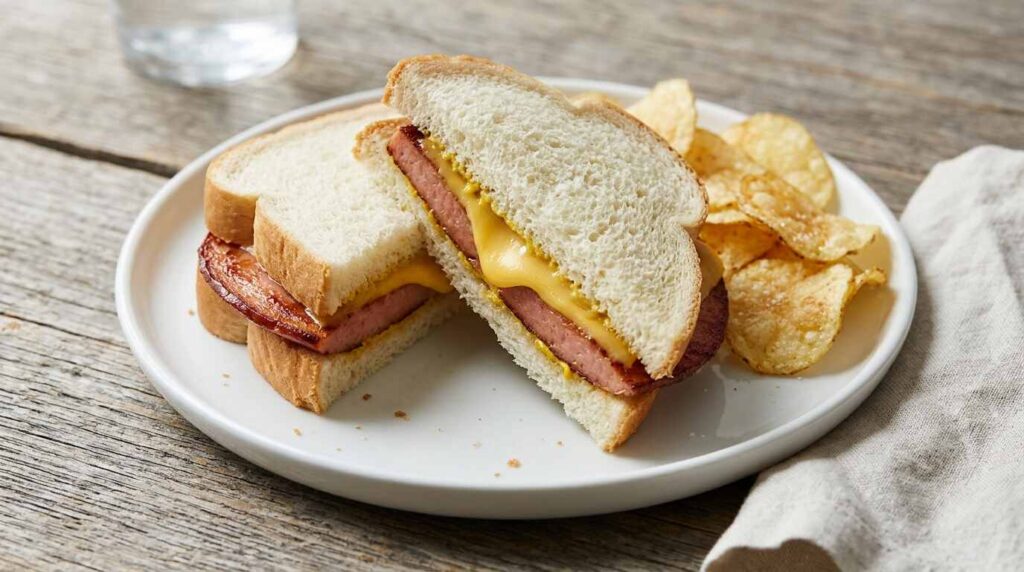
A fried bologna sandwich is a slice of cooked, finely ground sausage browned in a skillet or on a griddle and set between two pieces of bread, usually with cheese, mustard or mayonnaise. Wikipedia, used here only as a pointer to its cited sources, lists the bologna sandwich as a regional specialty of the Eastern, Midwestern, Appalachian and Southern United States, and the fried version turns up in sources from all four. Its family tree runs back through German butchers to a pork sausage made in Bologna, Italy, which differs in several ways from the product in an American supermarket.
Video: Betty’s Southern Fried Bologna Sandwich — from the Betty’s Kitchen YouTube channel
The Italian Ancestor: Mortadella
A mortar-ground pork sausage with cubes of fat, protected by law as a product of Bologna
The sausage that gave bologna its name is mortadella. The consortium that promotes it traces the product to the lands of ancient Felsina and Bononia and reports that the earliest evidence is a Roman-era stele in Bologna’s Archaeological Museum, one side showing seven piglets and the other a mortar and pestle. The name may come from the Latin mortarium or murtatum, meaning meat finely minced in a mortar; an alternative theory ties it to myrtle. The consortium’s page also records that on 24 October 1661 Cardinal Farnese officially set out the rules for preparing mortadella, a date now celebrated as International Mortadella Day.
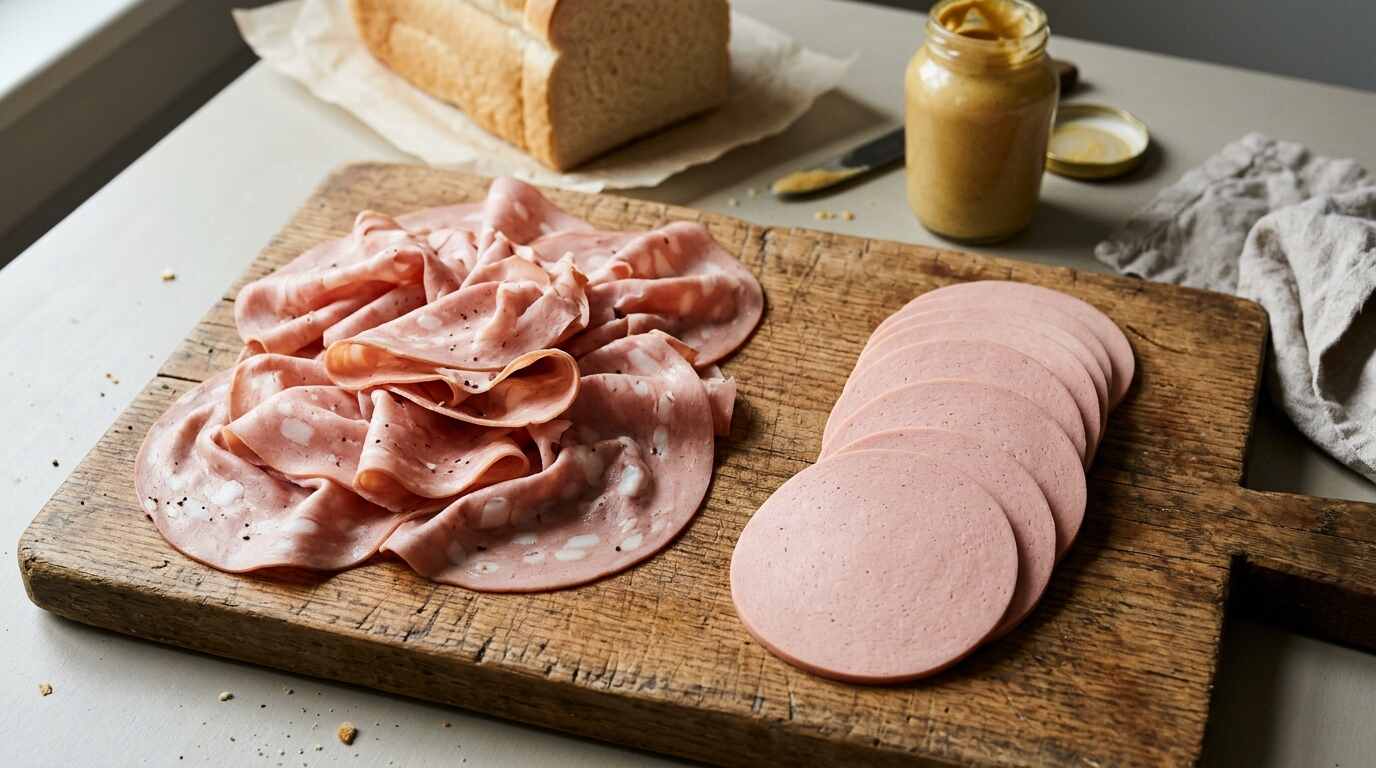
Italy’s national tourism site credits a recipe to Cristoforo di Messisbugo, a maître d’ for Cardinal Ippolito d’Este. The finished sausage is made from pork ground to a fine paste, mixed with cubes of fat from the pig’s throat, packed into a casing, cooked in hot, dry-air ovens and cooled quickly. Fat makes up 15 to 28 percent of the product, and it is not smoked. Under European law, mortadella Bologna holds a Protected Geographical Indication.
How Bologna Reached American Kitchens
German butchers, Italian immigrants and a US government definition turned a protected sausage into a generic one
The path from Bologna to the American deli counter is described as likely rather than documented. Chowhound calls American bologna “essentially a descendent of mortadella” and says it is thought that German immigrants brought it to the United States in the nineteenth century. Tasting Table credits German and Italian immigrants of the late nineteenth and early twentieth centuries, and adds that German butchers in Pennsylvania used mixed meats such as chicken, beef and turkey alongside pork. The same piece says fried bologna sandwiches “likely came from German immigrants,” offered as a probable explanation and not a confirmed one.
Chowhound reports that “Bologna became the unofficial name for similar fine-chopped sausages” that could not legally be called mortadella. In the United States, according to the same article, the USDA classifies bologna as a cooked and/or smoked sausage with a uniform paste and no visible fat, which makes it a different product from the original. A 1971 Italian film, La Mortadella, built a comedy on that gap, with Sophia Loren playing a character who tries to smuggle mortadella into the US, according to Tasting Table.
The English word “baloney” is an Americanism. Chowhound dates it to the mid-1800s, with its sense of nonsense attached in the 1920s. A 2018 Oak Park column by David Hammond argues that the dictionary meaning (“falsehoods, nonsense, or foolishness”) unfairly colors a food that dates back at least to the fifteenth century and is inexpensive, which he suggests feeds its low-class image.
Oscar Mayer and the Packaged Slice
The brand best known for yellow-banded packages entered the story through sliced lunch meat
Oscar F. Mayer and his brother Gottfried, German immigrants, started a small sausage business on Chicago’s North Side in 1883, according to the Encyclopedia of Chicago. A corporate history on FundingUniverse places the origin at a Chicago meat shop selling old-world sausages and traditional cuts, with incorporation in 1911 and the name Oscar Mayer & Co. from 1919. It records the Slice-Pak line of lunch meats in vacuum-sealed plastic packages in 1948. That history does not mention bologna by name.
The dating of the company’s first sliced, packaged bologna differs between sources. Tasting Table says Oscar Mayer introduced pre-sliced, packaged bologna in the 1920s; the FundingUniverse history puts sliced bacon at 1924 and Slice-Pak lunch meats at 1948. The two accounts have not been reconciled by anything found here.
Chowhound adds that bologna rose as a sandwich staple through the Great Depression, the popularity of sandwiches in the 1920s and “the proliferation of the deli meat slicer,” and that by the mid-1960s school lunch programs were serving it. A former Oscar Mayer marketing vice president, Jerry Ringlien, is quoted there saying the company sold as much bologna as hot dogs a few years after school lunch adoption. The company’s 1970s advertising, in Chowhound’s retelling, had a child singing the product’s name.
The Southern and Appalachian Skillet
Cheap, thick-sliced and fried in butter, the sandwich became a fixture of Southern family kitchens
Tasting Table calls the fried bologna sandwich “an inherently Southern creation” and reports it is widely believed bologna arrived with German immigrants who settled in the Midwest, Pennsylvania and the Appalachian states. Southern children, the piece says, often ate their bologna hot, from school cafeterias and roadside diners, rather than cold from a lunchbox. The standard build is soft white bread, one or two slices of packaged bologna, a slice of cheese and mustard, with mayonnaise and ketchup optional; the bologna is browned in butter and the cheese melts under a lid from the residual heat.
The home-cooking version is documented in detail on the blog Southern Plate, the author describes loaf bread, cheese slices, mayonnaise and potato chips pressed into the sandwich, bologna from Zeigler in Alabama, and a mother who fried bologna for lunch while the children built their own sandwiches. She calls bologna “the poor man’s steak.” Garden & Gun’s recipe for Puckett’s Smoked Bologna Sandwich records the same phrase from restaurateur Andy Marshall, who grew up eating fried bologna; his father, he says, called it “a poor man’s steak” and scored the edges to prevent buckling.
Local names and habits vary. Wikipedia’s pointer list records fried bologna at small family markets around the Great Smoky Mountains, a Knoxville nickname, the “Lonsdale ham” sandwich, and a Pittsburgh version called the “jumbo.” Cheddar and American are the most common cheeses on the Southern sandwich in Tasting Table’s account, and its garnishes include lettuce, tomato, pickles, potato chips and chow-chow relish. For the cheese that so often melts under the lid, the American cheese post covers its history.
Midwestern Griddles and Ohio Taverns
In the Chicago suburbs and Ohio, the slice gets thicker and the bread changes
In the Chicago area, Hammond’s Oak Park column describes Siciliano’s Fried Bologna stand at the Taste of Melrose Park, where the sandwich is griddled bologna and onions with mustard on white bread. Don Nielson, whose family runs the stand, recommends the cheapest bologna available and says the family once tried a higher grade, and “nobody liked it.” Hammond suggests cheaper bologna has more fat, which crisps better.
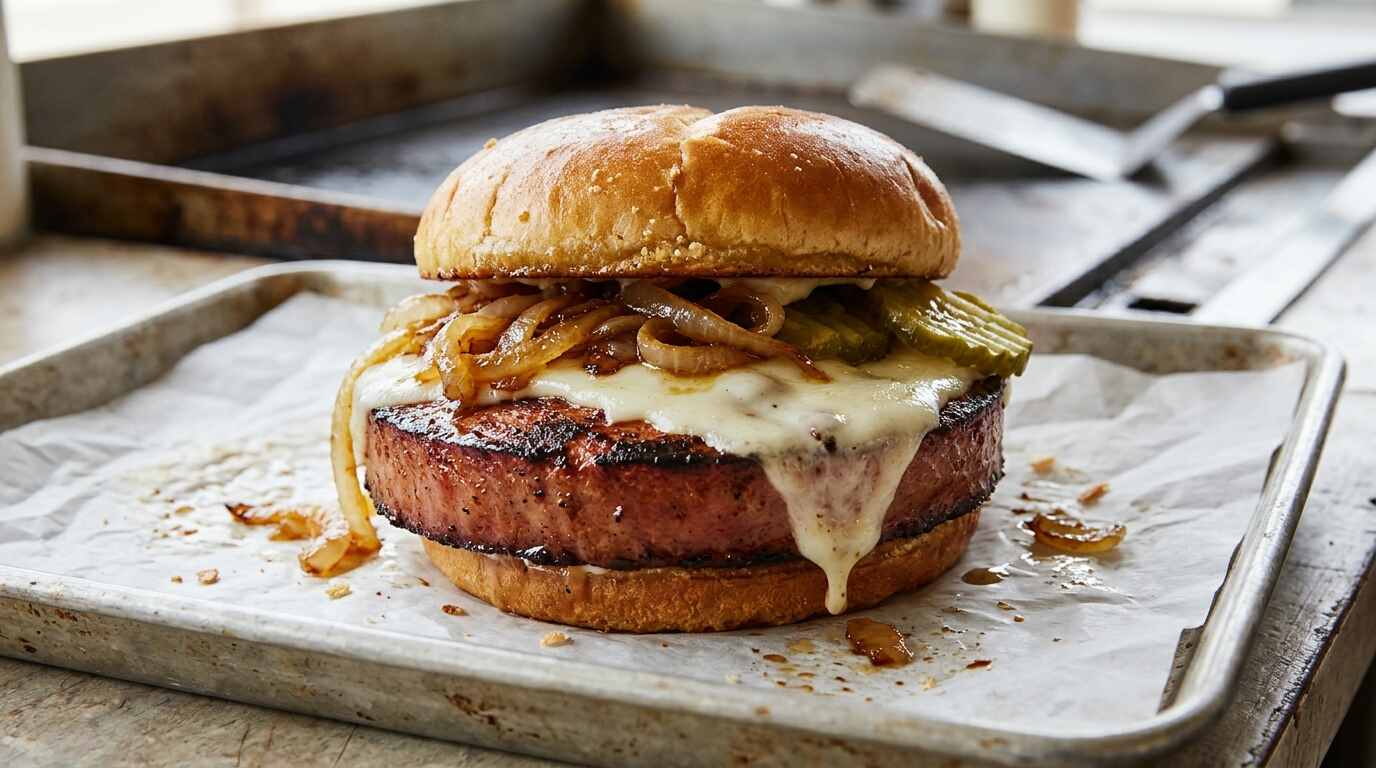
Ohio has its own landmarks. A 2003 CBS News report puts the center of the sandwich’s fame at G&R Tavern in Waldo, where the bologna is sliced as thick as a hamburger patty, cut from logs made especially for the tavern, and fried on a grill until crispy on both sides, with jack cheese, pickles and onions as standard toppings. Co-owner Mary Blevins says “What makes it good is from the heat of the grill.” Another Ohio version, per Amish America, was named the state’s best sandwich by Food & Wine: hot bologna and Swiss on a bun at Troyer’s General Store in the Holmes County hamlet of Trail. A variant served at the same store pairs bologna with peanut butter and pickles. Wikipedia’s pointer list also records the fried version at Cincinnati Reds concession stands.
Notching the Slice So It Lies Flat
Slices that curl or bubble in a hot pan are the problem; cuts at the edge or center are the fix
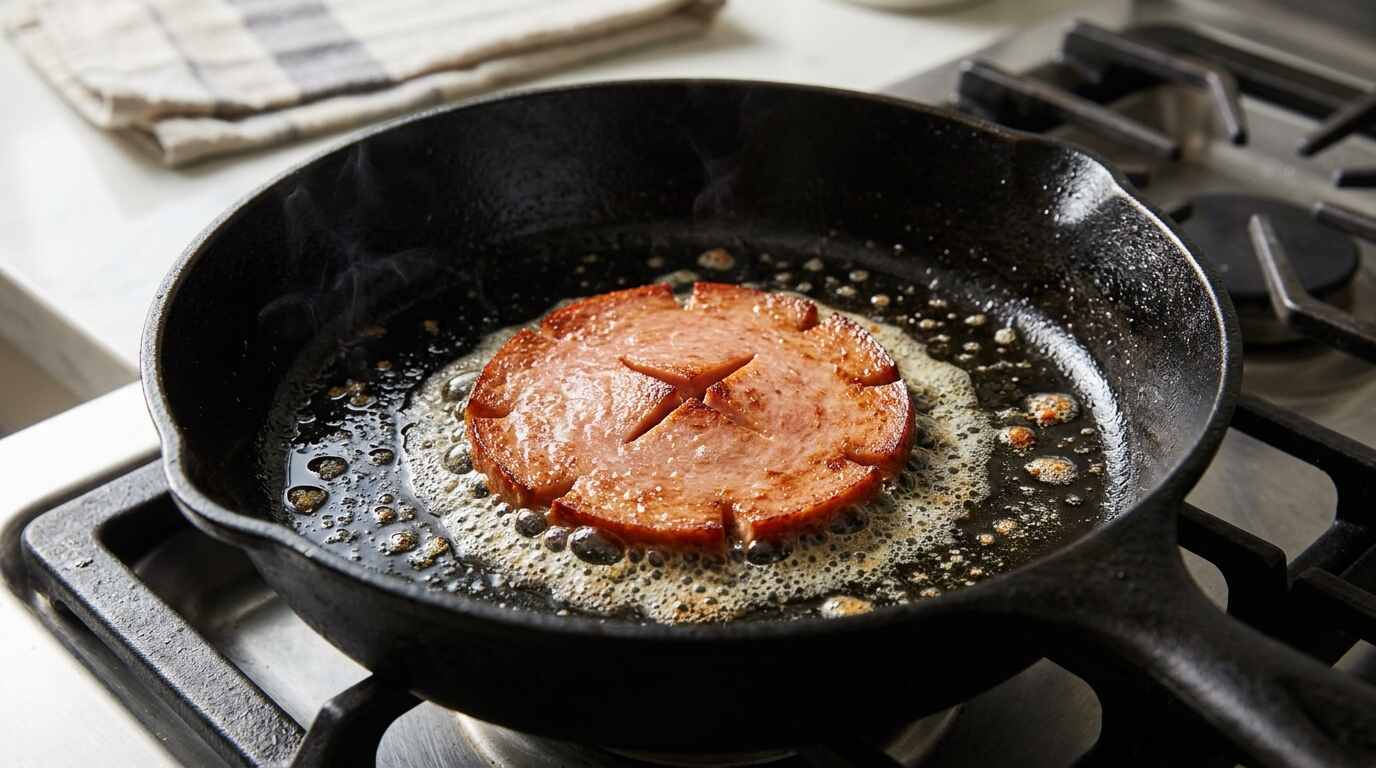
The cut that keeps a slice flat is documented independently by several sources, with the details varying. In the Oak Park column, Nielson advised notching each slice so it lies flat on the griddle instead of bubbling up. In Tasting Table’s recipe, the cook carves a one-inch “x” in the middle of each slice to keep the meat from curling. Southern Plate cuts a slit halfway through. Puckett’s Marshall describes his father scoring the edges, and Garden & Gun’s recipe applies the principle to a whole log, scoring it three times lengthwise to keep it from bursting.
The Daily Meal, in a July 2024 piece by DB Kelly, describes about four cuts around the edge plus a cross in the center so the slice expands without curling, and notes that thicker, butcher-sliced bologna curls less. The Takeout says to score the surface or snip the edges so the meat “won’t curl up in the pan,” and attributes the browning to the Maillard reaction. Southern Plate’s account has the bologna fried in a dry pan over medium heat, while Tasting Table and The Takeout use butter. Another griddled processed meat gets its own treatment in the pork roll vs. Taylor ham post.
Other Bologna Sandwiches
Smoked, pressed, chopped and chicken-fried, the same sausage keeps turning up in new forms
The Takeout lists a run of variations: chicken-fried bologna cut about a quarter inch thick, bologna salad (a Midwestern and Southern staple, per the piece, with chopped bologna, hard-boiled eggs, relish and mayonnaise), a pressed version with butter and American cheese on a kaiser roll in the style of chef David Chang, and an egg-and-cheese build. Alton Brown’s version, in the same list, alternates hot and cold slices. The egg-and-cheese format is shared with the bacon, egg and cheese sandwich.
Oklahoma treats bologna as barbecue. A Saveur report says smoked bologna is a signature of Oklahoma barbecue, sometimes called “Oklahoma tenderloin,” and that no one interviewed could pinpoint its origin. Keith Jimerson of Elmer’s BBQ calls it “poor people food.” One speculation, offered as a guess, links the tradition to German communities in Texas and Austrian-style leberkäse.
The condiment question has its own recorded split: Marshall’s father preferred Miracle Whip with a summer tomato, and Marshall mustard and pickles, a split taken up in the mayonnaise vs. Miracle Whip post.
Sources
- Wikipedia, “Bologna sandwich” (used as a pointer for regional variants; it cites Cincinnati Enquirer, Knoxville News Sentinel and Saveur): https://en.wikipedia.org/wiki/Bologna_sandwich
- Mortadella Bologna consortium, history page: https://mortadellabologna.com/en/?p=6108
- Italia.it, “Mortadella Bologna”: https://www.italia.it/en/emilia-romagna/bologna/things-to-do/mortadella-bologna
- Chowhound, “How Bologna Sandwiches Became A Lunch Time Staple”: https://chowhound.com/1749252/bologna-sandwich-lunch-history
- Tasting Table, “12 Facts You Didn’t Know About Bologna”: https://www.tastingtable.com/1795855/facts-didnt-know-bologna/
- Tasting Table, “The Fried Bologna Sandwich Is A Southern Classic”: https://www.tastingtable.com/1216676/the-fried-bologna-sandwich-is-a-southern-classic/
- Oak Park (David Hammond), “Give bologna a second chance”: https://www.oakpark.com/2018/10/17/give-bologna-a-second-chance-2/
- Encyclopedia of Chicago, Oscar Mayer entry: https://encyclopedia.chicagohistory.org/pages/2762.html
- FundingUniverse, “Oscar Mayer Foods Corp. History”: https://www.fundinguniverse.com/company-histories/oscar-mayer-foods-corp-history/
- Southern Plate, “Fried Bologna & Other Southern Sandwiches”: https://www.southernplate.com/fried-bologna-other-southern-sandwiches/comment-page-10/
- Garden & Gun, “The Ultimate Fried Bologna Sandwich” (Puckett’s): https://gardenandgun.com/recipe/the-ultimate-fried-bologna-sandwich
- CBS News, “Roadside’s Fried Bologna”: https://www.cbsnews.com/news/roadsides-fried-bologna
- Amish America, “Ohio’s Best Sandwich Comes From Holmes County Amish Country”: https://amishamerica.com/ohios-best-sandwich-comes-from-holmes-county-amish-country/
- Saveur, “Why Smoked Bologna Is the Secret Star of Oklahoma Barbecue”: https://www.saveur.com/smoked-bologna-oklahoma-bbq/
- The Daily Meal, “The Super Simple Tip For Better Fried Bologna”: https://www.thedailymeal.com/1613314/fry-bologna-cut-slit-tip/
- The Takeout, “14 Ways To Upgrade Your Bologna Sandwich”: https://www.thetakeout.com/1813246/best-ways-upgrade-bologna-sandwich/
Keep reading
- Filet-O-Fish History: Lou Groen, Lent and the Hula Burger
- Dagwood Sandwich: How a Comic Strip Snack Became a Dictionary Word
- Egg Salad Sandwich: Origins, the Mayonnaise Question and Food Safety
More in this section: Sandwich History guide.