In this story
A cheese toastie and a grilled cheese are both cheese melted between slices of bread, and the line between them is thinner than loyalists on either side of the Atlantic tend to admit. Food writers usually sort them by two things: where the butter goes and what supplies the heat. Food Republic describes a grilled cheese as buttered on the outside and a toastie as buttered on the inside.
Video: Grilled Cheese VS Cheese Toastie | British VS American, Evan Edinger
The names are less settled than the methods. A Pedestrian.tv piece from 2018 argued that every common label for the sandwich, from “toasted” to “grilled” to “jaffle,” fits imperfectly, and the same sandwich changes names again once it crosses into Australia, the Netherlands or the American Midwest.
Two names, one idea
“Grilled cheese” confuses people on both sides of the divide, because the sandwich is usually not cooked on a grill at all. Food Republic points out that it is normally shallow-fried in a skillet or cooked on a griddle in butter. In American usage “grill” means a surface for cooking over heat; in British usage it means an overhead element, and the Pedestrian.tv article notes that the same word works in Australia only when the sandwich is made under an oven’s grill.
“Toastie” is the British diminutive of toasted sandwich. It is not exclusively British, though. The radio programme A Way with Words took a call from a listener who grew up in Illinois calling a grilled cheese a “cheese toastie,” and the hosts said the term is used in Illinois, Indiana and Ohio, especially around Decatur and Springfield. They traced the earliest known American use for a grilled cheese to a 1909 recipe, and concluded that the American and British terms were coined independently, since the “-ie” ending is a common way of forming new words.
A newspaper column in Fort Wayne, Indiana turned up the same overlap. Readers who answered a columnist’s claim that a grilled cheese is not a toastie described families in the early 1950s making “toasties” from processed cheese heated between bread in a toaster, and one reader said the two terms had blurred over time.
The paper trail for the sandwich itself is also disputed. Tasting Table reports that the first recorded cheese toastie recipe appeared in an 1861 English cookbook and that some argue it inspired the American version, while many Britons name plain cheese on toast as the real original. The American side of that argument is laid out in the history of grilled cheese.
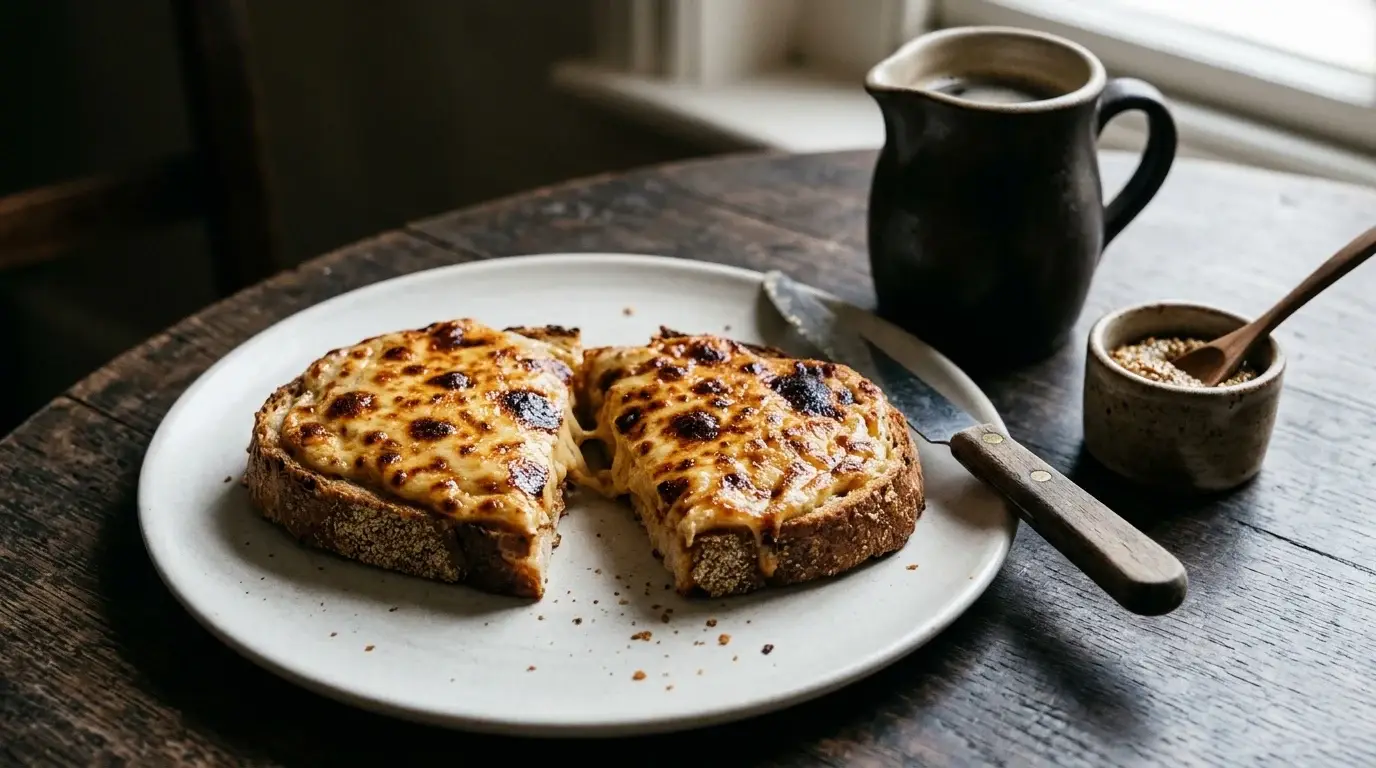
The two sandwiches side by side
The table follows the distinctions that Tasting Table, Chowhound and Food Republic draw. Each of those pieces describes a tendency, not a rule.
| Grilled cheese (American) | Cheese toastie (British) | |
|---|---|---|
| Butter | On the outside of each slice; mayonnaise also works | On the inside, where the filling sits |
| Bread after cooking | Fried until crisp and golden | Dry and airy, like toast |
| Usual heat | Skillet, griddle or frying pan | Sandwich toaster, oven or toaster basket |
| Typical cheese | Often processed American cheese | Sharp cheddar, or a milder Cheshire |
| Served with | Tomato soup or ketchup | A few drops of Worcestershire sauce |
| Cooking time | Short | Considerably longer |
Food writers also disagree about what the sandwich may contain. Food Republic notes that some people allow nothing but bread and cheese in a grilled cheese, while others add bacon, kimchi or peanut butter, and that a toastie can hold almost anything and is sometimes sweet.
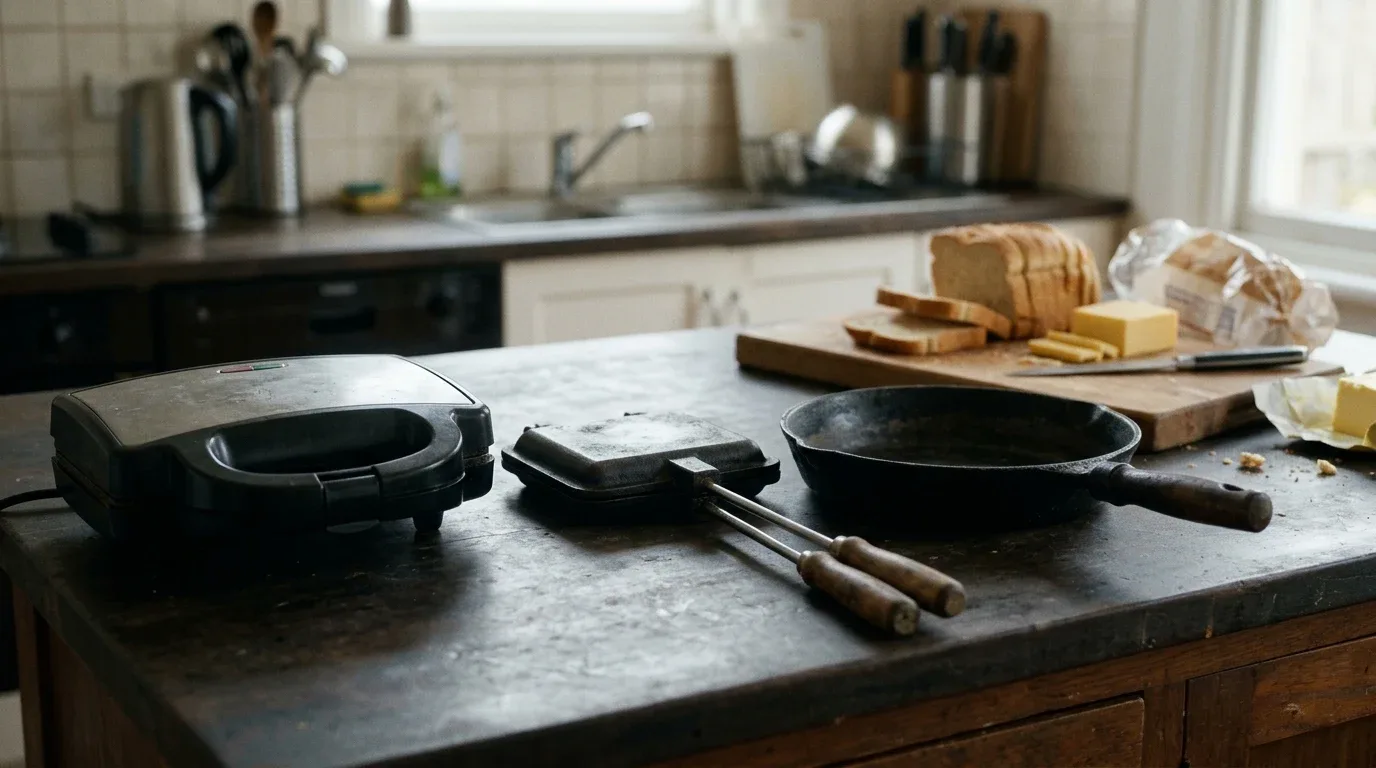
Pan, sandwich toaster or grill
The pan. Chowhound says a grilled cheese suits a skillet and gets flipped several times. A British recipe published by Tesco also uses a frying pan: the sandwich is buttered on the outside, covered with baking paper and a heavy weight, and cooked two to three minutes a side over low to medium heat. The pan, in other words, is not a strict dividing line.
The sandwich toaster. A toastie, in Chowhound’s account, fares better in a dedicated sandwich toaster that heats both sides at once. Machines of this kind close on the bread and press the edges together, which is the same sealing action the jaffle iron uses in Australia.
The grill. In Britain the overhead grill is associated with cheese on toast, an open-faced sandwich browned under the heat. Tasting Table says many Britons claim that open-faced sandwich as the original.
A food-industry guide from Erudus lists a toastie maker, a traditional toaster or a frying pan as all workable, and calls grilled cheese essentially the pan-fried version. Its practical advice is to seal the edges, leave a small gap between the filling and the crust so the cheese does not leak, and skip watery fillings such as tomato and cucumber, which make the sandwich soggy.
The sandwich toaster and the brand that gave it a name
Sealed, hinged toasting irons are older than the electric appliance. According to Wikipedia’s article on the sandwich toaster, a device called the Tostwich, applied for in May 1924 and patented in March 1925, may be the earliest toasted sandwich maker. The same article describes the basic design as two hinged, concave plates on long handles, in cast iron for the campfire or lighter aluminium for the stove, with the filling sealed by heat and pressure around the rim.
Australia developed its own line. The Nyngan Observer reports that a Bondi doctor, Ernest Smithers, designed, named and patented the Jaffle iron in June 1949, with the word “Jaffle” embossed on the cast-iron lid. The electric version came later. Qantas Travel Insider says Breville, founded in Sydney in 1932, launched its electric Snack ‘n’ Sandwich Toaster in 1974, reportedly selling 400,000 units in its first year and reaching about 10 per cent of Australian households. A scissor action added in 1976 cut each sandwich in half. The same article adds that in Sydney and the UK the toasted sandwiches are often simply called “brevilles.”
Popularity cooled and returned. The Qantas piece says the machine fell out of favour in the 1990s as focaccias and panini took over, then regained ground with retro appeal. The British side of the story is less tidy: Wikipedia cites a 2005 survey in which 45 percent of British adults owned a sandwich toaster but did not use it.
Which cheese goes in
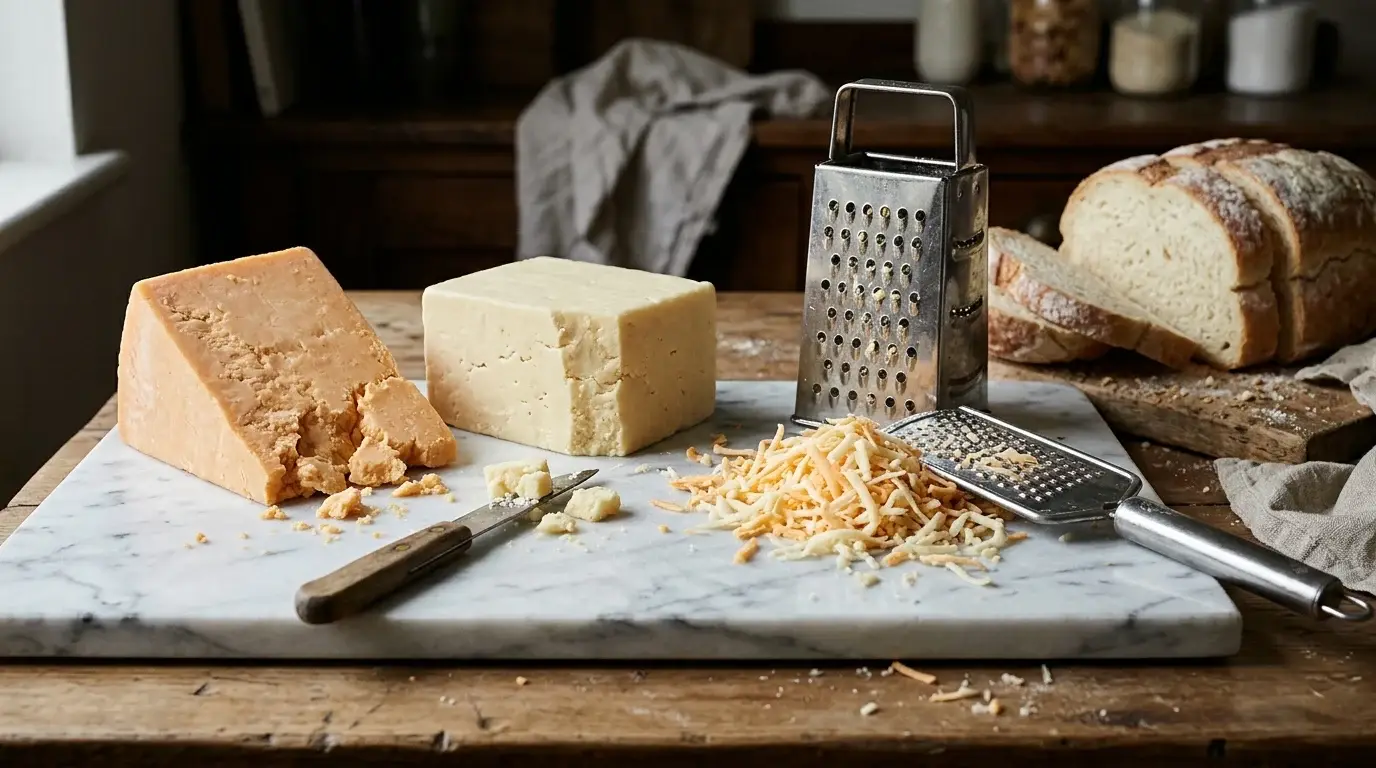
British writers lean toward cheddar. Erudus calls it the best cheese for a classic toastie because of its tang and good melt, with Gruyère and gouda as other options and a milder full-fat cheese such as mozzarella for toasties with other fillings. It also advises grating the cheese and letting it come to room temperature first.
Blends are common. A May 2026 piece in Crave Magazine names mature cheddar with Gruyère as its go-to pairing, the cheddar for sharpness and the Gruyère for a smooth, nutty melt. It also lists a Caerphilly and strong cheddar mix with Worcestershire sauce as a nod to Welsh rarebit. The Tesco recipe above combines mature cheddar, Red Leicester and mozzarella.
Red Leicester is the cheese that most obviously marks a sandwich as English. Wikipedia’s entry describes it as first made on Leicestershire farms, coloured orange with annatto since the 18th century, and similar to cheddar but more crumbly, with a mellow, slightly sweet, nutty flavour that gains tang after about six months. The source does not say how well it melts.
On the American side, Tasting Table says grilled cheese often calls for processed American cheese. Cheese choices for the pan-fried sandwich are covered in best cheese for grilled cheese.
Welsh rarebit and cheese on toast
Melted cheese on toast has a longer written history than either sandwich. Wikipedia’s Welsh rarebit article cites a 1542 line by Andrew Boorde, “I am a Welshman, I do love cause boby, good roasted cheese.” It dates “Welsh rabbit” to 1725 and “Welsh rarebit” to 1781, and describes a 1747 recipe by Hannah Glasse in which bread is toasted on both sides, cheese is toasted on one side and laid on the bread, and the top is browned with a hot iron.
Nobody knows why the dish carries its name. Snopes reports that the most common theory is an English jibe at the Welsh, who were either too poor for rabbit or too unsophisticated to know the difference, and that “rarebit” may have been adopted to remove the slur or to sound more exotic on menus. The Oxford English Dictionary, as Snopes cites it, puts “rabbit” first in print.
What separates rarebit from plain cheese on toast, according to Wikipedia, is the sauce, which may combine cheese with ale, mustard, Worcestershire sauce or a béchamel. The article also says there is no strong evidence that the dish began in Welsh cooking. A reader quoted in the Fort Wayne column above recalled an Irish immigrant grandmother who poured pan-melted cheese over plain toast, a version of Welsh rarebit in the reader’s words.
Jaffles, tostis and other toasted cousins
Australia. A jaffle is a toasted, sealed sandwich made in a jaffle iron. Wikipedia says the original 1949 iron sealed only the edges and did not cut the sandwich in half, leaving room for more filling or even a whole egg. After Breville’s 1974 toaster, most Australian electric jaffle makers split the sandwich. The same article notes that Australians sometimes use “Breville” for both the appliance and the sandwich. The Pedestrian.tv writer reserves “jaffle” for sandwiches made in a jaffle iron that seals the filling inside the bread.
The Netherlands. A tosti is a Dutch grilled ham and cheese sandwich. The Dutch Table says most Dutch homes own a tosti-ijzer, a small machine like a sandwich press, and that fillings run from young, mature or old cheese to Brie and Camembert, with pineapple on the Hawaii version. It also notes a frying pan works without the machine.
India. Wikipedia’s sandwich toaster article mentions that open-flame toasters make sandwiches often called “Bombay sandwiches” in Mumbai.
Elsewhere. The same article lists “pudgy pie iron,” “snackwicher,” “pie burner” and “panini grill” among names for the equipment, and says a similar utensil is sold in the United States under the trademark Toas-Tite. Whether the cheese sandwich itself began in a pan, under a grill or between hot plates is still argued.
Sources:
- Food Republic, “What’s The Difference Between A Grilled Cheese And An English Toastie?” https://www.foodrepublic.com/1673115/difference-between-grilled-cheese-english-toastie
- Chowhound, “Grilled Cheese Vs English Toastie: Is There A Difference?” https://www.chowhound.com/1687010/difference-grilled-cheese-vs-english-toastie
- Tasting Table, “The Subtle Difference Between A Grilled Cheese And English Toastie” https://www.tastingtable.com/1662247/distinction-grilled-cheese-vs-english-toastie
- Pedestrian.tv, “Nailing Down The Terminology Of The Type Of Cheese Sandwich That Is Toasted” https://www.pedestrian.tv/bites/toasted-grilled-sandwich-croque-monsieur-toastie-jaffle/
- A Way with Words, “Cheese Toastie for a Grilled Cheese Sandwich” https://waywordradio.org/cheese-toastie-grilled-cheese/
- The Journal Gazette, “Cheese toastie-vs.-grilled cheese debate rages” https://www.journalgazette.net/living/cheese-toastie-vs–grilled-cheese-debate-rages/article_e26991a8-3594-5b65-8799-794e1cd4c8b0.html
- Tesco, “The ultimate grilled cheese sandwich” https://www.tesco.com/recipes/en-GB/recipe/the-ultimate-grilled-cheese-sandwich
- Erudus, “Cheese toastie ideas and top tips” https://erudus.com/editorial/the-food-agenda/cheese-toastie-ideas-and-top-tips
- Wikipedia, “Sandwich toaster” https://en.wikipedia.org/wiki/Sandwich_toaster
- Wikipedia, “Jaffle” https://en.wikipedia.org/wiki/Jaffle
- Nyngan Observer, “Jaffle iron is not as old as you may think” https://www.nynganobserver.com.au/story/6517195/jaffle-iron-is-not-as-old-as-you-may-think/
- Qantas Travel Insider, “Why the Breville Jaffle Maker Is Still Resonating Today” https://qantas.com/travelinsider/en/lifestyle/style/breville-original-jaffle-maker.html
- Crave Magazine, “Best Cheese for Toasties” https://cravemag.co.uk/best-cheese-blends-for-toasties/
- Wikipedia, “Red Leicester” https://en.wikipedia.org/wiki/Red_Leicester
- Wikipedia, “Welsh rarebit” https://en.wikipedia.org/wiki/Welsh_rarebit
- Snopes, “What Are Welsh Rabbit and Welsh Rarebit?” https://www.snopes.com/fact-check/welsh-rabbit-and-welsh-rarebit/
- The Dutch Table, “Tosti Hawaii” https://www.thedutchtable.com/2013/03/tosti-hawaii.html
- Evan Edinger, “Grilled Cheese VS Cheese Toastie | British VS American” https://www.youtube.com/watch?v=RAUFCHBz2nM