In this story
Sauerkraut needs two ingredients and a few weeks. Shredded cabbage is mixed with salt and packed tight, the salt draws out the cabbage’s own juice, and bacteria already living on the leaves turn the sugars into acid. Nothing is cooked and nothing is added from a lab. The result keeps for months, which is why it rode in the holds of 18th-century ships, why American manufacturers panicked when the name became politically awkward in 1918, and why it still turns up on sandwiches built to cut through fat.
Video: What even is lacto-fermentation?, from the Adam Ragusea YouTube channel
What happens in the crock
One group of bacteria starts the fermentation; another finishes it
Sauerkraut is a relay. A U.S. Department of Agriculture research paper on commercial fermentations describes it as an initial heterofermentative stage followed by a homofermentative one. Leuconostoc mesenteroides starts the process and quickly dominates, producing acid and carbon dioxide. As acid builds and the environment turns hostile to it, more acid-tolerant Lactobacillus species take over. The paper puts the handoff at lactic acid of 1 percent or more and a pH below 4.5, and says Lactobacillus plantarum completes the fermentation at a final pH of about 3.5.
The order matters. The same USDA paper states that the correct sequence of species is essential for a stable product with the typical flavor and aroma of sauerkraut. Its researchers found the switch from the first group to the second happening between three and seven days after a fermentation began.
The cast is larger than older textbooks suggested. A 2007 study in Applied and Environmental Microbiology analyzed 686 bacterial isolates from four commercial fermentations over two years. Four species had traditionally been named as the sauerkraut organisms, but the researchers found the lactic acid bacteria present were more diverse than previously reported, including Leuconostoc citreum, Leuconostoc argentinum and a Weissella species. Two of the textbook four turned out to be rare. In their samples, L. plantarum became dominant after about seven days, once the pH dropped to 3.9 or lower, and led the fermentation by day 14.
Salt and temperature
The two controls a home fermenter actually has
Salt pulls water out of the shredded cabbage, and that juice becomes the brine the cabbage ferments in. The National Center for Home Food Preservation, based at the University of Georgia, calls for 3 tablespoons of canning or pickling salt per 5 pounds of cabbage, mixed by hand and packed until the juice is drawn out, then weighted under a plate so the cabbage stays submerged.
Temperature sets the pace. The center quotes the USDA recommendation to keep the crock at 70 to 75°F, where sauerkraut is fully fermented in about three to four weeks. At 60 to 65°F the process can take five to six weeks, and below 60°F it may not ferment at all. Warmer is not better. The center’s warning is plain: “Above 75ºF, kraut may become soft.”
Lower-salt sauerkraut is possible but riskier. A USDA study on reduced-salt fermentation found that adding a Leuconostoc mesenteroides starter culture produced firm texture and reduced off-flavors across all salt levels, while sauerkraut made without the starter varied widely in quality.

Older than the name
Romans salted cabbage, and China fermented it for Great Wall workers
The German word is recent compared with the practice. The medical humanities journal Hektoen International, in a 2021 history of fermented cabbage, notes that the Roman writers Cato, Columella and Pliny the Elder described salting cabbage and turnips to guard against intestinal complaints. The same article describes Chinese suan cai, cabbage fermented in rice wine, as a staple for workers on the Great Wall, and suggests that Mongol armies may have carried fermentation techniques west into central and Eastern Europe.
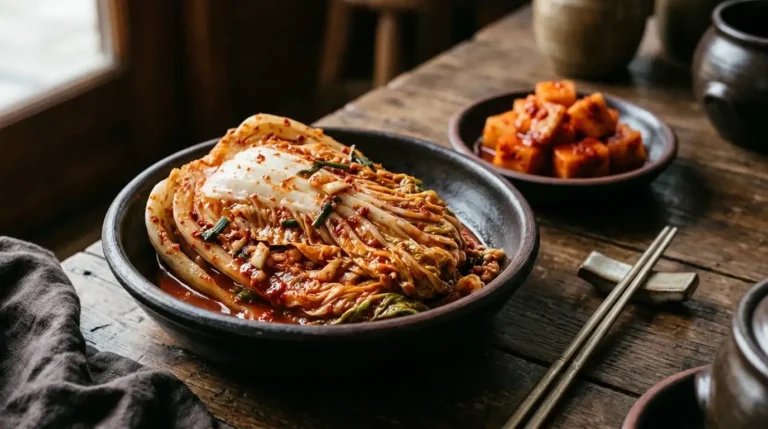
The names multiplied as the food spread. The Netherlands has zuurkool, popular along the North Sea coast. Russian kapusta mixes lacto-fermented cabbage with other vegetables and fruit. France calls it choucroute. Korea’s kimchi has been made with Chinese cabbage since the Koryeo Dynasty, according to the same history, though its seasonings take it somewhere else entirely.
Captain Cook’s secret weapon
Nearly four tons of “Sour Kroutt” on the Endeavour
Sauerkraut’s most famous voyage began in 1768. Hektoen International reports that Captain James Cook’s Endeavour carried 7,860 pounds of what the ship’s records called “Sour Kroutt,” enough to give each crew member two pounds a week. Scurvy, caused by a lack of vitamin C, routinely devastated long-distance crews at the time. The science was still unsettled. The Scottish naval surgeon James Lind had run what Hektoen calls the first controlled therapeutic trial for scurvy aboard HMS Salisbury in 1747, and published his Treatise of the Scurvy in 1753, but navies were still testing remedies by trial and error when Cook sailed.
Cook’s sailors did not want it at first. According to the same account, Cook had sauerkraut served daily at the officers’ table, and once the crew saw their superiors eating it, they accepted it too. On his return, Cook told the Navy’s Victualling Board that no dangerous cases of scurvy had occurred, and he wrote that sauerkraut “can never be enough recommended.”
The record was not spotless. Sauerkraut was one of several antiscorbutics on board, alongside malt, portable broth, vinegar and mustard, and the Australian National Maritime Museum notes that while Cook claimed he lost no one to scurvy on the three-year voyage, almost a third of the 94 men and boys aboard died, mostly of dysentery and malaria. Hektoen’s history lists three deaths on the first voyage that may have involved scurvy.

When sauerkraut became liberty cabbage
A wartime rebrand that lasted about as long as the war
In 1918 the word itself became a problem in the United States. The University of Wisconsin’s Max Kade Institute, in an essay on German-American language, reports that New York sauerkraut manufacturers asked their local Federal Food Board to approve the name “liberty cabbage” after demand collapsed following America’s entry into World War I. The manufacturers said they were losing money selling it at $13 and $14 a barrel.
The idea followed a pattern. According to the same essay, health officials at Camp Dix in New Jersey had proposed “liberty measles” for German measles, and other 1918 suggestions included “liberty steak” for hamburger and “liberty sausage” for frankfurters. The Associated Press story about the sauerkraut proposal ran in newspapers on April 25 and 26, 1918.
Popik notes the pattern repeated itself generations later, when “freedom fries” and “freedom toast” appeared during the 2003 invasion of Iraq.
The new name did not stick. By January 1922, the Wisconsin State Journal reported that “Sauerkraut Is Back In Favor.” Etymologist Barry Popik cites a Washington Post line from February 1918 that summed up the whole episode: sauerkraut “camouflaged as ‘liberty cabbage’ will taste just as good.”
Sauerkraut between bread
Acid that cuts fat, and why it gets drained first
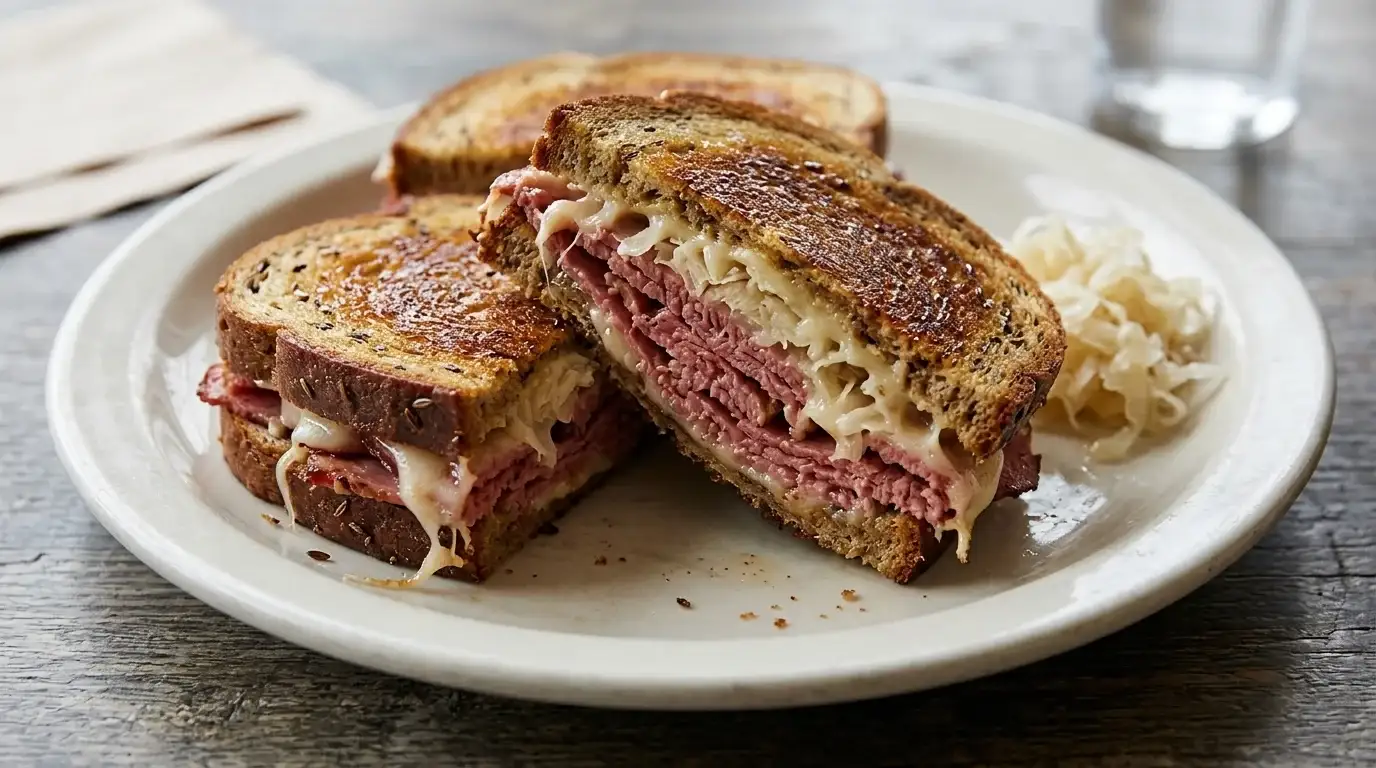
On a sandwich, sauerkraut plays the role pickles and vinegar slaws play elsewhere: acid set against rich meat and melted cheese. A fully fermented kraut finishes near pH 3.5, the USDA paper says, which is in the same sour range as vinegar pickles.
It also brings liquid. Sauerkraut ferments and is stored under its brine, so whatever goes onto bread arrives wet. Squeezing it before building the sandwich is the same logic cooks apply when they salt and drain cabbage for coleslaw: water that leaves the cabbage before assembly cannot soak the bread after.
The two kinds sold in stores come from the two endings the National Center for Home Food Preservation describes. Fully fermented kraut can be kept covered in the refrigerator for several months. Or it can be packed in jars and processed in a boiling-water canner, the method behind shelf-stable kraut, where the heat ends the fermentation.
Frequently asked questions
How does sauerkraut ferment?
Salt draws juice from shredded cabbage, and lactic acid bacteria on the leaves turn its sugars into acid. Leuconostoc mesenteroides starts the process and Lactobacillus plantarum finishes it at about pH 3.5, according to USDA research.
How much salt goes in sauerkraut?
The National Center for Home Food Preservation uses 3 tablespoons of canning or pickling salt per 5 pounds of cabbage.
How long does sauerkraut take?
About three to four weeks at 70 to 75°F, and five to six weeks at 60 to 65°F.
Why was sauerkraut called liberty cabbage?
New York manufacturers proposed the name in 1918, during World War I, after anti-German sentiment cut demand.
Sources
- USDA Agricultural Research Service, sauerkraut fermentation ecology (p321): https://ars.usda.gov/ARSUserFiles/60701000/Pickle%20Pubs/p321.pdf
- USDA Agricultural Research Service, “Effects of Leuconostoc mesenteroides Starter Culture on Fermentation of Cabbage with Reduced Salt Concentrations” (p348): https://ars.usda.gov/ARSUserFiles/60701000/Pickle%20Pubs/p348.pdf
- Plengvidhya, Breidt, Lu and Fleming, “DNA Fingerprinting of Lactic Acid Bacteria in Sauerkraut Fermentations,” Applied and Environmental Microbiology: https://pmc.ncbi.nlm.nih.gov/articles/PMC2168044
- National Center for Home Food Preservation, “Sauerkraut”: https://nchfp.uga.edu/how/ferment/recipes/sauerkraut/
- Hektoen International, Richard de Grijs, “Plague of the Sea, and the Spoyle of Mariners” (June 17, 2021): https://hekint.org/2021/06/17/plague-of-the-sea-and-the-spoyle-of-mariners-a-brief-history-of-fermented-cabbage-as-antiscorbutic/
- Australian National Maritime Museum, “Health and medicine” (HMB Endeavour): https://www.sea.museum/learn/school-excursions/teacher-resources/hmb-endeavour/a-voyage-of-exploration/health-and-medicine
- Max Kade Institute, University of Wisconsin, “Sauerkraut By Any Other Name”: https://language.mki.wisc.edu/essays/sauerkraut-by-any-other-name/
- Barry Popik, “Liberty Cabbage”: https://barrypopik.com/blog/liberty_cabbage