


In this story
Raclette is a cheese and a meal at once. A half-wheel is warmed in front of a fire until the cut face blisters and runs, then the soft layer is scraped off with a knife onto a plate of boiled potatoes, with small pickles and onions on the side. The process repeats until everyone has had enough. The name comes from the French verb racler, to scrape, and the practice comes from the Swiss canton of Valais, where cheesemakers still make it from raw milk under a protected designation.
Video: The Beautiful World of Raclette, from the Origins of Food YouTube channel
A name from the act of scraping
Racler, Bratchäs and the Valais record
The word describes the motion. The official Valais tourism site explains that “raclette” comes from the local French dialect, from racler, and that it became the cheese’s official name in 1874. Cheese itself is much older in the canton; the same page says it is documented there from the fourth century BC and that the Romans accepted it as payment. Melted cheese, it adds, was served in Valais at least as early as 1574.
Switzerland Cheese Marketing, the industry’s promotional body, gives the same 1574 date for the first written reference to raclette in Valais and points to a precursor called Bratchäs that appears in twelfth-century monastery writings from Obwalden and Nidwalden.
The tourism site also passes along an origin legend: a wine-grower named Léon melting a piece of cheese over an open fire. It labels the story a legend.
Raclette du Valais AOP
Raw milk, five kilos, three to six months
Valais protects its version. The tourism site says Raclette du Valais has been registered as an AOP since 2007. The milk must be full-fat, untreated cow’s milk, and milk production, cheesemaking and aging must all happen in Valais, with one exception for the Spittelmatten alpine pastures near Kandersteg in canton Bern. Only milk, water, salt, rennet, starter cultures and the cheese smear are allowed.
The wheels are modest. Each weighs about 5 kilograms and measures about 30 centimeters across, with its origin stamped on the side. They age three to six months. The tourism site lists the cow breeds as Hérens, Brown Swiss, Simmental, Holstein and Red Holstein, and describes the flavor as fresh, like butter or cream, with a slight acidity and floral, fruity notes that vary with the grazing.
Switzerland Cheese Marketing adds that Swiss raclette cheese in general is full-fat and semi-hard, matured at least three months and made without additives, from raw or pasteurized milk. Raclette du Valais AOP is the raw-milk version. Raclette Suisse is another Swiss variety on its list.

The wood fire and the half-wheel
The traditional method
The old method needs only a fire and a knife. Switzerland Cheese Marketing describes a half-wheel set on a board near the embers and the softened cheese scraped directly onto the plate, a style now found mainly in Valais, at festivals and in traditional restaurants. Purists, the Valais tourism site notes, still insist on a wood fire.
The cheese does not need much heat. The tourism site says Raclette du Valais melts at about 40°C, a little above body temperature. Switzerland Cheese Marketing warns that with unpasteurized cheese, heating it too long or too quickly should be avoided.

The tabletop grill
Half-wheel machines and mini-pans
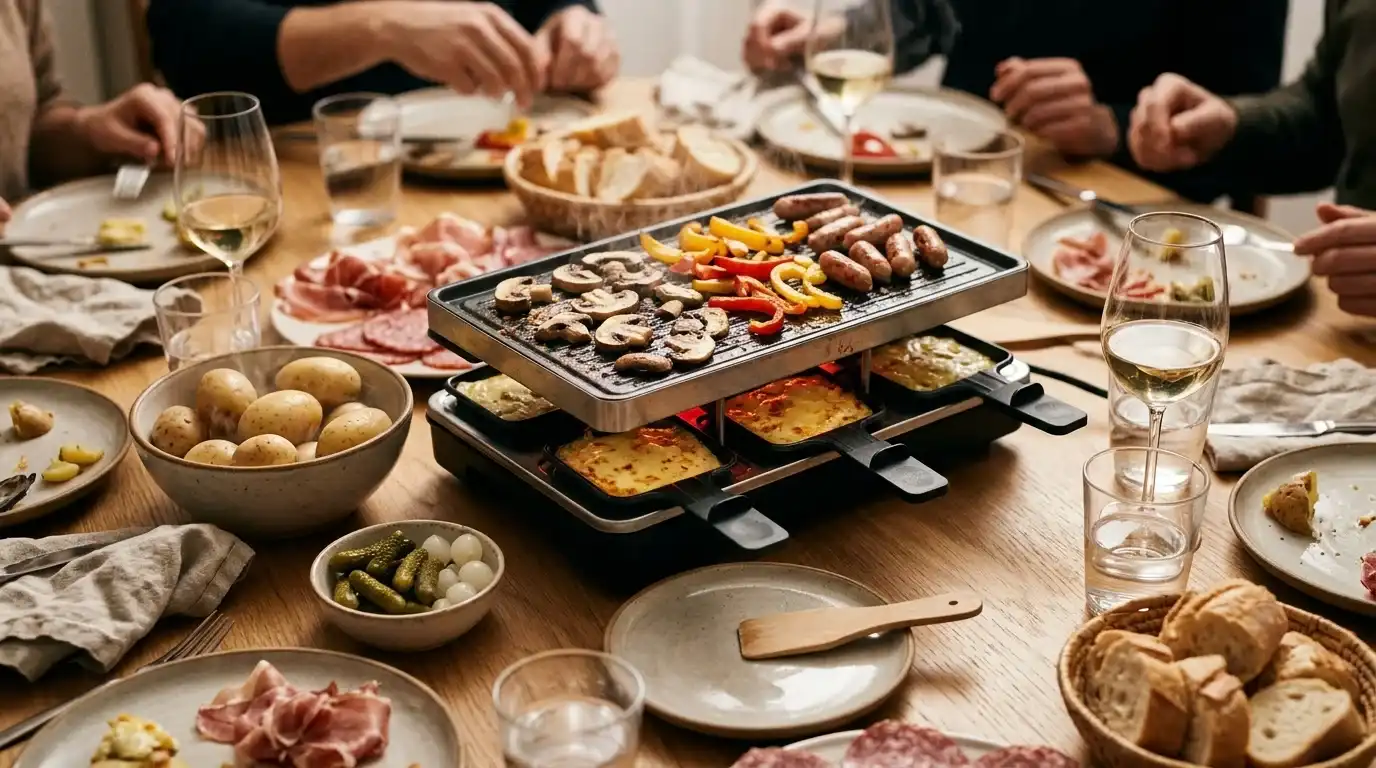
Most raclette eaten at home today comes off an electric machine. Switzerland Cheese Marketing describes two kinds: stoves that heat a half-wheel from above so the cheese can still be scraped onto plates, and tabletop grills with small individual pans, where each diner melts slices under a heating element and slides the cheese off with a spatula. Some of the larger ovens serve up to 12 people. For the mini-pan style, it recommends pasteurized cheese.
The Valais tourism site calls the small electric units “raclonettes.” A typical eight-person party grill pairs the pans underneath with a cooking plate on top:
- Swissmar Classic 8-Person Raclette Party Grill: an electric tabletop grill with eight cheese pans and a reversible cast-iron grill plate and crepe top. See it on Amazon (affiliate link)
- BOSKA Raclette Grill Mini, 2 Person: a two-pan tabletop raclette grill for small servings. See it on Amazon (affiliate link)
Video: Swissmar Classic 8 Person Raclette Party Grill, from the Kitchen & Company YouTube channel
As an Amazon Associate I earn from qualifying purchases. A commission may be earned if you buy through this link, at no extra cost to you.
What goes on the plate
Potatoes, pickles and Fendant
The sides are fixed by tradition. The Valais tourism site lists boiled potatoes in their skins, silverskin onions and small pickled gherkins, with a glass of white Fendant wine from Valais as the suggested pairing. Raclette du Valais can also be sliced and eaten cold, the site notes, or served on an “assiette valaisanne” platter.
The same melted-cheese logic runs through Switzerland’s other famous pot, fondue, and through the potato dishes of the Swiss kitchen, including the rösti that sits beside American hash browns.
Frequently asked questions
What does raclette mean?
It comes from racler, French for “to scrape,” because the melted cheese is scraped off the wheel.
Where does raclette come from?
The canton of Valais in Switzerland, where melted cheese is documented from at least 1574.
What is Raclette du Valais AOP?
A raw cow’s milk cheese made and aged only in Valais (with one alpine exception), aged three to six months and protected since 2007.
What do you serve with raclette?
Traditionally boiled potatoes in their skins, small pickled onions and gherkins, and a white Valais wine such as Fendant.
Sources
- Valais Tourism, “Raclette du Valais AOP”: https://www.valais.ch/en/taste/valais-specialties/raclette
- Switzerland Cheese Marketing, “Types of raclette cheese and preparation”: https://www.cheesesfromswitzerland.com/en/inspiration/raclette/cheese-and-preparation


