


In this story
A smash burger breaks the oldest rule of burger cooking. Instead of leaving the patty alone so it stays juicy, the cook presses a ball of ground beef flat against a ripping-hot griddle, hard, right at the start. The thin patty that results is cooked through, with a deep brown, lacy-edged crust over most of its surface. Diner cooks have made burgers this way for generations. The modern name belongs to a Denver chain, the science was popularized by a food writer with a skillet and a scale, and the craze that followed turned a cheap diner burger into one of the most copied menu items of the decade.
Video: Smashburgers on the Griddle, from the J. Kenji López-Alt YouTube channel
A diner cook and a can of beans
The best-known origin story starts in Ashland, Kentucky
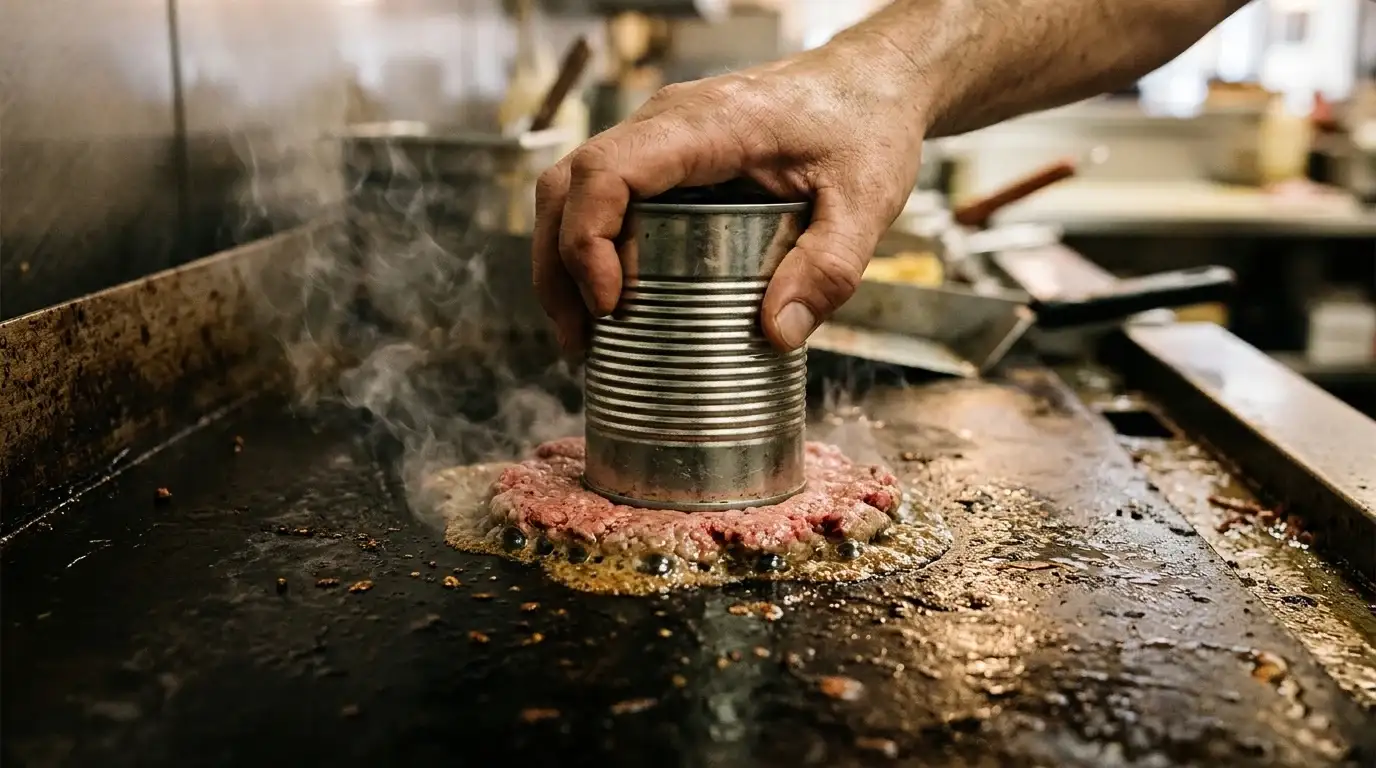
The story most often told begins at a Dairy Cheer in Ashland, Kentucky. Chowhound reports that a fry cook there figured out how to maximize flavor by smashing ground beef with a 10-ounce can of beans, and that the owner, Bill Culvertson, saw the value in the ultra-thin, crispy-edged patties it produced. Chowhound places the moment in the 1960s.
Accounts disagree on the decade. The San Francisco Chronicle, reporting on the smash burger boom, writes that Dairy Cheer claims to have invented the method in the 1950s, when a cook pressed a can of beans down on a spatula over a burger. The same report says Dairy Cheer sued the Smashburger chain over its trademark in 2010 and the two settled out of court.
As with the hamburger itself, the safest conclusion is that pressing a patty on a flat-top was a common diner practice before anyone owned a name for it. Dairy Cheer’s claim is the one with a lawsuit attached.
How a chain got the name
Smashburger opened in Denver in 2007
The word became a brand in Colorado. The Chronicle reports that Tom Ryan bought a small Denver-area diner called Icon Burger in 2006 and planned a higher-end chain around its burgers. His team began calling them smashburgers, and the name stuck. Ryan founded Smashburger in Colorado in 2007, and the chain is now owned by Jollibee, with 235 locations worldwide by the Chronicle’s count.
Ryan’s pitch for the method was blunt. He told the Chronicle, “When you smash burgers correctly, you get more flavor bang per ounce than any other method of cooking burgers.”
The chain did not invent the technique, but it made the word part of American menus.
Why smashing works
More contact with the pan means more browning
The flavor of a smash burger is the flavor of its crust. Chowhound explains that flattening the patty increases the surface area available for the Maillard reaction, the browning reaction between proteins and sugars that gives seared meat its savory, toasty taste. A thick burger browns only on its two faces. A smashed one is almost all face.
The timing is the part people get wrong. Food52, writing about J. Kenji López-Alt’s work in his cookbook The Food Lab, sums up his argument: if a burger is smashed once, decisively, as soon as it hits the hot skillet, while the meat and fat are still cold, there are no juices yet to lose. Pressing a burger later, after the fat has melted, is what squeezes moisture out and earns the technique its bad reputation.
Food52 notes that burgers made this way take under a minute to cook. The press comes first, once and hard, and then the patty is left alone until it is time to flip.
What the test kitchen found
Fine grind, hard pressure and a patty that sticks
America’s Test Kitchen worked through the details for its own smashed burger and came away with several findings that run against instinct:
- Supermarket ground beef beats home-ground chuck. Commercial 80 percent lean beef is ground finer, which releases more myosin, a sticky meat protein that helps the patties hold together when they are smashed.
- Smaller portions. ATK keeps each ball at 4 ounces or less so the smashed patty doesn’t hang far past the bun, and splits a burger into two 2-ounce patties for more crust.
- Use a can or a saucepan, not a spatula. An offset spatula makes even pressure hard. ATK presses straight down with a small saucepan, a burger press or a 28-ounce can.
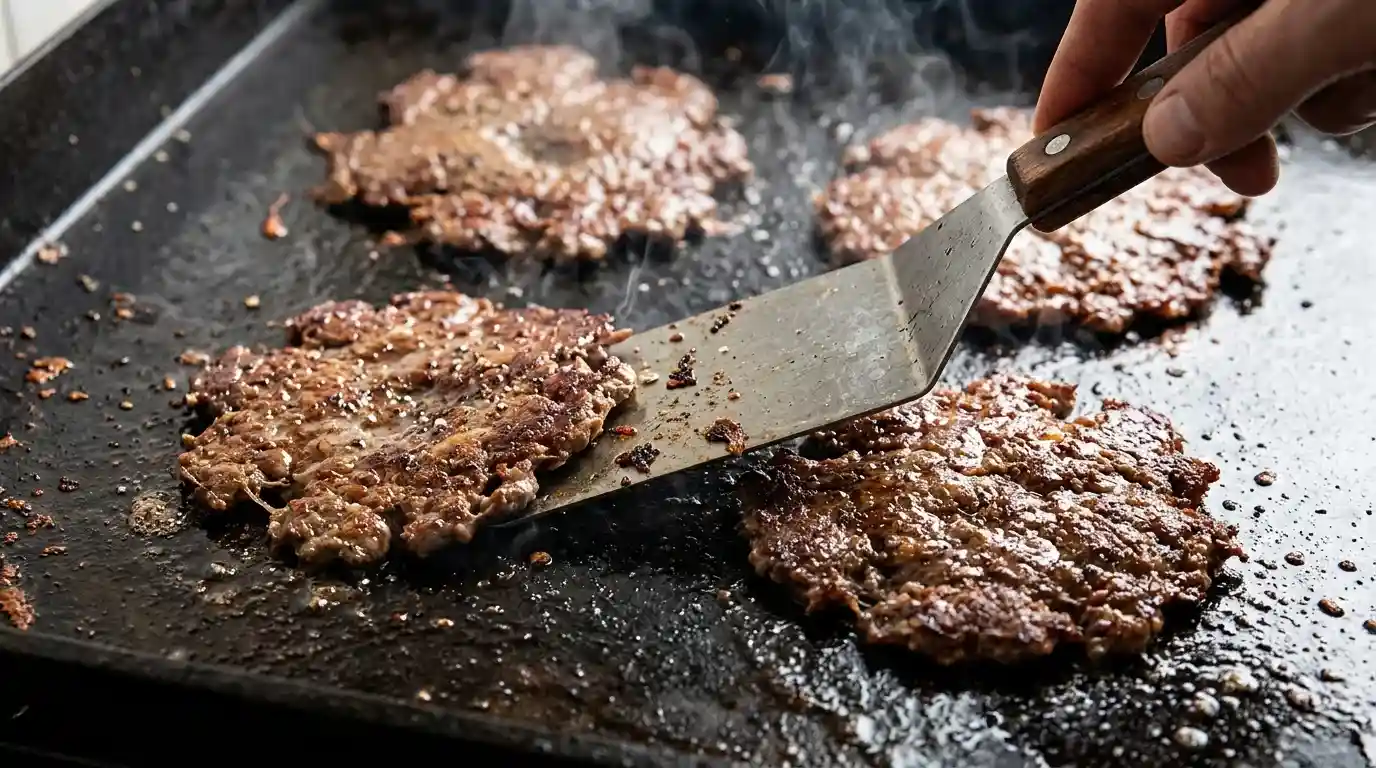
- Let it stick. A patty that sticks to the pan has full contact and browns evenly; one that releases early shrinks and thickens. The crust forms in one to two minutes, and the patty needs only seconds on the second side.
ATK’s summary of the whole exercise fits in three words: “Crust is king.” Its burger puts a slice of American cheese between the two patties and a creamy, tangy sauce on the toasted bun to supply the moisture a thin, crusty patty lacks.
The griddle matters
Steel and cast iron, not nonstick
Smash burgers are a flat-top food. The surface has to be hot enough that the meat browns rather than steams, and solid enough to take a hard press and a scraping flip. ATK uses a smoking-hot cast-iron skillet with a few drops of oil. Chowhound recommends stainless steel or cast iron, a high-fat blend such as 75/25 and a stiff, large metal spatula for scraping the patty loose.
A well-seasoned steel griddle is the natural home for the technique, and it is the setup diners have always used. GrillCheesy’s guide to seasoning a flat-top griddle covers how that surface is built and maintained. ATK adds one practical step between batches: scrape out the browned bits before the next ball of beef goes down.
How the smash burger took over
Pop-ups, social media and a cheap plate in an expensive decade
Smash burgers moved from diner staple to trend in the late 2010s. The Chronicle traces part of the boom to Burgers Never Say Die, a pop-up Shawn Nee started in Hollywood in 2017, after which smash burgers spread quickly with help from Instagram. The pandemic helped too, the paper reports, boosting sales at smash-burger spots that were built for takeout.
Price is part of the appeal. The Chronicle describes smash burgers as typically around $10 and built from inexpensive ingredients, a value option at a time when beef and restaurant prices had climbed. A two-ounce patty on a griddle costs less than a half-pound steakhouse burger, and the crust makes it taste like more.
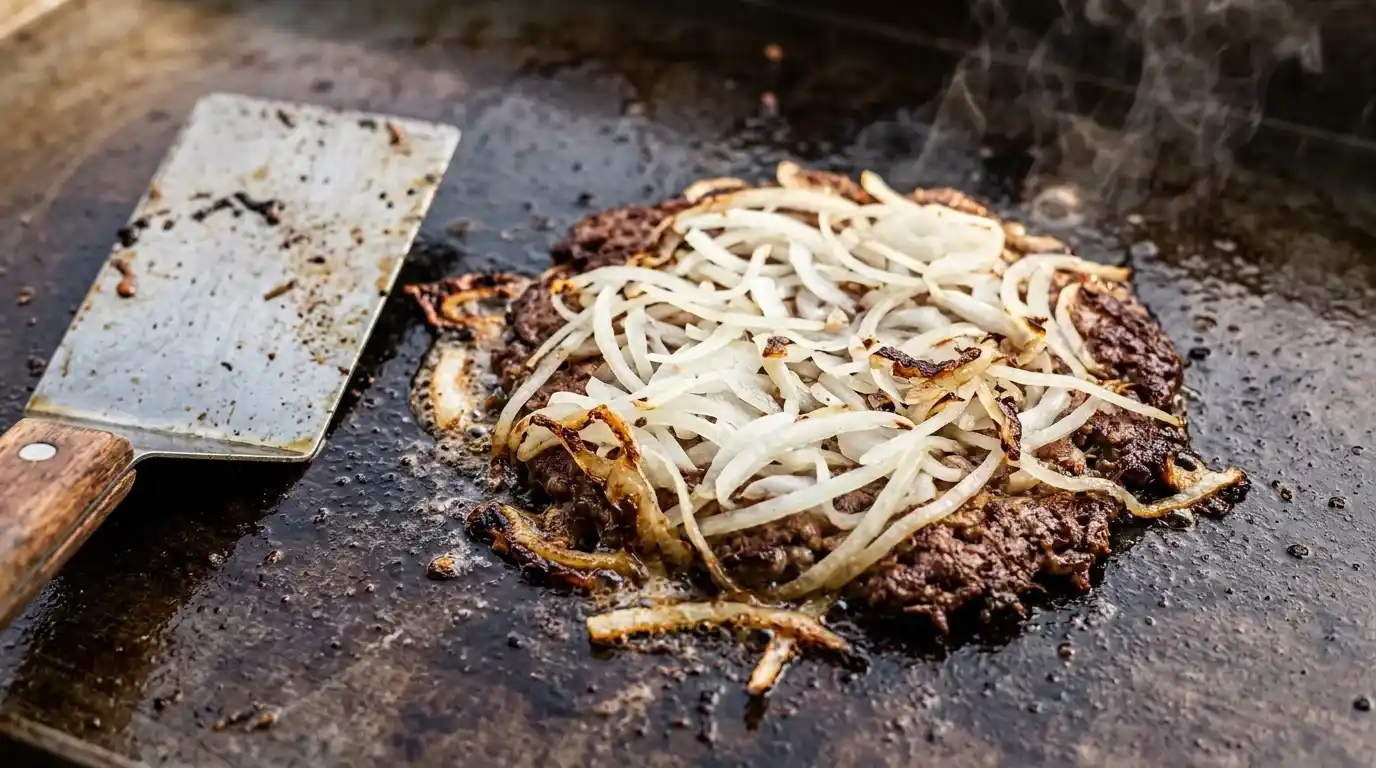
The style also carries regional cousins. Food52’s follow-up on the smashed cheeseburger borrows from López-Alt’s work on the Oklahoma-style onion burger, in which onion makes up roughly half the patty’s volume: very thinly sliced onion is pressed into the smashed beef so it cooks into the meat.
Frequently asked questions
Who invented the smash burger?
No one can be proven. Dairy Cheer in Ashland, Kentucky, claims a cook invented it by pressing burgers with a can of beans, dated to the 1950s or 1960s depending on the account.
When should you smash a burger?
Right away, as soon as the ball of beef hits a very hot surface, while the meat and fat are still cold. Pressing later squeezes out juices that have already formed.
What beef is best for smash burgers?
America’s Test Kitchen recommends finely ground commercial beef around 80 percent lean, because the finer grind helps the patties hold together.
Why do smash burgers stick to the pan?
Sticking means full contact and even browning. ATK lets the patties stick and scrapes them loose to flip.
Sources
- Kim Ranjbar, “Who Really Invented The Smash Burger?,” Chowhound (January 12, 2025): https://chowhound.com/1754968/who-invented-smash-burgers
- San Francisco Chronicle, on the smashburger boom: https://preview-prod.w.sfchronicle.com/food/restaurants/article/smashburger-burger-popularity-price-20218366.php
- Food52, “The Genius Rule-Breaking Secret to Better Burgers”: https://food52.com/blog/16980-the-genius-rule-breaking-secret-to-better-burgers
- Food52, “How to Make the Genius Smashed Cheeseburger Even Juicier”: https://food52.com/blog/17121-how-to-make-the-genius-smashed-cheeseburger-even-juicier
- America’s Test Kitchen, “How to Make the Ultimate Smashed Burger”: https://www.americastestkitchen.com/articles/2312-how-to-make-the-ultimate-smashed-burger


