In this story
A flat-top griddle is a sheet of steel or iron with a fire under it, and bare steel sticks, rusts and browns food unevenly. Seasoning fixes all three problems. The method is the same whether the plate sits on a backyard cart or in a diner line: wipe on a very thin coat of oil, heat it until it stops smoking, and do it again until the surface turns dark and slick. The reason it works is chemistry, and understanding that chemistry explains why thin coats beat thick ones and why the best seasoning comes from cooking.
Video: How To Season a New Blackstone Griddle, from the Blackstone Griddles YouTube channel
What seasoning is
Oil turned into a hard, plastic-like layer bonded to the metal
Seasoning is not a flavor and not leftover grease. NOVA describes the payoff in two parts: a somewhat nonstick surface, and protection for the metal against rust. America’s Test Kitchen defines it as a coating of polymerized triglyceride molecules many molecules thick, formed when fat is held at a high enough temperature for long enough. In polymerization, the fatty acids in the oil link together through new chemical bonds into very large molecules. ATK describes the result as a plastic-like layer physically trapped in the pitted surface of the metal and partly bonded to it.
The metal helps. ATK notes that the iron in the pan speeds up the reaction. Lodge, the cast iron maker, describes the end product as a slick, hardened surface that is molecularly bonded to the iron.
The American Chemical Society adds the practical payoff. Its cast-iron fact sheet says a proper seasoning fills the tiny pores in the metal with a hydrophobic layer that prevents water-soluble proteins from sticking, naming eggs, meat and cheese. That list covers most of what goes on a griddle.
The iron does more than anyone thought
A wok study suggests the metal itself changes during seasoning
Polymerization is the standard explanation, but it may not be the whole story. NOVA reported in 2022 on research from Chongqing University in which scientists coated a wok with beef tallow and heated it while watching the surface with X-ray techniques. They saw oxygen moving into the iron-rich areas and iron atoms rearranging into small lumps the team called “iron nanoballs.”
The surface that resulted was what the researchers called conditionally hydrophobic. It repelled water when only a little was present but wetted when there was a lot. The authors argued that this is useful for cooking: a perfectly nonstick surface lets fat bead and clump, while one that can wet spreads oil into an even film and chars food less.
For griddle cooks, the point is that seasoning is a change to the metal’s surface as well as a coating on it. Both processes need the same things: clean metal, a little fat and enough heat.
Seasoning a new griddle, step by step
Clean, heat, wipe thin, smoke off, repeat
Blackstone, the outdoor griddle maker, publishes the sequence most home cooks follow. Its guide breaks down like this:
- Wash once. Scrub the new plate with soapy water to remove dust and residue from manufacturing and shipping, then rinse.
- Heat. Run the burners on high for about 10 to 15 minutes, until the surface starts to brown.
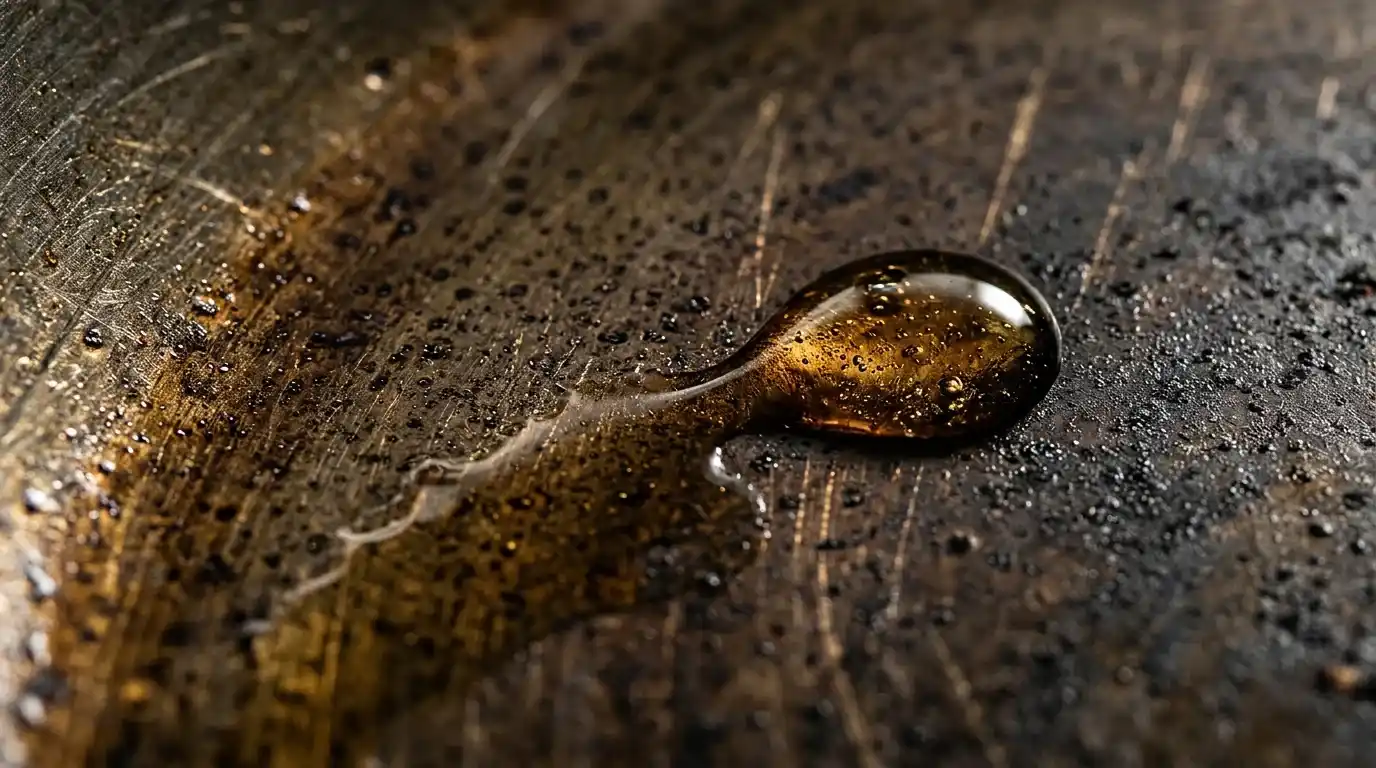
- Oil thinly. Wipe a very thin layer over the whole plate with paper towels held in tongs. Blackstone’s instruction is direct: “Make sure there aren’t any thick oil puddles or dry spots.”
- Smoke it off. Keep the heat on for roughly 30 minutes, until the smoking stops.
- Repeat. Do the oil-and-heat cycle several more times until the plate is dark brown. The company’s guide gives two to three rounds in one place and three to four in another.
- Protect it. Once it cools slightly, wipe on one last light coat to guard against rust.
The thinness rule matters more than the brand of oil. Blackstone’s owner’s manual traces a sticky, gummy surface to oil that was never fully cooked off, and its fix is to heat the plate, scrape off the thickened oil and re-season with a much thinner coat. Wiping the plate as though trying to remove the oil leaves the right amount.
Stovetop and oven seasoning follow the same logic. ATK presents a 500°F oven as the easiest way to push a pan just past the oil’s smoke point, and says the stovetop works if the pan is held at the smoke point for a few minutes.
Which oil to use
More unsaturated oils polymerize more readily
ATK explains that the more unsaturated an oil is, the more readily it oxidizes and polymerizes. Canola, sunflower, soybean and corn oils are all highly unsaturated. ATK singles out flaxseed oil, rich in omega-3 fatty acids, as forming an especially durable layer.
Blackstone lists canola, flax, vegetable oil, shortening and olive oil as acceptable, along with its own seasoning blend. The ACS fact sheet pushes back on one popular choice: bacon fat and lard are high in saturated fat, which is much less reactive, so they are poor choices for building the first layers even if they taste good later.
Smoke point is the other variable. NOVA’s article notes it varies widely, citing virgin avocado oil at 520°F and coconut oil at 350°F, and that seasoning begins once the oil reaches its smoke point. An oil with a very high smoke point simply needs more heat to get there.

How restaurant kitchens care for a steel plate
Cool it partway, use water, brick with the grain, oil it
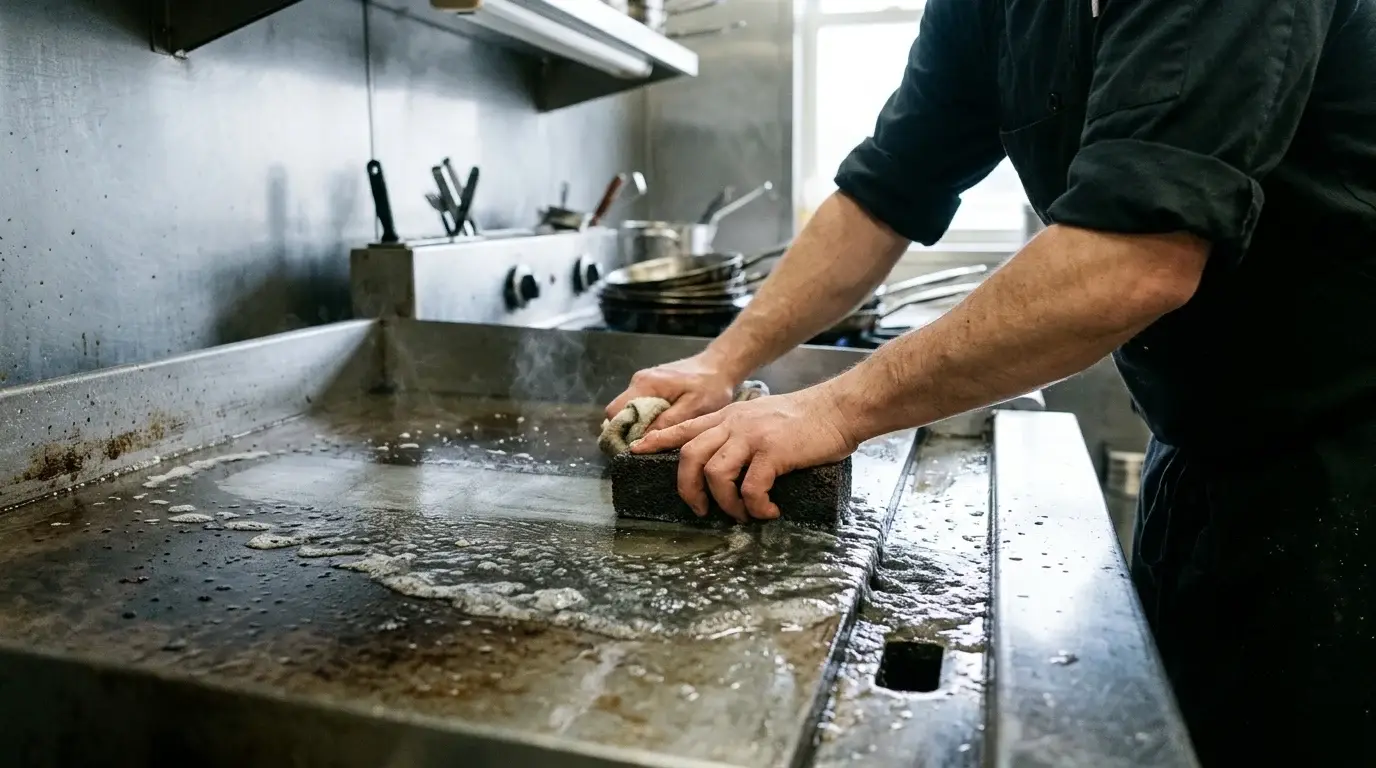
Commercial griddles see far more use than backyard models, and their manufacturers publish strict routines. Vulcan, which builds restaurant cooking equipment, tells operators of steel-plate griddles to let the plate cool to about 300 to 350°F after service, then add room-temperature water and scrape. Next comes either a griddle-specific detergent or a light coat of oil scrubbed in with a griddle brick, moving with the grain of the metal. The plate gets a light coat of oil afterward to protect the seasoning.
Two warnings appear in Vulcan’s guidance. Ice should never be used to cool a griddle, because the sudden temperature change can damage the plate. And chrome or composite plates need different, gentler treatment, so the brick is for steel only. For chrome, Vulcan specifies a razor-blade scraper, a Palmetto brush and a non-abrasive, food-safe polish wiped off completely; for composite plates, mild detergent, a non-abrasive pad and a thorough rinse. Neither gets the oil-and-brick treatment a steel plate does.
During service the rule is constant scraping. Vulcan tells kitchens to scrape and wipe throughout the shift and to empty the grease drawer as needed, not just at close.
Keeping the seasoning once it’s built
The best maintenance is cooking
Every source agrees on the long game. ATK says each time oil and heat meet the pan, the seasoning layer grows. The ACS fact sheet describes good seasoning as something that builds over many uses in microscopic layers. Blackstone says regular cooking adds to the surface and recommends a thin protective coat between cooks, with the griddle stored under a cover.
Soap is less of a threat than its reputation. The ACS calls the idea that soap ruins cast iron a myth, explaining that a proper seasoning is durable and that only lye-based cleaners will dissolve the polymer. Drying the plate right after cleaning is the step it does insist on.
For anyone cooking sandwiches on a flat-top, that layered surface is what lets butter brown evenly under bread and lets melted cheese that escapes the edges lift off with a scraper instead of welding to the steel.
Two tools that come up in nearly every routine above:
- Blackstone Griddle Seasoning and Cast Iron Conditioner, 15.3 oz. The company’s own seasoning blend, made for building and maintaining the layer on its griddles. See it on Amazon (affiliate link)
- Cuisinart Heavy Duty 6 In. Stainless Steel Griddle Scraper, CCB-500A. A wide stainless blade for scraping a flat-top during and after cooking. See it on Amazon (affiliate link)
As an Amazon Associate I earn from qualifying purchases. A commission may be earned if you buy through this link, at no extra cost to you.
Video: Blackstone Griddle Seasoning and Conditioner, from the Blackstone Griddles YouTube channel
Frequently asked questions
How many times should a new griddle be seasoned?
Blackstone’s guide calls for repeating the thin-oil-and-heat cycle several times, two to four rounds, until the plate turns dark brown.
Why is my griddle seasoning sticky?
Usually too much oil. Thick layers do not fully polymerize. Heat the plate, scrape off the tacky residue and re-season with a much thinner coat.
Can I use soap on a seasoned griddle?
The American Chemical Society says proper seasoning is not harmed by dish soap; only lye-based cleaners dissolve it. Dry the surface right away afterward.
What is the best oil for seasoning?
Highly unsaturated oils such as canola, sunflower, soybean, corn and flaxseed polymerize most readily, according to America’s Test Kitchen.
Sources
- America’s Test Kitchen, “The Science of Seasoning”: https://www.americastestkitchen.com/lessons/articles/2357-science-the-science-of-seasoning
- Lodge Cast Iron, “Science of cast iron seasoning”: https://www.lodgecastiron.com/cleaning-and-care/cast-iron/science-cast-iron-seasoning
- American Chemical Society, “Cast iron: fact or fiction?”: https://www.Acs.Org/content/dam/acsorg/pressroom/reactions/infographics/cast-iron-fact-or-fiction.pdf
- NOVA, Attabey Rodríguez Benítez, “What happens when you season a cast iron pan” (August 1, 2022): https://www.pbs.org/wgbh/nova/article/season-cast-iron-skillet-polymerization
- Blackstone, “Griddle Seasoning Complete Guide”: https://blackstoneproducts.com/blogs/griddling-101/griddle-seasoning-complete-guide
- Blackstone, “Seasoning and Cleaning Instructions” (owner’s manual): https://cdn.shopify.com/s/files/1/1723/1387/files/Seasoning_and_Cleaning_Instructions.pdf
- Vulcan, “How to Use and Clean a Commercial Griddle”: https://vulcanequipment.com/blog/how-use-and-clean-commercial-griddle-usage-and-cleaning-tips