In this story
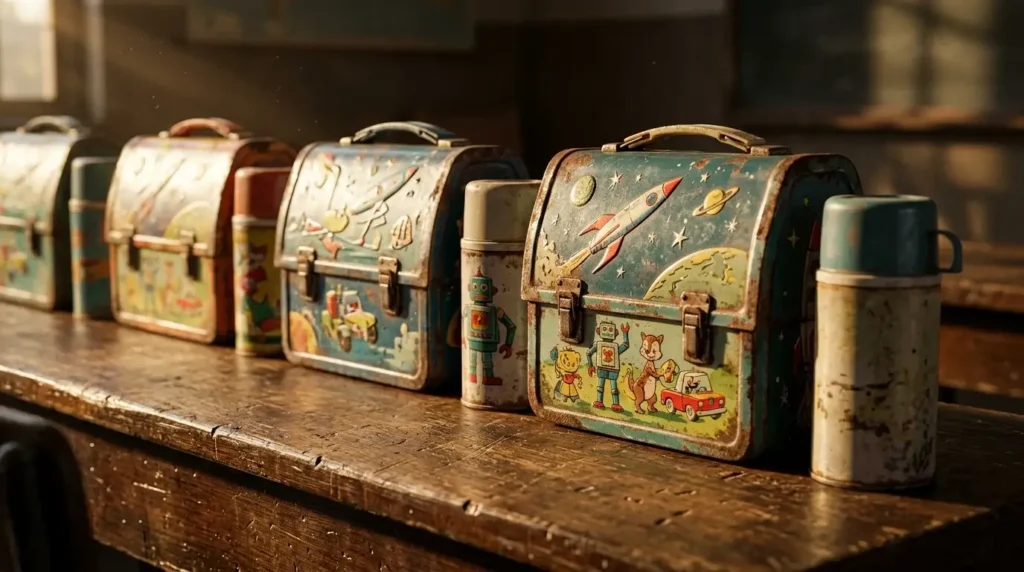
Before the lunch box was a status symbol in a school hallway, it was a tin pail carried to a mine or a factory, holding the sandwich that would have to last a shift. Over a century it became a license plate for childhood, stamped with cowboys, astronauts and cartoon stars, then switched to plastic. Museums now hold hundreds of them, and the record of which box came first, and how many sold, still depends on whom you ask.
Video: The Lunchboxes Of My Youth, A brief history of the kids lunchbox, from the PatmanQC History of Everything Retro YouTube channel
Dinner pails
Miners, mill hands and tins
The working lunch came first. Linda Gross of the Hagley Museum and Library, writing in September 2023, cites the Smithsonian’s National Museum of American History: since the mid-19th century, miners, factory workers, dock hands and other laborers carried sturdy dinner pails for hearty food. Chris Bensch, chief curator at The Strong National Museum of Play, adds that metal lunch boxes of the late 1800s were often used by adults at work and handed down to children, who also reused cracker and cigar tins.
The drink came separately. Gross notes that Thermos vacuum bottles began keeping drinks hot or cold in 1904.
The first box for kids
1870s images or 1935 Mickey Mouse
When the children’s lunch box began depends on the definition. Bensch writes that by the 1870s manufacturers were making lunch boxes decorated with images aimed at children. Hagley dates the modern lunch box to 1935, when Geuder, Paeschke and Frey of Milwaukee licensed the new Mickey Mouse character for the top of its oblong Lunch Kit. Gross found the patent behind it: Phillip Kempter of Milwaukee received U.S. patent 1,737,249 for the lunch kit on November 26, 1929, assigned to Geuder, Paeschke and Frey.
Erin Blakemore, writing for HISTORY (first published September 2017), describes the 1935 kit as an oval metal box that sold for 10 or 20 cents.

Hopalong Cassidy, 1950
The licensed box and its disputed numbers
The boom started in Nashville. All three sources credit Aladdin Industries with the 1950 Hopalong Cassidy box, built on the cowboy star’s popularity on television. Bensch explains the business logic: durable metal boxes lasted children years and hurt repeat sales, so Aladdin used pictures to make every year’s box look new.
The details differ. Hagley describes a lithographed steel box with matching thermos; Bensch describes a Hopalong decal applied to a plain painted box, with full-box lithography arriving at Aladdin in 1954. The sales figures also vary: Hagley, citing The Henry Ford museum, reports unit sales rising from 50,000 to 600,000 in one year; HISTORY says more than 600,000 in the first year; The Strong says more than half a million within a year.
The lunch box war
Thermos, Roy Rogers and the golden era
Competition followed. Hagley records American Thermos of Norwich, Connecticut, releasing Roy Rogers and Dale Evans boxes around 1953, a vinyl Barbie box in 1962, and a 1954 Superman box that sold at auction for $11,500 in 1999. HISTORY values a mint 1954 Superman, made by Universal, at up to $13,000, and cites collector Thad Reece’s estimate of more than 120 million metal lunch boxes in more than 450 designs sold from 1950 to 1970. Aladdin added raised, embossed designs in 1962, per The Strong.
HISTORY’s list includes the 1963 Beatles and Jetsons boxes from Aladdin, the 1963 Orbit box that Thermos stopped making after a cease-and-desist over John Glenn images taken from National Geographic, and the 1957 Toppie, given to Kroger shoppers around Dayton with Top Value Stamps, of which only about 12 are thought to survive.

Plastic, and the ban that wasn’t
Rambo, 1985
Metal gave way to plastic. Bensch dates plastic lunch boxes to 1972 and attributes the shift partly to lower cost and perceived safety. HISTORY reports that Thermos’s 1985 Rambo box is believed to be the last metal lunch box with a licensed character, and credits the decline to the falling cost of vinyl and plastic. The popular story that mothers or legislators banned metal boxes as weapons, Blakemore writes, is an urban legend.
Collectors brought the metal box back. The Strong traces a nostalgia market for old boxes and reissues to the late 1990s. HISTORY says Allen Woodall’s museum in Columbus, Georgia, holds more than 1,300 metal boxes, and the Smithsonian’s collection more than 240; The Strong holds more than 100. Woodall calls old boxes “fabulous time capsules.”
What went inside
The packed sandwich
The box shaped the lunch. A sandwich carried for hours has to survive the trip, the problem covered in Grill Cheesy’s why sandwiches get soggy. The marshmallow-and-peanut-butter lunch is in the fluffernutter, and the cold-cut standard in black forest ham and Genoa salami.

Questions people ask
What was the first lunch box? Workers’ dinner pails go back to the mid-19th century; The Strong dates children’s illustrated boxes to the 1870s; Hagley dates the modern character lunch box to the 1935 Mickey Mouse Lunch Kit.
What was the first TV lunch box? Aladdin’s 1950 Hopalong Cassidy box.
How many Hopalong Cassidy lunch boxes were sold? Accounts range from more than half a million (The Strong) to more than 600,000 (HISTORY) in the first year.
Were metal lunch boxes banned? HISTORY calls the story an urban legend; it attributes the switch to cheaper vinyl and plastic.
What was the last metal character lunch box? Thermos’s 1985 Rambo box is believed to be the last, per HISTORY.
Sources
- Linda Gross, Hagley Museum and Library, All Packed Up and Ready to Go: A Brief History of the Lunch Box (Sept. 27, 2023): https://hagley.org/node/3777
- Chris Bensch, The Strong National Museum of Play, Time for Lunch Boxes (Sept. 11, 2012): https://www.museumofplay.org/blog/time-for-lunch-boxes/
- Erin Blakemore, HISTORY, Nine of the Most Collectible School Lunch Boxes, 1935 to Now (first published Sept. 7, 2017): https://www.history.com/articles/nine-of-the-most-collectible-school-lunch-boxes-1935-to-now