

In this story
A sandwich turns soggy because water moves from the wet fillings into the drier bread until the two reach balance, and the bread loses the firmness that made it a sandwich. Food scientists call the process moisture migration, and it is a recognized problem for any product built from parts with different moisture levels. The surprise in the research is that the amount of water a filling holds matters less than how freely it gives that water up.
Video: This special breed of tomato won’t make your sandwich soggy! | Food Unwrapped
Water follows activity, not quantity
The water-activity company AQUALAB states the principle in its guide to predicting moisture migration: water activity, not water content, predicts how water will migrate. Each component’s water activity indicates whether it will gain or lose moisture when components touch. The page uses a fruitcake to illustrate. A cake at 50 percent moisture content next to dried fruit at 30 percent can still send water into the fruit or take it from the fruit, depending on the water activity of each, and the same page compares the effect to pressure moving between a large tank and a small one.
The page names no individual author and comes from a company that sells water-activity instruments, so it is best read as a plain-language statement of the principle rather than a study. A doctoral thesis from the University of Surrey by Paschalia Mavrou gives the same framework in academic terms: moisture migration can occur between food and its atmosphere, or between compartments with different water activities, and it can affect the quality, sensory attributes and shelf life of manufactured foods. The thesis modeled a dry wafer against a wet material, with the ice cream cone as its example, and concerned temperature rather than bread. Its model predicted that the wafer would likely lose crispness during cold storage while its average moisture content stayed below the threshold for being considered soggy, a reminder that crispness and sogginess are separate thresholds, with a stretch of limp but intact food between them.
AQUALAB lists several ways manufacturers control the problem: matching the water activity of components, adjusting it, increasing viscosity to slow diffusion, adding an edible barrier, or packaging components separately. A home sandwich can use some of these in rough form. Separating the parts until eating is the packaging strategy, and a layer of fat is the edible barrier.
What the bread holds before anything is added
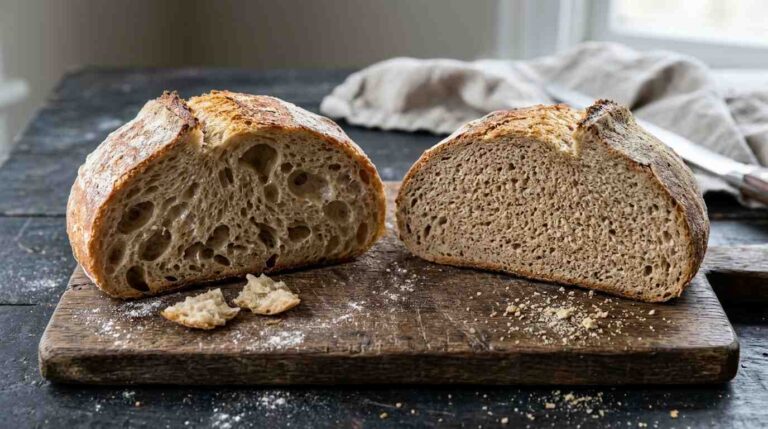
Bread starts out wet. In a 1990 paper in Cereal Chemistry, H. He and R. C. Hoseney tracked crumb moisture during storage and report a freshly baked crumb at about 47 percent moisture, falling to 41 percent after two hours of cooling. A loaf stored for a month at 25°C settled near 31.5 percent in the 24-minute-bake case they measured.
Two details in that study bear on sandwiches. Moisture loss slowed over time because the difference in moisture between crust and crumb shrank, and with the crust removed, crumb moisture stayed essentially constant near 40 percent for 90 days, which the authors attribute to minimized water migration. The crumb, in other words, dries toward the crust, which is why taking the crust off stopped most of the loss. The paper does not report crust moisture values.
A thesis from Universiti Putra Malaysia by Yanti Maslina Mohd. Jusoh adds that humidified baking retains moisture and reduces moisture migration during storage, and that sandwich bread has lower moisture than open bread, with no numbers given for the comparison. The same thesis found that higher baking temperature produced crumb with higher initial moisture, while longer baking reduced it, though time mattered less than temperature. Those results concern storage and staleness more than sogginess, and no source fetched here measured sliced sandwich bread against wet fillings directly.
Fillings that carry the water
Produce is the usual source. A fact sheet from the University of Florida’s Institute of Food and Agricultural Sciences, written by Jesse Murray, Gilles Basset and German Sandoya, states that lettuce is about 95 percent water, against roughly 91 percent for spinach and 85 percent for kale. That is a nutrition document rather than a sandwich study, but the figure explains why a leaf pressed against bread can leave a damp patch.
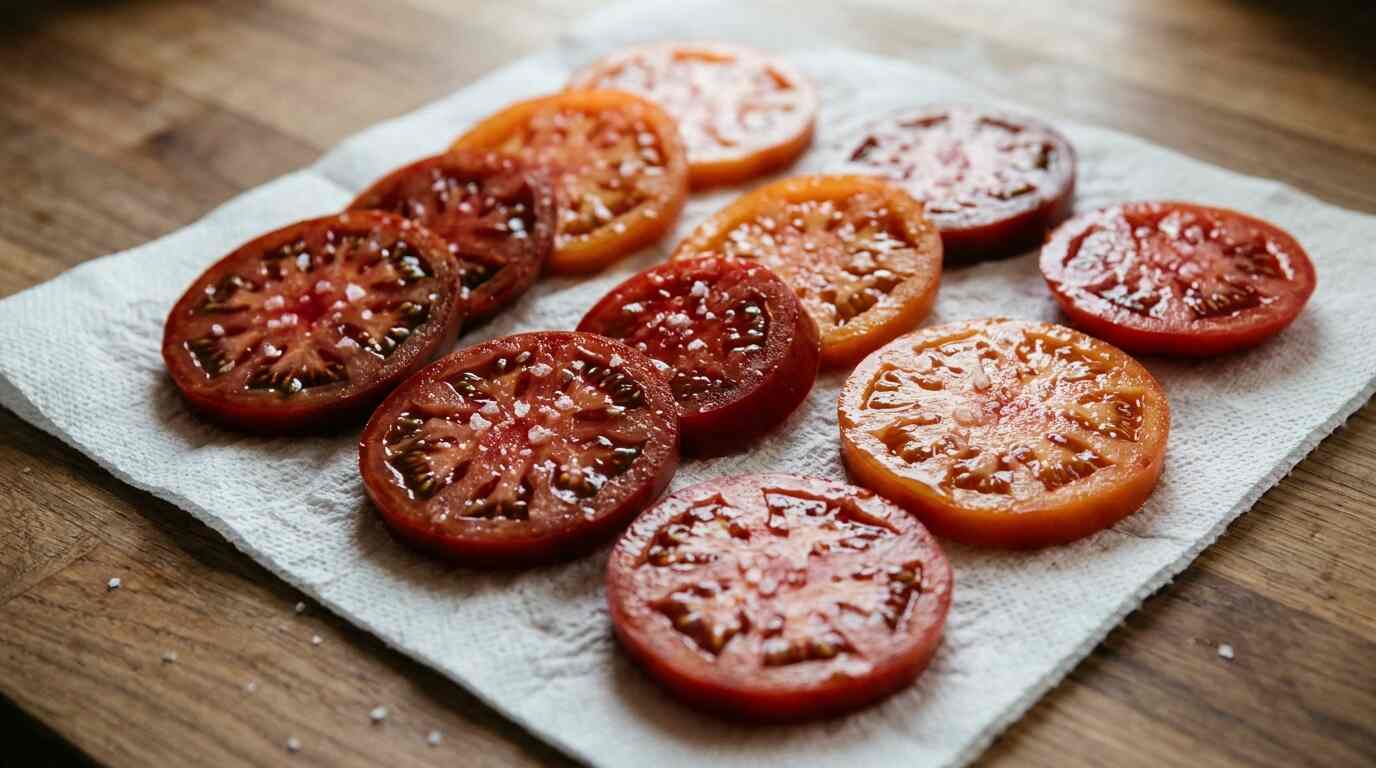
Tomatoes are the most common culprit in food writing, though none of the pieces found for this post cite studies or quote food scientists. Chowhound’s writer Amber Sutherland-Namako says sliced tomatoes can slide around and soak the bread and fillings, which dilutes condiments. Her fix is to salt slices ¼ to ½ inch thick on both sides, rest them on paper towels for about 10 minutes and blot, since the salt draws liquid to the surface.
Food Republic’s Kristina Vanni gives a related set of steps for a BLT: lay tomato slices in a single layer on paper towels, season them to draw out liquid, drain the bacon, and choose a heartier bread, toasted before assembling. She recommends nestling the tomato in the center, between lettuce and bacon, so that it does not touch the bread. She adds that parchment paper is slightly porous and can absorb some moisture, and that cooked bacon should be drained on a paper-towel-lined plate. These are practical recommendations from food media; no tests are described.
A packaged sandwich as an engineering problem
Where sogginess has been studied as a design problem is in packaged sandwiches. A Kraft Foods patent for a microwaveable grilled cheese, US 7,226,629, filed in 2003 and granted in 2007, states in its background that in prepackaged products the bread’s texture may change with time, especially becoming soft or soggy, while the cheese may dry out. The patent notes that moisture from the cheese can travel through the air around a barrier and reach other parts of the bread.
The document also describes why sealing the bread is hard. Bread has many crevices, and a coating thick enough to seal a refrigerated slice would be unpalatable to consumers. A fat barrier is typically applied to the cheese-facing side of the bread, the patent says, citing an earlier patent, but this kind of barrier stays fairly static after the cheese melts, so consumers notice it more. The invention proposes applying a lipid barrier around the cheese-and-meat filling instead.
A second Kraft patent, US 7,226,630, on an edible moisture barrier, describes the wider problem. In multi-component foods, the text says, moisture moves between adjacent components and can change the character of each; its examples include cheese drying out while a cracker loses crispness. Patents state an inventor’s case, and these were assigned to a company selling the solution, but they are among the few fetched sources that describe the mechanism in a sandwich-like product.
Fat, toast and placement as barriers
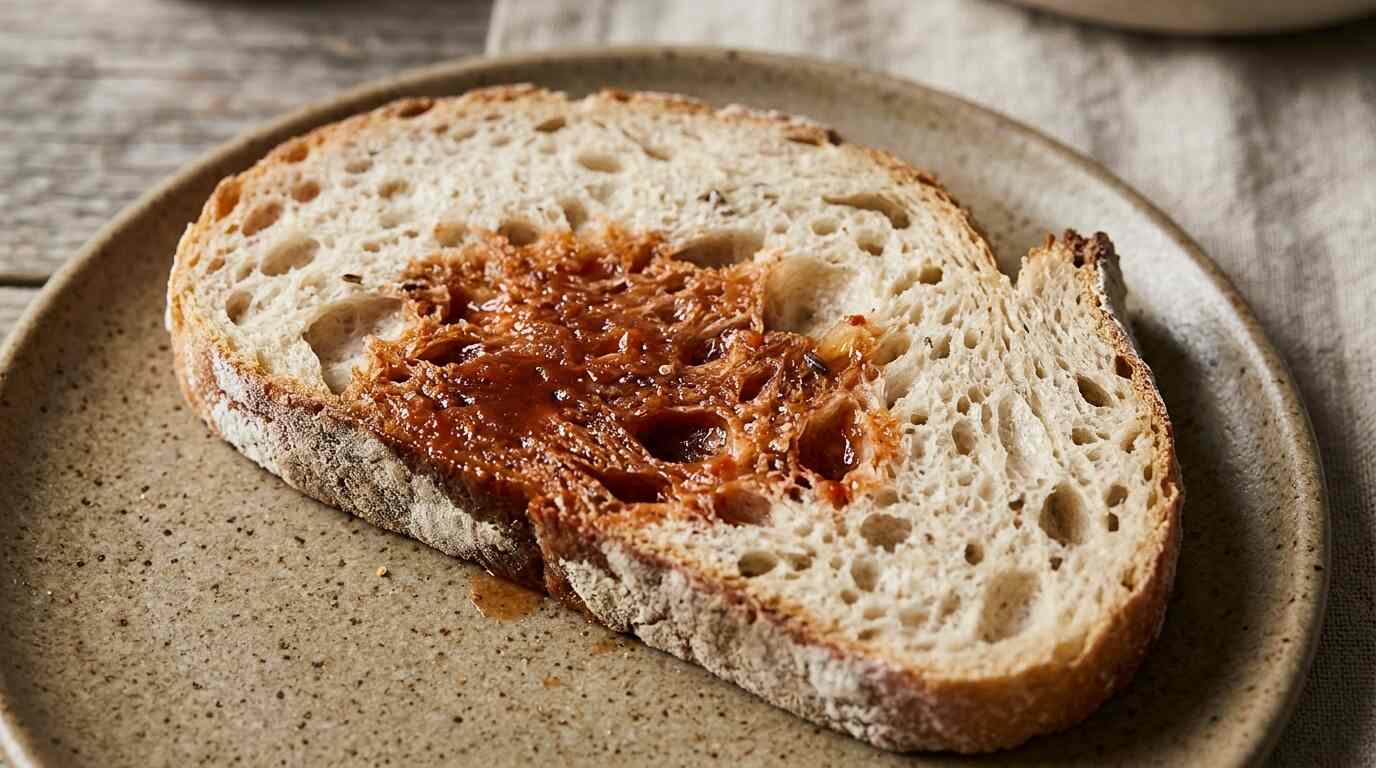
Lipids are the standard barrier material because they do not dissolve in water. The same patent says oils, fats and waxes can form a water-impervious structure, but that lipid-only films tend to be unstable in practice, may oil out or crack, and can feel greasy or waxy. The barrier the patent proposes pairs a low-melting triglyceride blend, with a melting point of 35°C or lower, such as palm kernel oil and canola oil, with a microparticulated high-melting lipid melting at 70°C or higher, with calcium stearate as the preferred example. Many prior barriers combined a lipid with hydrocolloids such as alginate, pectin or starch, and the patent says those absorb water more quickly once a food’s water activity is above 0.75.
A 2015 record for a study of a model bread crust, whose authors are not listed on the page fetched, reports that lipids and citric acid lowered water vapor permeability, which the authors attribute to lipid hydrophobicity and citric acid’s crosslinking effect. Hydrophobic additives gave the crust a water barrier and a brittle texture. This study concerns a laboratory crust, not a buttered slice, and the evidence for a household spread working the same way was not found in the sources fetched.
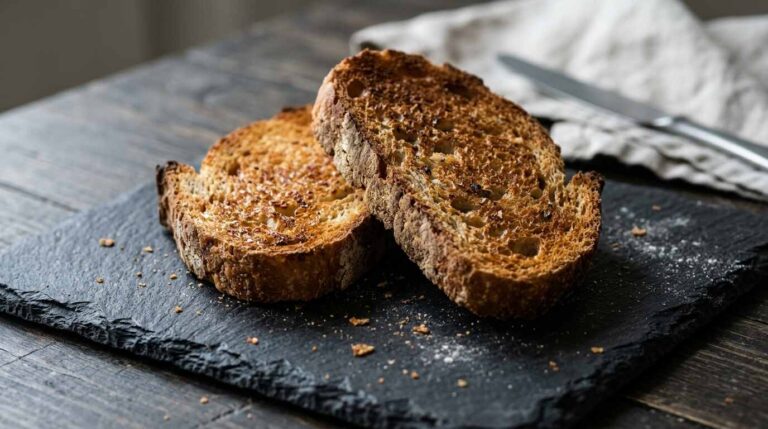
Toasting changes the bread itself. A 2008 study by Edoardo Capuano and colleagues found that water loss during toasting was fastest at the start and at higher temperatures, so a toasted surface starts with less water to give and a drier, more rigid structure. How that surface forms is covered in the post on the Maillard reaction and bread browning. Tasting Table’s Karen Hart, writing on caprese sandwiches, says toasted softer bread won’t stay crunchy but won’t fall apart when picked up, and suggests surrounding tomato with mozzarella and basil as a “food fence” and patting lettuce and meat dry.
Missing timelines and untested spreads
The mechanism is well supported: water moves between parts with different water activity, bread begins moist, and produce brings a lot of water. What the fetched sources do not supply is a timeline. No source gave minutes or hours until a given sandwich turns soft, or compared butter, mayonnaise or other spreads under controlled conditions. The food-media advice on salting, placement and toasting is consistent with the physics, but it rests on the writers’ experience rather than on measurements.
Sources:
- AQUALAB, “How to predict moisture migration with water activity”: https://aqualab.com/learn/how-predict-moisture-migration-water-activity
- Paschalia Mavrou, “Moisture migration in multicomponent food systems: Investigating the effect of temperature,” University of Surrey, 2022: https://openresearch.surrey.ac.uk/esploro/outputs/doctoral/Moisture-migration-in-multicomponent-food-systems/99653764702346
- H. He and R. C. Hoseney, “Changes in Bread Firmness and Moisture During Long-Term Storage,” Cereal Chemistry 67(6), 1990: https://www.cerealsgrains.org/publications/cc/backissues/1990/Documents/67_603.pdf
- Yanti Maslina Mohd. Jusoh, “Effects of Baking Temperature, Time and Humidity on Bread Crust and Crumb Properties,” MSc thesis, Universiti Putra Malaysia, 2008: https://core.ac.uk/download/42992649.pdf
- Murray, Basset and Sandoya, “Nutritional Benefits of Lettuce Consumed at Recommended Portion Sizes,” UF/IFAS HS1416: https://ask.ifas.ufl.edu/publication/HS1416/pdf
- Chowhound, “To Help Prevent Sandwiches From Getting Too Soggy, Don’t Skip This Tomato Step”: https://www.chowhound.com/1918219/prevent-soggy-sandwiches-salt-wick-tomatoes
- Food Republic, “To Avoid A Soggy BLT Sandwich, Tomato Placement Is Key”: https://www.foodrepublic.com/1572943/prevent-soggy-blt-sandwich/
- Tasting Table, “Prevent Soggy Caprese Sandwiches With Carefully Placed Tomatoes”: https://www.tastingtable.com/1399762/preventing-soggy-caprese-sandwiches-tomato-placement
- US Patent 7,226,629, “Microwaveable grilled cheese and meat sandwiches and method of preparation”: https://patents.google.com/patent/US7226629
- US Patent 7,226,630, “Edible moisture barrier for food and method of use”: https://patents.google.com/patent/US7226630
- Model bread crust study record (2015), “Mechanical, microstructure and permeability properties of a model bread crust: Effect of different food additives”: https://redi.cedia.edu.ec/document/347962
- Capuano et al., “Characterization of the Maillard reaction in bread crisps,” European Food Research and Technology, 2008: https://link.springer.com/article/10.1007/s00217-008-0936-5
- Grill Cheesy, “The Maillard Reaction and Why Bread Browns”: https://grillcheesy.com/maillard-reaction-and-bread-browning/
- Food Unwrapped (YouTube), “This special breed of tomato won’t make your sandwich soggy!”: https://www.youtube.com/watch?v=tIFFlsr042U