In this story
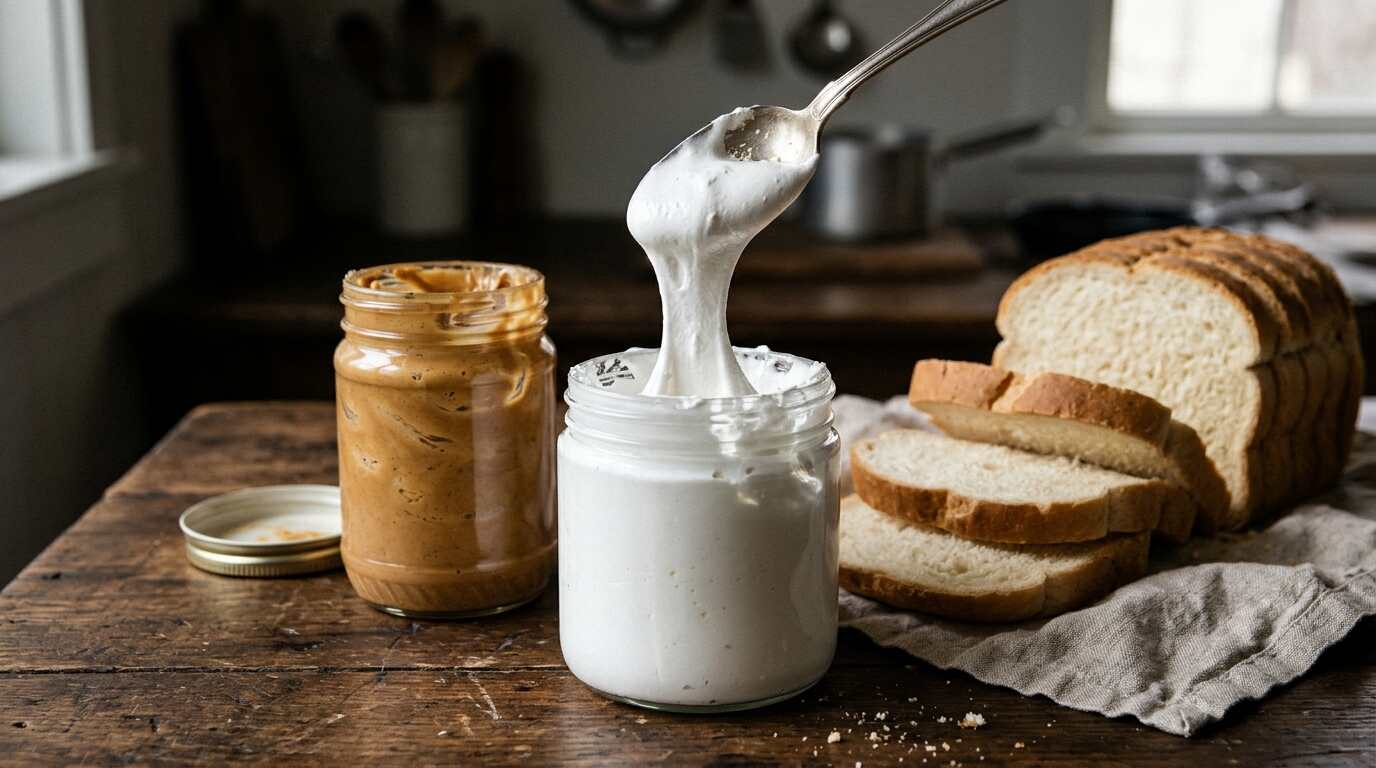
The fluffernutter is peanut butter and marshmallow creme on bread, and three parties have a claim on it: the Curtis family of Melrose, Massachusetts, who published a peanut butter and marshmallow creme recipe during World War I, the Durkee-Mower company of Lynn, which makes Marshmallow Fluff and gave the sandwich its name, and the Somerville candy maker who first sold the spread called Fluff. The sources agree that the sandwich is a Massachusetts creation. They disagree on who made it, on what year its name appeared, and even on the first name of the man who invented Fluff.
Video: Fluffernutter Sandwich on Sandwiches of History | Sandwiches of History
The spread before the sandwich
Marshmallow creme came first, and Fluff was not the first brand. Boston.com reports that earlier versions existed at least 20 years before the Fluff brand and that Durkee-Mower has acknowledged this. The same article repeats a claim by Brigid Alverson that the creme originated in nineteenth-century Paris, where pharmacists whipped marshmallow with sugar and egg whites as a throat remedy.
In New Jersey, the Limpert Brothers company says it created a product called “Marshmallow Fluff” in 1910 and trademarked it in 1913, according to Boston.com. A dispute in 1939 ended in an agreement: Durkee-Mower acquired part of the trademark for retail grocery sales in New England, in containers up to one pound, and Limpert kept restaurants and ice cream shops. The Kitchen Archeology blog agrees that Limpert had a named marshmallow product by 1910 but questions whether it was shelf-stable, and adds that Whitman’s Marshmallow Whip appeared in 1913 and is sometimes wrongly said to predate the Curtis product.
The claim that matters most to the sandwich belongs to Melrose, Massachusetts. The New England Historical Society says siblings Emma and Amory Curtis, descendants of Paul Revere, began making Snowflake Marshmallow Creme in 1913, with Amory cooking it in the basement of his Melrose house. Mental Floss describes Snowflake as the first commercially successful shelf-stable marshmallow creme, and says Emma’s marketing set it apart: she wrote a weekly newspaper column, hosted a radio show and wrote sandwich recipes, so that by 1915 the brand sold nationwide.
The Liberty Sandwich
Emma Curtis published a peanut butter and marshmallow creme sandwich recipe that she called the Liberty Sandwich. Whether she did so in 1918 depends on the source. Mental Floss gives 1918, during World War I. The Takeout agrees and ties the sandwich to wartime encouragement to skip meat one day a week, describing it as a vegetarian recipe. Boston.com says the recipe appeared in a 1918 booklet. The New England Historical Society and the Tasting Table say only that it came during World War I, and Tasting Table calls it the first known example of the fluffernutter.
An earlier recipe may exist. Mental Floss notes a 1915 “Mallonut Sandwich” listing in the trade journal Candy and Ice Cream, which it considers the earliest recipe it found, and the Kitchen Archeology post gives the same 1915 date. Neither fetched source describes the filling, so the 1915 entry remains a possible precursor, not a documented first.
The same blog adds a later detail: a Liberty Sandwich recipe was printed on the company’s jars after 1922, when Amory renamed the product Miss Curtis’s SMAC Marshmallow. It says the company, Emma E. Curtis, Inc., was sold at auction in 1951 and that the factory closed in 1962. The post flags that several of these points are speculative or unresolved.
Archibald Query and the first Fluff
Fluff has its own origin story. The Lemelson-MIT program says Archibald Query, who lived from 1873 to 1964, developed his marshmallow creme in his Somerville kitchen in 1917 and sold it door to door with reasonable success, until World War I sugar shortages hurt the business. Durkee-Mower’s company history page uses the same name and the same year. Boston.com gives his first name as Albert, which makes it the only fetched source that departs from Archibald.
In 1920, Query sold the recipe. The company’s own history reports that the Lynn Daily Evening Item announced on May 14, 1920, a partnership between H. Allen Durkee and Fred L. Mower, both Swampscott High graduates and World War I infantry veterans. Durkee and Mower paid $500, a figure repeated by Mental Floss, Boston.com, the Lemelson program and the New England Historical Society. Tasting Table puts that sum at about $13,600 by its own reckoning at the time of publication, and the Lemelson-MIT page says Query moved on to other work afterward, had no further involvement with the product, and reports no dispute over the recipe, the sale or the price. They first sold the product as “Toot Sweet Marshmallow Fluff,” a French pun that did not last. According to the company, the first documented sale came in April 1920, when three one-gallon cans went to a New Hampshire vacation lodge at $1.00 per gallon.
The firm grew over the following decade. Tasting Table says that after 12 years of small-scale sales the partners opened their own plant, and the company history places the move in 1929. In 1929 the firm also merged with the Cream of Chocolate Company and entered the hot chocolate business, and its Sweeco product stayed in production until 1962. The factory stood on Brookline Street in East Lynn, and in 1930 the company sponsored a weekly radio show on the Yankee network called Flufferettes, per the company page. Tasting Table reports that the new factory covered 10,000 square feet and employed 10 people, and that sugar rationing in World War II cut production and turned the factory over to waterproofing for military electronics. The company, which today operates at 2 Empire Street in Lynn, introduced a 13-ounce economy jar in 1965 and a one-pound plastic container in 1969.
How the company sold the spread
Durkee-Mower’s own timeline shows how much of the sandwich’s reach came from advertising. The company advertised prominently in Boston newspapers in 1927, bought a two-story factory in 1934, and opened a new, highly automated plant in 1950, according to its history page. In 1956 it worked with Nestle on an ad campaign that won a Promotion-of-the-Year Award, and in 1966 it co-promoted a Marshmallow Treat recipe with Kellogg’s using Rice Krispies cereal.
Tasting Table adds that after the war the company introduced colorful new logos and packaging, advertised before The Ed Sullivan Show, and in 1969 became an early food-packaging adopter of plastic with a larger, heat-resistant jar that is still in use, in an article on the spread’s pre-World War I origins. Mental Floss notes that the sandwich now has a National Fluffernutter Day on October 8 and that Somerville holds an annual What the Fluff? festival. Festival director Mimi Graney is quoted there saying, “Everyone feels like Fluff is part of their childhood.”
Who named it, and when
Two of the three claims turn on the name. Mental Floss says the sandwich was not officially called the fluffernutter until the 1960s, when Durkee-Mower hired a public relations firm that produced a jingle. The New England Historical Society is more specific, saying the company’s ad agency coined the word in 1960. CulinaryLore also says the name was coined in 1960 during an advertising campaign, and says the original Fluff labels carried sandwich ideas with peanut butter first.
Boston.com disagrees on the date. It says the term first appeared in a Boston Globe ad in 1969, and adds that Durkee-Mower popularized it even though the sandwich is older than the name. The 1960 and 1969 dates both come from secondary sources, and none of the fetched pages reproduces the original advertisement or jingle.
A question about credit follows from this. CulinaryLore says the company claims credit for the Liberty Sandwich, though the Curtis recipe appeared first in the accounts that give a date. Tasting Table’s Fluff article goes further and says Emma later invented the fluffernutter using her own spread as the base. In the accounts fetched, the recipe is credited to Curtis, the word to Durkee-Mower and the Fluff brand to Query, and no source settles which of the three deserves the title of inventor.
Boston.com says the Curtis company closed in 1947, while Durkee-Mower is still making Fluff, and quotes Alverson on the imbalance: “History is written by the survivors.” The Kitchen Archeology post puts the sale at auction in 1951, a date that differs by four years from Boston.com’s.
Massachusetts and the state sandwich
The sandwich has had a place in state politics. Boston.com reports that in 2006 State Sen. Jarrett Barrios proposed limiting schools to serving Fluff once a week, and that Cambridge schools said the sandwich met their nutritional guidelines. In 2014, WBUR and the Associated Press reported that former state Rep. Kathi-Anne Reinstein of Revere had filed a bill to name the fluffernutter the official state sandwich, and that the House advanced it on a voice vote in an informal session. The article said it still needed another House vote before going to the Senate. The WBUR piece also lists the four ingredients in Fluff as corn syrup, sugar syrup, dried egg whites and artificial vanilla flavoring.
The fetched sources do not say what happened to the bill after that vote.
Sources:
- Mental Floss, “The Gooey History of the Fluffernutter Sandwich”: https://www.mentalfloss.com/food/gooey-history-fluffernutter-sandwich
- Tasting Table, “The State That Claims the Invention of the Fluffernutter Sandwich”: https://www.tastingtable.com/1181081/the-state-that-claims-the-invention-of-the-fluffernutter-sandwich
- Tasting Table, “The Pre-WWI Origins of Marshmallow Fluff”: https://www.tastingtable.com/1925649/marshmallow-fluff-history/
- New England Historical Society, “The Revolutionary Roots of the Fluffernutter Sandwich”: https://newenglandhistoricalsociety.com/revolutionary-roots-fluffernutter-sandwich/
- The Takeout, “The Fluffernutter Is a Sticky, Contested New England Delicacy”: https://thetakeout.com/fluffernutter-sandwich-history-new-england-delicacy-1830535847
- Boston.com, “For 100 years, Fluff has stuck to its Somerville roots, but the story isn’t that simple”: https://www.boston.com/news/food/2017/09/22/for-100-years-fluff-has-stuck-to-its-somerville-roots-but-the-story-isnt-that-simple
- Marshmallow Fluff (Durkee-Mower), company history: https://marshmallowfluff.com/?p=11661
- Lemelson-MIT, “Archibald Query”: https://lemelson.mit.edu/resources/archibald-query
- Kitchen Archeology (Historic Cooking School), “Earlier than Marshmallow Fluff”: https://historiccookingschool.com/?p=14911
- CulinaryLore, “What Is a Fluffernutter?”: https://culinarylore.com/food-history:what-is-a-fluffernutter/
- WBUR/AP, “Fluffernutter state sandwich”: https://www.wbur.org/news/2014/04/22/fluffernutter-mass-state-sandwich
- Sandwiches of History (YouTube), “Fluffernutter Sandwich”: https://www.youtube.com/watch?v=Pzn2vv9hoLQ