In this story
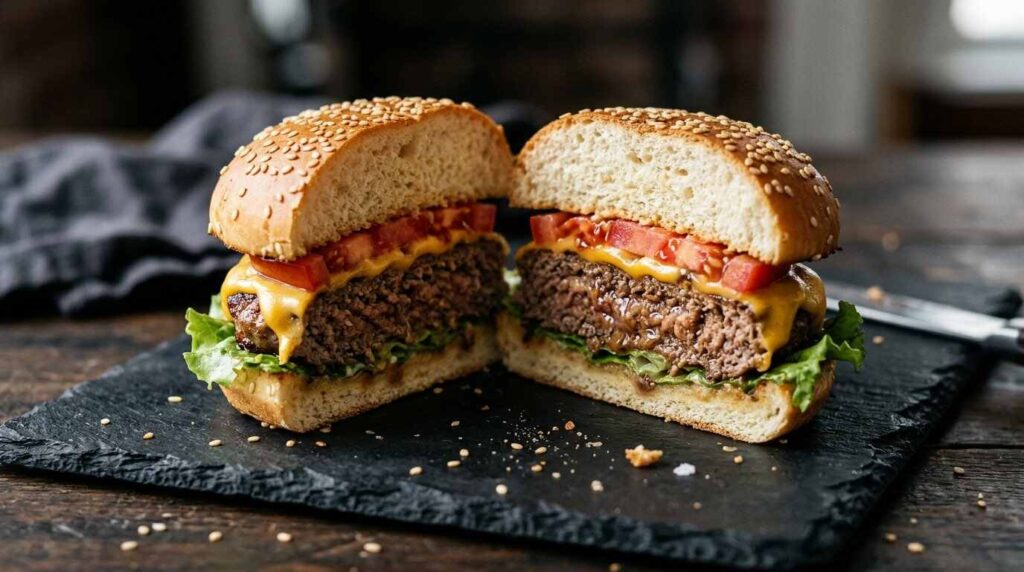
In 2006 a Panera Bread operator stood before a Massachusetts court arguing that burritos, tacos and quesadillas were sandwiches, and lost. The burger question looks simpler on paper. Merriam-Webster answers it in its own entry for the word: a hamburger is “a sandwich consisting of a patty of hamburger in a split typically round bun,” according to the dictionary’s definition of hamburger. Outside the dictionary the answer fragments. Food writers, chefs, that Massachusetts judge, an internet food-classification scheme and a federal labeling manual each draw the line in a different place, and none of them has settled the matter for everyone else.
Video: When Does A Burger Become A Sandwich? — from the Andy Cooks YouTube channel
The dictionary position
Two slices, a split roll, and a filling in between
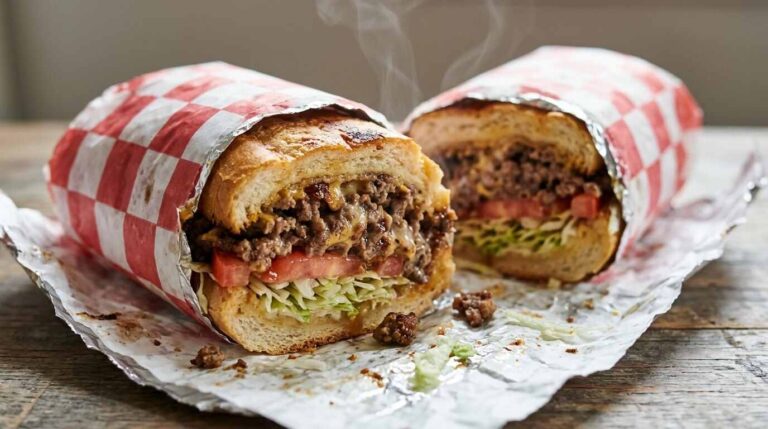
The general entry in Merriam-Webster defines a sandwich as “two or more slices of bread or a split roll having a filling in between”, with a second sense of one slice of bread covered with food. The entry mentions neither hamburgers nor hot dogs; its examples are a ham sandwich and a peanut butter and jelly sandwich. A split bun is a split roll, which is why writers who start from the dictionary tend to reach the same conclusion. Food Republic’s Erin Metz applies that definition and concludes that by the technical definition burgers are sandwiches, while granting that no consensus exists.
The same dictionary dates the word to 1762 and names it for John Montagu, the 4th Earl of Sandwich, who died in 1792. The origin of the food and the man is covered in the earl of Sandwich origin post.
The definition, though, is a description of how English speakers use a word, and speakers have been unusually split on this one. Matthew Spina of Tasting Table calls the burger “just a subcategory of sandwich,” then adds a wrinkle: in the United States a burger is defined by its meat more than its bread, whereas he reports that in other English-speaking countries it is defined by the bun. His article names no source for the second claim.
What the USDA labeling book says
A sandwich defined by meat content and jurisdiction
The Food Safety and Inspection Service of the U.S. Department of Agriculture keeps a Food Standards and Labeling Policy Book, and a revised edition of that book defines sandwiches by type rather than offering a single culinary definition. The closed sandwich entry states that the “product must contain at least 35 percent cooked meat and no more than 50 percent bread.” Two bread slices, or the top and bottom of a sliced bun, enclosing meat or poultry fall outside federal meat and poultry inspection. Open-faced sandwiches, which must contain at least 50 percent cooked meat, are inspected.
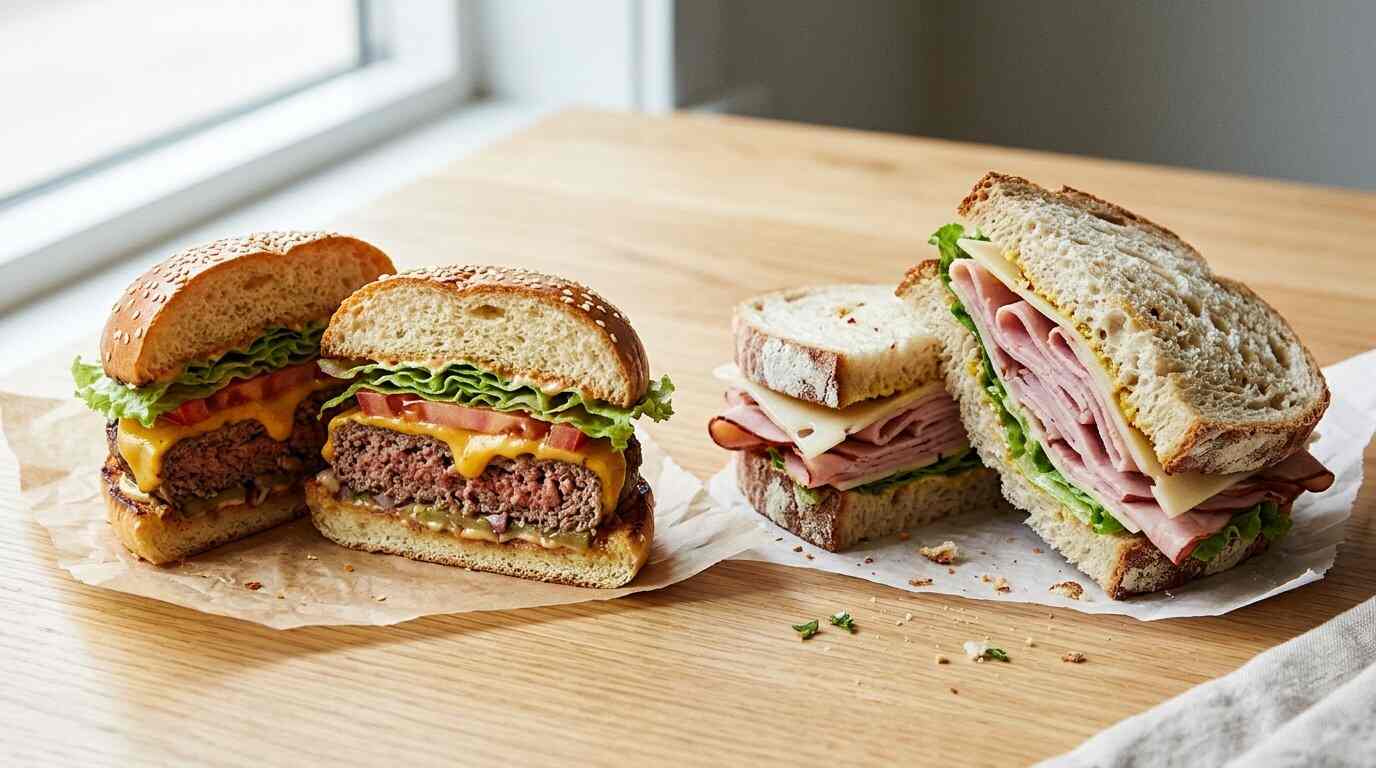
The purpose of those entries is deciding which agency inspects which product, not settling a dispute over lunch. A separate entry for dinner products notes that a frankfurter or hamburger on a bun counts as a sandwich-type product when it is a component of a dinner. The book thus treats a hamburger on a bun as sandwich-type for its own regulatory purposes without ruling on what a diner should call it.
The Massachusetts burrito case
A lease clause, a Panera, and a Qdoba
The best-known court ruling on the sandwich question never mentioned burgers. In 2006 the Massachusetts Superior Court for Worcester County heard White City Shopping Center v. PR Restaurants, reported at 21 Mass. L. Rptr. 565. PR Restaurants operated Panera Bread locations, and its lease barred the landlord from renting to a bakery or restaurant whose sandwich sales exceeded 10 percent of total sales. The lease did not define sandwiches. When the landlord negotiated with a Qdoba franchisee, the Panera operator argued that burritos, quesadillas and tacos were sandwiches.
Judge Jeffrey Locke disagreed. According to a contemporary account, he wrote that “A sandwich is not commonly understood to include burritos, tacos, and quesadillas.” The same account says the judge heard from food experts, including a Cambridge chef, and consulted a dictionary. A later article describes the ruling as resting on the Merriam-Webster wording, which fits a split roll but not a single tortilla.
The opinion’s logic is relevant to burgers only by implication. A court that treats two slices or a split roll as the marker of a sandwich leaves a hamburger inside the category. These details come from secondary accounts of the ruling.
The Cube Rule
Structural starch decides everything
An internet classification scheme, the Cube Rule, sorts foods by where structural starch sits on the faces of a cube. The site credits the Twitter/X account @Phosphatide with the idea and says “Identify your food based on the location of structural starch.” A sandwich in this system has solid top and bottom faces. A taco has a bottom and two sides, and the site places hot dogs and sub sandwiches there. A food with three stacked layers is a cake, and the site’s example is a Big Mac.
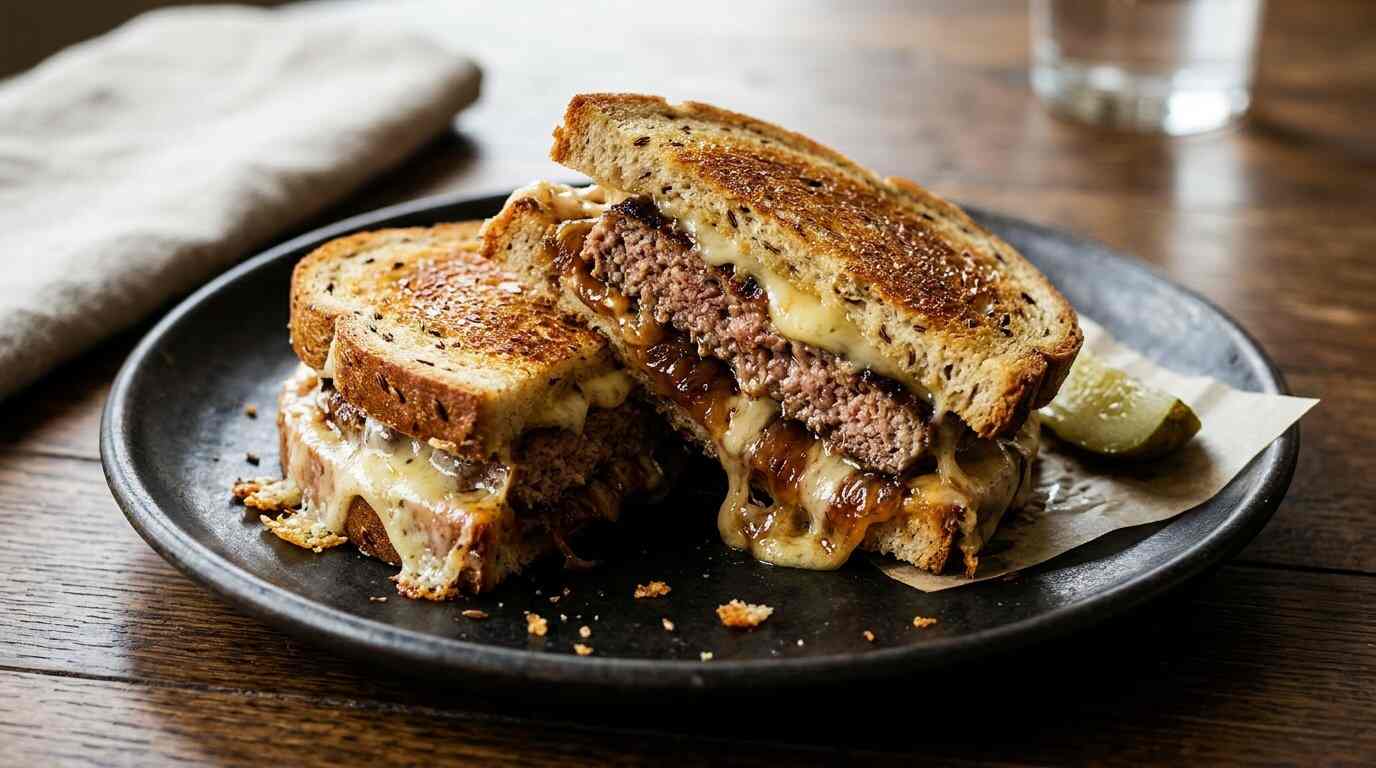
A plain hamburger is not addressed directly on the page. By the logic of the scheme, a burger with one bun top and one bun bottom would have two solid faces, which is the sandwich definition, while a multi-layer burger would drift toward cake.
Chefs and food writers split
Five yeses, one no, and a shrug
Charlotte Magazine put the question to seven restaurant professionals, and the answers ran across the range. Chris Coleman of Stoke said “a burger is a sandwich. Period.” Clark Barlowe of Heirloom Restaurant agreed but called the burger “the pinnacle of sandwiches,” and Tom Condron of The Liberty described the hamburger as a sandwich that “broke off and began a solo career.” Marc Jacksina, host of Order/Fire, held that a burger is sandwich-like in construction but is not a sandwich. Katy Kindred of Kindred Restaurant declined to pick a side.
Elsewhere the same split shows up. The Daily Meal’s Dan Myers and Elaina Friedman wrote in 2021 that “all burgers can be considered sandwiches”, and they cite a definition from The Atlantic that requires two exterior pieces that are separate or mostly separate. Mashed argues that the difference is cultural rather than structural: sandwiches are tied to work and convenience, burgers to leisure and American fast-food identity. It reports a 2020 BuzzFeed poll in which 56 percent of respondents called burgers a separate food category.
Attendees at a 2016 burger event in Philadelphia, interviewed by Billy Penn, produced the argument in miniature. One camp said a burger comes between two pieces of bread. The other said a burger’s bun is a roll, not bread. Some participants argued both sides in the same conversation.
Where the hot dog fits
The neighboring argument has an official trade-group answer
The burger debate keeps getting tangled with its sibling. The National Hot Dog and Sausage Council, established in 1994 by the American Meat Institute, offers twelve reasons that a hot dog is not a sandwich, according to Tasting Table, and the argument is mostly cultural. One reason: a lottery winner would shout “hot dog!” rather than “sand wich!” The twelve reasons are about hot dogs only.
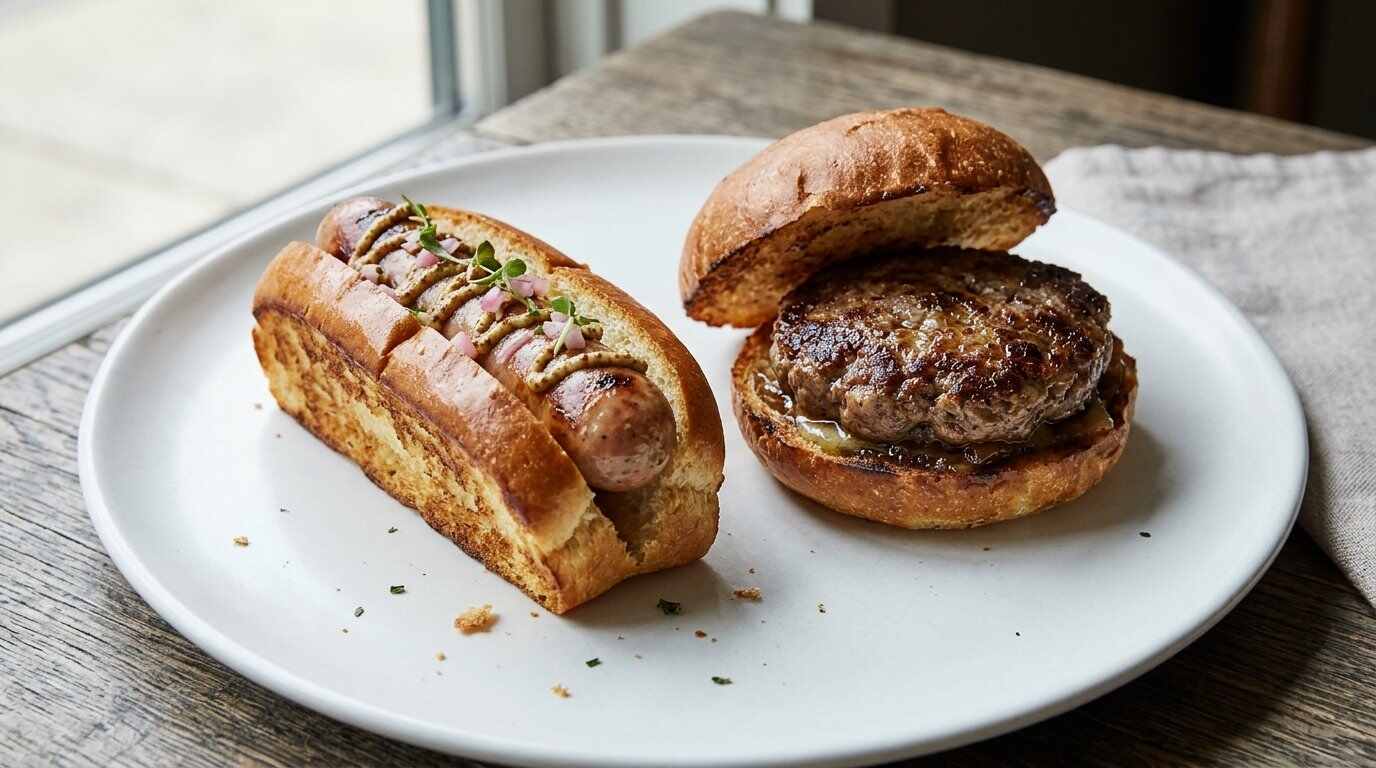
The Cube Rule files the hot dog under tacos, with a bottom and two sides, rather than under sandwiches. Food Republic’s Metz treats the burger as the easier case because most burgers are served between bread or a bun. Spina draws a separate line, saying nobody would call sliced deli turkey on a bun a turkey burger.
The site’s separate post Is a Hot Dog a Sandwich? follows the same split in more detail. Merriam-Webster treats the hot dog as a sandwich because its definition covers a split roll with a filling, and according to Mental Floss the publisher’s account posted “The hot dog is a sandwich.” on May 27, 2016. The National Hot Dog and Sausage Council places the hot dog in a category of its own, and New York’s tax department counts it as a sandwich.
A hamburger follows the same dictionary logic. A patty in a split bun fits wording that makes a split roll with a filling a sandwich, which is why the dictionary position and the court ruling on burritos point the same way even though neither mentions burgers by name.
Burgers built like other sandwiches
Patty melts, sloppy joes, and the edges of the category
Several griddle sandwiches sit on the line between the two camps. Spina notes that opinions on the patty melt differ: some call it a type of hamburger, others a sandwich, and he says it forms “a category all its own.” The sloppy joe is another ground-beef sandwich that tends to come up in the same arguments.
Naming history adds a wrinkle. The Tasting Table piece says hamburgers evolved from German immigrants’ Hamburg-style ground steaks, first called hamburger steak sandwiches. If that account is right, the sandwich label arrived with the food, and the later doubt about it is the newer development.
Common questions
Does the dictionary call a hamburger a sandwich?
Yes. Merriam-Webster’s entry for hamburger describes it as a sandwich consisting of a patty of hamburger in a split, typically round bun. The general sandwich entry mentions neither hamburgers nor hot dogs.
What is the Cube Rule?
An internet classification scheme that sorts foods by where structural starch sits on the faces of a cube. A sandwich in this system has solid top and bottom faces.
Why does the hot dog keep coming up?
The National Hot Dog and Sausage Council, established in 1994 by the American Meat Institute, offers twelve reasons that a hot dog is not a sandwich, according to Tasting Table, and the argument is mostly cultural.
Sources
- Merriam-Webster, Sandwich: https://www.merriam-webster.com/dictionary/sandwich
- Merriam-Webster, Hamburger: https://www.merriam-webster.com/dictionary/hamburger
- USDA FSIS, Food Standards and Labeling Policy Book (revised): https://www.usda.gov/sites/default/files/guidance-documents/Labeling-Policy-Book%20Revised%20Disclaimer%202.24.26.pdf
- Quimbee, White City Shopping Center v. PR Restaurants, LLC: https://quimbee.com/cases/white-city-shopping-center-v-pr-restaurants-llc
- Lowering the Bar, Judge Rules Burrito Is Not Sandwich: https://loweringthebar.net/2006/11/judge_rules_bur.html
- Seacoast Current, Is a burrito a sandwich? This Massachusetts judge doesn’t think so: https://seacoastcurrent.com/is-a-burrito-a-sandwich-this-massachusetts-judge-doesnt-think-so/
- The Cube Rule: https://cuberule.com/
- Tasting Table, What Makes A Hamburger Different From A Sandwich?: https://www.tastingtable.com/1871154/hamburger-vs-sandwich-difference
- Charlotte Magazine, Is a Burger a Sandwich? We Asked 7 Charlotte Restaurant Pros: https://www.charlottemagazine.com/?p=12819
- Food Republic, Are Burgers Sandwiches? What About Hot Dogs?: https://www.foodrepublic.com/1845087/are-burgers-hot-dogs-sandwiches/
- The Daily Meal, Are Burgers And Hot Dogs Sandwiches?: https://www.thedailymeal.com/eat/are-burgers-hot-dogs-sandwiches
- Mashed, A Burger Is, Indeed, A Sandwich: https://www.mashed.com/1364080/burger-sandwich-debate
- Billy Penn, Sandwich or nah?: https://billypenn.com/?p=165929
- Tasting Table, Are Hot Dogs Sandwiches? The National Hot Dog And Sausage Council Settles The Debate: https://www.tastingtable.com/2201679/are-hot-dogs-sandwiches-national-hot-dog-sausage-council/
Keep reading
- Mayonnaise vs Miracle Whip: What the Labels, the Law and the History Show
- Fluffernutter Origin: Emma Curtis, Archibald Query and Who Gets Credit for the Sandwich
- Pork Roll vs Taylor Ham: One New Jersey Meat, Two Names and a Century of Argument
More in this section: Sandwich Debates guide.