In this story
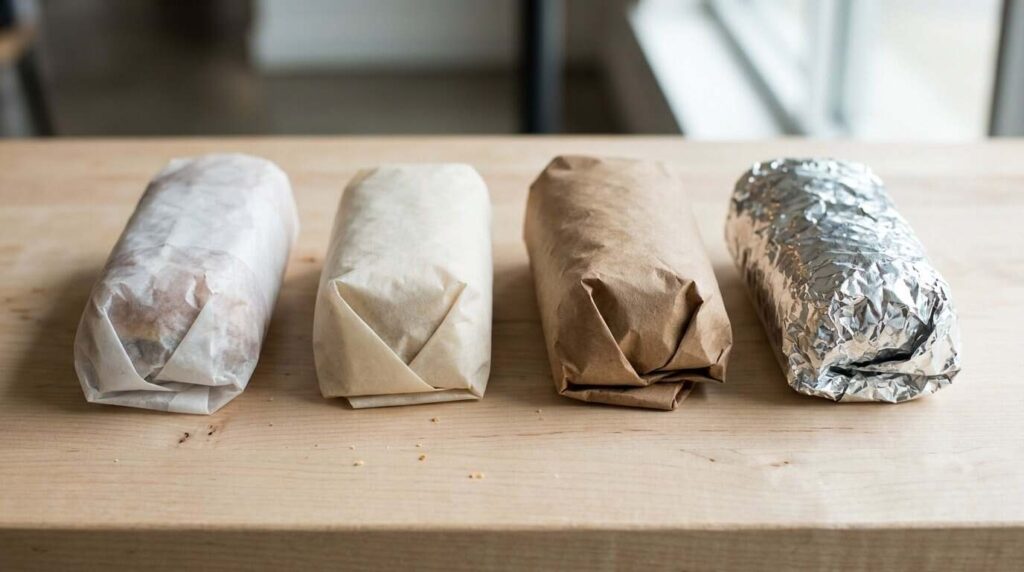
A sheet of kitchen foil is 98.5 percent aluminum. Wax paper is a triple-waxed tissue, and baking parchment gets its grease resistance from a bath of sulfuric acid. The first and second descriptions come from a U.S. Department of Agriculture page on packaging, the third from a Cal Poly explainer, and all three sheets end up around sandwiches alongside kraft butcher paper and purpose-made wrap sheets. The makers and the food-safety agencies draw the lines between them in different places.
Video: Wax Paper vs. Parchment Paper: What’s the Difference? — from the History of Simple Things YouTube channel
The sheets delis use
Butcher paper, sandwich wrap and the older drugstore fold
Butcher paper is kraft paper, described by the restaurant supplier WebstaurantStore as coarse and sturdy. Most rolls carry a sizing treatment that adds wet strength and leak resistance, while the wide 24-, 30- and 36-inch rolls are usually untreated. In a 2023 trade interview, Oren International president Alan NeSmith told PaperAge that butcher paper is simple, uncoated and low-priced, and that it works best on dry fillings such as turkey and pita sandwiches. Juicier or greasier fillings call for something else.
Butcher paper and freezer paper are separate products. NeSmith describes butcher paper as the base from which freezer paper starts before a polyethylene coat is added, and the USDA describes freezer paper as white paper with one side coated in plastic to guard against freezer burn.
Retail sandwich wrap is a third category. The same WebstaurantStore guide says traditional fully open sheets wrap sandwiches, burgers and hot dogs, and that grease-resistant versions exist.
A packed-lunch fold appears in print too. An undated Virginia Cooperative Extension bulletin, Safe Carried Meals by Ann A. Hertzler, lists sandwiches among foods to wrap in “moisture and vapor proof” materials and describes a “drug store wrap” in which enough paper is used to fold the edges over, fold the sides and seal.
Wax paper
Paraffin pressed into tissue
The Museum of Fine Arts Boston’s conservation wiki defines it as moistureproof paper coated or impregnated with wax. The USDA description is more specific: a triple-waxed tissue paper with food-safe paraffin pressed into the pores and coated on the outside.
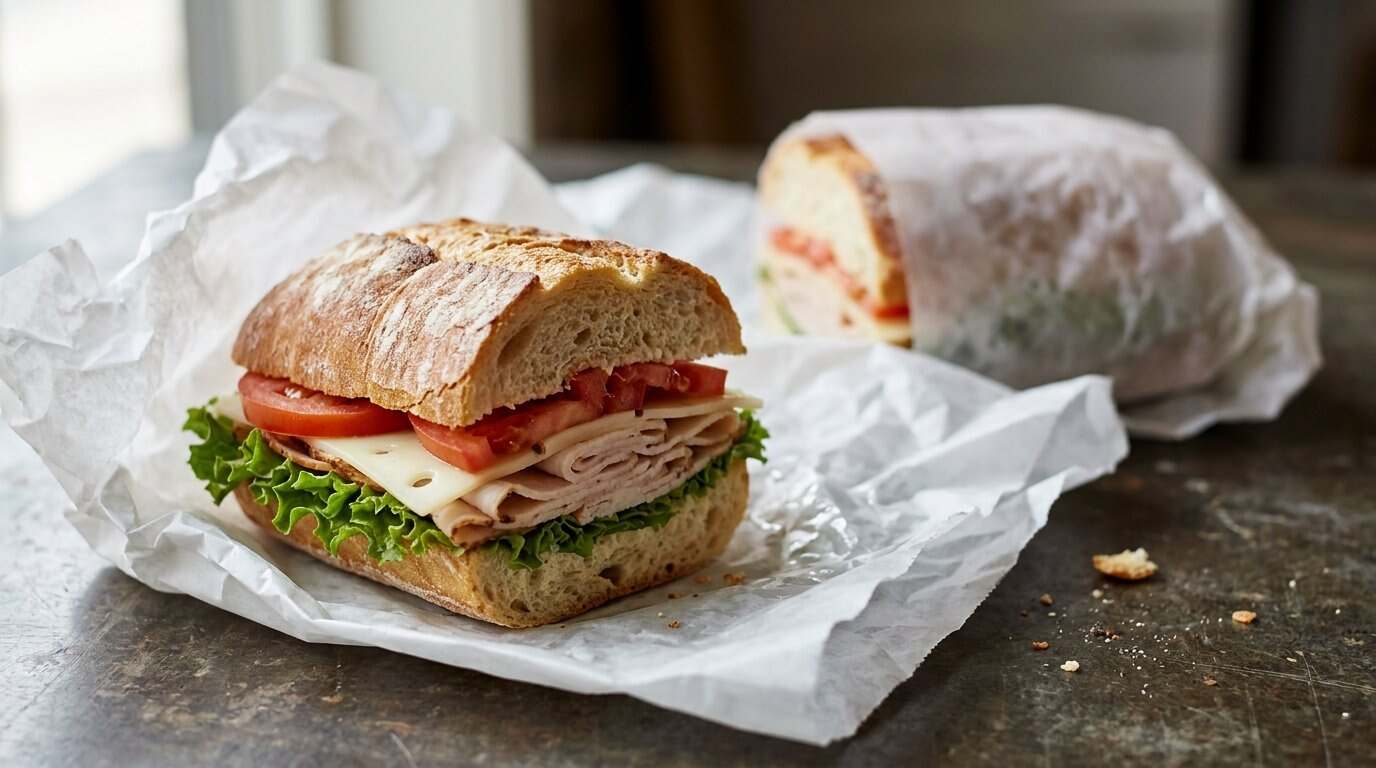
Suppliers sort it into two kinds. WebstaurantStore says dry wax paper has wax pressed into the sheet with no surface residue and suits hot foods, sandwiches, pizza box liners and patty paper, while wet wax paper is waxed on both sides for a glossy, water-resistant finish and suits refrigerated foods and candy dipping. The seller gives no temperature limit.
Manufacturers state heat limits more strictly. Reynolds, which sells wax paper at retail, says on its product page that “Wax paper should not be directly exposed to the heat of an oven,” while allowing it as a pan liner when batter or dough covers it completely. The same page says microwaves have little effect on it and recommends it as a splatter cover. The USDA lists wax paper among materials suitable for microwaving when the package directs and only for a single use.
On the regulatory side, the federal food-contact rule for paper, 21 CFR 176.170, covers substances in paper and paperboard that touch aqueous and fatty foods. Its list includes petroleum wax and synthetic petroleum wax that meet requirements in other sections of the rule.
How wax paper got its start
A disputed inventor and a Chicago wrapper factory
Oiling or waxing paper to make it translucent or moisture-resistant goes back at least to the Middle Ages, according to a Wikipedia article on wax paper, which is used here only as a pointer because no better history was available. It dates widely used beeswax-coated paper to the 19th century, Gustave Le Gray’s waxed paper negatives to 1851, and Herman Frasch’s method of purifying paraffin and coating paper with it to 1876, after which paraffin largely replaced natural wax.
Who invented it is contested. The Museum of Fine Arts Boston entry credits Thomas Edison with inventing wax paper in 1872, while the Wikipedia article’s history section cites a web piece titled “9 Inventions Edison Did Not Make.”
A Chicago firm shows the commercial side. The Made in Chicago Museum lists Central Waxed Paper Co., established in 1915 at 5659 W. Taylor Street, and holds a bread-wrapper sheet from the 1920s, though the museum notes its research on the company is unfinished. A Cooks Info entry on food wrappers, citing an Ohio State University Extension source, notes that when Kellogg’s cereal went to the general public it was sold in a waxed, heat-sealed bag called Waxtite wrapped around a plain box.
Parchment paper
An acid bath instead of a wax coat
Baking parchment starts as ordinary wood-pulp paper. A Cal Poly housing blog on the subject describes pulping softwood, forming the sheet on a moving wire mesh, and then passing the paper through a sulfuric acid bath that partially dissolves the surface cellulose in a step called parchmentizing. This makes the sheet denser and less permeable. Some parchment is then coated with silicone, which the post calls optional, for non-stick properties and greater heat resistance.
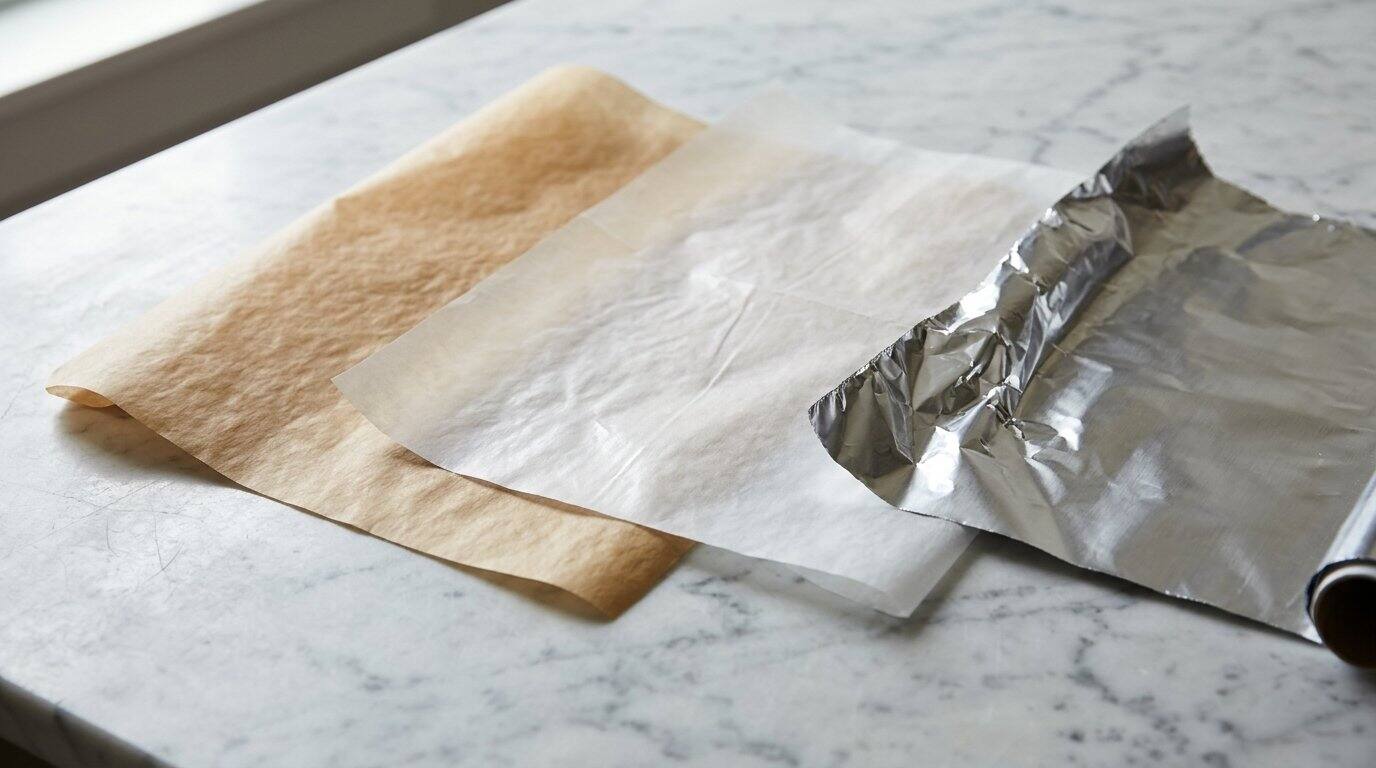
Wikipedia’s article on parchment paper says non-stick surfaces are made either with quilon, a chromium(III) solution, or with silicone, and gives “420 °F (216 °C)” as the tolerance of some brands. Cal Poly gives 425°F for most parchment and advises checking the maker’s instructions, and the Reynolds page cites 425°F as the oven-safe limit for parchment in contrast to wax paper. Five degrees separates them, a gap that matters more to a cookie sheet than to a wrapped sandwich.
The USDA calls parchment odorless and tasteless, made from cotton fiber and/or pure chemical wood pulps, used mainly in baking as a pan liner or for wrapping food during cooking.
Aluminum foil
From Schaffhausen to Reynolds Wrap
Foil is a metal sheet where the others are paper. According to the Wikipedia article on aluminium foil, J. G. Neher & Sons founded an aluminium works at Schaffhausen, Switzerland, in 1886; an endless rolling process was invented in December 1907; and the first foil rolling plant, Dr. Lauber, Neher & Cie., opened in Emmishofen in 1910. Tobler began wrapping chocolate in the foil in 1911. The same article says tin foil gave food a slight tin taste, one reason aluminum replaced it.
In the United States, the Lemelson Center at MIT records that Richard S. Reynolds founded U.S. Foil Co. in 1919, making tin-lead wrappers for cigarette and candy makers, then moved to aluminum in the 1920s as falling prices made it cheaper. Reynolds Metals formed in 1928 and introduced Reynolds Wrap Aluminum Foil in 1947. A 1997 Spokesman-Review anniversary story says the company had leftover aluminum from wartime production and sent salespeople door to door; the first Reynolds Wrap salesman, Charles Mapes, said it “wasn’t easy selling a product that people had never seen.” By 1997, the article reports, foil was in 98 percent of American kitchens. Encyclopedia.com gives the same 1947 launch date and adds that Reynolds built its first aluminum foil plant and rolling mill in Louisville in 1928.
The shiny and dull sides are a by-product of manufacturing, not a coating. Wikipedia explains that thin foil is rolled in two sheets stacked together for the final pass, so the sides touching each other come out matte and the outer sides shiny. The USDA agrees that it makes no difference which side contacts the food. The same page says pinholes or a blue liquid from contact with salty, vinegary, acidic or spicy foods are harmless, and recommends heavy-duty foil or freezer wrap for longer freezer storage. Metal in a microwave can cause electric arcing, according to the Wikipedia article.
Where the materials differ
Heat, grease, moisture and storage
Heat splits them first: Reynolds and the reference articles agree that parchment is the paper made for ovens and wax paper is not. In a microwave the order flips, with wax paper listed as suitable by the USDA and Reynolds and foil liable to arc. Against grease and moisture, wax paper and treated butcher paper hold up, uncoated butcher paper struggles with juicy fillings, and parchment relies on its acid bath and cross-linking, plus an optional silicone coat. For long freezer storage the USDA points to heavy-duty foil or freezer wrap rather than ordinary papers.
Inside any of these wrappers, the real contest is between the filling and the bread. Moisture moving from fillings into slices is covered in the post on why sandwiches get soggy, and the drying side of the same problem in why bread goes stale. The regional names for the long-roll sandwich are covered in the post on the hoagie, sub, hero and grinder.
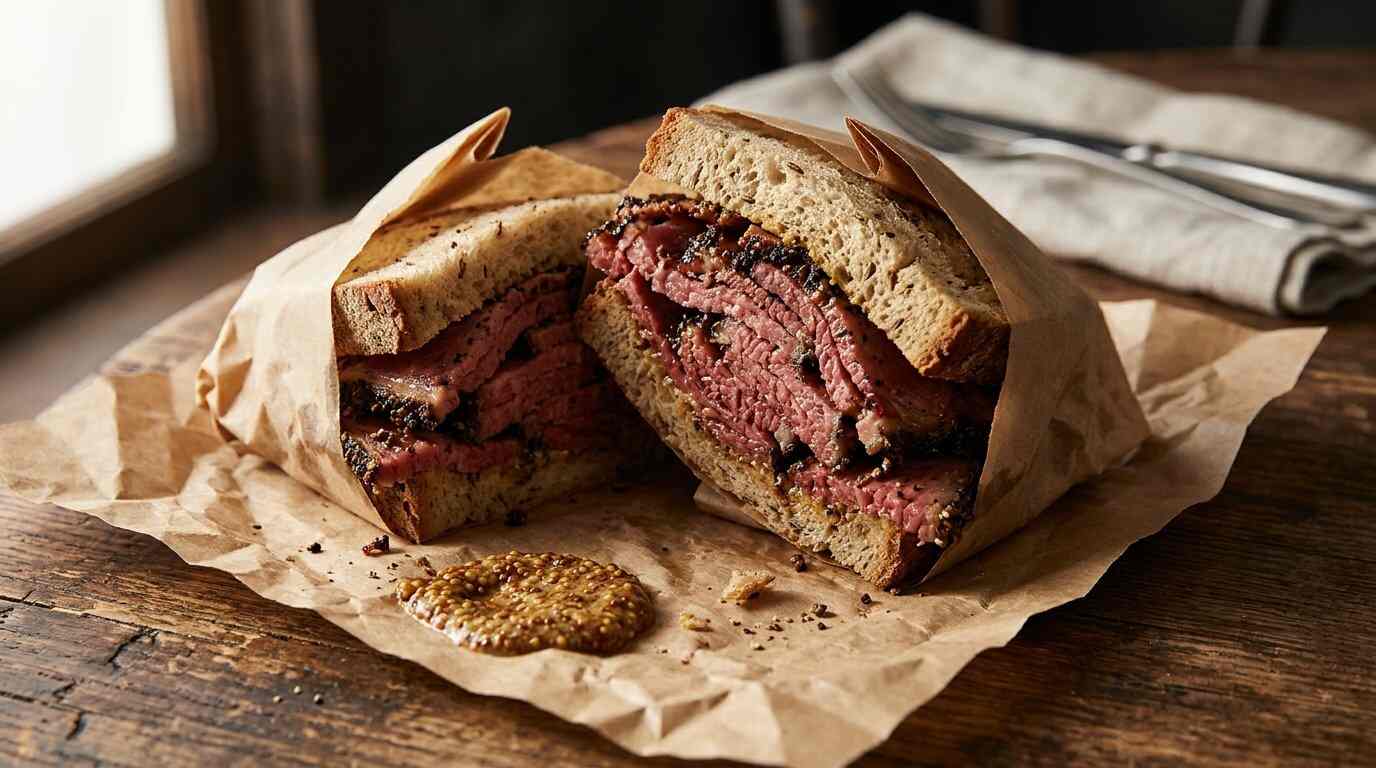
The guides settle ovens, microwaves, grease and freezer burn. They leave one question to the people behind the counter: which sheet goes around a hot pastrami on rye, and which goes around a cold turkey hoagie?
Common questions
What are wax paper, parchment and foil made of?
A U.S. Department of Agriculture page lists wax paper as a triple-waxed tissue paper, parchment as a paper made from cotton fiber or chemical wood pulp, and foil as 98.5 percent aluminum.
Which of them can go in an oven or microwave?
Reynolds and the reference articles agree that parchment is the paper made for ovens and wax paper is not. For microwaves, wax paper is listed as suitable by the USDA and Reynolds, while foil can cause arcing.
What is butcher paper?
Butcher paper is kraft paper, described by the restaurant supplier WebstaurantStore as coarse and sturdy. Most rolls carry a sizing treatment that adds wet strength and leak resistance, while the wide 24-, 30- and 36-inch rolls are usually untreated.
Sources
- USDA Food Safety and Inspection Service, Meat and Poultry Packaging Materials: https://www.fsis.usda.gov/food-safety/safe-food-handling-and-preparation/food-safety-basics/meat-and-poultry-packaging
- Reynolds Brands, Wax Paper: https://www.reynoldsbrands.com/products/food-storage/wax-paper
- Museum of Fine Arts Boston, CAMEO, Wax paper: https://cameo.mfa.org/wiki/Wax_paper
- eCFR, 21 CFR 176.170: https://www.ecfr.gov/current/title-21/chapter-I/subchapter-B/part-176/subpart-B/section-176.170
- WebstaurantStore, Types of Food Wrapping Paper: https://www.webstaurantstore.com/guide/587/types-of-food-wrapping-paper.html
- PaperAge, Oren International butcher paper (Aug. 25, 2023): https://www.paperage.com/2023news/08-25-2023oren-international-butcher-paper.html
- Virginia Cooperative Extension, Safe Carried Meals: https://vtechworks.lib.vt.edu/server/api/core/bitstreams/12965ddf-6638-4737-8100-19e6f7ea5988/content
- Made in Chicago Museum, Central Waxed Paper Co., est. 1915: https://www.madeinchicagomuseum.com/?p=1642
- Cooks Info, Food wrappers: https://www.cooksinfo.com/food-wrappers
- Cal Poly Grand Avenue Housing, Parchment Paper: From Pulp To Perfection: https://grandavehousing.calpoly.edu/blog/parchment-paper-from-pulp-to-perfection-1764797152
- Lemelson Center, Richard Reynolds: https://lemelson.mit.edu/resources/richard-reynolds
- Spokesman-Review, Aluminum foil 50 years old (April 30, 1997): https://www.spokesman.com/stories/1997/apr/30/aluminum-foil-50-years-old/
- Encyclopedia.com, Reynolds Metals Company: https://www.encyclopedia.com/social-sciences-and-law/economics-business-and-labor/businesses-and-occupations/reynolds-metals-company
- Wikipedia, Wax paper (pointer only): https://en.wikipedia.org/wiki/Wax_paper
- Wikipedia, Parchment paper (pointer only): https://en.wikipedia.org/wiki/Parchment_paper
- Wikipedia, Aluminium foil (pointer only): https://en.wikipedia.org/wiki/Aluminium_foil
Keep reading
- Serrated Bread Knife for Sandwiches: Why the Teeth Matter and What to Look For
- Who Invented the Sandwich? What the Earl of Sandwich Sources Say
- Tea Sandwiches: History, Fillings and How They Are Made
More in this section: Gear and Equipment guide.