In this story
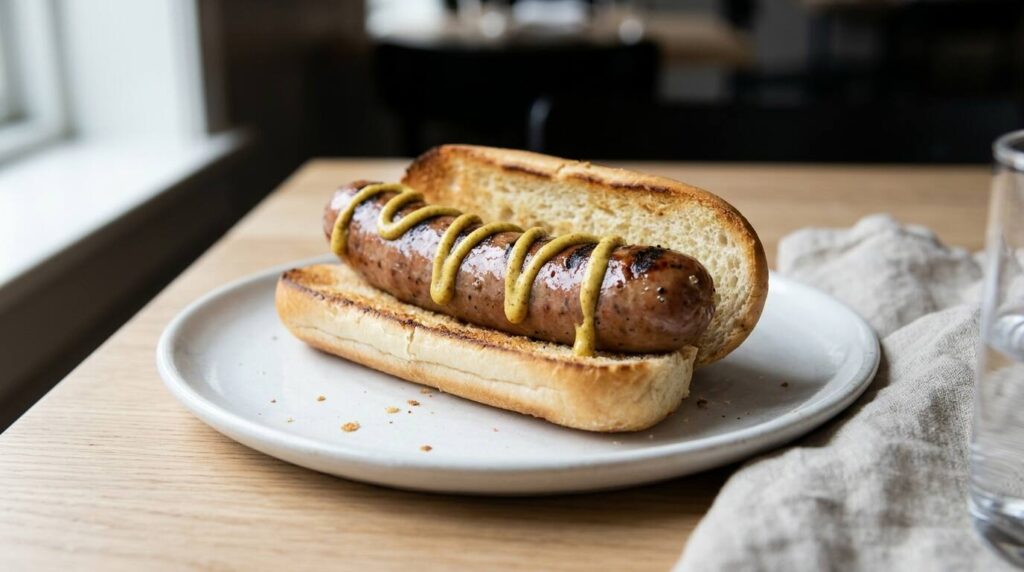
No single authority decides whether a hot dog is a sandwich, and the ones that have ruled disagree. Merriam-Webster says it is. The National Hot Dog and Sausage Council says it belongs in a category of its own. New York’s tax department counts it as a sandwich, and the U.S. Department of Agriculture’s labeling rules leave the matter less clear than either camp admits. The documents behind each position are short, and they show that the argument is mostly about where the word “sandwich” is drawn.
Video: A hot debate: Is a hot dog…a sandwich? | Chronicle 5 WCVB
The dictionary definition
Merriam-Webster’s entry for sandwich gives two senses of the noun: “two or more slices of bread or a split roll having a filling in between,” and “one slice of bread covered with food.” The entry does not mention hot dogs. The inclusion of “a split roll” is what makes the definition elastic, since a frankfurter in a bun is a filling in a split roll.
The company has said as much in public. According to Mental Floss, the publisher’s official Twitter account posted on May 27, 2016, over Memorial Day weekend: “The hot dog is a sandwich.” A longer argument sits on Merriam-Webster’s own word-history pages. The author defines a hot dog as a frankfurter “heated and served in a long split roll,” applies the sandwich definition, and concludes that a hot dog is a sandwich. The page also anticipates the objection that a sausage is not a “filling” because it is a single item. That reading, it points out, would exclude peanut butter and bologna sandwiches too.
Other dictionaries draw the line elsewhere. Tasting Table quotes the Oxford English Dictionary as describing a sandwich as “an article of food for a light meal or snack, composed of two thin slices of bread, usually buttered.” A frankfurter roll that is hinged at one edge, rather than two separate slices, sits awkwardly inside that wording. The Oxford entry itself was not fetched for this article, so that phrasing rests on the secondary report.
What the hot dog council argues
The National Hot Dog and Sausage Council is a trade-group project of the meat industry. Tasting Table reports that the American Meat Institute established it in 1994 and notes that it is not a regulatory body. In November 2015 it issued an announcement on its official policy, dated November 6 on the Council’s own site. Council president Janet Riley is quoted there: “Limiting the hot dog’s significance by saying it’s ‘just a sandwich’ category is like calling the Dalai Lama ‘just a guy.'” The Council’s stated position is that the hot dog should be called a “hot dog formerly known as a sandwich.”
The statement is less absolute than the slogan. It says the Council has often followed American history and USDA guidance, and that those sources have placed the hot dog among sandwiches. It also says the rules are unclear, because they turn on whether a sandwich is “open” or “closed.” Mental Floss covered the announcement as a ruling that the hot dog is a category of its own, and reports that the Council acknowledged older names such as “Coney Island sandwich.” Mental Floss dates the news to the week of November 11, 2015, a few days later than the Council’s own release.
A separate page on the Council’s site, “Is A Hot Dog A Sandwich?”, lists 12 reasons the two words are not interchangeable. They are cultural rather than legal. Ballpark vendors do not call out “sandwiches,” the list says, and sandwich-eating contests do not air on ESPN. The twelfth reason is that a lottery winner would shout “hot dog,” not “sandwich.” Nothing on the list cites a statute, a dictionary or a court.
Where the hot dog came from
The sausage and the bun arrived in the United States separately and were joined in the nineteenth century, and the credit for joining them is contested. Britannica says German immigrants brought the sausage to New York in the 1860s, where street vendors sold it as “dachshund sausages,” and that the first recorded use of “hot dog” dates to 1884. It also places Charles Feltman’s popular Coney Island stand in 1871 and reports that hot dogs were served by the thousands at the 1893 World’s Columbian Exposition in Chicago. It does not say who first put one in a bun.
The Coney Island History Project says Feltman is “generally credited” with inventing the hot dog on a bun and passes along a legend that he put a sausage in a roll so he would not have to supply silverware and plates. Its account notes that Nathan Handwerker, a former employee, opened Nathan’s Famous nearby in 1916. The Coney Island account frames the Feltman story as tradition rather than a documented first, and neither source says whether early buyers thought of the result as a sandwich.
Tax law says yes
Government tax rules are among the few places where the question gets a written answer. New York’s Department of Taxation and Finance published Tax Bulletin ST-835, issued April 8, 2019. It defines sandwiches as “cold and hot sandwiches of every kind that are prepared and ready to be eaten,” taxable regardless of “the filling or number of layers.” Its list of examples names “hot dogs and sausages on buns, rolls, etc.” alongside hamburgers, “heroes, hoagies, torpedoes, grinders, submarines,” burritos, gyros and breakfast sandwiches.
Food Republic reports that the bulletin also covers “any other sausage or frank encased in a bun,” and that Colorado classified hot dogs as sandwiches in 2016, along with frozen pizza and chicken wings, in a liquor-licensing context. Food Republic does not name the Colorado statute, so the claim is reported here as that outlet’s description rather than as a verified citation.
These rules answer a narrow question: which foods are taxed at which rate or qualify under which license. They define “sandwich” for administrative purposes and say nothing about what the word means in everyday speech.

What the USDA says
The federal picture is split by who inspects what. Food Safety News explained in 2015 that the USDA regulates open-face sandwiches containing meat, while the Food and Drug Administration takes over once a top slice of bread or a top bun is added. The USDA’s Food Safety and Inspection Service does not cover closed-face sandwiches, which is why the agency created an Export Verification Program for those headed to Canada, starting in February 2016.
On definitions, Chowhound quotes the 2024 edition of the USDA’s Food Standards and Labeling Policy Book. A closed-face sandwich is “consisting of two slices of bread or the top and bottom sections of a sliced bun that enclose meat or poultry.” An open-faced sandwich must contain at least 50 percent cooked meat. Chowhound notes that the book does not say how hot dogs are classified. The policy book itself could not be retrieved for this article, so the wording rests on those reports. A hot dog in a split bun could fit either reading, depending on whether a “split” bun counts as “top and bottom sections.”
Courts and the burrito precedent
No court has been found, in the sources checked, that rules directly on hot dogs. The cases that exist concern burritos and tacos, and they are cited in hot dog arguments because they show how judges handle the word.
In 2006 a Massachusetts judge, Jeffrey Locke, sided with the Qdoba restaurant chain in a lease dispute. According to the Boston Globe, Panera Bread had argued that an exclusivity clause barring leases to businesses that “primarily sell sandwiches” kept Qdoba out of a shopping center. The Globe reports that the judge found the agreement did not define sandwiches and concluded that tacos, burritos and quesadillas are not commonly understood to be sandwiches. Lowering the Bar quotes the opinion: “A sandwich is not commonly understood to include burritos, tacos, and quesadillas.” The reasoning there was that those foods are typically made with a single tortilla and stuffed with a filling.
In 2024 an Indiana judge went the other way. The Syracuse Law Review summarizes Quintana v. Fort Wayne Plan Commission, in which Allen County Superior Court Judge Craig J. Bobay held that tacos and burritos are “Mexican-style sandwiches” under a zoning policy that allowed sandwich restaurants, so the Famous Taco could open without a zoning amendment. The Globe adds that the judge reasoned the policy did not limit sandwiches to American cuisine. The Syracuse piece observes that the hot dog question remains open.
Each ruling turned on the text of a private lease or a local zoning policy, so neither binds anyone outside its own dispute.

Where the companies stand
Manufacturers have weighed in as well. Fox News reported that Oscar Mayer posted on Twitter that it believed hot dogs are sandwiches and asked followers to call a hotline to say why they thought a hot dog is not one. A day later the company declared that “hot dogs ARE sandwiches” and said the callers had not changed its stance. The article quotes unnamed callers, one of whom said people would be upset if a hot dog were served cut in half, as sandwiches often are.
Each party’s position tracks what it needs the word to do. A dictionary records usage, so it counts any filling in a split roll. A tax agency needs a category broad enough to cover prepared food. A trade group wants the product to stand as a brand of its own, while a sausage maker has declared for the sandwich. No source fetched for this article gives a ruling that settles everyday usage.
Sources:
- Merriam-Webster, “sandwich” (dictionary entry): https://www.merriam-webster.com/dictionary/sandwich
- Mental Floss, “Merriam-Webster Boldly Declares That a Hot Dog is a Sandwich”: https://mentalfloss.com/article/80901/merriam-webster-boldly-declares-hot-dog-sandwich
- Merriam-Webster, “Sandwich History: 10 Words You Can Chew On” (hot dog entry): https://www.merriam-webster.com/wordplay/to-chew-on-10-kinds-of-sandwiches/hot-dog
- Tasting Table, “Are Hot Dogs Sandwiches? The National Hot Dog And Sausage Council Settles The Debate”: https://www.tastingtable.com/2201679/are-hot-dogs-sandwiches-national-hot-dog-sausage-council/
- National Hot Dog and Sausage Council, official policy announcement: https://hot-dog.org/press/national-hot-dog-and-sausage-council-announces-official-policy-hot-dog-sandwich-controversy
- Mental Floss, “Hot Dog Council Says a Hot Dog is Not a Sandwich”: https://www.mentalfloss.com/food/hot-dog-council-says-hot-dog-not-sandwich
- National Hot Dog and Sausage Council, “Is A Hot Dog A Sandwich?”: https://hot-dog.org/culture/hot-dog-sandwich
- Britannica, “hot dog”: https://www.britannica.com/topic/hot-dog
- Coney Island History Project, Charles Feltman: https://www.coneyislandhistory.org/node/1881
- New York State Department of Taxation and Finance, Tax Bulletin ST-835: https://www.tax.ny.gov/pubs_and_bulls/tg_bulletins/st/sandwiches.htm
- Food Republic, “The US States Where Hot Dogs Are Legally Sandwiches”: https://www.foodrepublic.com/1493160/hot-dog-sandwich-law-us-states/
- Food Safety News, “Why USDA needs a new program to export sandwiches to Canada”: https://www.foodsafetynews.com/2015/11/why-usda-needs-a-new-program-to-export-sandwiches-to-canada
- Chowhound, “What’s The Definition Of A Sandwich? The USDA Might Not Even Know”: https://www.chowhound.com/1585606/definition-of-a-sandwich-usda/
- Boston Globe, Indiana taco and burrito sandwich ruling: https://www.bostonglobe.com/2024/05/16/lifestyle/taco-burritos-sandwich-judge-court-ruling
- Lowering the Bar, “Judge Rules Burrito Is Not Sandwich”: https://loweringthebar.net/2006/11/judge_rules_bur.html
- Syracuse Law Review, “Are Burritos Sandwiches”: https://lawreview.syr.edu/are-burritos-sandwiches-indiana-judge-rules-that-burritos-are-sandwiches/
- Fox News, Oscar Mayer hot dog hotline: https://www.foxnews.com/food-drink/oscar-mayer-says-hot-dogs-are-sandwiches-twitter-isnt-so-sure.amp
- Chronicle 5 WCVB (YouTube), “A hot debate: Is a hot dog…a sandwich?”: https://www.youtube.com/watch?v=tTA05M_CPp8