In this story
Havarti is a pale Danish cow’s milk cheese, soft enough to bend and firm enough to slice, scattered with small irregular holes. It turns up on sandwiches and in grilled cheese, and it carries a name that was chosen by government decree, honors a 19th-century farm woman and was fought over in Brussels for nearly a decade.
Video: How to Make Havarti Cheese, from the Gavin Webber YouTube channel
What Havarti is
Rice-sized holes and an al dente bite
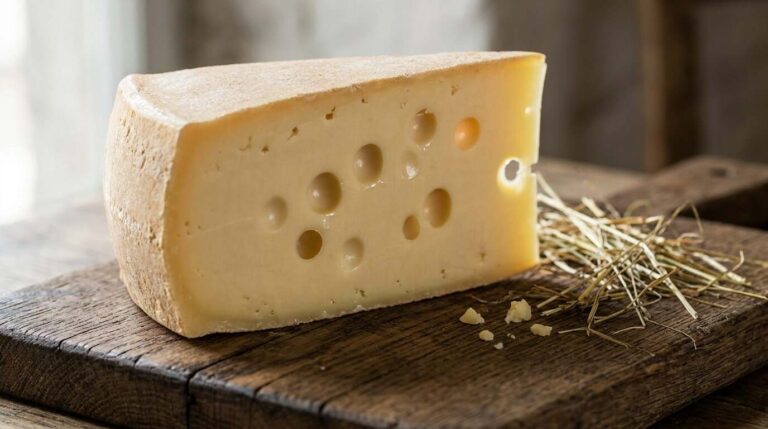
The official description comes from Denmark itself. The Danish product specification filed with the Danish food authority, Fødevarestyrelsen, defines Havarti as a ripened, semi-hard cheese of cow’s milk, soft but still sliceable with a slight al dente bite. It has many irregular holes about the size of rice grains, mostly 1 to 2 millimeters wide and up to 10 long, spread evenly through the paste. The flavor is described as mild, slightly sour and aromatic, growing stronger with age.
The cheese comes in more than one style. It can be made with a smear-ripened rind, ripened one to two weeks at 14 to 21 °C and then one to three weeks cooler, or without a rind, ripened about three weeks. Fat content varies too. The specification sets the maximum water content by fat level, from up to 54 percent water in a cheese with 30 to 40 percent fat in dry matter down to 44 percent water in the richest cream Havarti at 60 percent fat or more. The holes in the richest versions are generally smaller.
How it is made
Cut, stirred, heated and pressed
The method in the specification is straightforward. Milk is fat-standardized and pasteurized, starter culture and rennet are added, and the curd is cut, stirred, partly drained of whey and heated before it is molded, pressed, cooled and salted. The finished cheese is then packed or given its rind treatment.
How moisture and fat shape the way any cheese melts is covered in Grill Cheesy’s why cheese melts and turns greasy.

Hanne Nielsen
The farm at Holte
The name points to a person and a place. The Danish specification says the name was chosen to honor Hanne Nielsen, who in the second half of the 1800s worked at Havartigaarden, a farm in Holte near Copenhagen. From 1866 to 1890, it says, she made the farm’s cheese well known across Denmark and became a supplier to the Royal Danish Court. The document also describes “Havarti” as an old Danish word dating to the Viking era.
Nielsen’s own life is documented in Danish records, which Wikipedia’s Hanne Nielsen entry, used here as a pointer, summarizes: born in 1829 near Søllerød, married at 19 to Hans Nielsen, living at Havarthigaard, and traveling in Europe to study cheesemaking.
Invented in 1852, or named in 1952
Two dates a century apart
Whether Nielsen invented the cheese is a separate claim. Some popular accounts, and Wikipedia’s Havarti entry citing The Oxford Companion to Cheese, credit her with creating it after returning from her travels. The Danish government’s own specification makes a narrower claim. It says the name was adopted in 1952, by a Ministry of Agriculture decree dated March 13, 1952, because Danish names were needed for typical Danish cheeses under the Stresa Convention, and it chose Havarti to honor her work.
The specification’s own timeline begins later than her lifetime: first Danish production of the cheese type in 1921, L.A. Sørensen’s switch to rectangular molds in 1930, trials at the State Experimental Dairy in 1951, and the naming decree in 1952. Wikipedia notes that the cheese was previously called Danish Tilsiter. The defensible version, then, is that Havarti is a 20th-century Danish cheese named for a 19th-century cheesemaker, and that the invention credit rests on secondary accounts.

The fight over the name
Brussels, 2010 to 2019
Denmark’s claim to the name took nine years. The European Commission’s Implementing Regulation (EU) 2019/1751, dated Oct. 21, 2019, registered Havarti as a Protected Geographical Indication, which limits the name in the EU to cheese made in Denmark. Denmark had applied on Oct. 5, 2010.
The opposition was broad. The regulation lists objections from Germany and Spain; the U.S. Dairy Export Council, the National Milk Producers Federation and the International Dairy Foods Association; the U.S. Trade Representative’s Office; New Zealand’s foreign ministry and its Dairy Companies Association; and Dairy Australia, backed by the Australian government. They argued the name was generic, pointing to a Codex Alimentarius standard for Havarti dating to 1966, its listing in the Stresa Convention and production in several countries.
The Commission rejected those arguments. It held that international standards and tariff codes do not prove a name is generic and that only European consumer perception counts. It cited a Danish consumer survey linking Havarti to Denmark, found that small volumes made in Spain, Germany, Poland, Finland and Estonia did not break that link, and refused the compromise name “Danish Havarti.” German and Spanish producers who had sold Havarti before 2010 got a five-year transition. The regulation records Spanish output at 5,100 tonnes in 2014 and German output at 2,571 tonnes in 2012.
The protection applies inside the EU. Havarti made in the United States and sold in the United States is not covered by the regulation.
Havarti on bread
Smørrebrød and the grilled cheese
In Denmark the cheese’s natural place is on rye. The Danish specification calls Havarti easy to slice and lay on bread, a common breakfast cheese on rye, and ties it to smørrebrød, the open-faced sandwich tradition covered in Grill Cheesy’s smørrebrød. Other soft sandwich cheeses on Grill Cheesy include Monterey Jack and Fontina. Its Dutch neighbor at the cheese counter is Gouda.

Questions people ask
Is Havarti a Danish cheese? Yes. In the EU the name is a Protected Geographical Indication reserved for cheese made in Denmark, under Regulation (EU) 2019/1751.
Who invented Havarti? The name honors Hanne Nielsen of Havartigaarden in Holte. The Danish specification says the name was adopted in 1952; the claim that Nielsen invented the cheese comes from secondary sources.
What is cream Havarti? A richer Havarti with 60 percent or more fat in dry matter, which the Danish specification allows to hold up to 44 percent water and notes tends to have smaller holes.
Slicing it thin
A cheese plane, the flat Scandinavian-style slicer, takes thin even slices from a soft block like Havarti:
- BOSKA Cheese Slicer Copenhagen – Stainless Steel, Dishwasher Safe: a stainless steel cheese plane. See it on Amazon (affiliate link)
Video: Boska Cheese Slicer Copenhagen Review, from the Just Cook n Bake YouTube channel
Other tools for cutting cheese are compared in Grill Cheesy’s cheese slicer vs knife vs grater.
As an Amazon Associate I earn from qualifying purchases. A commission may be earned if you buy through this link, at no extra cost to you.
Sources
- Fødevarestyrelsen (Danish Veterinary and Food Administration), Produktspecifikation for Havarti: https://cdn2.gopublic.dk/fvst/Media/638929154696604590/Produktspecifikation%20for%20Havarti%20-%20080925.pdf
- European Commission, Implementing Regulation (EU) 2019/1751 of 21 October 2019 entering the name ‘Havarti’ (PGI): https://eur-lex.europa.eu/eli/reg_impl/2019/1751/oj/eng
- Wikipedia, Havarti (pointer only): https://en.wikipedia.org/wiki/Havarti
- Wikipedia, Hanne Nielsen (pointer only): https://en.wikipedia.org/wiki/Hanne_Nielsen