In this story
Gouda is a cheese named after a place where nobody had to make it. The town of Gouda, in South Holland, earned its name on the world’s most familiar yellow wheel by selling cheese rather than producing it. According to the European Commission’s register of protected food names, Gouda received feudal rights to sell cheese in the county of Holland in 1395, and the county’s farmers could sell only at its market. Over generations the product took the name of the square where it changed hands. Today the word covers everything from a waxed supermarket wheel to a five-year-old block that shatters under the knife, and that range is the reason it shows up in so many grilled cheese recipes.
Video: How world-famous Gouda cheese is made in the Netherlands, from the DW Food YouTube channel
A cheese named for a market square
Trading rights, not a dairy, gave the wheel its name
The Commission’s account dates the Gouda cheese market to the 14th century and ties the cheese’s name directly to it. Medieval Dutch cities could apply for monopolies on certain goods, and Gouda’s monopoly on cheese turned the town into the place every farmer in the county had to visit. Production later spread to North Holland and then across the country, and by the 20th century Gouda was a national product.
Some histories push the name back further. Culture, the American cheese magazine, writes that Gouda can trace its name back to at least 1184, and the EU’s own Colours by Europe campaign uses the same 1184 date for when the cheese was first made. The two dates describe different things. 1184 is the claim for the cheese’s age; 1395 is the documented market right.
The market itself still runs. The Commission lists it on Thursday mornings from April to August, with farmers stacking wheels in front of City Hall and bargaining with traders, though it now works mostly as a spectacle for visitors. National Geographic reports that cheese is no longer sold at the market itself and that buyers head to the town’s cheese shops instead.
Pronunciation splits along the Atlantic. Culture gives the Dutch version as HOW-duh and notes that most Americans say GOO-duh.
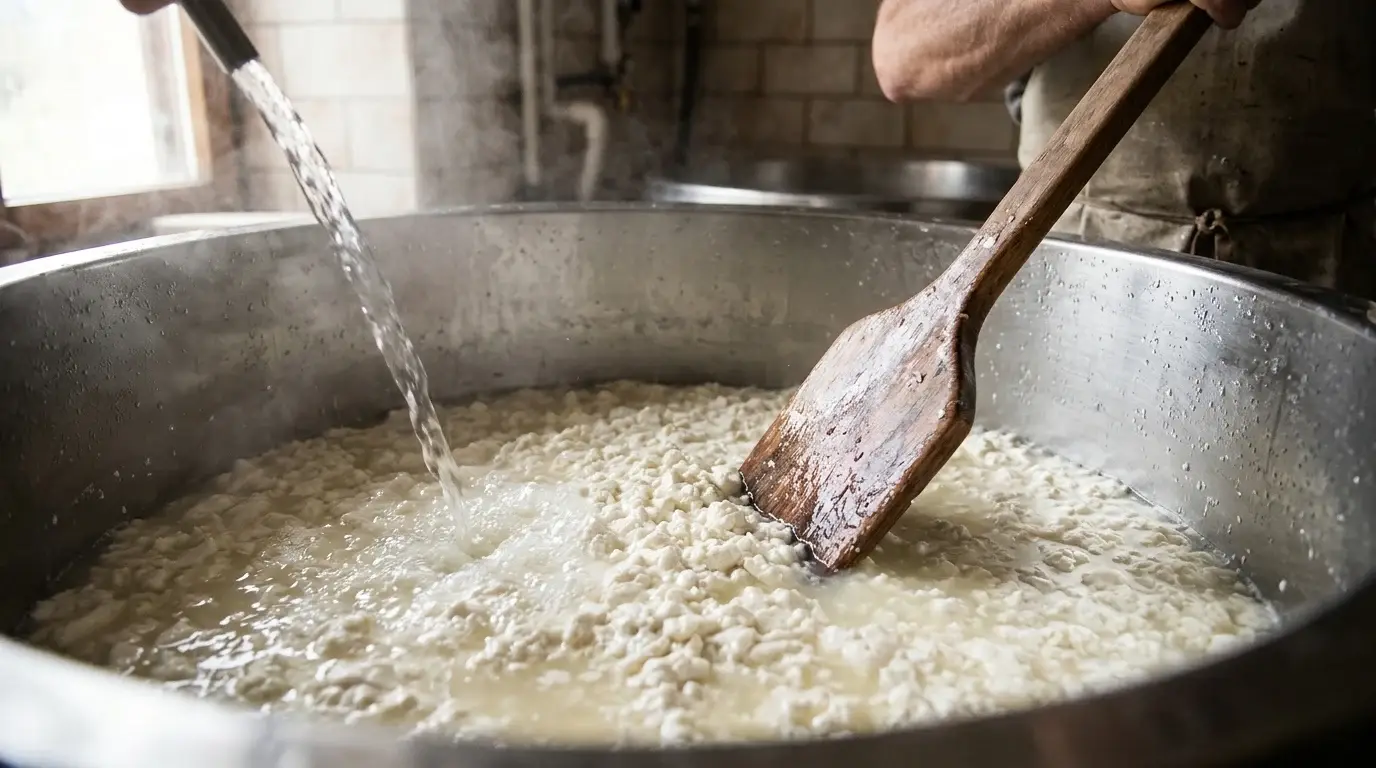
How the washed curd makes Gouda sweet
Hot water replaces some of the whey, and the lactose goes with it
Every Gouda shares one step that sets it apart from cheddar and most other firm cheeses. After the milk is curdled and some whey is drained, the cheesemaker adds water to the vat. Culture explains that the curds are washed with hot water before pressing, which removes some lactose and leaves less sugar for lactic bacteria to turn into acid. The result is a cheese that stays sweet as it ages instead of turning tart.
The Commission’s production summary for Gouda Holland fills in the rest of the sequence:
- Milk is held on the farm at no more than 6°C and reaches the cheese plant within 72 hours.
- It is pasteurised at a minimum of 72°C for 15 seconds.
- Curdling happens at about 30°C.
- The curds are separated, washed and pressed into a flattened wheel.
- Each wheel soaks in brine, then matures in open air, turned and checked until a dry rind forms.
That flattened wheel is a rule, not a habit. Culture puts it plainly: “All Goudas are made as flattened wheels.” The magazine gives the size range as anywhere from 1 to 176 pounds, with natural, coated or waxed rinds, plain or flavored with herbs and spices such as cumin or fenugreek.
The yield is steep. Marieke Penterman, who makes Gouda on her family’s dairy in Thorp, Wisconsin, told the Clark County Press that roughly 10 pounds of milk make 1 pound of cheese.
Young, aged and the crunch inside
Months on the shelf change the paste, the color and the flavor
Age is the main variable in Gouda, and it changes almost everything. The Commission notes that full maturity can take more than a year, and that the cheese goes from sweet and soft to firmer, deeper gold and more aromatic. Culture describes young Gouda, at two to six months, as semi-soft to semi-firm with a mild, creamy, pale-yellow paste. At five years or more, the same cheese becomes very hard, breaks into shards and turns a rich orange, with tasters picking up toasted nuts, butterscotch, vanilla and bourbon.
Those white specks in old Gouda are not salt. A 2015 study in the journal Dairy Science & Technology used powder X-ray diffraction to examine them, and its authors report that the hard, crunchy crystals in long-aged Gouda and Parmigiano-Reggiano consist of tyrosine, an amino acid released as proteins break down. The same researchers tentatively identified a form of crystalline leucine in larger spherical “pearls” found in long-aged Gouda, and they found crystals growing inside the cheese’s small eyes as well.

What “Gouda” protects, and what it doesn’t
Three Dutch names have EU protection; the word itself does not
Plain “Gouda” can be made anywhere. The European Union protects only specific Dutch names. According to the Commission, Noord-Hollandse Gouda was registered as a protected designation of origin in 1996, and Gouda Holland as a protected geographical indication in 2010. Gouda Holland uses milk from dairy farms anywhere in the Netherlands. Noord-Hollandse Gouda uses milk only from the province of Noord-Holland and is a less salty variety.
The Gouda Holland specification gets precise. Its single document, published by the EU and reproduced by Australia’s trade department, says only calf rennet is used and that each cheese is identified by a casein mark that can be traced through a Dutch register. The geographical area is defined as Holland, meaning the European part of the Kingdom of the Netherlands.
The farmhouse version is a separate category. Boerenkaas, or “farmer’s cheese,” is registered as a Traditional Speciality Guaranteed. Its specification, published by the UK government, requires that it be made on the farm from raw milk, with at least half the milk from the farm’s own herd. Goudse Boerenkaas is the Gouda-style version, alongside Edam and Leiden styles and versions made from goat, sheep and buffalo milk. Britannica adds a practical detail for shoppers: farm-made Gouda bears an imprint of the word “Boerenkaas” on the rind.
Gouda made in America
A Dutch dairy family in Wisconsin built a raw-milk farmstead version
Gouda-style cheese is made well beyond the Netherlands, and one of the best-documented American producers is in Clark County, Wisconsin. Marieke Penterman and her husband, Rolf, emigrated from the Netherlands to run a dairy, and Wisconsin Public Radio reported that Marieke became homesick for gouda and set out to make it herself.
The Clark County Press reported in 2017 that her Holland’s Family Cheese imports its equipment, cultures, herbs and spices from the Netherlands and uses milk from the family’s own herd. Penterman described the method in two short sentences: “We do not pasteurize our milk before we make it into cheese,” and the milk goes straight from the cow into the vat. Culture has written that before Marieke Gouda began in 2007, no authentic Boerenkaas-style Gouda was being made in America.
The awards followed. The same Clark County Press article lists a top award in 2013 at the U.S. Championship Cheese Contest for the 6-to-9-month Marieke Gouda, and the Thorp Courier reported that at the 2019 contest Marieke Gouda took both the first and second runner-up positions, one-tenth of a point behind the grand champion.
Gouda on the griddle
Younger wheels melt cleanly; older ones are for shaving
For a grilled cheese, age decides the outcome. Culture’s cheesemonger column sums up the rule for any cheese: higher fat, higher moisture and younger cheeses melt best, while older cheeses are drier and need more heat. America’s Test Kitchen reached the same conclusion while developing its grown-up grilled cheese, finding that younger cheeses almost always performed better than aged ones because aged cheese has less moisture and tends to clump.
Gouda fits that pattern exactly. Clare Malfitano, head chef at Murray’s Cheese in New York, told Chowhound that “younger cheeses like New York white cheddar and red wax gouda have a higher moisture content”, and she credits that moisture for an even melt. By Culture’s age bands, that means a wheel in the two-to-six-month range rather than a crystalline block.
Aged Gouda is a different tool. A five-year wheel will not stretch, but grated finely and mixed with a younger melter it brings the butterscotch and the faint crunch of tyrosine into the sandwich.

Frequently asked questions
Is Gouda made in the town of Gouda?
The name comes from the town’s cheese market, not from dairies inside the town. The European Commission ties the name to the market rights Gouda received in 1395.
Why is Gouda sweet?
The curds are washed with water before pressing, which removes some lactose. Less lactose means less lactic acid, so the cheese stays sweet as it ages.
What are the crunchy bits in aged Gouda?
Researchers using X-ray diffraction identified the hard crystals in long-aged Gouda as tyrosine, an amino acid released as proteins break down.
Which Gouda is best for grilled cheese?
Young Gouda, at roughly two to six months, has the moisture to melt evenly. Aged Gouda is better grated in small amounts alongside a younger cheese.
Sources
- European Commission, “Gouda Holland PGI / Noord-Hollandse Gouda PDO”: https://agriculture.ec.europa.eu/farming/geographical-indications-and-quality-schemes/geographical-indications-food-and-drink/gouda-holland-pgi-noord-hollandse-gouda-pdo_en
- Colours by Europe (European Commission), “Gouda Holland PGI”: https://colours-by-europe.campaign.europa.eu/en/gouda-holland-pgi
- Culture magazine, “Gouda”: https://culturecheesemag.com/?p=6441
- Culture magazine, “Distant Cheeses, Local Farmers: Authentic Dutch Gouda in Wisconsin”: https://culturecheesemag.com/blog/distant-cheeses-local-farmers-authentic-dutch-gouda-wisconsin
- Culture magazine, “What Makes a Good Melting Cheese?”: https://culturecheesemag.com/cheese-iq/ask-the-monger/makes-good-melting-cheese/
- National Geographic, “What to do in Gouda”: https://www.nationalgeographic.com/travel/article/gouda-the-netherlands
- Tansman, Kindstedt and Hughes, “Crystal fingerprinting,” Dairy Science & Technology (2015): https://pmc.ncbi.nlm.nih.gov/articles/PMC4768243
- Gouda Holland single document (EU No NL-PGI-0105-01335), via DFAT Australia: https://www.dfat.gov.au/sites/default/files/141f.docx
- Boerenkaas TSG specification, via GOV.UK: https://assets.publishing.service.gov.uk/media/666048f87b792ffff71a8755/Boerenkaas.pdf
- Britannica, “Gouda”: https://www.britannica.com/topic/Gouda-cheese
- Wisconsin Public Radio, “Marieke Penterman Missed Dutch Gouda”: https://www.wpr.org/marieke-penterman-missed-dutch-gouda-so-she-decided-make-it-herself
- Clark County Press, “Thorp – Marieke Gouda (Wins Bronze – 2017)”: https://wiclarkcountyhistory.org/6data/129/129710.htm
- Thorp Courier, “Thorp – Marieke Cheese Awards (2019)”: https://wiclarkcountyhistory.org/7data/140/140663.htm
- America’s Test Kitchen, “Why Young Cheese Melts Better than Aged Cheese”: https://www.americastestkitchen.com/how-tos/6679-why-young-cheese-melts-better-than-aged-cheese
- Chowhound, “The Best Cheese For Grilled Cheese, According To Murray’s”: https://www.chowhound.com/2023458/murrays-best-cheese-for-grilled-cheese-sandwich/