
In this story
Cheese melts because heat loosens a protein network that holds fat and water in place, and it turns greasy when that network gives way and the fat leaks out. The protein is casein, and the way it was built, acidified and aged decides whether a slice flows into a smooth sheet, stretches into strands or sweats a puddle of oil. Scientific American’s explainer on melting describes cheese-making as turning casein into a network held together by weak bonds, with water and fat trapped inside.
Video: Why Do Some Cheeses Melt Easily and Others Don’t? | Grilled Cheese | What’s Eating Dan? | America’s Test Kitchen
A protein mesh with fat and water in the holes
Cheese is not one substance, so it does not melt the way ice does. America’s Test Kitchen’s explanation says it is a protein network surrounding fat and water, and that heating liquefies the fat while the proteins loosen enough to let the cheese flow. The Cheese Science Toolkit, a teaching site created by food scientist Pat Polowsky, puts the same idea in terms of structure: casein makes up the structure of the cheese, forming a three-dimensional mesh with fat and water sitting in its holes.
Calcium holds the mesh together. Discover magazine writes that calcium, as calcium phosphate, acts as a bridge that stabilizes the casein networks. Melting and stretching depend on those bridges loosening under heat and then re-forming. Mark Johnson of the Wisconsin Center for Dairy Research, writing in the center’s Dairy Pipeline, frames it as a matter of contact: the fewer the interactions between casein molecules, the greater the melt.
A distinction in that same article is easy to miss. Chemists define melting as a solid turning to liquid, while a food scientist uses the word to mean the ability to flow or spread. Some ripened cheeses, Johnson notes, such as Camembert and Limburger, flow at refrigerator temperature.
What happens as the temperature climbs
Melting is a sequence, and the published temperatures vary by source. Prateek Sharma of Utah State University, quoted by Scientific American, describes fats softening and seeping to the surface first, then proteins losing water and softening, with melting complete around 160°F. Sharma and co-author Nitin Joshi, in a Dairy Foods column, place the start of fat melting at about 100°F and say the protein phase softens and starts to flow above about 120°F.
Discover gives a different set of numbers. It puts the release of milkfat at around 90°F and the flow stage between roughly 130°F and 180°F, and it says the proteins do not break down in that second stage but simply move more. The same article lists mozzarella melting near 130°F and Swiss near 150°F. The sources agree on the order of events, fat first and protein second, while disagreeing on the exact degrees, which is unsurprising for a material whose composition changes from one wheel to the next.
Heat also tightens the network before it loosens it. Johnson explains that warming strengthens hydrophobic interactions among the casein, which squeezes out water and opens gaps through which fat can leak. That is the first step toward a greasy surface.
Acid, calcium and the narrow window for a good melt
Acidity does most of the work in separating good melters from bad ones. Acid pulls calcium out of the casein mesh, and the amount left behind sets how firmly the proteins grip each other. Scientific American quotes John Lucey of the University of Wisconsin-Madison saying that acid dissolves some calcium and phosphate bonds and makes the cheese more fluid, but that too much acid dissolves so many bonds that casein molecules bind directly to each other and stretch is lost.
Calcium has an opposite failure mode. Sharma tells the magazine that too much calcium content means the cheese will not melt, while too little makes it melt very fast and turn runny. The Dairy Foods column adds that excess calcium in the curd forms rigid bonds between protein strands, which makes cheese harder to melt and gives poor stretch.
Johnson ties the two together with numbers. At a pH around 6.6 to 6.7, casein interactions depend mainly on calcium phosphate, and as the pH falls the calcium phosphate dissolves and hydrogen ions take its place, so melt and stretch increase. Push the pH too low and the protein clumps into large masses with too few contacts. Blue and Camembert cheeses begin at about pH 4.8 and do not stretch. Discover states that cheeses melt evenly at a pH of roughly 5.0 to 5.4, a range it describes with the caution that above pH 6 too much calcium stays bound, and below 4.6 the calcium bridges are lost.
Moisture and fat
Water and fat both soften the network, through different routes. Johnson writes that moisture increases melt and stretch by a different mechanism than fat or pH, and that higher moisture is no guarantee on its own. His example is cottage cheese, which is about 80 percent water and low in pH, and softens when heated without ever stretching. Fat helps because fat globules separate the casein aggregates, so higher-fat cheeses melt and stretch more readily and at cooler temperatures than lower-fat ones.
Discover compresses this into a rule of thumb, that cheese with higher moisture and fat content tends to have lower melting points, since liquid fat can no longer support the protein network and extra water spreads the casein apart. The Cheese Science Toolkit repeats the trend with a warning that it holds only sometimes. Drier cheeses such as aged Gouda and Parmigiano Reggiano, it says, won’t melt so well unless there is added moisture around.
Age: the point where sources split
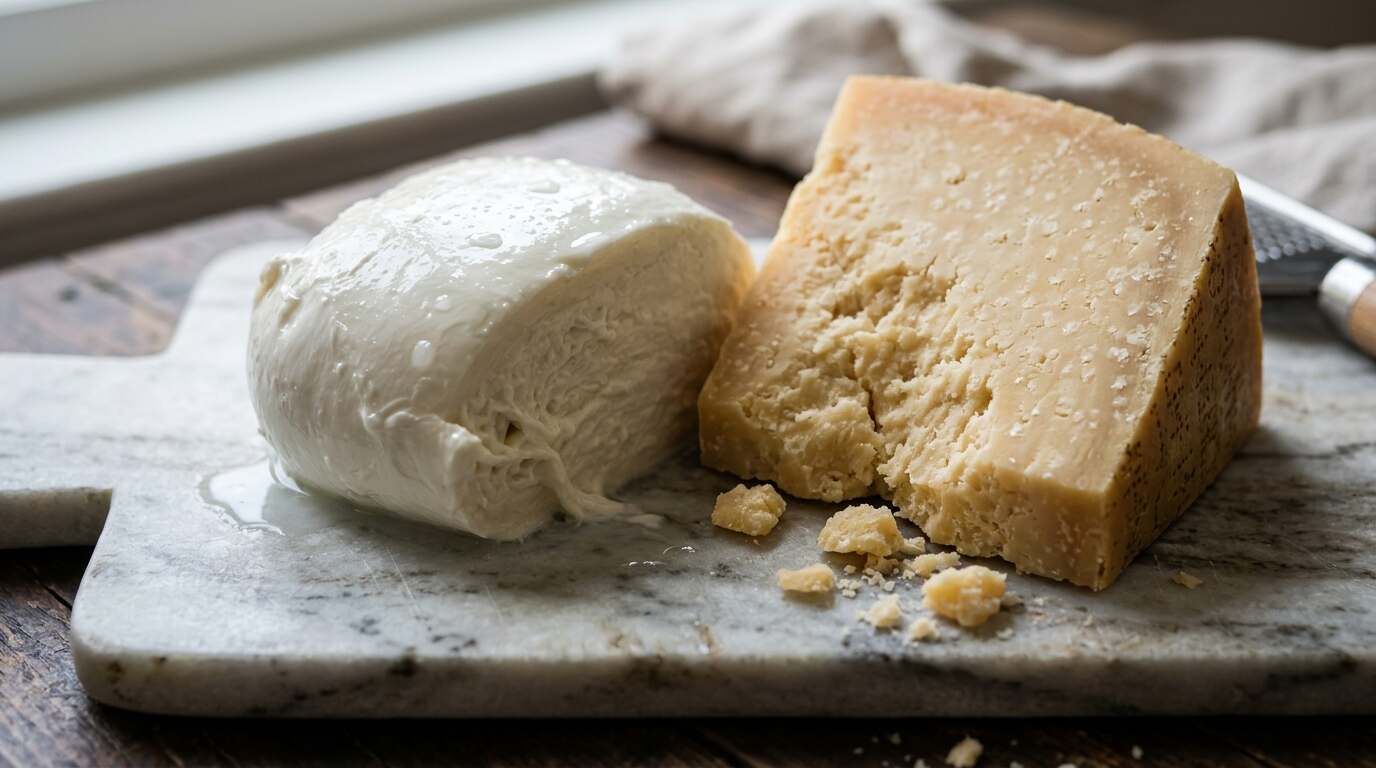
Age changes everything above, and the sources do not tell a single story. America’s Test Kitchen says younger cheeses hold more water and have looser protein structures, which lets them melt smoothly, while aging drives water out and makes the proteins bind more tightly. Its test used shredded cheese baked on tortilla wedges at 200°F for ten minutes. Unaged mozzarella melted into what the page calls “gooey perfection,” sharp cheddar aged six to 12 months melted but turned greasy, and Parmesan aged more than a year barely melted.
Johnson’s account of the chemistry points the other way on one count. Proteolysis, the slow cutting of casein by enzymes, increases melt, he writes, while decreasing stretch. Scientific American agrees that enzymes and microorganisms cut casein molecules as cheese ages, making it melt more easily but less stretchy and more likely to turn soupy. The Cheese Science Toolkit describes the result bluntly: with age, very little stretch and lots of free oil.
Both descriptions can be true together. A cheese can lose moisture and gain proteolysis as it ages, so it turns firmer on the board and, once hot, collapses into a thin, oily liquid with no strands. Johnson also describes a separate early phase in which bound calcium is replaced by hydrogen ions and the casein hydrates, which takes several days and is the main reason melt and stretch rise in very young cheese. The culture magazine writer Rebecca Haley-Park calls it common knowledge in the cheese world that younger cheeses tend to be better melters, without supplying a mechanism of her own.
Why the oil appears
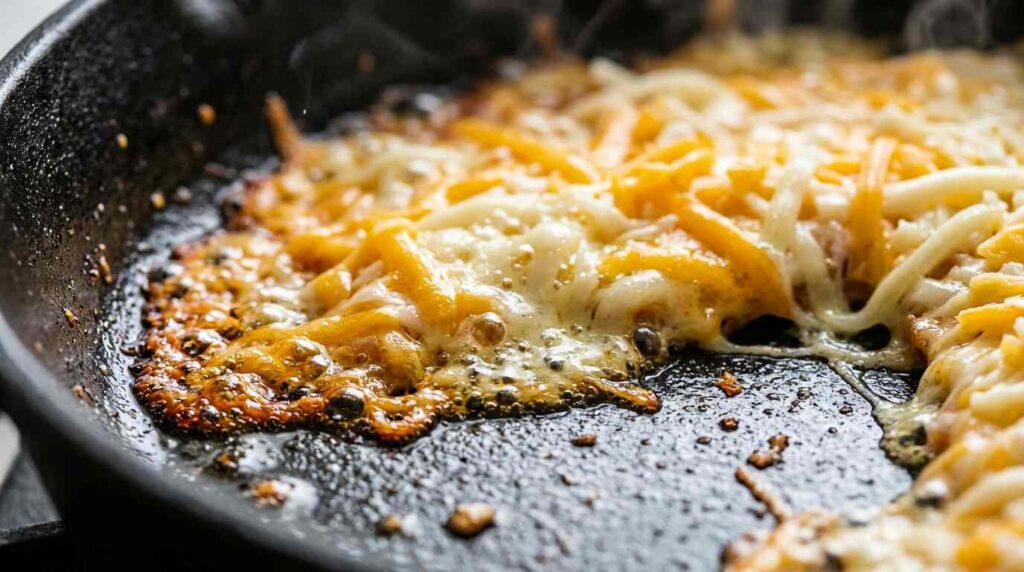
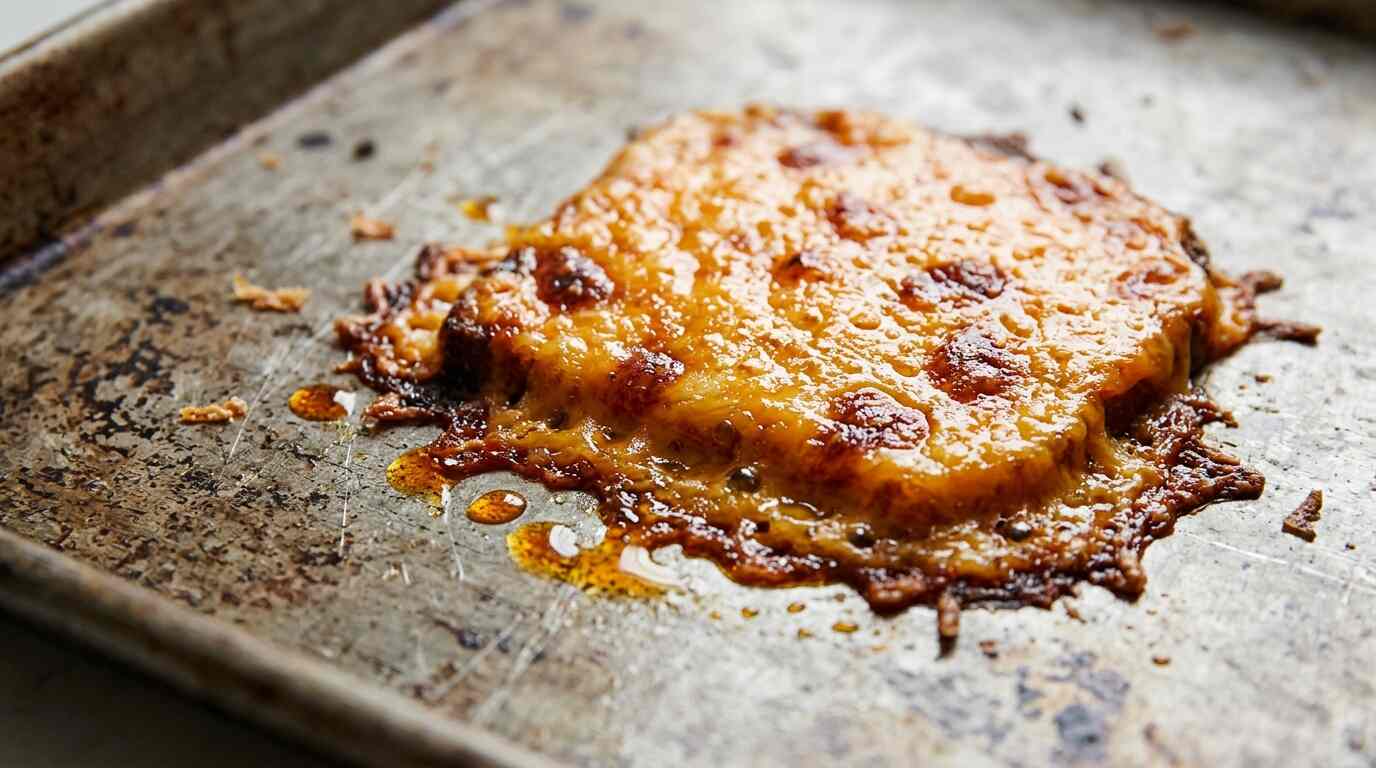
Greasiness is the visible end of the same process. The Dairy Foods column says oiling off happens when the protein matrix softens and collapses on heating, letting fat globules coalesce and flow to the surface. How much oil appears depends on whether the fat is emulsified, on the size and shape of the globules, and on the cheese’s age and degree of proteolysis. The authors add that oiling off can moderate surface dehydration, which affects browning.
Johnson’s article makes two further points. Stirring during heating increases fat release. Pasta filata cheeses such as mozzarella, which are kneaded and stretched in hot water, pool fat that is not redistributed and so release it when baked, whereas in non-pasta-filata cheeses the fat stays more evenly distributed and a faster, greater melt is needed to free it. The same working that gives mozzarella its fibrous structure, per Dairy Foods, creates fat and serum channels that matter for flow on a pizza.
America’s Test Kitchen names the failure “breaking,” the separation of fat from a cheese that squeezes out droplets instead of flowing. The Wisconsin article offers the industrial counterpoint: process cheese uses phosphates or other melting salts and water to emulsify the fat and keep it from pooling.

Cheeses that soften and never flow
Some cheeses never melt in the sense a grilled cheese needs. Ricotta is made from whey, so its structure is mostly whey proteins with permanent sulfur bonds, and Sharma says it softens rather than melts. Feta is acidic enough to be brittle and crumbly. Panela has too little acid, so it is held together too firmly to flow. Blue cheese starts acidic and hard to melt and gets easier as microbes break down its acids over time.
Plant-based cheese lacks casein altogether. Neil Cunningham, a materials scientist at the Center for Industrial Rheology in England, is quoted describing those products as “cold Jell-O” that become “hot Jell-O”. Discover adds that acid-set cheeses like queso fresco, paneer and ricotta are generally avoided for melting because calcium bridges never form in an acidic setting, so they do not produce even melts.
Heat treatment of the milk can interfere too. Johnson reports that heating milk may create sulfur bonds between denatured whey proteins and kappa-casein, which can stop a cheese from melting or stretching when baked.
Sources:
- Scientific American, “The Science of Melting Cheese”: https://www.scientificamerican.com/article/why-cheeses-such-as-mozzarella-and-cheddar-melt-differently-than-ricotta/
- Mark Johnson, “The Melt and Stretch of Cheese,” Dairy Pipeline, Center for Dairy Research, University of Wisconsin-Madison, Winter 2000: https://www.cdr.wisc.edu/assets/pipeline-pdfs/pipeline_2000_vol12_01.pdf
- Dairy Foods, Dairy Detective column by Prateek Sharma and Nitin Joshi, “The Baking Properties of Cheese: Functionality”: https://www.dairyfoods.com/articles/98955-the-baking-properties-of-cheese-functionality
- Cheese Science Toolkit, “Melt and Stretch”: https://www.cheesescience.org/melt.html
- Discover Magazine, “The Keys to Cheese: Does This Cheese Melt?”: https://www.discovermagazine.com/the-keys-to-cheese-does-this-cheese-melt-3173
- America’s Test Kitchen, “The Gooey Science of Melting Cheese”: https://www.americastestkitchen.com/articles/6836-the-gooey-science-of-melting-cheese
- culture: the word on cheese, “Why Young Cheese Melts Better Than Aged Cheese”: https://culturecheesemag.com/?p=6161
- America’s Test Kitchen (YouTube), “Why Do Some Cheeses Melt Easily and Others Don’t?”: https://www.youtube.com/watch?v=GGCA9FcgKX4