In this story
Three tools turn a block of cheese into something a sandwich can hold: a plane-style slicer, a knife and a grater. The slicer is the youngest, and its inventor is documented. Thor Bjørklund, a Norwegian furniture maker, filed for a patent in February 1925, according to the Norwegian encyclopedia Store norske leksikon, which says the patent was granted in November 1926 and expired in 1942. The knife and grater have no single inventor, and the question that matters for a sandwich is what each one does to melting.
Video: The Cheesy History of Norway’s Cheese Slicer! | WorldlyWisdom
Thor Bjørklund and the cheese plane
Bjørklund was born in 1889 in what is now Lillehammer and worked as a furniture maker and inventor, per the same encyclopedia entry. The slicer grew out of his trade. Scandification says he was frustrated by how poorly a knife cut dense cheese, brunost in particular, and shrank the angled blade of a carpenter’s plane into a small blade set in a slot. Taste magazine describes the plane as a tool meant to be kinder to cheese than a knife and to stretch supplies by taking thin slices in the lean years between the World Wars. It also repeats a story that he built the first one by cutting apart his wife’s potato pot, and adds that the national dairy at first opposed the device as a threat to the dairy industry.
The object outgrew its workshop origins. The European Correspondent reports that the design is unchanged since 1925, that it has appeared on stamps and that it was given to winners at the 1994 Olympics held in Norway.
The sources do not agree on every detail. Taste dates the design to 1925 and says the family company, Thor Bjørklund & Sønner, was established in 1927, with about 40,000 planes made that year. Scandification dates the patent to 27 February 1925. The encyclopedia gives the filing as February 1925 and the grant as November 1926, and notes that its own text also mentions 1926 as a production year. The sales figure is similarly soft: Taste says more than 60 million have been sold worldwide, while Scandification calls the same number an estimate and notes that it cites no source.
Ownership of the idea has been disputed in jest. In 2014 Sweden’s official @sweden account posted a photo of an osthyvel as a Swedish object, and after a user pointed out the Norwegian origin it replied that Sweden would “annex the Osthyvel,” according to The Local. The European Correspondent adds that many Dutch people believe the invention came from the Netherlands.
How the plane behaves on a block
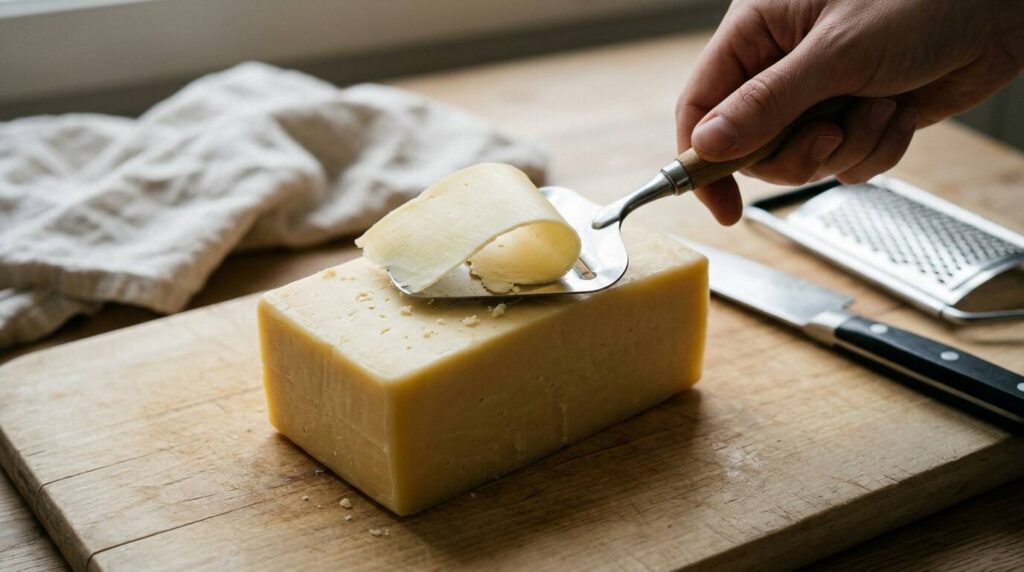
The tool is a flat handle with a slot and a blade. Taste describes running it along the flat surface of a block with some pressure, so that a thin slice pops out and rests on the blade. Scandification describes a single smooth pull toward the user with light pressure. The two accounts differ on how hard to press, and neither is a controlled test.
Taste lists medium-hard cheeses as the natural fit: Gouda, Emmental, Edam and Jarlsberg. Norwegian kitchens often keep a second plane with a ridged blade for the sticky brown cheese known as brunost. The practical limit is hardness. A block that crumbles, as aged cheddar tends to, does not shave cleanly, and a very soft cheese smears.
No fetched test of cheese planes was found, so the description above rests on a magazine feature and a history article. The same goes for any ranking of brands; none is offered here.
What a knife does
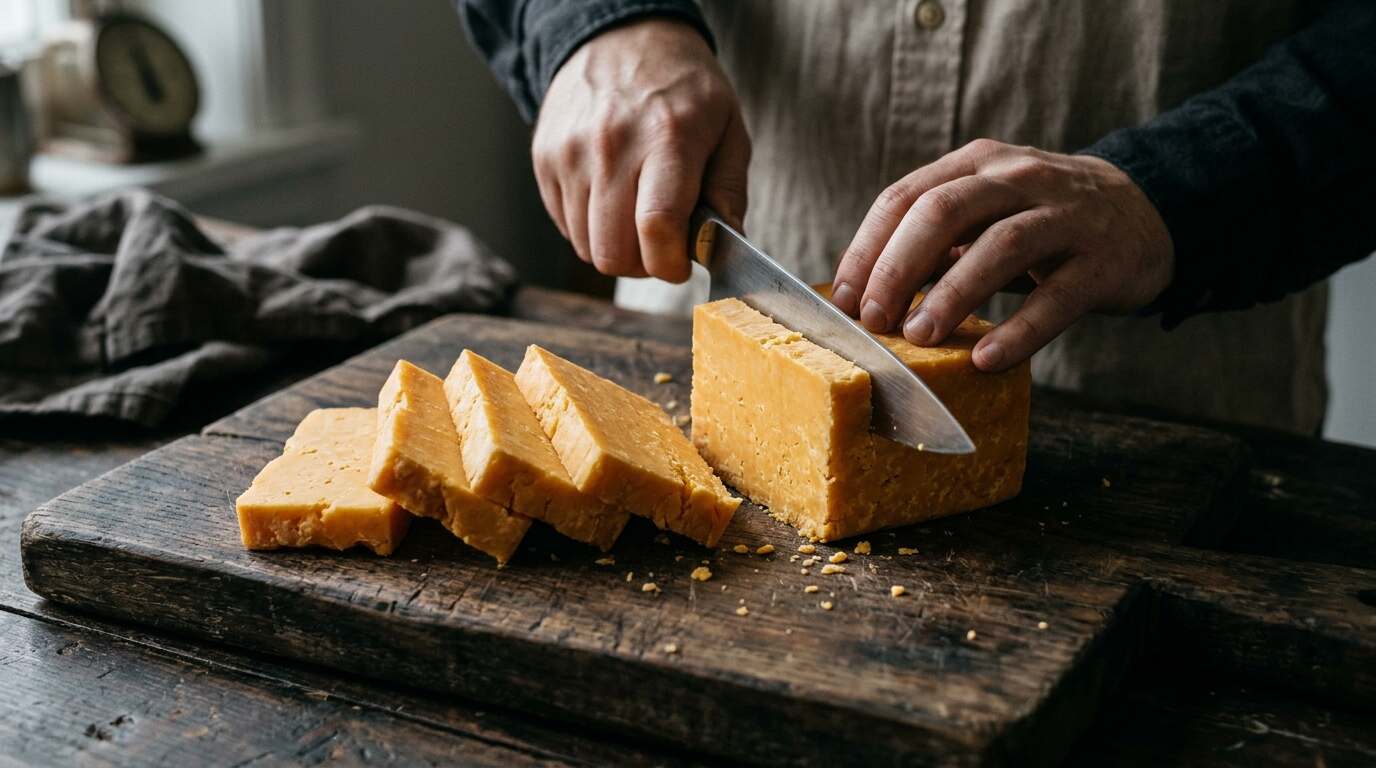
A knife remains the default because it works on every shape. The America’s Test Kitchen guide to cutting cheese opens by noting that “there is no special prepwork or fancy tools required,” and then gives cutting plans by shape: wedges are halved or sliced from the sides toward the center, firm rectangles are sliced straight across, and softer blocks are cut diagonally first. The same guide advises letting cheese “sit at room temperature to take the chill off,” which also makes it easier to portion.
Thickness is where a knife differs most from a plane for sandwich work. A knife can cut a thick slab, and thick slabs behave badly. The Takeout reports that thick cheese melts unevenly and takes longer to heat through, so the bread can burn before the center softens. It recommends slices under half an inch. Its author does not quote an expert, so the advice stands as one writer’s observation.
Sliced cheese in general gets a mixed review from Tasting Table, which says sliced cheese is easier to handle and melt for beginners but adds that it “often does not melt as well as grated cheese.” That article also quotes no outside source.
The grater and the box
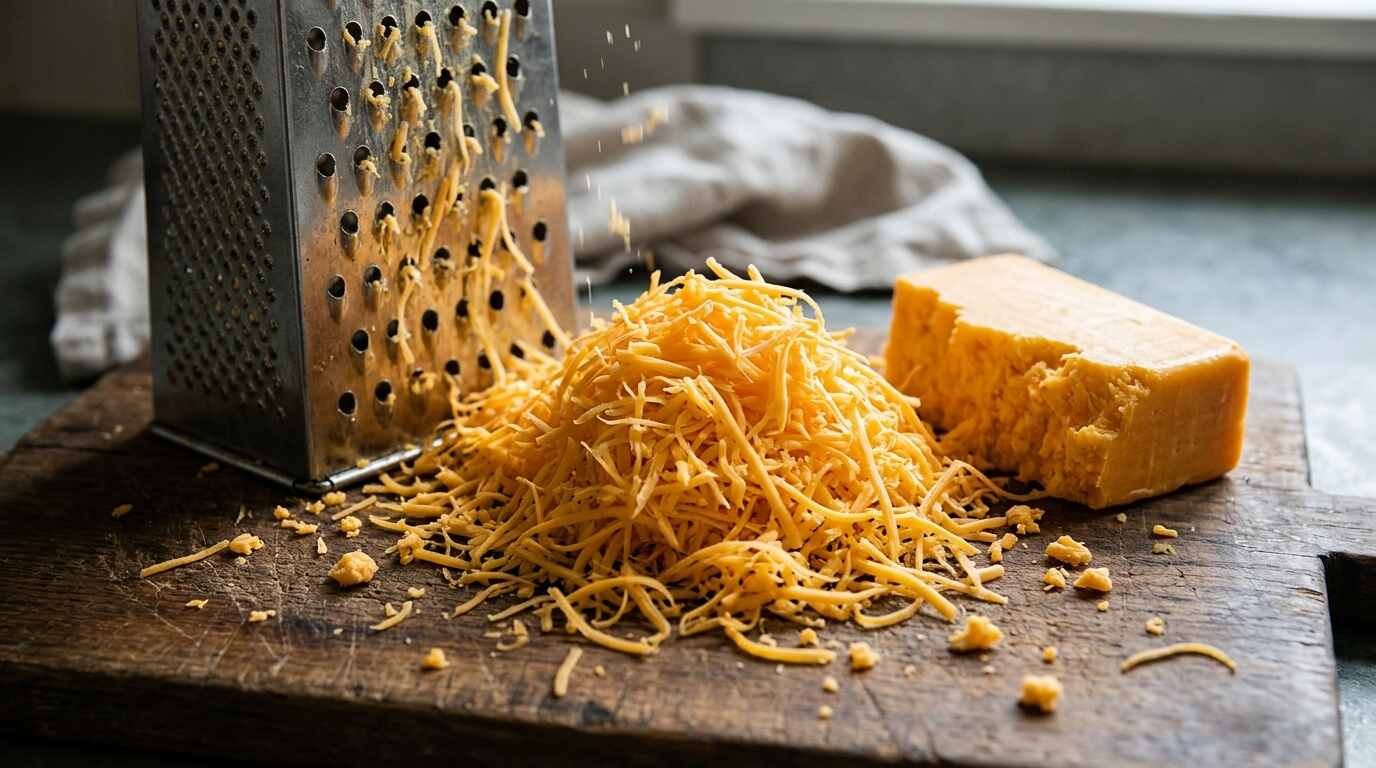
Grating changes the geometry. Instead of one flat slab, the cheese becomes many small pieces with far more surface exposed to the pan. Wisconsin Cheese separates shredded cheese, long strands from the large holes of a box grater, from grated cheese, which is finer and close to powder. It says higher-moisture cheeses such as mozzarella, young Gouda, fontina and Monterey Jack form neat shreds and melt evenly, which suits grilled cheese, while drier aged cheeses tend to crumble and are better finely grated. It also suggests chilling cheese for 20 to 30 minutes before grating for cleaner results.
Cheese that is too soft or too hard defeats the tool. The Takeout’s grater guide says a medium consistency is needed, suggests freezing mozzarella for about 15 minutes first, and wrapping hard cheeses like Parmesan in a damp cloth in the refrigerator for about an hour. It calls feta, queso fresco and blue cheese un-shreddable and points to a food processor for those. The same guide notes that a box grater has more than one side, including a slicer side for thin layers.
The site CheeseScientist.com argues that freshly grated cheese melts more evenly and browns better, and that grating just before cooking preserves aroma. The page cites no experiment, so those claims are best read as the author’s position.
Pre-shredded cheese and its coating
Most of the evidence about melting concerns bagged shreds rather than the grater itself. Pre-shredded cheese is coated to stop clumping, and the usual coatings are cellulose, potato starch or cornstarch, as Chowhound lists them. Chowhound says block cheese has none of these and melts evenly, and recommends shredding a block at home for sauces, fondue or pizza.
The one fetched taste test, from America’s Test Kitchen, supports part of that claim and complicates the rest. Experts told the testers that cellulose and starches “dry out the surface of the shreds and inhibit melting and flow.” In a head-to-head on nachos, block cheddar shredded at home beat a bagged supermarket cheddar for silkier texture, yet the bagged cheddar still melted smoothly and did not turn greasy. The testers found no clear link between the type of anti-caking agent and meltability, and suspected that some lower-ranked cheeses had simply dried out more.
A Better Homes & Gardens test kitchen specialist, Sarah Brekke, told Allrecipes via AOL that the additives are safe to eat, and that some bagged shreds also contain natamycin, an anti-mold agent. Her first suggestion is to shred a block at home. The article traces a trend of rinsing bagged cheese to a February 2024 TikTok video and describes it as an anecdote, not a controlled comparison.
Federal rules allow the coatings. The standard for grated cheeses in 21 CFR 133.146 lists antimycotics and anticaking agents among the optional ingredients, in a 2012 edition of the regulation. The text read for this post did not name cellulose or natamycin specifically, and a later edition was not checked. Cheese technologist Dean Sommer told DairyReporter that some anti-caking agent is “absolutely necessary” to keep grated Parmesan from clumping in the container.
A fourth tool: the vegetable peeler
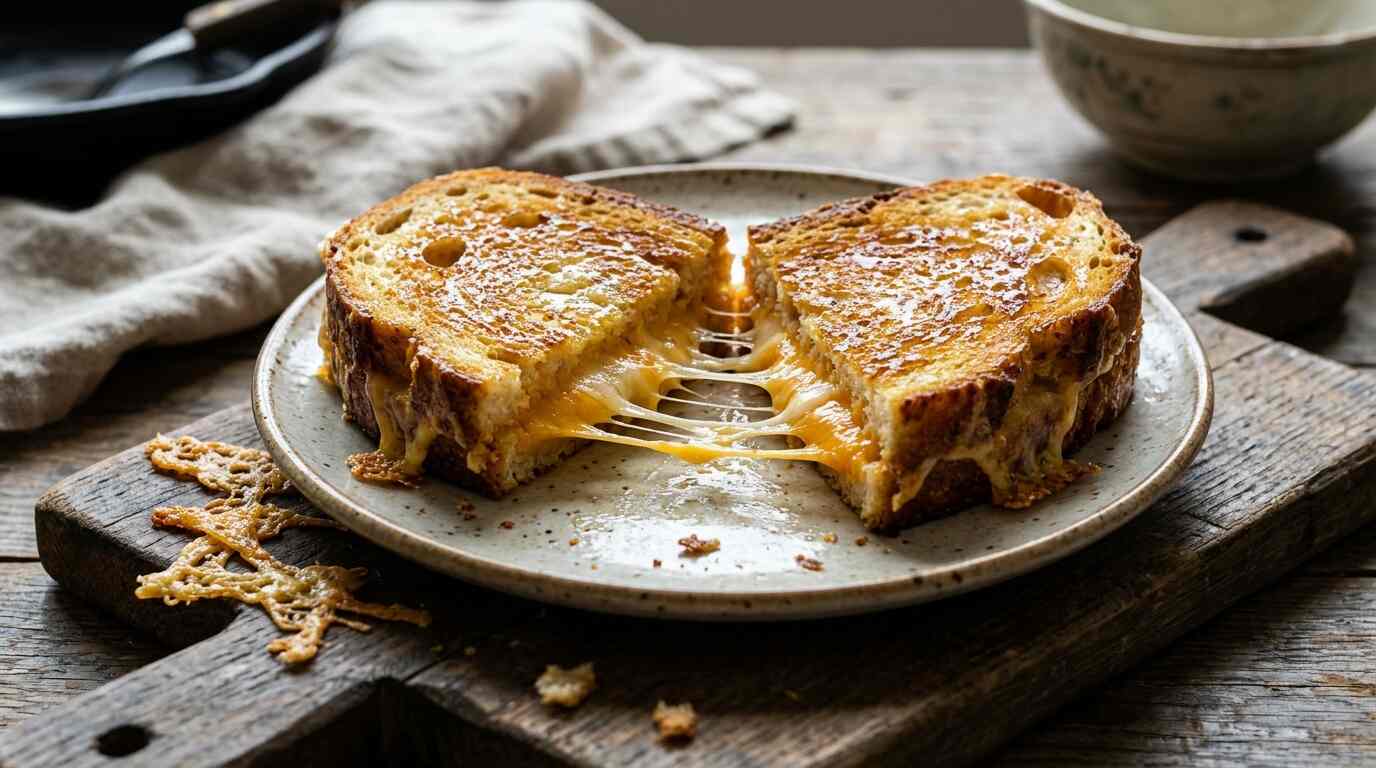
America’s Test Kitchen has also published a grilled cheese tip that sidesteps the three-way choice. A Y-shaped vegetable peeler draws long, thin ribbons off a block of sharp cheddar. The ribbons are long enough to stay inside the sandwich when it is flipped, and thin enough to melt at about the pace the bread browns. In the author’s experience, sliced cheese often stays unmelted in the center and shredded cheese falls out. The piece is a single cook’s method, not a panel test.
Matching tool to cheese
Read together, the sources describe a trade between handling and melt. The plane makes uniform thin slices from medium-hard blocks. The knife suits any shape but demands discipline on thickness. The grater gives the fastest melt from a block and the most mess, and works best on cheeses of middle firmness. Bagged shreds save the step at the cost of a coating that some tests and writers link to a drier, slower melt, though the one test fetched here found the effect small once the cheese was melted.
Products mentioned in this article
- OXO Good Grips Non-Stick Cheese Slicer. A plane-style slicer for cutting even slices from a block. See it on Amazon (affiliate link)
- OXO Good Grips 4-Sided Box Grater for Cheese & Vegetables with Container. A four-sided box grater for shredding cheese from the block. See it on Amazon (affiliate link)
As an Amazon Associate I earn from qualifying purchases. A commission may be earned if you buy through this link, at no extra cost to you.
Sources:
- Store norske leksikon, “Thor Bjørklund”: https://snl.no/Thor_Bj%C3%B8rklund
- Scandification, “Ostehøvel: the 100-year story of Norway’s cheese slicer invention”: https://scandification.com/ostehovel-the-100-year-story-of-norways-cheese-slicer-invention/
- Taste, “Let Us Celebrate the Norwegian Cheese Plane”: https://tastecooking.com/let-us-celebrate-norwegian-cheese-plane/
- The Local, “Sweden threatens to ‘annex’ the ostehøvel”: https://www.thelocal.com/20140612/sweden-threatens-to-annex-ostehovel
- The European Correspondent, “One hundred years of perfect cheese slices”: https://www.europeancorrespondent.com/r/one-hundred-years-of-perfect-cheese-slices
- America’s Test Kitchen, “The Right Way to Slice and Serve Cheese”: https://www.americastestkitchen.com/articles/3416-the-right-way-to-slice-and-serve-cheese-and-why-it-matters
- The Takeout, “One Little Mistake Could Be Ruining Your Grilled Cheese Sandwich”: https://www.thetakeout.com/1855327/grilled-cheese-mistake-thick-slices-cheese/
- Tasting Table, “Sliced Or Grated: What’s The Best Option In A Grilled Cheese?”: https://www.tastingtable.com/1203336/sliced-or-grated-whats-the-best-option-in-a-grilled-cheese
- Wisconsin Cheese, “Shredded vs. Grated”: https://wisconsincheese.com/the-cheese-life/article/238/shredded-vs-grated-cheese-how-do-they-differ-and-which-is-best-for-your-dish
- The Takeout, “13 Cheese Grater Mistakes You Need To Stop Making”: https://www.thetakeout.com/1682875/cheese-graters-mistakes/
- CheeseScientist.com, “Why Grating Your Own Cheese”: https://cheesescientist.com/rants/grate-cheese/
- Chowhound, “Why Your Pre-Shredded Cheese Won’t Melt”: https://www.chowhound.com/1627879/why-doesnt-pre-shredded-cheese-melt
- America’s Test Kitchen, shredded sharp cheddar taste test: https://www.americastestkitchen.com/taste_tests/2143-shredded-sharp-cheddar-cheese
- Allrecipes via AOL, “Should You Wash Shredded Cheese So It Melts Better?”: https://www.aol.com/wash-shredded-cheese-melts-better-163851819.html
- Code of Federal Regulations, Title 21 Part 133 (2012 edition): https://www.govinfo.gov/content/pkg/CFR-2012-title21-vol2/xml/CFR-2012-title21-vol2-part133.xml
- DairyReporter, “Shredded Parmesan market growing despite wood pulp controversy”: https://www.dairyreporter.com/Article/2016/02/21/Shredded-Parmesan-market-growing-despite-wood-pulp-controversy/
- America’s Test Kitchen, “Better Grilled Cheese: Use a Vegetable Peeler”: https://www.americastestkitchen.com/articles/3699-better-grilled-cheese-use-vegetable-peeler
- WorldlyWisdom (YouTube), “The Cheesy History of Norway’s Cheese Slicer!”: https://www.youtube.com/watch?v=iK_HuvRWzdE