In this story
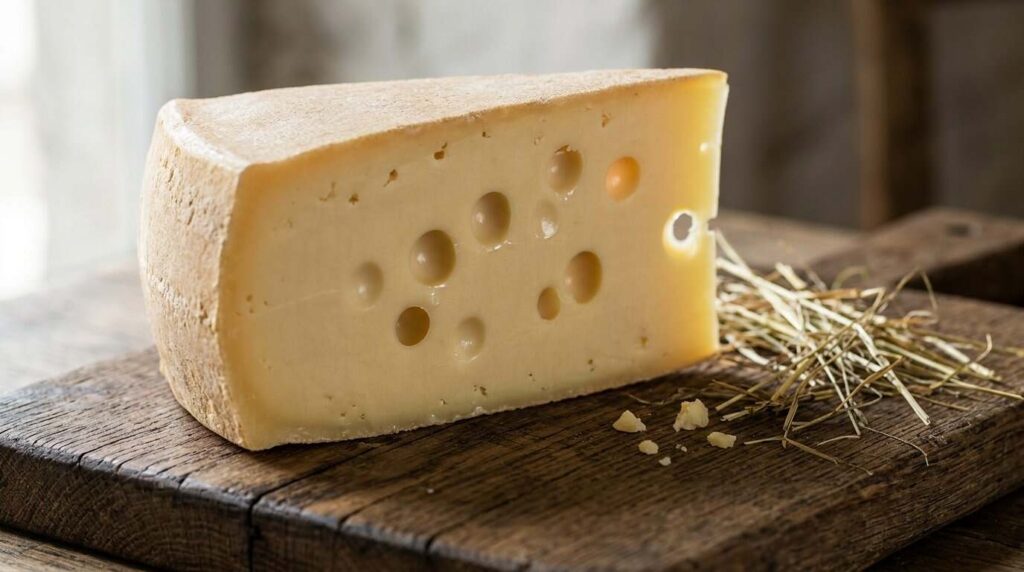
Emmentaler’s makers went to court over the holes in their cheese. On 2 April 2025 the Federal Administrative Court let Emmentaler makers add natural hay powder to the curd, after years of a hole shortage. The holes, which cheesemakers call eyes, are pockets of carbon dioxide released by bacteria while a wheel ripens in a warm cellar. In Emmentaler, the Swiss original, the gas cannot escape the curd, and it forms the holes over roughly six to eight weeks. A 2015 study from Agroscope, the Swiss federal agricultural research centre, added a second ingredient to the story: microscopic particles of hay, which decide where the bubbles start.
Video: How they saved the holes in Swiss cheese — from the Tom Scott YouTube channel
Bacteria and carbon dioxide inside the wheel
Propionic acid bacteria do the work in a warm cellar
Emmentaler starts as raw milk from cows fed grass and hay, never silage. According to Emmentaler Switzerland, the producer organisation, selected bacterial cultures go into the milk at about 32°C, and the curd is later pressed for 20 hours under a load of up to 2,000 kilograms. After two days in brine, each wheel goes to a fermentation cellar held at roughly 19 to 24°C. There, propionic acid fermentation produces carbon dioxide that has nowhere to go.
Britannica describes the culture set as Streptococcus thermophilus, Lactobacillus bulgaricus and Propionibacterium shermanii, with the propionic acid bacteria largely responsible for the large holes. Newer sources, such as the Cheese Scientist, name the same group as Propionibacterium freudenreichii. The chemistry is a handoff. Ordinary starter bacteria turn lactose into lactic acid, and the propionibacteria then consume that lactic acid and release propionic acid, acetic acid and carbon dioxide. The propionic acid also supplies the sweet, nutty note associated with Swiss-style cheese. The same source puts the dependency bluntly: “No propionic bacteria, no eyes.”
Texture matters as much as gas. When the curd is elastic, the carbon dioxide stretches it into round bubbles; when the curd is too rigid, the gas escapes or tears the paste.
Timing is controlled by temperature. Britannica reports that the eyes appear within six to eight weeks, each about 0.6 inch wide, and Emmentaler Switzerland says wheels then move to a storage cellar at about 12°C, which stops hole formation.
What the 2015 Agroscope study found
Hay dust turned out to be the starting point for each hole
The study, titled “Mechanism and control of the eye formation in cheese,” appeared in International Dairy Journal, volume 47, pages 118 to 127, with Dominik Guggisberg of Agroscope listed first among twelve authors. Agroscope and EMPA, the Swiss materials science institute, announced it in a press release dated 28 May 2015.
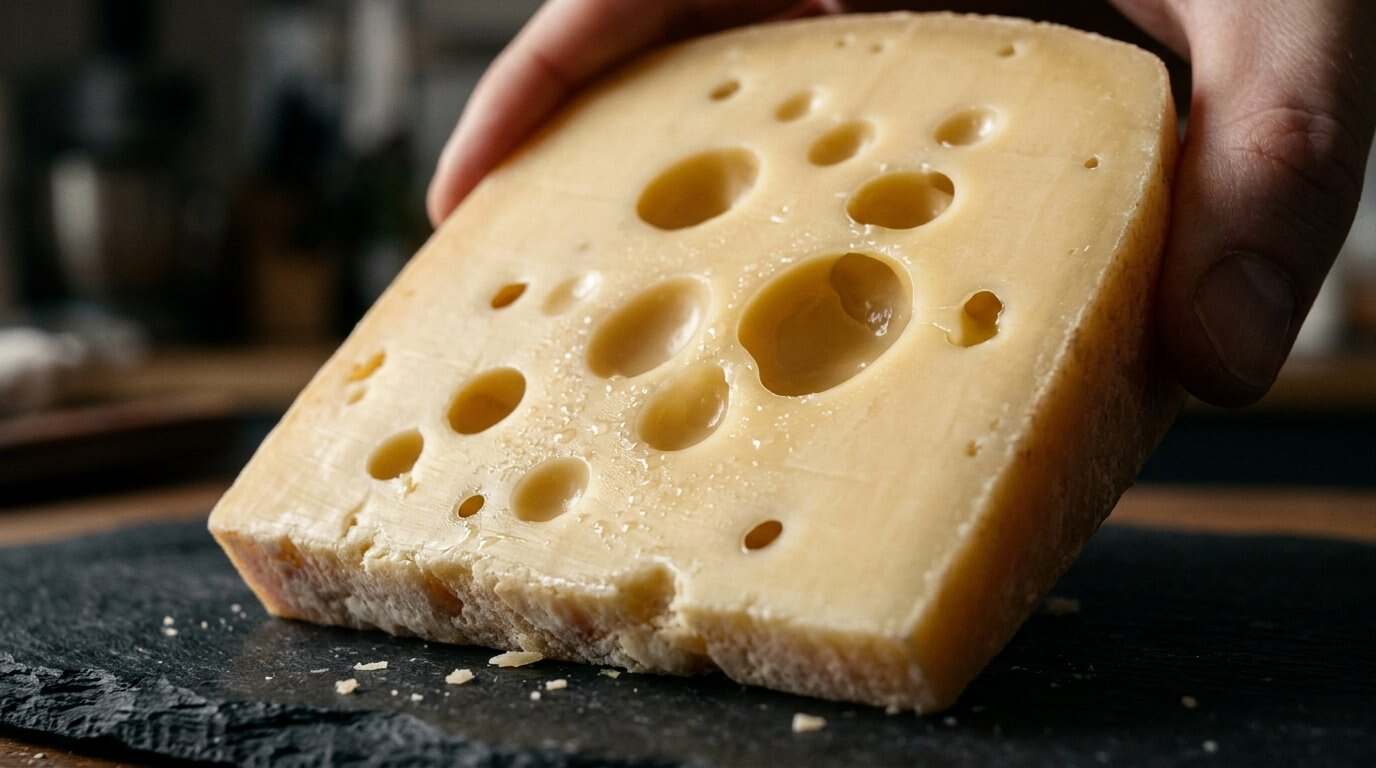
The researchers used X-ray computed tomography to follow hole formation across a 130-day ripening period. Microscopic hay particles, each carrying tiny air bubbles, act as what the release calls eye starting points: the bubbles grow as bacterial carbon dioxide diffuses into them. About 5 to 10 milligrams of hay particles per 1,000 kilograms of milk produced typical eye formation. The release states that the number of eyes “could be controlled almost at will, depending on the amount of hay particles added.”
The release also places the work in a longer line of research. The first detailed study of hole formation dates to 1917 and was led by the American researcher William Clark, who attributed the holes to carbon dioxide from bacteria, as AFP reported through Phys.org. Agroscope did not overturn that explanation. Bacteria remain necessary, and the same release notes that some bacteria produce too little carbon dioxide to form holes, which is why Gruyère and Sbrinz have none. Agroscope also added a caution to the press release, saying that hay particles are not the only factor and that calling them “dirt” oversimplifies the finding.
A follow-up came in 2026. Guggisberg, Walter Bisig and Marie-Therese Fröhlich-Wyder added synthetic hollow fibres and capillaries to curd, and X-ray analysis showed every eye contained at least one capillary. Their conclusion: nuclei carrying entrapped air are the most likely starting points for eyes, and structures without capillaries cannot serve as starting points.
Closed milking systems and the missing holes
Cleaner milk meant fewer eyes
The Agroscope release describes a “hole shortage” over the preceding 10 to 15 years and links it to closed milking systems. Open pails let hay fall into the milk; sealed machines, in the words reported by AFP, “completely did away with the presence of tiny hay particles in the milk.” Agroscope spokesman Regis Nyffeler summed up the change as “the disappearance of the traditional bucket.”
Some press coverage framed the result as hay replacing bacteria as the cause. Agroscope’s own release describes both as required, with hay particles deciding where and how many holes form.
The finding turned into a legal question. Emmentaler Switzerland asked to amend the cheese’s specification so that hay flower powder could be added. The Federal Office for Agriculture refused, arguing, according to Swissinfo, that additives would lead to industrialised Emmental. After a hearing in St Gallen in June 2024, the same report quoted the consortium’s lawyer on the stakes: “Because if we do nothing, they will disappear.”
The Federal Administrative Court ruled in the producers’ favour on 2 April 2025 (case B-6947/2023). In its 11 April 2025 press release, the court said that protected-origin products must keep their originality and that any easing of specification rules “must remain exceptional,” but found the evidence sufficient. It added that the cheese could still end up with too many holes, so the change would not standardise production. The judgment could be appealed to the Federal Supreme Court.
In practice, producers may add natural hay powder to the curd since 2025. A Keystone-SDA report published in April 2026 describes the powder as 100 percent ground organic hay flowers, with a tiny amount enough for more than 600 kilograms of cheese. Master cheesemaker Andreas Brunner said he was “very happy that this powder exists.”
What the Emmentaler AOP protects
A named valley, a fixed recipe and a quality score
Emmentaler takes its name from the Emme valley in the canton of Bern, and production there can be traced to the 13th century. Emmentaler Switzerland says the cheese received AOP status, protected designation of origin, in 2006; the cheese magazine Culture dates the AOP to 2000, after an earlier AOC.
The specification covers the production area, the milk, the cheesemaking, ageing and a quality assessment that includes hole number and size. Dairy farms may be no more than 20 kilometres from the dairy, milk must be processed within 24 hours and cannot be heated, and genetically modified feed and rennet are prohibited. One wheel takes about 1,200 litres of milk. Wheels measure 80 to 100 centimetres across and average 95 kilograms, and the organisation describes the holes as cherry-sized, mostly 2 to 4 centimetres. MySwitzerland gives the range as a cherry to a walnut.
Ageing lasts at least four months. After four months, experts grade each wheel, and it must score at least 18 of 20 points to be sold.
Appenzeller, the other Swiss cheese named in the hay coverage, works differently. It comes from the Appenzell region in northeastern Switzerland, and the Appenzeller factsheet describes its Elegant variety as holding none to a few evenly spread holes of 3 to 6 millimetres, much smaller than Emmentaler’s. Its trade association formed in 1942 and the AOC followed in 1981. A herbal brine applied to the rind is kept secret, and the wheels are made of raw cow’s milk.
Swiss-style cheese outside Switzerland
“Swiss” became a generic name in the United States
The words “Swiss cheese” mean something looser abroad. The United States Department of Agriculture’s grading standard describes Swiss and Emmentaler cheese as having eyes “developed throughout the cheese by microbiological activity.” For U.S. Grade A, eyes should be round or slightly oval and fairly even in size and spacing, with most about 3/8 to 13/16 inch across. Lower grades tolerate defects the standard names with trade terms such as frogmouth, nesty and dead eyes.
A Swissinfo report from November 2000 set the American product against the original. The U.S. version costs about half as much, is made from pasteurised milk and sells as rindless blocks, while Emmental comes in giant rinded wheels. Baby Swiss is richer and carries smaller holes. John Umhofer of the Wisconsin Cheese Makers Association told the reporter that “the generic term is out of the barn.”
Other countries have their own relatives. Britannica lists Norway’s Jarlsberg among cheeses made by similar methods, and Culture adds Germany’s Allgäuer Emmentaler, France’s Emmental de Savoie, and Holland’s Maasdam, all well made but not Swiss Emmentaler AOP.
Swiss cheese in the Reuben, the Cuban and the croque-monsieur
Three sandwiches that rely on the same melting slice
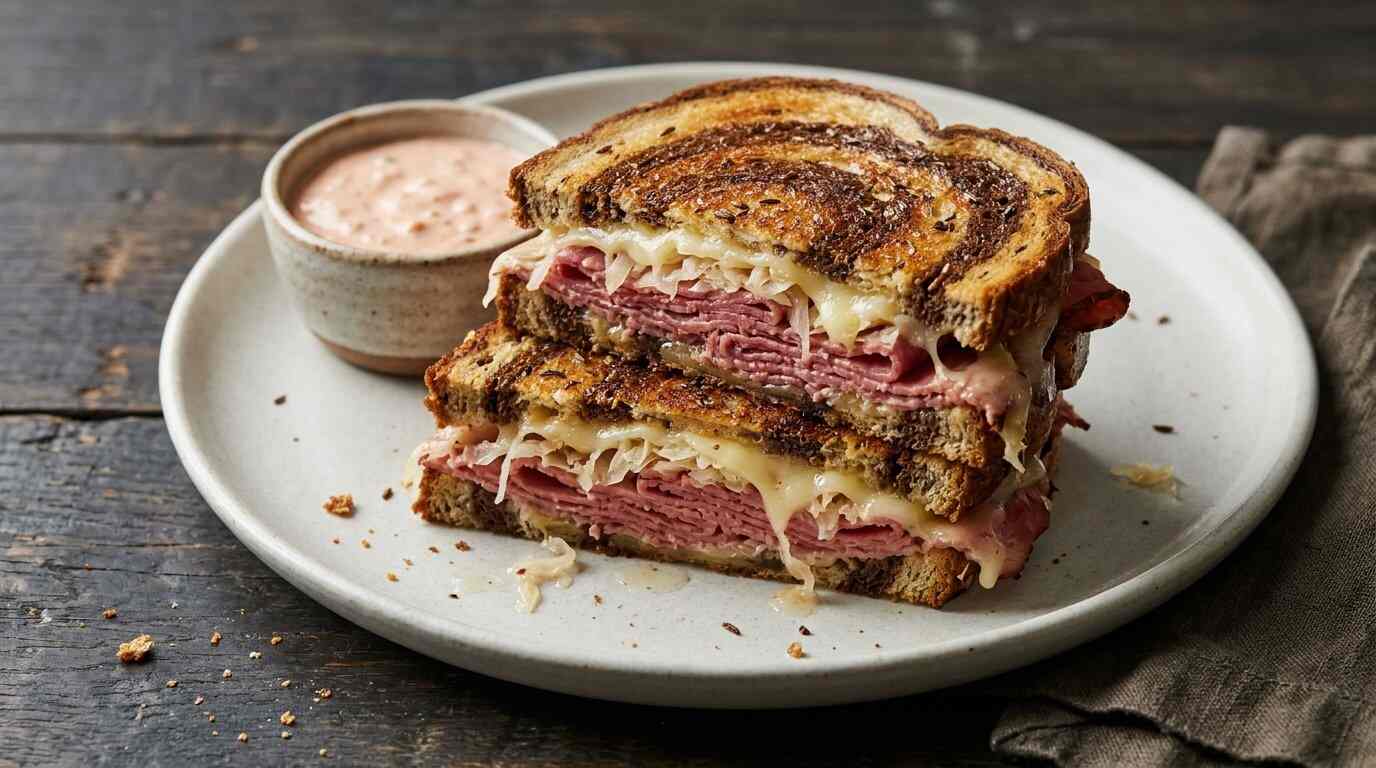
Swiss is one of the fixed parts of the Reuben. National Geographic lists hot corned beef, melted Swiss cheese, sauerkraut and rye bread among its simple ingredients and says the cheese melts into the dressing and binds the whole sandwich during pressing. One exception is Liebman’s Deli, a strictly kosher establishment, where the Reuben omits the cheese.
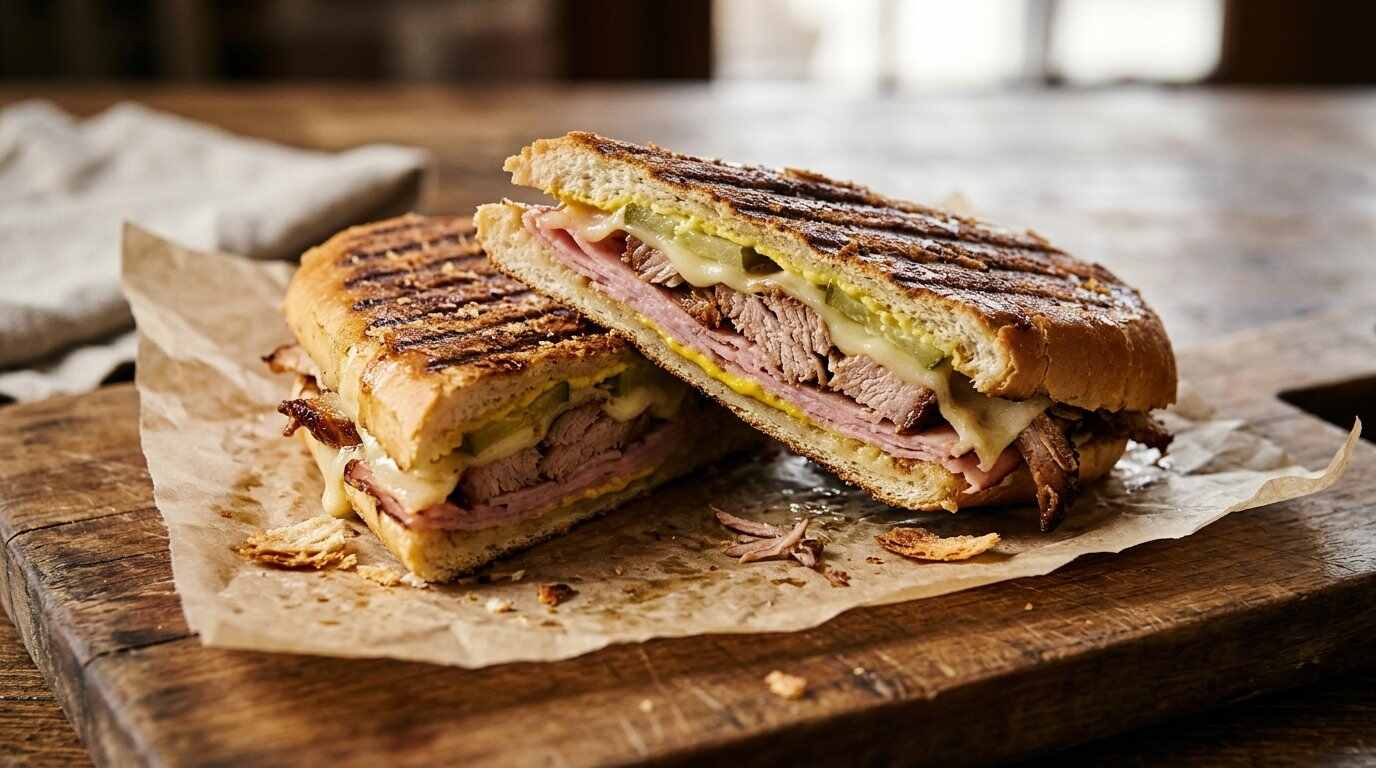
The Cuban sandwich uses it as well. Tampa’s 2012 city council resolution listed the ingredients of an authentic Tampa Cuban as sweet ham, mojo-marinated roast pork, Swiss cheese, dill pickles, mustard and Genoa salami, according to WUSF. The Miami version has no salami; cookbook author Raquel Roque’s recipe calls for three slices each of ham, roast pork and Swiss cheese.
The French croque-monsieur splits between two cheeses. America’s Test Kitchen describes “plenty of nutty Gruyère cheese”, and Milk Street writes of shredded Gruyère or Comté on top. Taste France, the French food-promotion site, builds its recipe on Emmental de Savoie PGI, both in the sauce and between the slices of bread. Only the Emmental version belongs to the holey family, since Agroscope’s release names Gruyère among the cheeses without holes. Either way, the eyes are gone once the cheese melts.
Common questions
What causes the holes in Swiss cheese?
The holes, which cheesemakers call eyes, are pockets of carbon dioxide released by bacteria while a wheel ripens in a warm cellar. In Emmentaler the gas cannot escape the curd, and the holes form over roughly six to eight weeks.
What did the 2015 Agroscope study find?
The Swiss federal agricultural research centre reported that microscopic particles of hay decide where the bubbles start. Its release linked a “hole shortage” over the preceding 10 to 15 years to closed milking systems, which keep hay out of the milk.
Is every Swiss cheese the same?
No. Abroad the words mean something looser. The USDA grading standard describes Swiss and Emmentaler cheese as having eyes developed throughout the cheese by microbiological activity.
Sources
- Emmentaler Switzerland, “How milk becomes cheese”: https://www.emmentaler.ch/en/how-milk-becomes-cheese
- Emmentaler Switzerland, FAQ: https://www.emmentaler.ch/en/kategorie/faq-en
- Agroscope and EMPA press release, 28 May 2015: https://www.newsd.admin.ch/newsd/message/attachments/39613.pdf
- Agroscope publication record, “Mechanism and control of the eye formation in cheese,” International Dairy Journal 47 (2015): https://ira.agroscope.ch/it-CH/publication/34781
- Agrarforschung Schweiz, “Capillary effect confirmed: why hay particles are key for eye formation in Emmentaler cheese” (23 March 2026): https://www.agrarforschungschweiz.ch/en/2026/03/capillary-effect-confirmed-why-hay-particles-are-key-for-eye-formation-in-emmentaler-cheese/
- AFP via Phys.org, “A century on, experts crack mystery of holes in Swiss cheese”: https://phys.org/news/2015-05-century-experts-mystery-holes-swiss.amp
- Swissinfo, “The mysterious court case of the disappearing cheese holes” (11 June 2024): https://www.swissinfo.ch/eng/archive-swiss-made/the-mysterious-court-case-of-the-disappearing-cheese-holes/80237144
- Swiss Federal Administrative Court press release, 11 April 2025 (judgment B-6947/2023): https://www.bvger.ch/en/newsroom/media-releases/enough-holes-in-emmental-cheese-1722
- blue News (Keystone-SDA), “How Swiss cheesemakers saved the holes in Emmentaler” (3 April 2026): https://www.bluewin.ch/en/news/how-swiss-cheesemakers-saved-the-holes-in-emmentaler-li.3173613
- Britannica, “Emmentaler”: https://www.britannica.com/topic/Emmentaler
- Cheese Scientist, “Why some cheeses have holes”: https://cheesescientist.com/science/cheese-holes/
- MySwitzerland, “Emmentaler AOP”: https://www.myswitzerland.com/en-gb/experiences/food-wine/emmentaler-aop/
- Culture, “Will the real Emmentaler please stand up?”: https://culturecheesemag.com/cheese-iq/will-real-emmentaler-please-stand/
- Appenzeller factsheet: https://cms.appenzeller.ch/fileadmin/data/user_upload/APP_Factsheet_AppenzellerinElegant_A4_en_RZ-18.pdf
- Cheese Professor, “Everything you need to know about Appenzeller”: https://www.cheeseprofessor.com/blog/appenzeller
- USDA Agricultural Marketing Service, Swiss cheese and Emmentaler cheese grades and standards: https://www.ams.usda.gov/node/5190
- Swissinfo, “When American cheese makers taste real Emmental” (5 November 2000): https://www.swissinfo.ch/eng/when-american-cheese-makers-taste-real-emmental/1738676
- National Geographic, “What is the Reuben sandwich?”: https://www.nationalgeographic.com/travel/article/what-is-reuben-sandwich-the-story-behind-the-iconic-deli-staple
- WUSF, “A historic vote for Tampa’s Cuban sandwich” (19 April 2012): https://wusf.org/culture/2012-04-19/a-historic-vote-for-tampas-cuban-sandwich-pressed-or-cold
- NBC Miami, “Miami engages Tampa in Cuban sandwich war”: https://www.nbcmiami.com/news/local/miami-engages-tampa-in-cuban-sandwich-war/1920629
- America’s Test Kitchen, croque-monsieur recipe: https://www.americastestkitchen.com/articles/1317-we-take-grilled-cheese-to-new-heights-with-our-croque-monsieur-recipe
- Milk Street, “French call it croque monsieur”: https://www.177milkstreet.com/2023/12/french-call-it-croque-monsieur
- Taste France, croque-monsieur: https://www.tastefrance.com/recipes/french-classics/croque-monsieur
Keep reading
- Provolone Cheese: How It Is Made, Dolce vs Piccante and How It Melts
- Cheese Toastie vs Grilled Cheese: What Is the Difference?
- Cheddar Cheese History: From Cheddar, Somerset to the Grilled Cheese Pan
More in this section: Ingredients guide.