In this story
Gruyère is a cooked, pressed cow’s milk cheese named for the town of Gruyères in the Swiss canton of Fribourg, and it is legally two different cheeses. The Swiss Le Gruyère AOP is made in a defined area of western Switzerland under a long list of rules about feed, vats and cellars. The French Gruyère IGP is made in eastern France and, unlike the Swiss wheel, must have holes. A third usage, the American one, is unprotected: a US appeals court ruled in 2023 that the word is generic there.
Video: Film about Gruyère AOP production (English) | Le Gruyère AOP
Gruyères, Fribourg and the name
The producers’ own history page says cheese production in the region can be traced back to 1115, the earliest date it offers, and that medieval chronicles describe local herders turning milk into full-fat cheese sold in France and Italy. Great British Chefs also gives 1115 for the first records, describing a cheese made to preserve milk for lean periods. Neither page names the document behind the date, so 1115 stands as the producers’ claim, not a checked archive reference.
The tourism office of the Fribourg region dates the first citation of the term “fromage de Gruyère” to around 1600, when an alpine dairy economy began to grow, and places the start of the cheese’s golden age in 1648, after the Thirty Years’ War. The same page gives two accounts of the name. A legend ties it to a Vandal captain called Gruérius, who supposedly founded the town in 436. The historian it cites, Hisley, suggests instead that the name comes from “grand-gruyer,” a Romance-language word for a forest warden in a district called the Gruerie. The town is spelled Gruyères, with an s, while the district and the cheese drop it.
By the seventeenth century, according to the producers, the name had official recognition and exports were growing. The word entered the dictionary of the Académie Française in 1762. Emigration from Fribourg then carried cheesemaking into Vaud, Neuchâtel, Jura and across the border into France, and imitation became common enough that a campaign for a recognized designation began in the mid-1800s. Meetings in Madrid, Paris and Rome in 1891, 1926 and 1930 produced a first agreement on protecting product names. Switzerland granted the cheese AOC status in 2001, and the European-level AOP followed in 2011.
What the Swiss specification requires
The published specification for Le Gruyère AOP, hosted on the producers’ site, starts with geography. The core area is the cantons of Fribourg, Vaud, Neuchâtel and Jura, the Jura bernois district and listed communes of Bern. Dairies in several other cantons, including Lucerne, Schwyz and St. Gall, may also qualify, with milk-collection radii set out in an appendix.
Milk rules are strict. The milk must come from cows and may not be mixed with that of other species. Silage is prohibited in the herd’s diet, apart from an exception for young cattle, and at least 70 percent of the ration, measured in dry matter, must come from the farm’s own fodder area. Growth activators and hormones such as somatotropin are banned. Milk is cooled on the farm to between 12 and 18 degrees Celsius and delivered twice daily. Bactofugation, ultrafiltration and microfiltration are not allowed, and neither are additives. The cheese is made in open copper vats of no more than 6,600 litres.
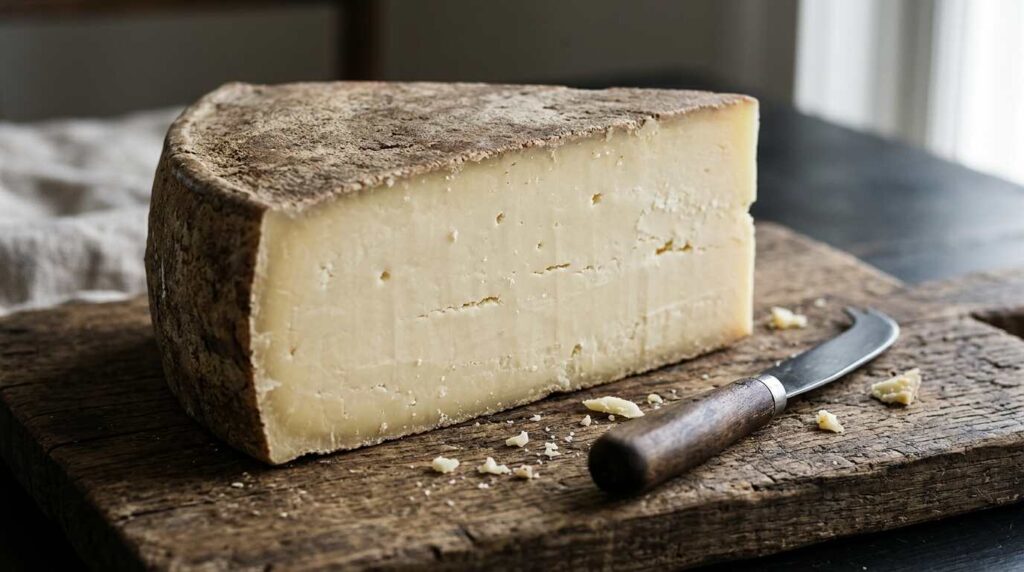
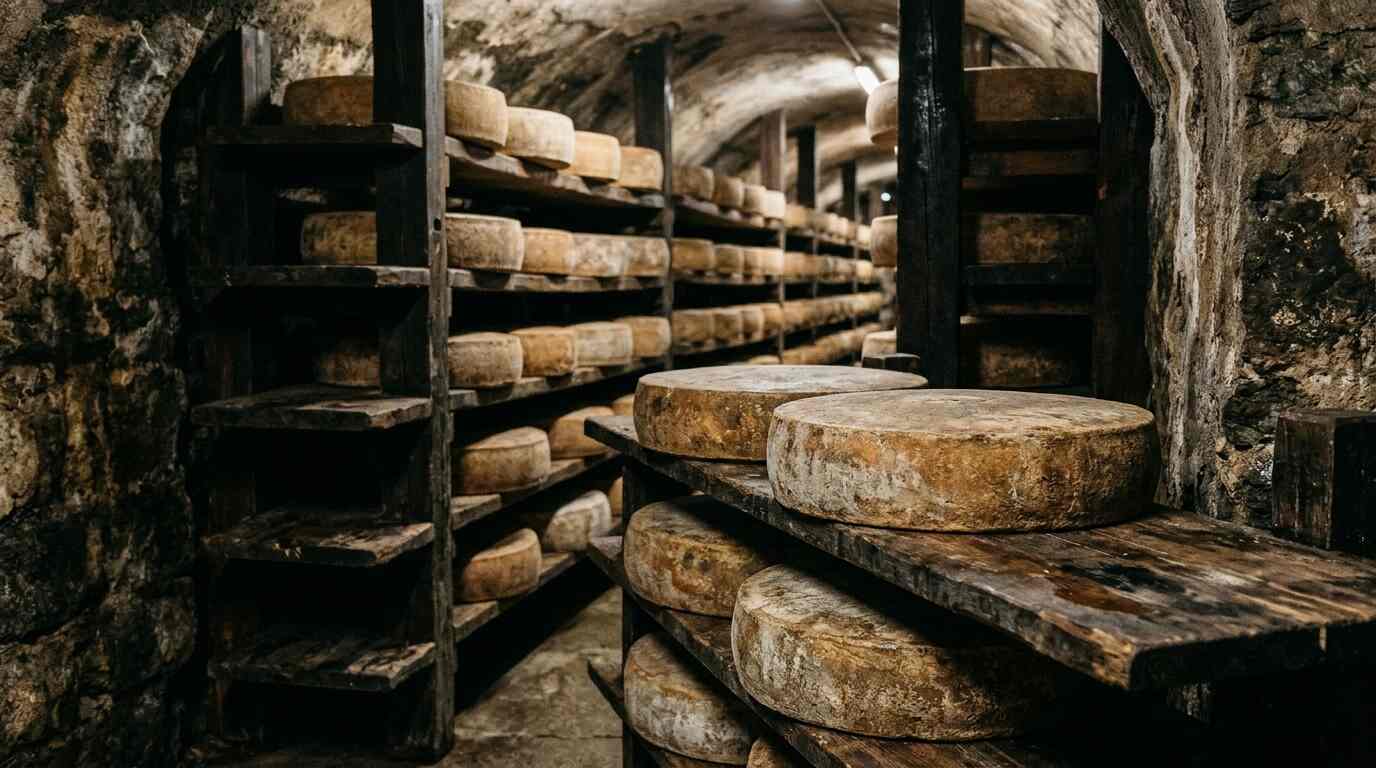
Brine salting begins right after the wheel leaves the mould. Cellars run at 12 to 18 degrees with humidity around 92 percent, and the wheels rest on unpolished spruce shelves. Each wheel is rubbed and turned daily for 8 to 12 days so that salted water forms the rind, which must be smeared and uniformly brownish. A standard wheel stands 9.5 to 12 centimetres tall, measures 55 to 65 centimetres across and weighs 25 to 40 kilograms.
On holes, the specification is permissive. Holes are desirable but not required, and are mostly 4 to 6 millimetres across; anything larger than 6 millimetres is a grading defect. That sits uneasily with press coverage that describes Swiss Gruyère flatly as holeless. The Local, reporting on the French approval, calls Swiss Gruyère the version without holes. The specification itself describes small eyes and tiny closed cracks as acceptable, so “few and small” is closer to the rule than “none.”
Ageing and the grading system
No wheel leaves the cellar young. The specification sets a minimum of five months out of the ripening cellars, which must be in Switzerland, and the producers’ characteristics page says maturation lasts between 5 and 18 months, and sometimes longer. Wheels are first appraised at three to four months and graded at four to five.
Grades determine where a wheel ends up. Wheels scoring 18 or more points, with at least 8.5 for taste and texture, earn grade 1A, carry the label and can be sold whole or prepacked. A 1B wheel, which scores 16.5 or more, cannot be sold loose or prepacked and goes to melted or grated products. Second-choice wheels may not carry the name at all.
Retail labels sort the cheese by age. The producers’ type guide describes Classic as aged six to nine months, soft and mildly sweet, and Réserve as aged more than ten months, firmer, slightly crumbly and fruity. Great British Chefs adds that Classic is sweet and nutty with a pliable texture, while the older Réserve is darker, more intense and shows visible graining and calcium crystals. Gruyère d’Alpage is a separate category. It is made only on mountain pastures between mid-May and mid-October from the unpasteurised milk of local cows, pressed in cloth, in wheels of about 25 kilograms.
Aged cheese tastes stronger, and a Cook’s Illustrated taste test of Gruyère held that longer ageing makes the flavor more intense. The testers’ top-rated cheeses were aged nine to 14 months, and they found the Swiss-made wheels generally more complex than American-made ones.
French Gruyère IGP
France’s Gruyère has a different legal basis. The European Commission’s committee voted in late 2012 to register it as a protected geographical indication, after France applied in November 2010, according to Dairy Reporter. The application described a cow’s milk cheese with 47 to 52 percent fat and holes “ranging in size from that of a pea to a cherry.” French origin must appear next to the name on labels. A French bid for the stricter AOP failed in 2010, Connexion France reports, because Brussels found the cheese was matured over a larger area than it was produced in.
The specification text is hosted by France’s INAO. The version fetched for this post is marked as a draft under review, so the figures below should be read as provisional. It lists milk from Abondance, Tarentaise, Montbéliarde, Vosgienne and Simmental française cows or crossbreeds, with the whole of Doubs, Jura, Haute-Saône, Savoie and Haute-Savoie in the production area and parts of several other departments. The INAO document describes a raw-milk cheese, requires at least 120 days of ageing after renneting, and says the paste must have openings the size of a pea to a cherry. Wheels are 53 to 63 centimetres across and 13 to 16 centimetres high.
Connexion France puts annual French output at about 2,000 tonnes, almost all sold in France. Its comparison of the two cheeses also gives a shared baseline: both are cooked-curd cow’s milk cheeses pressed in large moulds. It states that both mature for at least four months, which does not match the Swiss five-month minimum above, so the French figure and the Swiss one should not be treated as equal.
Gruyère in the United States
Neither designation carries weight in American law. On 3 March 2023 a US appeals court upheld an earlier ruling for American cheesemakers, saying that cheese consumers in the United States understand “GRUYERE” to refer to a type of cheese, which made the term generic. European producers had objected since 2013. The Swiss association that defends the brand said it was disappointed that Swiss Gruyère now competes with very different products sold under the same name. In practice an American shopper may find Swiss AOP wheels, French IGP wheels and domestic cheeses under one word, and only the label shows which.
How Gruyère melts
Gruyère has a reputation as a reliable melter, though the reasons depend on age. The Wisconsin Cheese board explains that young cheeses hold more water and melt smoothly, while ageing dries cheese and tightens its proteins. It puts the best pH range for melting at 5 to 5.5, and describes Gruyère as a semi-hard cheese with balanced moisture and fat. Great British Chefs applies the same logic to the Swiss types: young Gruyère melts best, and aged Gruyère still melts, only less readily.
Taste-test results are mixed on how well the cheese performs. Cook’s Illustrated said its top-rated Swiss wheel melts like a champ. The post on the best cheese for grilled cheese records the disagreement: one list includes Gruyère among its melting cheeses, another places it with the poor melters in a microwave test, and neither article says how old its Gruyère was. Given the age effect above, that missing detail probably explains much of the split, though none of the sources says so directly.
Gruyère in a croque monsieur and a grilled cheese
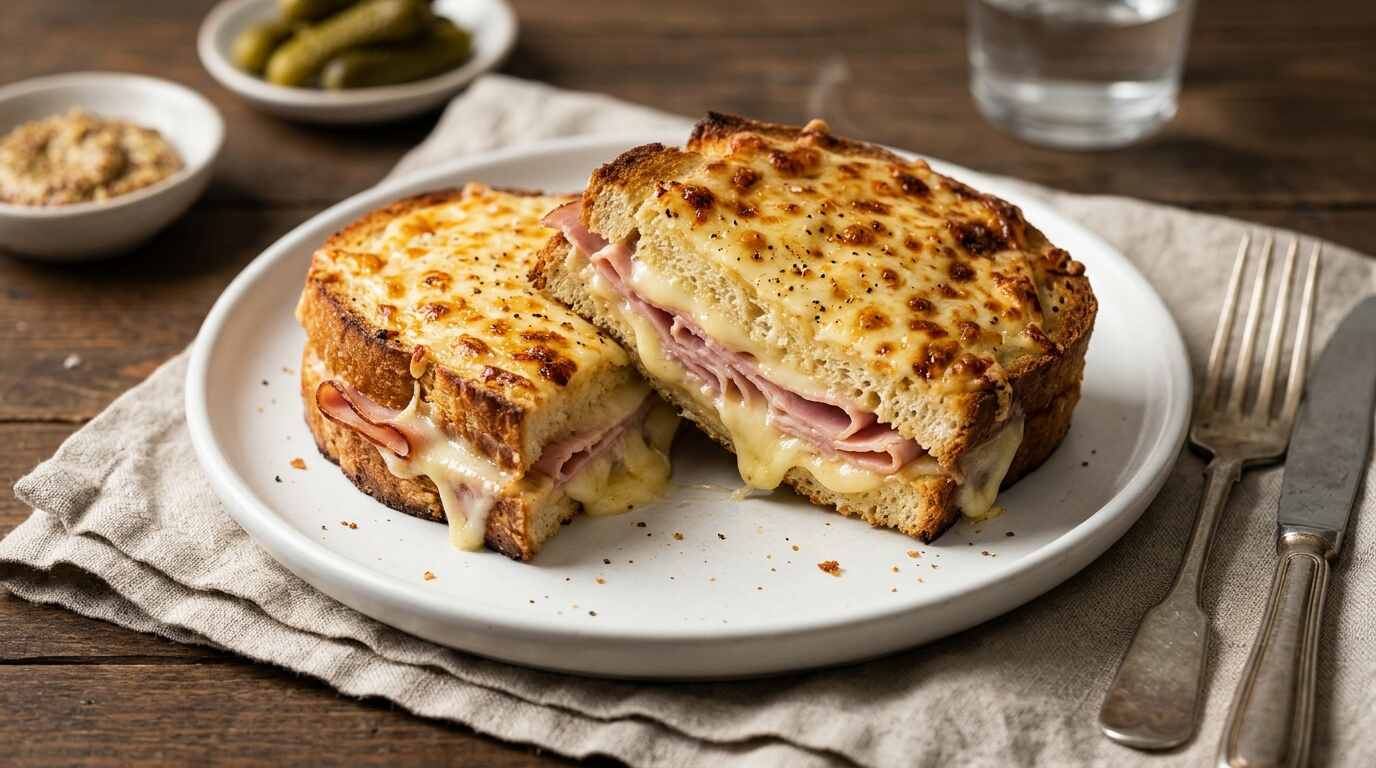
Gruyère is the cheese most often named in the croque monsieur. The post on croque monsieur describes the sandwich as ham and sliced cheese, usually Gruyère, between slices of pain de mie, and notes that other sources substitute Emmental de Savoie or Comté. Great British Chefs recommends young Gruyère Classic for fondue and croque monsieur, reasoning that its higher moisture helps it melt, and says the older Réserve suits eating with wine, seasoning and sauces.
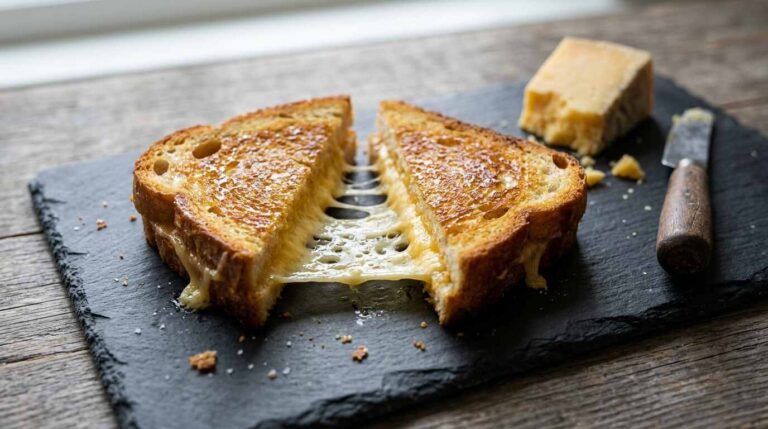
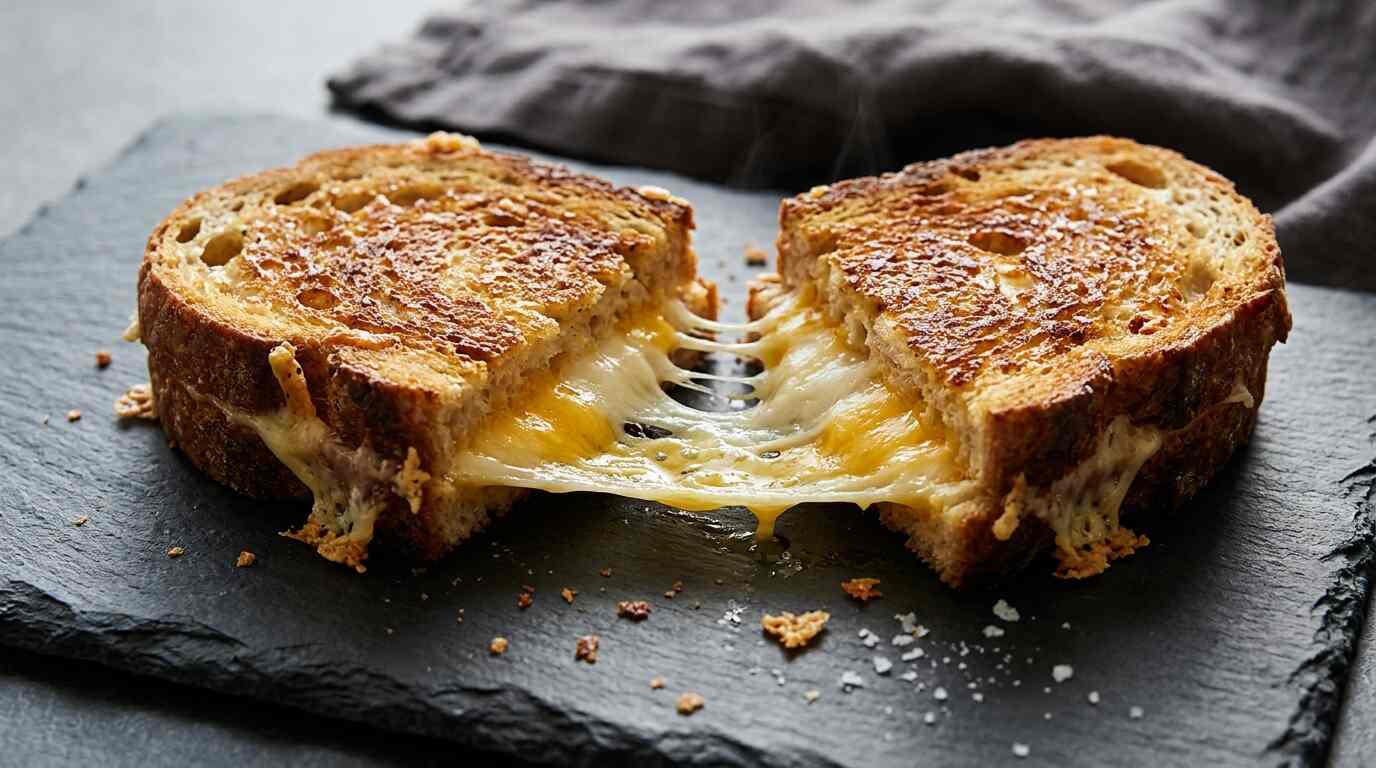
In grilled cheese, Gruyère is more often a partner than the sole cheese. Tasting Table’s recipe blends 3 ounces of Gruyère with 3 ounces of cheddar in a food processor, pairing the cheddar’s sharpness with Gruyère’s nuttiness, and spreads sourdough with mayonnaise before cooking.
The producers’ own grilled sandwich goes the other way and stacks three Gruyères. Their recipe for four uses 100 grams each of Le Gruyère AOP, Le Gruyère aged at least 11 months and Gruyère d’Alpage, layered on thick bread spread with coarse mustard. The sandwiches are fried in butter, then finished in a 160 degree oven for six minutes so the middle melts. A second producer recipe pairs thin slices of Réserve with spinach and red pesto on sour bread, fried until golden. The page does not say why Réserve was chosen.
Sources:
- Le Gruyère AOP, “The history of Le Gruyère AOP”: https://www.gruyere.com/en/le-gruyere-aop/the-history
- Great British Chefs, “Le Gruyère AOP: a history”: https://www.greatbritishchefs.com/features/gruyere-aop-history
- Fribourg Region, “Gruyère, l’origine du nom”: https://fribourg.ch/fr/blog/le-gruyere-origine/
- Le Gruyère AOP, specifications: https://gruyere.com/en/specifications/
- The Local, “Holes in approval for French Gruyère cheese”: https://www.thelocal.com/20121207/holes-in-approval-for-french-gruyere-cheese/
- Le Gruyère AOP, characteristics: https://gruyere.com/en/le-gruyere-aop/characteristics
- Le Gruyère AOP, types: https://www.gruyere.com/en/le-gruyere-aop
- Great British Chefs, “Gruyère AOP: not just for melting”: https://www.greatbritishchefs.com/features/types-of-gruyere
- Cook’s Country / America’s Test Kitchen, Gruyère taste test: https://www.americastestkitchen.com/cookscountry/taste_tests/1791-gruyere-cheese
- Dairy Reporter, “French Gruyere cheese granted EC protected geographical status”: https://www.dairyreporter.com/Article/2012/12/10/French-Gruyere-cheese-granted-EC-protected-geographical-status
- Connexion France, “French gruyere makers angry as court approves US version”: https://www.connexionfrance.com/news/french-gruyere-makers-angry-as-court-approves-us-version/127818
- INAO, Gruyère IGP specification (draft): https://extranet.inao.gouv.fr/fichier/PNOCDCGruyere.pdf
- Connexion France, “Gruyère makers’ disappointment at US bid to allow name to be generic”: https://www.connexionfrance.com/news/gruyre-makers-disappointment-at-us-bid-to-allow-name-to-be-generic/118861
- Le News, “Gruyère cheese can be made in America, rules US court”: https://lenews.ch/2023/03/10/gruyere-cheese-can-be-made-in-america-rules-us-court/
- Wisconsin Cheese, “Why some cheese melts better than others”: https://wisconsincheese.com/the-cheese-life/article/219/why-some-cheese-melts-better-than-others
- Tasting Table, “Ultimate Grilled Cheese Recipe”: https://www.tastingtable.com/cook/recipes/how-to-make-grilled-cheese-cheddar-gruyere-cheese-sandwich
- Le Gruyère AOP, grilled cheese sandwich recipe: https://www.gruyere.com/en/recipes/list-of-recipes/recipe-detail/sandwich-chaud-au-gruyere-aop
- Gruyère Stories, “Grilled sandwiches with Le Gruyère AOP Réserve”: https://gruyerestories.com/grilled-sandwiches-with-le-gruyere-aop-reserve/
- Le Gruyère AOP (YouTube), “Film about Gruyère AOP production (English)”: https://www.youtube.com/watch?v=3y-W8BYeEvc