

In this story
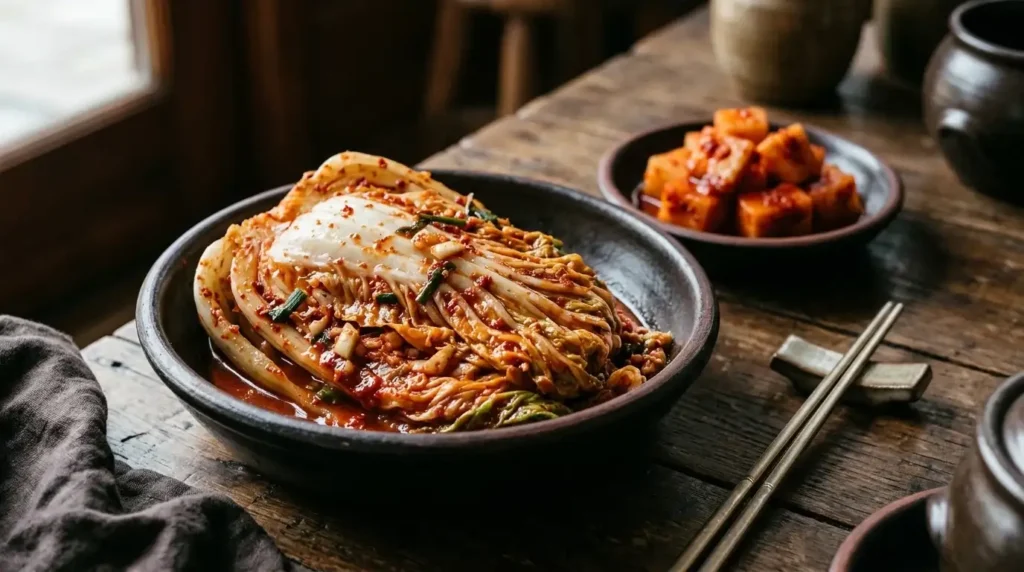
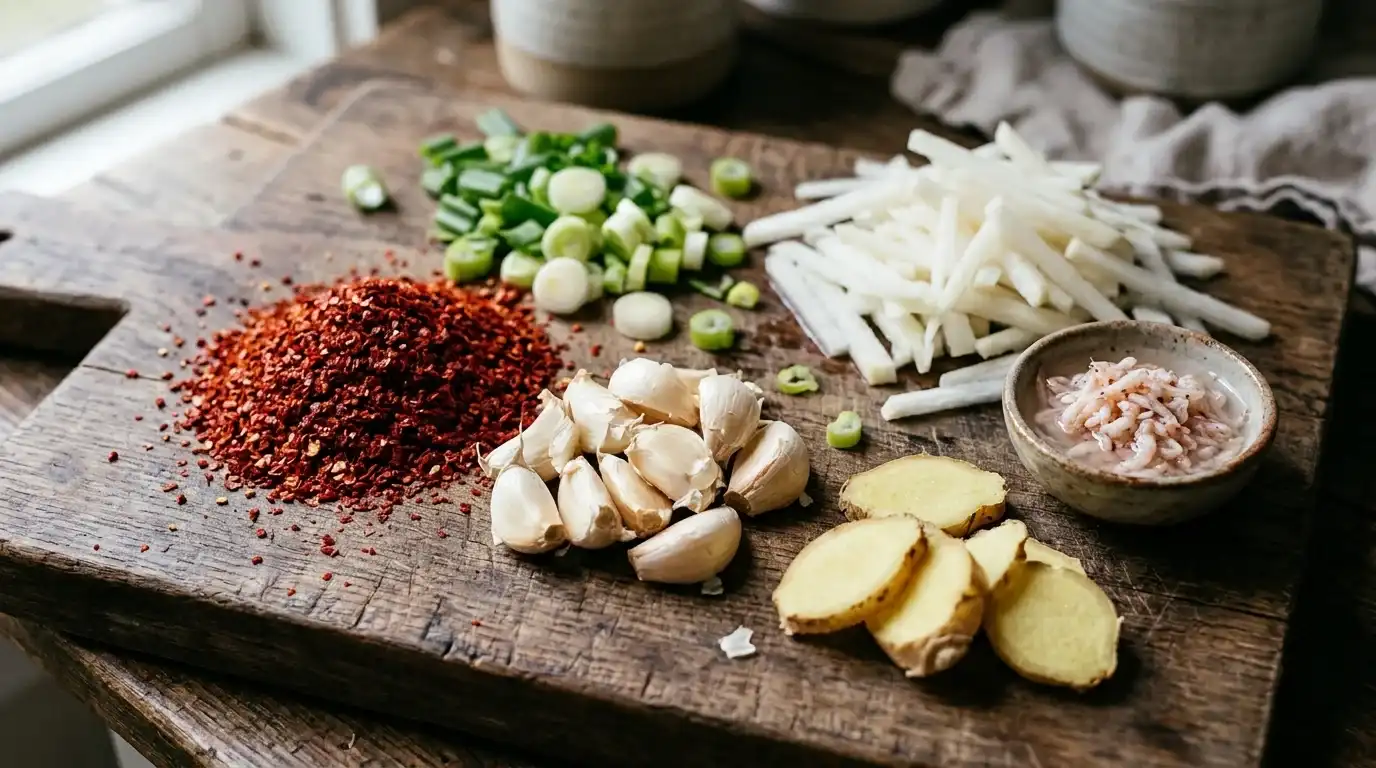
Kimchi is vegetables, usually napa cabbage or radish, salted and then seasoned with chili, garlic, ginger, scallions and fermented seafood, and left to sour. UNESCO’s definition is shorter: the Korean name for preserved vegetables seasoned with spices and fermented seafood. There are hundreds of versions. The red, crunchy cabbage kimchi most people outside Korea know is one of them, and its familiar form is younger than the practice behind it. How much younger is one of the more heated arguments in food history.
Video: Traditional kimchi recipe (Tongbaechu-kimchi), from the Maangchi YouTube channel
Kimjang, the winter making
A yearly cycle UNESCO put on its heritage list
Kimchi was a winter survival food before it was a side dish, and the making of it was a community job. In 2013 UNESCO inscribed kimjang, the making and sharing of kimchi, on its Representative List of the Intangible Cultural Heritage of Humanity.
UNESCO describes kimjang as the end of a year-long cycle. In spring, households buy shrimp, anchovy and other seafood to salt and ferment. In summer they buy sea salt for the brine. In late summer red chili peppers are dried and ground into powder. Late autumn is kimjang season, when communities make and share large batches to carry every household through the winter, and cooks watch weather forecasts to pick the best day and temperature. Methods differ from region to region and are treated as family heritage, often passed from a mother-in-law to a newly married daughter-in-law.
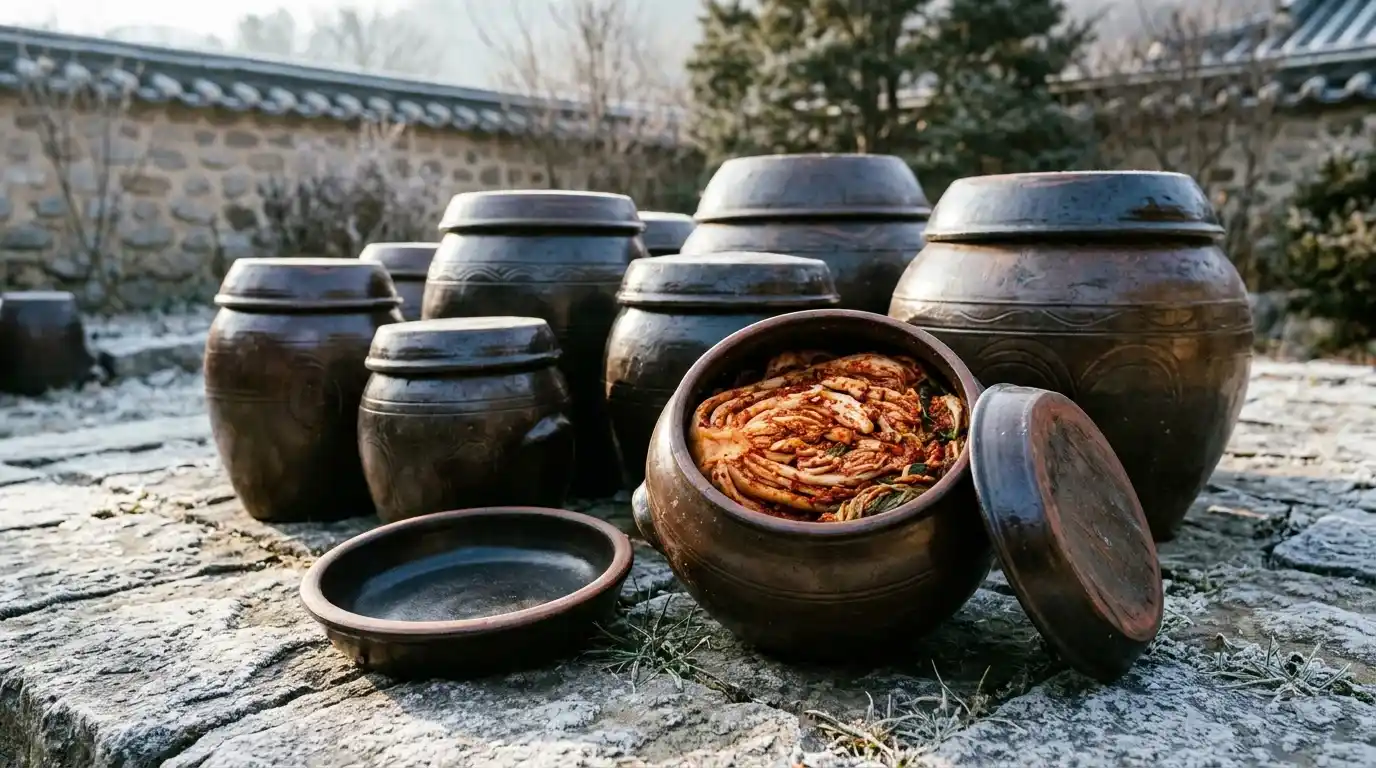
The Korea Herald, writing ahead of Kimchi Day in 2022, describes families and neighbors gathering to salt cabbages, mix the paste and pack the jars, and notes that many households now use kimchi refrigerators instead of earthenware crocks.

When did chili arrive?
A dispute with national stakes
Early kimchi was not red. The question is when chili entered the jar, and sources disagree sharply.
The common account dates it to the late sixteenth century. The Korea Herald reports that historians believe chili arrived around the 1592 Imjin War, the Japanese invasion of Korea, and that it took about 200 years to become a common kimchi seasoning. The same article suggests Koreans may have taken it up to mask the fishy smell of the salted seafood, or jeotgal, then used in place of salt.
Other researchers reject that timeline. In a 2023 review in the Journal of Ethnic Foods, Reggie Surya and David Nugroho argue against the claims that kimchi derives from Chinese pao cai, that chili came with the 1592 war and that cabbage kimchi is a nineteenth-century development. Citing the Samguk Sagi, a history completed in 1145, they hold that Korean chili, or gochu, has existed on the peninsula for about 2,000 years. Their review also cites a thirteenth-century poem by Yi Kyubo on radish pickles as the first literature mentioning fermented vegetables in Korea.
The Imjin War timeline is the more widely repeated one. The longer chronology has its own published defenders, and the question remains contested.
Cabbage, radish and the paste
How today’s kimchi took shape
The cabbage changed too. The Korea Herald says the napa cabbage used today was grown starting in the early twentieth century, and that radish, cucumber and scallions, once the main vegetables, became ingredients in the seasoning paste. It also traces kimchi’s development during the Goryeo period, from 918 to 1392, into three types: pickles, dongchimi and nabak kimchi, the last two being watery kimchis.
Surya and Nugroho count more than 200 variations in Korea, with baechu kimchi, made from napa cabbage, the best known and often called simply kimchi. Kkakdugi, cubed radish kimchi, and dongchimi, a mild radish water kimchi, are two common alternatives.
Salted, soured cabbage has relatives elsewhere. GrillCheesy’s guide to sauerkraut covers the German cousin, another cabbage fermented by lactic acid bacteria.
What happens in the jar
Lactic acid bacteria and temperature
The sourness comes from lactic acid bacteria. Surya and Nugroho name the main groups as Lactobacillus, Leuconostoc and Weissella, and note that kimchi ferments best at low temperatures, where microbial activity is slow.
Temperature decides which bacteria lead. A 2008 study in The Journal of Microbiology by Dongyun Lee and colleagues followed kimjang kimchi fermented underground the traditional way. The researchers found that Lactobacillus sakei predominates in kimjang kimchi, which they linked to fermentation at about 5 to 9 degrees Celsius and storage near minus 2. The kimchi’s temperature fell to 3.2 degrees over the first 20 days and then held around 1.6. The authors called the buried-jar method efficient for both fermenting and storing.
Kimchi goes global
From the Olympic Village to Kimchi Day
International attention came with a sporting event. The Korea Herald reports that kimchi went global after the 1988 Seoul Olympics, when it appeared on the Olympic Village menu and coverage boosted exports. The South Korean government later designated November 22 as Kimchi Day, and several US states and Washington, D.C. have recognized the same date.
The standards fights followed. Surya and Nugroho describe Korea’s 1996 protest over Japanese “kimuchi,” which they characterize as unfermented, the 2001 Codex Alimentarius standard for kimchi, Chinese import restrictions on Korean kimchi from 2012 to 2017 and a 2020 dispute after ISO issued rules for Chinese pao cai.
Frequently asked questions
What is kimchi made of?
Most often napa cabbage or Korean radish, salted, then seasoned with chili, garlic, ginger, scallions and fermented seafood.
What is kimjang?
The traditional late-autumn making and sharing of kimchi for winter, inscribed by UNESCO in 2013.
When did chili peppers come to Korea?
Disputed. Many historians date it to around the 1592 Imjin War; other researchers argue chili was present far earlier.
Why does kimchi get more sour?
Lactic acid bacteria keep producing acid. Cold storage slows them down.
Sources
- UNESCO, “Kimjang, making and sharing kimchi in the Republic of Korea”: https://ich.unesco.org/en/RL/kimjang-making-and-sharing-kimchi-00881
- Kim So-hyun, Korea Herald (November 17, 2022): https://www.koreaherald.com/article/3002765
- Reggie Surya and David Nugroho, “Kimchi throughout millennia: a narrative review on the early and modern history of kimchi,” Journal of Ethnic Foods (2023): https://pmc.ncbi.nlm.nih.gov/articles/PMC10068239/
- Dongyun Lee, Sunjoo Kim, Jinhee Cho and Jeongho Kim, “Microbial population dynamics and temperature changes during fermentation of kimjang kimchi,” The Journal of Microbiology (2008): https://link.springer.com/doi/10.1007/s12275-008-0156-5


