In this story
Parmigiano Reggiano is a hard cow’s milk cheese from a small area of northern Italy, made from raw milk, salt and calf rennet and aged at least a year before anyone may sell it under that name. Each wheel weighs 30 kilograms or more. In Europe, the word parmesan belongs to it too. In the United States, parmesan is a generic federal category that can be made almost anywhere, from pasteurized milk, in ten months.
Video: Why Parmesan Cheese Is So Expensive, from the Insider Food YouTube channel (Regional Eats)
The rules of the wheel
Raw milk, two milkings, no starters
The cheese is defined by its EU registration. The single document for Parmigiano Reggiano PDO describes a hard cheese of raw cow’s milk, partially skimmed by letting the cream rise naturally, from cows fed mainly on forage grown in the area of origin. The milk may not be heat-treated.
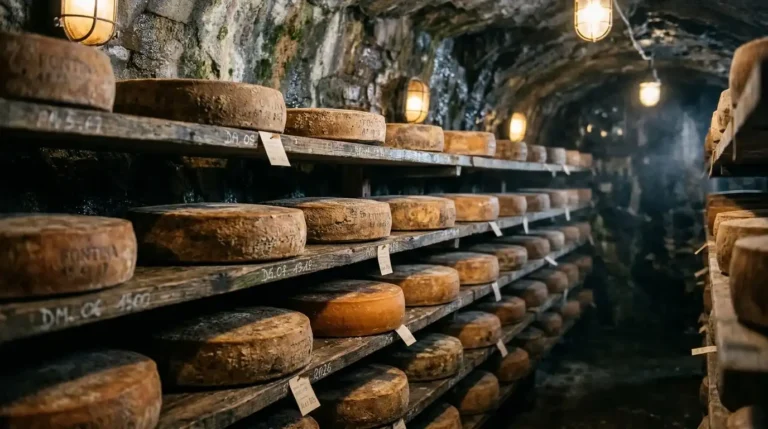
The method follows the dairy’s day. Evening milk rests overnight while its cream rises and is skimmed; in the morning it goes into copper vats with that day’s milk. Natural whey from the previous day’s batch serves as the starter culture, and selected commercial starters are not allowed. Only calf rennet may set the curd. The curd is broken up, cooked, left to settle, then lifted into molds where each wheel is marked. After several days, the wheels go into brine, then onto shelves for at least 12 months inside the production zone.
The finished wheel is large. The specification requires at least 30 kilograms, flat faces 35 to 45 centimeters across, and a side 20 to 26 centimeters high.
Where it can be made
The zone covers the provinces of Parma, Reggio Emilia and Modena, plus the part of Bologna on the left bank of the Reno River and the part of Mantua on the right bank of the Po. Everything from milking to the minimum year of aging happens there.

Inspection at twelve months
Every wheel, checked
The single document says only that compliance tests follow the minimum maturing period. A May 2023 FoodNavigator visit to Ciaolatte, a dairy in the province of Parma and one of more than 300 making the cheese, described what that looks like. After a year, an inspector taps each wheel with a hammer and listens; a compact wheel with no cracks or holes passes and receives an oval brand reading “Parmigiano Reggiano Consorzio Tutela.” Wheels with small flaws under five millimeters are still branded but marked with engraved lines and recommended for eating after one year.
The scale is visible at the vat. Each copper vat holds 1,100 to 1,200 liters of milk and yields two wheels a day, so a single wheel takes roughly 550 to 600 liters of raw milk.
Twelve months is the floor, not the target. The dairy told FoodNavigator that 24 months is the most common age. Past about 18 months, small white crystals form in the paste; the article explains that they are an amino acid released as the milk protein casein breaks down, not grains of salt.
Parmesan in a European court
Germany, 2008
The best-known fight over the English word played out in Germany, where cheesemakers sold hard grated cheese as “Parmesan” without following the Italian rules. The European Commission sued Germany for failing to stop it. On February 26, 2008, the Court of Justice of the European Union ruled in Case C-132/05.
The decision was mixed. The court held that “Parmesan,” because it looks and sounds like Parmigiano Reggiano and is used on a similar product, is an evocation of the protected name, which EU law forbids, whether or not it is a translation. Germany had not shown that Parmesan was a generic word, so it could not use the generic-name exception. But the court dismissed the Commission’s case anyway, finding that German law already gave producers the tools to protect themselves and that Germany was not obliged to police another country’s designation on its own initiative.
The practical result inside the EU was clear: cheese sold there as parmesan must be Parmigiano Reggiano. The ruling did not apply outside Europe.

Parmesan in America
A federal standard of identity
In the United States, parmesan is defined by the Food and Drug Administration. The federal standard of identity, 21 CFR 133.165, requires parmesan and reggiano cheese to be cured at least ten months, with no more than 32 percent moisture and at least 32 percent milkfat in the solids. The milk may be pasteurized. The standard says nothing about where the cows live or what they eat.
What was in the shaker
The grated product drew its own scrutiny. In February 2016, Bloomberg’s Lydia Mulvany had store-brand grated parmesan tested by an independent lab for cellulose, the wood-pulp anti-caking agent that is legal in small amounts. Dean Sommer of the Center for Dairy Research in Wisconsin put the acceptable range at 2 to 4 percent. Jewel-Osco’s Essential Everyday tested at 8.8 percent and Walmart’s Great Value at 7.8 percent; Kraft came in at 3.8 percent. Walmart and Whole Foods questioned the single-sample results and said they were investigating.
The same report described an FDA case against Castle Cheese, a Pennsylvania plant whose product sold as 100 percent grated parmesan turned out to include Swiss, mozzarella and white cheddar; its president was scheduled to plead guilty to criminal charges. Neal Schuman, whose company held about a third of the domestic hard Italian cheese market, estimated that 20 percent of US hard Italian cheese production was mislabeled. His summary: “Consumers are innocent, and they’re not getting what they bargained for.”
Parmigiano in a sandwich
Grated into the sandwich
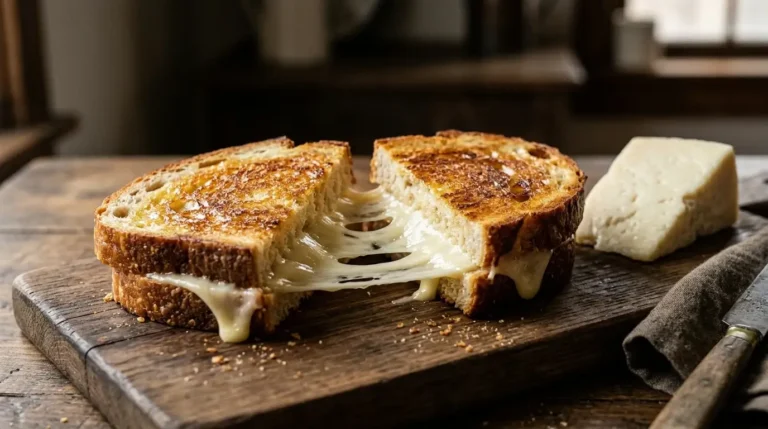
The PDO rules allow Parmigiano Reggiano to be sold as whole wheels, in portions or grated. A hard, crystalline cheese aged for years is a different ingredient from the soft cheeses that stretch in a grilled sandwich. For those, GrillCheesy’s guides to Fontina, Gouda and Monterey Jack cover the melting side, and the brie guide covers another European cheese protected by origin rules.
Genuine Parmigiano Reggiano is sold by the wedge online, and a fine rasp grater is the usual tool for a hard aged cheese:
- EMILIA FOOD LOVE Parmigiano Reggiano DOP 24 months 2.2 lb (1kg) – The Only Parmesan: a one-kilogram piece of 24-month PDO cheese. See it on Amazon (affiliate link)
- Microplane Classic Red Zester Grater, Stainless Steel – Citrus Zesting & Cheese Grating, Dishwasher Safe, Made in USA: a stainless rasp for grating hard cheese finely. See it on Amazon (affiliate link)
Video: Microplane Classic Zester Grater Demo & Review, from the Creative Home Reviews YouTube channel
As an Amazon Associate I earn from qualifying purchases. A commission may be earned if you buy through this link, at no extra cost to you.

Frequently asked questions
What is the difference between Parmigiano Reggiano and parmesan?
In the EU, none: only Parmigiano Reggiano may be sold as parmesan. In the US, parmesan is a federal category that may use pasteurized milk and be aged 10 months, made anywhere.
How long is Parmigiano Reggiano aged?
At least 12 months in the production zone, after which every wheel is inspected. Many are aged 18 to 36 months.
What are the ingredients in Parmigiano Reggiano?
Raw cow’s milk, salt and calf rennet. Selected starter cultures and additives are not allowed.
Is there wood pulp in grated parmesan?
Cellulose, made from wood pulp, is a legal anti-caking agent in US grated cheese. A 2016 Bloomberg test found some store brands well above the 2 to 4 percent experts consider normal.
Sources
- “Parmigiano Reggiano” PDO single document: https://www.gob.mx/cms/uploads/attachment/file/245696/IT_Parmigiano_Reggiano.pdf
- “How is Parmigiano Reggiano made? We take a look inside the dairy,” FoodNavigator (May 22, 2023): https://www.foodnavigator.com/Article/2023/05/22/How-is-Parmigiano-Reggiano-made-We-take-a-look-inside-the-dairy
- Court of Justice of the European Union, Press Release No 11/08, Case C-132/05 (February 26, 2008): https://curia.europa.eu/en/actu/communiques/cp08/aff/cp080011en.pdf
- 21 CFR 133.165, Parmesan and reggiano cheese: https://www.ecfr.gov/current/title-21/chapter-I/subchapter-B/part-133/subpart-B/section-133.165
- Lydia Mulvany, “The Parmesan Cheese You Sprinkle on Your Penne Could Be Wood,” Bloomberg (February 16, 2016), as filed in a court record: https://www.lb7.uscourts.gov/documents/16c5802.pdf