In this story
Pain de mie is white sandwich bread baked in a box. The dough rises inside a long rectangular pan with a lid on top, presses against all six sides and comes out as a flat-topped, square-cornered loaf with a thin crust and a close, soft interior. The French name points at the inside of the bread. The American name, Pullman loaf, points at a railroad company that never ran a railroad. Both describe the loaf behind countless grilled cheese sandwiches, croque monsieurs and slices of French toast.
Video: How To Make Pain De Mie, Sandwich Bread, Pullman Loaf, from the ChainBaker YouTube channel
Bread of the crumb
What “mie” means
The name is literal. CooksInfo explains that “mie” is French for crumb, the soft interior of a loaf, as in a coarse or fine crumb, and that the name presumably calls attention to the particular fineness of the crumb compared with other French breads. A baguette is mostly crust and open, irregular holes. Pain de mie is the opposite: very little crust and a tight, even interior.
The same source notes that pain de mie is sold sliced and packaged in French supermarkets, contains sugar and fat that give it a slightly sweet taste and a tighter crumb, and keeps fresher longer than most French breads because of that fat. The French use it for toast, fancy sandwiches and the croque-monsieur. CooksInfo also passes along the French account that the bread was introduced in the early 1900s for English-speaking tourists.
The lidded pan
Why the slices come out square
The pan does the shaping. PJ Hamel of King Arthur Baking describes the traditional pain de mie pan as a lidded 13-by-4-by-4-inch box. Tall straight sides and the lid stop the loaf from “mushrooming” over the rim, so the slices come out square, and the end slices match the ones from the middle.
The lid also changes the bread. Hamel writes that rising against the lid gives yeast bread a fine-grained, close texture. She recommends taking the lid off about 15 minutes before the end of baking so trapped steam can escape and the top can brown.

A railroad name
George Pullman’s dining cars
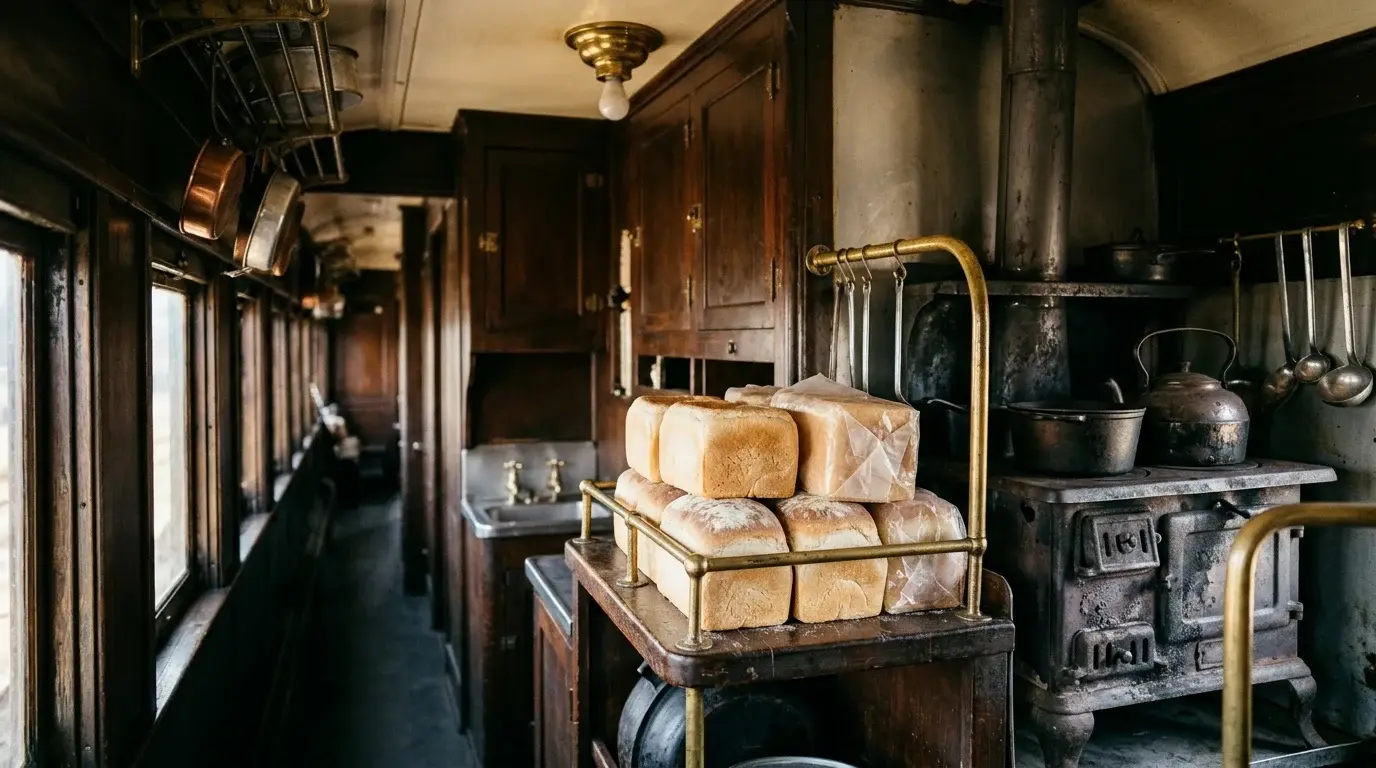
The American name comes from the Pullman Company. Edward Bottone, writing in The Cook’s Cook in 2022, describes the company as one that built, staffed and leased sleeping, parlor and dining cars to railroads such as the Pennsylvania Railroad, Union Pacific and the Baltimore & Ohio, while never operating a railroad itself. George Pullman’s first Palace Car appeared in 1864, Bottone writes, and a car he commissioned carried Abraham Lincoln’s body on its funeral journey the following year. Later came dining cars with full kitchens and professional staff.
Those kitchens were small. Bottone writes that the lidded loaf, which already existed in eighteenth-century Europe as pain de mie or pain anglais, suited them because the flat-topped loaves stacked neatly, and he says four of them fit where three round-topped loaves would. The square bread served in Pullman dining cars became known as the Pullman loaf, he writes, helped by its resemblance to the railcars themselves.
The story has more than one version. CooksInfo records two theories: that the loaf was named for looking like a railway car, or that it was shaped that way to save space in Pullman kitchens. Either way, the bread came before the name.
A baking-industry staple
The 1930s Pullman formula
By the 1930s the name belonged to commercial bakers. CooksInfo found that in 1931 the American Society of Baking held a session called “Building the Pullman Formula,” led by John C. Summers, and a second session on slicing Pullman bread. In 1936, another session addressed eliminating a particular type of hole in Pullman bread. The square loaf had become an industrial product with its own technical problems.
Baking one at home
King Arthur’s method
King Arthur’s pain de mie recipe, by Hamel, shows what goes into the classic loaf. It calls for 570 grams of all-purpose flour, milk and water, 85 grams of butter, sugar, dry milk, a few tablespoons of potato flour, salt and instant yeast. The shaped log rises in the 13-inch pan until it is just below the lip, which takes 45 minutes to an hour. Then the lid goes on and the loaf bakes at 350°F for 25 minutes, followed by 10 to 20 minutes uncovered, until the center reaches 190°F.
The amount of dough matters. CooksInfo warns that too little dough won’t fill the pan and too much makes the bread dense, and suggests sliding the lid on once the dough is within about half an inch of the top.
The pan Hamel describes is easy to find:
- USA Pan Bakeware Pullman Loaf Pan with Cover, 13 x 4 inch: a lidded 13-inch aluminized steel pan, the standard size for a full pain de mie loaf. See it on Amazon (affiliate link)
Video: How to Use a Pullman Pan, from the Robyn On The Farm YouTube channel
As an Amazon Associate I earn from qualifying purchases. A commission may be earned if you buy through this link, at no extra cost to you.
Why it makes the grilled cheese
Even slices, even browning
In the introduction to a smaller pain de mie recipe, Hamel names grilled cheese as her favorite sandwich to make with the loaf. Square slices of equal size cover the pan or griddle edge to edge, and the fine crumb leaves no large holes for melting cheese to run through. A sourdough slice brings sour flavor and an open, chewy structure; pain de mie brings softness and a uniform golden crust. A mild melter such as Monterey Jack fits it well.

Frequently asked questions
What does pain de mie mean?
“Mie” is French for the crumb, the soft inside of bread. The name points to the loaf’s fine crumb and minimal crust.
Why is it called a Pullman loaf?
The name is tied to the Pullman Company’s railroad dining cars, where the flat, stackable loaves saved space. Lidded pans predate the company.
What size is a Pullman pan?
The traditional size is 13 by 4 by 4 inches, with a sliding lid.
Is a Pullman loaf the same as pain de mie?
Essentially, yes. Both describe a fine-crumbed white sandwich loaf baked in a lidded pan, though recipes vary.
Sources
- CooksInfo, “Pain de Mie”: https://www.cooksinfo.com/pain-de-mie
- CooksInfo, “Pullman Bread” (updated October 4, 2020): https://www.cooksinfo.com/pullman-bread
- PJ Hamel, “There’s more to this pan than pain de mie,” King Arthur Baking (September 2, 2019): https://www.kingarthurbaking.com/blog/2019/09/02/theres-more-to-this-pan-than-pain-de-mie
- PJ Hamel, “Pain de Mie” recipe, King Arthur Baking: https://www.kingarthurbaking.com/recipes/pain-de-mie-recipe
- PJ Hamel, “A Smaller Pain de Mie” recipe, King Arthur Baking: https://www.kingarthurbaking.com/recipes/a-smaller-pain-de-mie-recipe
- Edward Bottone, “The Pullman Loaf Legacy,” The Cook’s Cook (July 22, 2022): https://thecookscook.com/columns/back-story/the-pullman-loaf-legacy/