
In this story
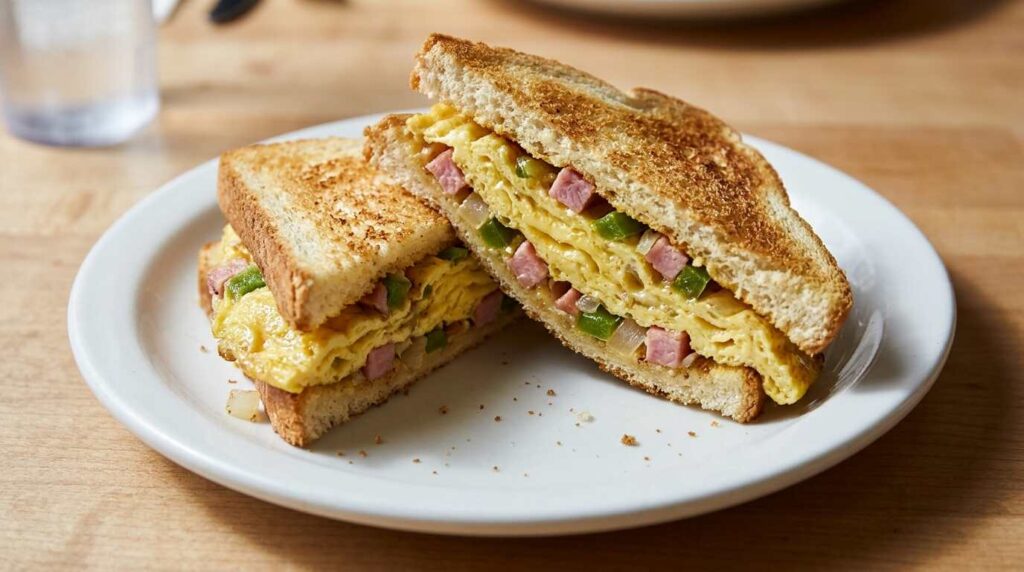
The Denver sandwich, also called the Western sandwich, is a ham, onion and green pepper omelet folded between two slices of toast or bread. No one has shown that it began in Denver. The earliest dated use of the name that blogger and word researcher Barry Popik lists is April 7, 1903, in an Iowa newspaper, and the stories naming inventors all turn up decades after that.
Video: Western Sandwich (1909) on Sandwiches of History | Sandwiches of History
What goes between the bread
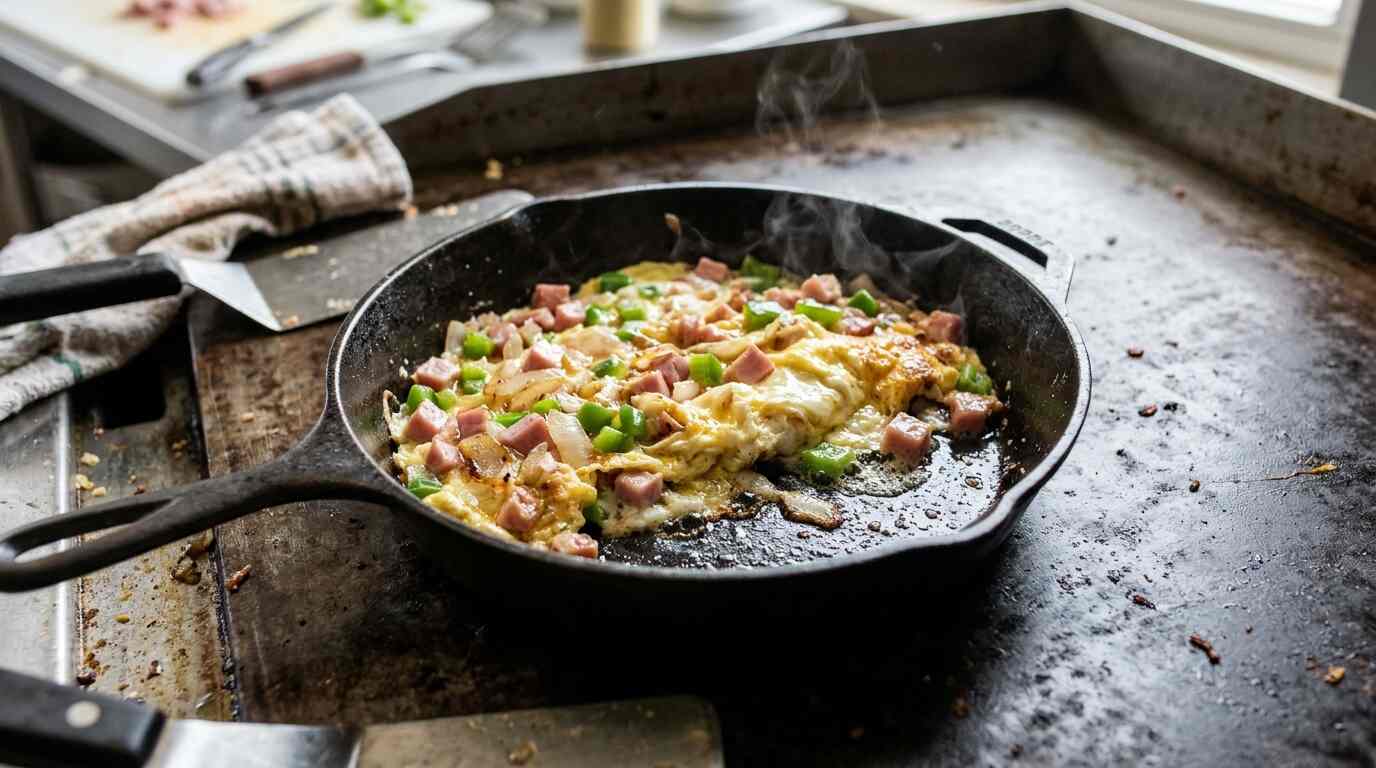
The fillings have never been fixed. A Denver Gazette explainer from February 2026 describes the closely related omelet as typically filled with diced ham, sautéed onions, diced green bell peppers and melted cheese, and notes that there is no single definitive ingredient list.
Old newspapers show the same drift. Popik’s collection of citations includes a 1909 Missoulian definition: “A ‘Denver’ sandwich is made of minced ham, eggs and onions.” A Chicago Tribune recipe from July 26, 1908, printed under the Western name, used bacon, peppers, onions and eggs. In 1950, in a long-running reader debate in the Amarillo Daily News, a chef wrote in that the Denver has minced onion, pepper, ham and egg, while another reader said the onions were optional and that the meat was what set it apart. By the columnist’s own 1977 summary, the sandwich “consisted of scrambled eggs with diced ham and chopped green peppers, served on toast.”
That Amarillo exchange also shows a second rival name. The columnist, Wes Izzard, wrote that the sandwich was known as a Denver or St. Paul sandwich, and readers spent weeks arguing over how the two differed. A 1963 Christian Science Monitor mention, in Popik’s list, calls it sometimes a St. Paul sandwich, sometimes a Denver.
What the print record shows
Popik’s entry is the best dated trail. It runs from an 1884 recipe printed in the Perry, Iowa, Pilot for ham and egg on toast, which does not use the name, to the 1903 Iowa newspaper line comparing a hungry hobo to “a Denver sandwich.” A St. Paul, Minnesota, lunch-room menu from 1905 lists New York, Denver and St. Paul sandwiches side by side. By 1908 the Denver sandwich turns up in Newark, Ohio, and a San Antonio newspaper that year is the earliest cited use of “Western Sandwich.” Hotel Monthly printed menu prices for a Denver sandwich in 1918 and 1919.
Menus and advertisements fill in the commercial side. A Janesville, Wisconsin, ad of November 8, 1912, lists the Denver sandwich at 10 cents, and an Oshkosh ad that March offers one for 20 cents. By May 1919 a Hotel Monthly menu priced a hot Denver sandwich at 40 cents. Cooksense adds a close relative, the Manhattan sandwich, cited from 1909 and made with fried egg, minced ham and onion, and Popik’s list has a 1922 Davenport, Iowa, newspaper explaining the Manhattan sandwich in the same terms. The Denver Gazette, for its part, says the dish was likely served before 1900 without the Denver name.
A few details stand out in that list:
- The name spread across the Midwest, Mountain West and Texas before 1910, in ordinary newspapers and in advertisements.
- The Boston Cooking-School Magazine of March 1, 1913, answering a reader’s question, said its editors were not able to verify a statement about the sandwich. The entry gives no more than that.
- A Time review of April 5, 1926, defined a western sandwich as a ham and onion omelet, which suggests the term needed no explanation to its readers by then.
- Cookbooks took it up by the 1930s and 1940s. Popik lists a Denver sandwich recipe in Hibben’s American Regional Cookery of 1932 and another, with a history, in Brown’s American Cooks of 1940, and Time ran a book review headlined “Western Sandwich” on March 29, 1937.
A Westword article, whose date was not shown when it was fetched, cites John Mariani’s Encyclopedia of American Food and Drink for 1935 as the first print mention of the Western omelet. It also cites the Oxford Encyclopedia of Food and Drink in America for a 1918 Denver sandwich reference in a restaurant-industry publication. Popik’s earlier dates show that those reference works were not citing the earliest uses, a reminder that encyclopedia dates are only as good as the searches behind them.
Inventors who claim it
The stories naming a person fall into a handful of camps, and none rests on a document from the time.
Restaurateurs M. D. Looney and Albert A. McVittie both claimed the sandwich in 1907. Popik traces those claims to a July 13, 1950, Amarillo column in which Looney says he was “the originator of the Denver sandwich” in 1907, and to a 1954 Dallas Morning News line stating that the late Albert A. McVittie invented it. Popik notes that the 1907 claims appear only in the 1950 and 1954 texts, not in 1907 print.
A 1973 Hayward, California, newspaper piece said the sandwich originated at the Tabor Hotel in Denver. A 2002 Seattle Post-Intelligencer column credited Baby Doe Tabor. Colorado Life Magazine, in a 2016 article by Matt Masich, calls the Baby Doe story probably apocryphal. The same article lists an Italian immigrant who reportedly sold the sandwiches from a street-corner cart in Denver in 1893, though the Food Republic article that repeats the claim names no source for it.
Taken together, the sources describe a dish with many claimants and no dated proof for any of them.
The railroad, the wagon and other theories
Origin stories that explain how the dish formed are older than the inventors in the record, and they are speculation rather than evidence.
The most repeated theory ties the sandwich to Chinese cooks. The Cooksense food dictionary says James Beard and Evan Jones believed it was created earlier by the many Chinese chefs who cooked for logging camps and railroad gangs and that it probably derived from egg foo young. Food Republic calls this the most plausible of the competing claims, pointing to the estimated 10,000 to 15,000 Chinese workers contracted for western railroad construction and the completion of the Transcontinental Railroad in 1869, but adds that there is “no definitive evidence.” The Denver Gazette, citing Britannica, says historians have speculated about the same link, and ties it to the role Chinese immigrants played in building Colorado’s railways.
A second theory is that strong ingredients hid the taste of stale eggs. A plaque on California Street between 15th and 16th Streets in downtown Denver, the Gazette reports, states that the Denver omelet was developed to mask the stale flavor of eggs shipped by wagon freight. The Gazette adds that the plaque refers to the omelet and does not mention the sandwich. Food Republic says the story is “probably not true,” and the Gazette notes that Sam’s No. 3, a Denver diner, says many historians have balked at the claim.
Britannica, again via the Gazette, also mentions cattle drivers as a possible original audience for a portable meal. Westword lists several further ideas, including the “Truckstop Premise,” a descent from the Basque dish piperade, and a link to 17th-century English frizzled ham with eggs. Its author writes that no one really believes the Denver omelette was invented in Denver.

From sandwich to omelet
The sandwich came first, according to Colorado Life, which says there is clear evidence it predates the omelet. By the 1950s it was a national menu item. The article quotes a 1954 Dallas Morning News headline, “Denver sandwich has become big coast-to-coast favorite,” and a nationally syndicated 1959 article claiming it was listed on more restaurant menus than any other sandwich with a name.
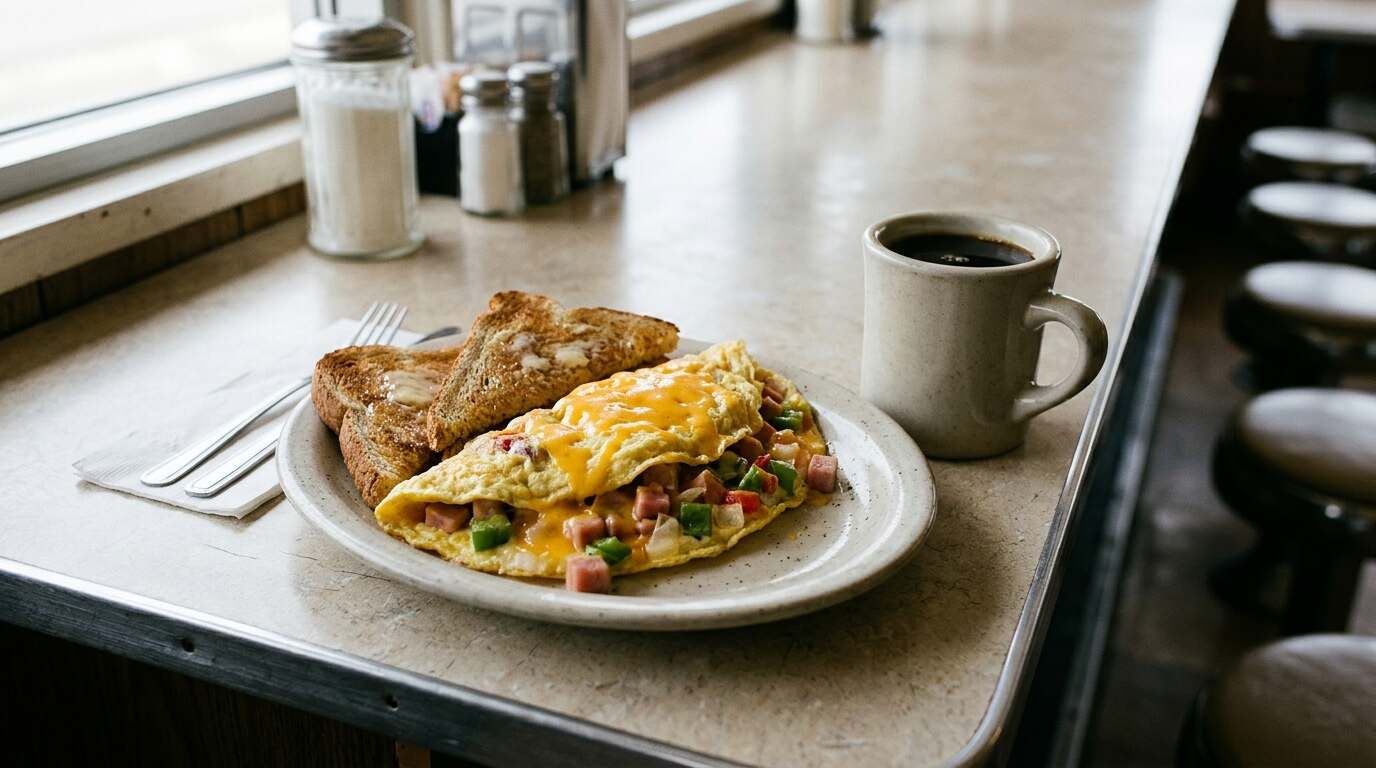
Then the bread dropped out. Colorado Life says the sandwich was a breakfast menu staple from the 1910s through the 1970s and largely vanished in the 1980s as the omelet took its place. Food Republic agrees on the order of events and says most regional historians treat the omelet as a descendant of the sandwich. Some restaurants still call the omelet the Western omelet.
Where the sandwich survives
In a Colorado Public Radio segment, Masich said he could not find a Denver sandwich within the city limits of Denver itself, though restaurants in Arvada and Wheat Ridge still served versions. He also noted that Wisconsin has many Denver sandwich restaurants, without explaining why, and Colorado Life adds Minnesota to the list.
Two local restaurants appear in that coverage. Li’l Nick’s Pizza in Wheat Ridge serves a North Denver sandwich created by owner Bob Quintana, who, per Colorado Life, first met the Denver sandwich in the late 1950s while working in North Denver restaurants. His version adds mozzarella, peppers, roasted green chile and marinara for dipping. George’s Cafe in Arvada serves a version that Masich likened, on the radio segment, to a BLT with the omelet in place of the bacon. Both accounts are several years old, so current menus should be checked with the restaurants directly.
The Denver Gazette closes its own survey by saying that any certain origin has been lost to time.
Sources:
- Barry Popik, “Western Sandwich (Denver Sandwich; Denver Omelet)”: https://barrypopik.com/blog/western_sandwich_denver_sandwich_denver_omelet
- Colorado Life Magazine, “Mysterious Origins of the Denver Omelet” (Matt Masich): https://www.coloradolifemagazine.com/blog/post/mysterious-origins-of-the-denver-omelet
- Denver Gazette, “Where did the ‘Denver omelette’ come from and what’s the reason for its Mile High namesake?” (February 12, 2026): https://www.denvergazette.com/2026/02/12/where-did-the-denver-omelette-come-from-and-whats-the-reason-for-its-mile-high-namesake/
- Food Republic, “The Denver Omelette Got Its Start As A Massively Popular Sandwich”: https://www.foodrepublic.com/1294636/first-denver-omelette-sandwich/
- Colorado Public Radio, “Order Up: Cracking Open The History Of The Denver Omelet”: https://cpr.org/show-segment/order-up-cracking-open-the-history-of-the-denver-omelet
- Cooksense, “Denver sandwich”: https://cooksense.org/denver-sandwich
- Westword, “The Yolk’s on Us”: https://www.westword.com/?p=40673635
- Sandwiches of History (YouTube), “Western Sandwich (1909) on Sandwiches of History”: https://www.youtube.com/watch?v=UI0j1L0Pj-4