In this story
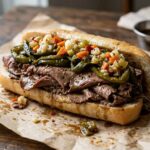
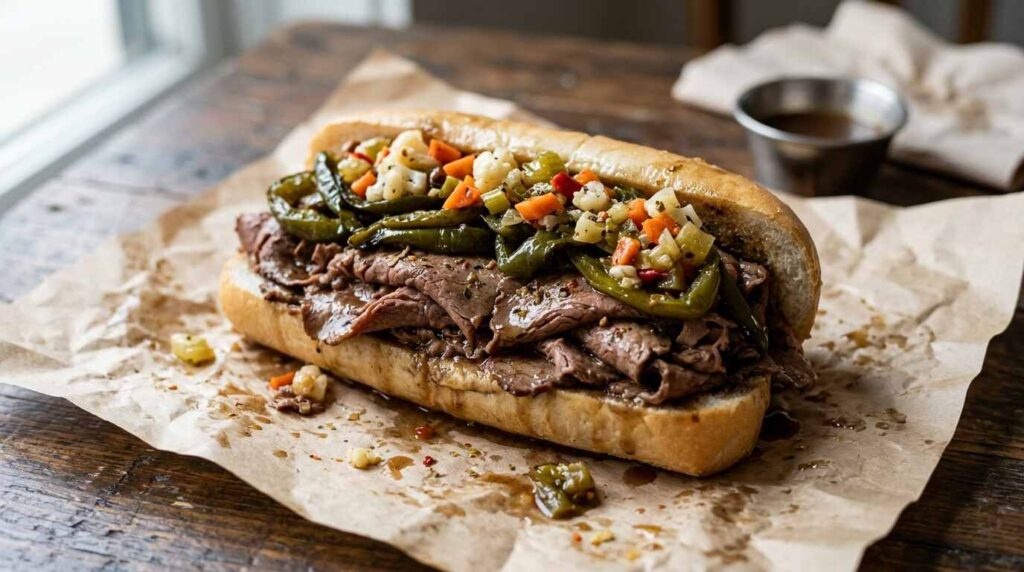
Italian beef is a Chicago sandwich of thinly sliced, spiced roast beef, soaked in its own cooking juices and piled into a long roll with sweet peppers or hot giardiniera. Chowhound writes that Chicagoans, asked to name the city’s signature dish, will almost surely give that title to the Italian beef. Who first made it is another matter, and at least three families and a meat-packing company have a stake in the answer.
Video: Johnnie’s Iconic Italian Beef Is A Delicious Mess Of Beef And Gravy | Legendary Eats, Insider Food
The sections below cover what goes into the sandwich, the vocabulary used to order it, the competing origin stories and the point at which a local specialty became a national one.
What goes into an Italian beef
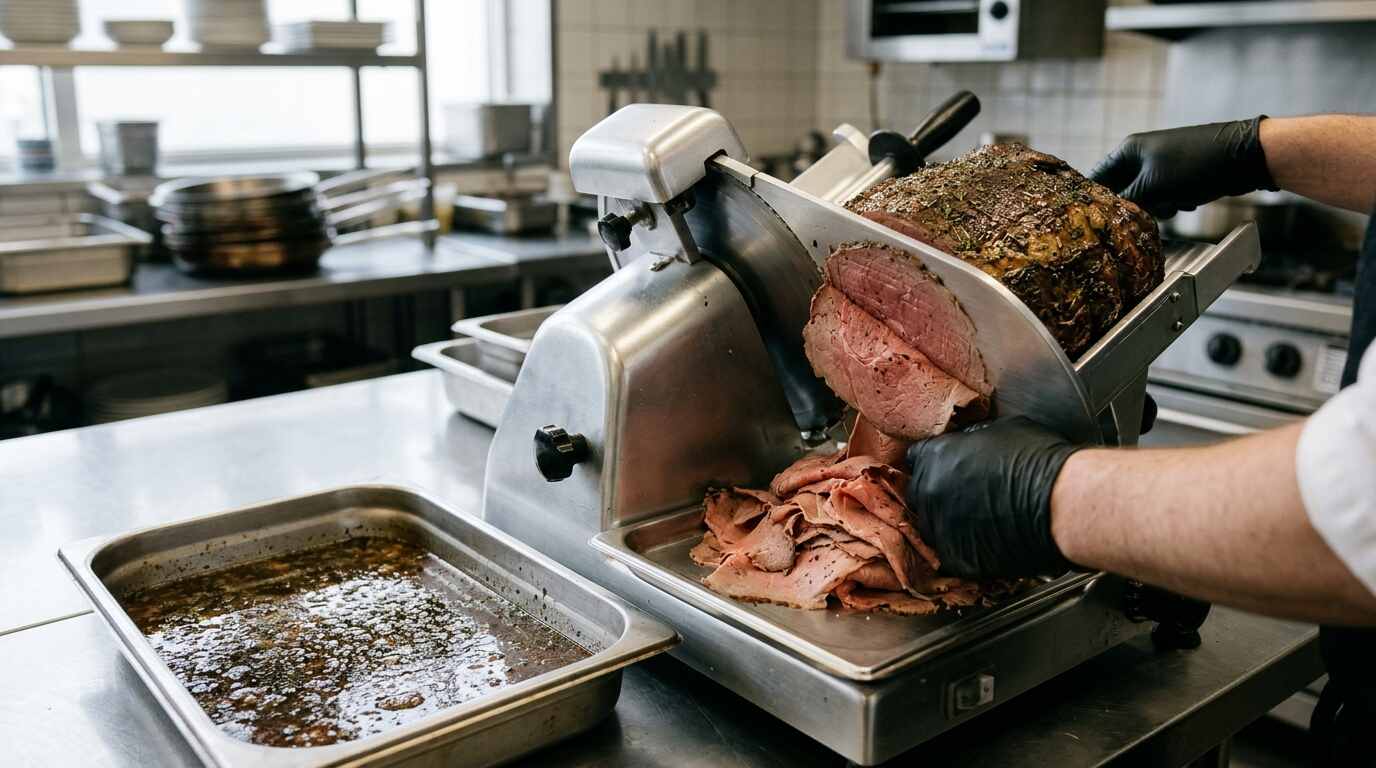
The beef is a lean cut, typically sirloin or top round, slow-roasted and sliced very thin before being bathed in au jus made from the roasting drippings. Wikipedia, which serves here only as a pointer because nothing better summarized the point, says inside round is commonly used and cites Eater for the detail that some restaurants prefer top sirloin. Home recipes vary more. A version from the Italian Enclaves Historical Society braises a boneless chuck eye roast for about three and a half hours and shreds it, a different texture from the shaved slices of a Chicago stand.
A restaurant recipe shows the slicing logic. Sammich, an Oregon restaurant featured on Diners, Drive-Ins and Dives, roasts a sirloin roast, lets it cool, then thin-slices it as thinly as possible, and simmers the saved juices into a strained dipping liquid. Cooling the meat first is what makes the thin slicing possible.
The Takeout describes the base as thin roast beef simmered in seasoned beef jus, which Chicagoans often call gravy, and heaped into a soft, chewy, hinge-cut French roll. Wikipedia describes the bread as typically crusty so it can hold up to dipping. The two descriptions pull in opposite directions, and the sources do not settle how much crust the roll should carry.
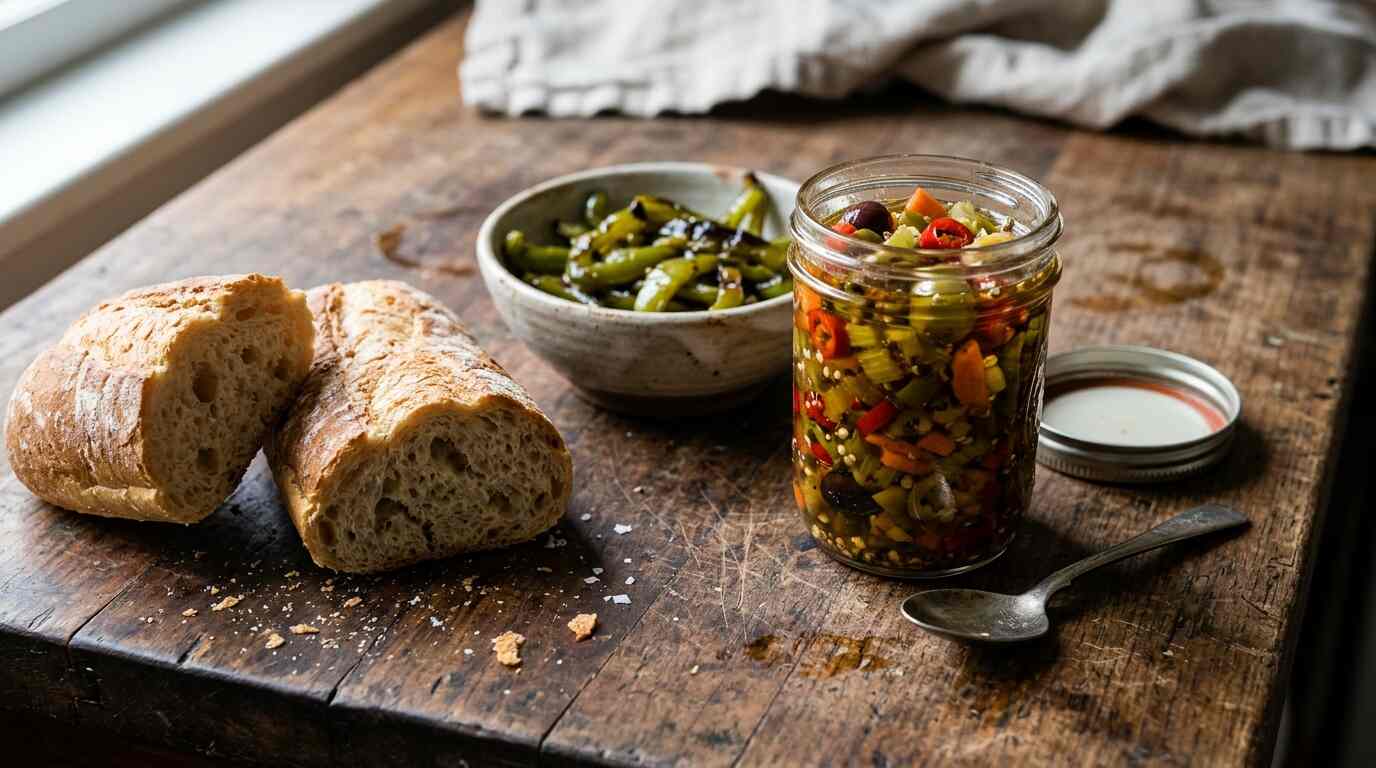
Two toppings define the sandwich. “Sweet” means slivers of roasted bell pepper, usually green. “Hot” means giardiniera, which The Takeout defines as a pickled mix of chiles, vegetables and olives in oil, with the leftover oil prized by regulars. Cheese is not included by default. When ordered, it is usually mozzarella and occasionally provolone. A “combo” adds a whole Italian sausage.
Dry, wet or dipped
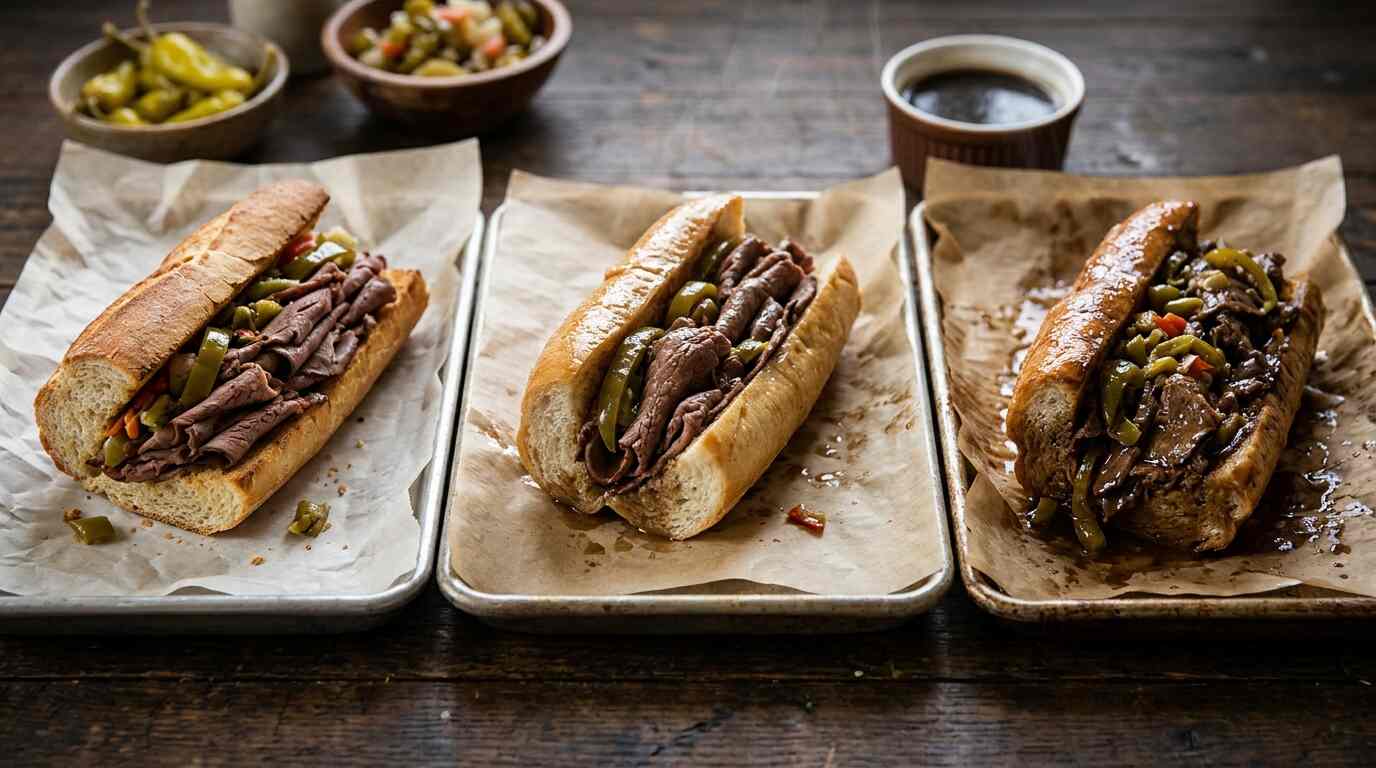
Italian beef ordering rests on how much liquid the bread takes on. The Takeout lays out the scale. A dry beef is drained briefly before it goes on the bread, so the roll stays intact and the sandwich is less messy. Wet leaves the beef undrained and often adds extra jus, and the bread can fall apart quickly. Dipped means the whole sandwich goes into the jus.
There is a fourth item that skips the meat altogether. Gravy bread is a French bun soaked in jus until it collapses, and The Takeout notes that it is now rare on menus. Stands also draw the lines in different places, which is why Tasting Table says shops offer varying degrees of dipping, from totally dry to fully soaked.
The vocabulary appears in print early. In a 1979 column, the Chicago Tribune’s Phyllis Magida wrote that Chicagoans know to “demand hot pepper with Italian beef”. Cheese turned up as a common addition by the 1980s, according to the same Tribune history, which cites a November 1983 recipe for cheesy Italian beef sandwiches.
The peanut wedding story
Nearly every account begins with a peanut wedding. Many Italian-American couples in early twentieth-century Chicago could not afford a catered reception, so the party moved to a family home or a church basement, and the food budget stayed small. Chowhound reports that peanuts and beef sandwiches were served, and that Chicago’s role as a meatpacking center kept beef plentiful. Early wedding sandwiches used thicker slices. Slicing thinner stretched one roast across more guests.
The Italian Enclaves article gives a second source of supply: stockyard workers, it says, took home less desirable cuts of beef that could not be sold and cooked them for hours in Italian spices. Historian Shermann “Dilla” Thomas, cited in an NPR obituary of Mr. Beef’s Joe Zucchero republished by WUWF, made a related point: immigrant cooks limited to tougher cuts found that long cooking in the meat’s own juices made it tender.
Each account dates the peanut weddings differently. Tasting Table puts them in the early 1900s. Al’s Beef places its own wedding scene after World War I. The Chicago Tribune’s history points to the 1920s, citing The Chicago Food Encyclopedia.
Anthony Ferreri and Al’s Beef
Al’s Beef gives the most detailed single-family version. On its own site, the restaurant says Anthony Ferreri, a street peddler selling cold sandwiches and bakery goods from a truck, saw a family at a peanut wedding slicing a roast thickly by hand. He then sliced the beef much thinner on a deli slicer and cooked it in its juices with a secret spice mix, which let the same roast serve about twice as many people. According to the page, the name “Italian beef” came from the sandwiches being made by Italians.
The next step is the stand. The company page says Ferreri’s son Albert “Al” Ferreri, with his sister Frances and brother-in-law Chris Pacelli Sr., opened a stand at Harrison and Laflin in Little Italy in 1938, first called Al’s Bar B-Q. Chris Pacelli, who now runs Al’s, offered a less polished detail to WTTW: his uncle started a beef stand as a front for a bookmaking operation, probably in the late 1920s or 1930s, with the first stand cooking over charcoal. Chowhound, citing a Newcity interview with Pacelli, has the same gambling front. It adds that the stand stayed open until midnight on Saturdays so Catholic Italian-Americans who avoided meat on Fridays could buy beef.
The name of the founding figure is not settled in print. Al’s own page uses both Ferreri and Ferrari, and the Italian Enclaves article names Albert Ferrari delivering sandwiches from his basement and selling them at weddings, a role that the Al’s story gives to his father. Tasting Table notes that Chicago Magazine named Al’s the city’s number one Italian beef shop in 1980, after which the restaurant adopted its current name.
Scala, Ferraro and what the newspaper record shows
Pasquale Scala is the rival claimant. CBS Chicago, in a 2012 article that reads as promotional copy and rests on the company’s own account, says he began making sausages and meats after World War I in the old Lucca Bakery on South Western Avenue and founded Scala Packing Company on West Harrison Street in 1925. The company says it developed the thin-sliced beef on a bun with gravy during the Depression, first for weddings and banquets. Chowhound finds Scala’s story closely resembles Ferreri’s, notes that he later supplied many beef stands, and concludes that it is impossible to say which account is true.
A third family enters through WTTW. The Ciccio website says the sandwich was commercialized in 1938, but Mario Ferraro told WTTW his parents first sold it around 1934 or 1935 at a grocery in Little Italy before taking sandwiches to Fulton Market and moving into catering. The Ferraros made early versions with whatever the store had on hand, including prime rib.
Documents are thin. The Tribune’s own history says its author found no Tribune coverage from the 1920s to confirm either Scala or Ferreri. The first clear mention is a June 28, 1953 notice for a picnic at Villa Scalabrini in Northlake serving Italian beef and sausage sandwiches. Barsanti’s Grill advertised the sandwich in 1954, and a 1962 recipe by Mary Meade, a pen name for several writers, may be the first printed recipe and the first to mention dipping the bread. The Chicago Food Encyclopedia, as the Tribune summarizes it, suggests the sandwich more likely came out of Italian-American home cooking than from any one inventor.
How Italian beef differs from a French dip
The two get compared constantly because both soak sliced roast beef in jus. The French dip post on this site covers that sandwich’s own contested origin and sets out the contrasts in detail. In brief, Italian beef is seasoned with a spice blend, sliced very thin and held in its own reheated broth, while a French dip is plainer, with jus served on the side or applied at the counter. The toppings also differ. Hot giardiniera or sweet peppers are traditional on an Italian beef, and a French dip leans toward Swiss or provolone and spicy mustard.
Chicago’s other well-known local sandwich, the Puerto Rican jibarito built on fried plantains, has its own post. On the beef itself, sources disagree about whether the cut differs between the two sandwiches, so no firm rule can be given.
From Little Italy stands to national attention
For decades the sandwich stayed local. The Tribune history says it was not very popular in the 1950s and 1960s, then climbed in the 1970s. Charles Leroux praised Mr. Beef in the Chicago Tribune Magazine on May 17, 1975, and Taste of Chicago, which debuted in 1980, made the sandwich a fixture among its vendors. By September 1989, the Tribune’s Manuel Galvan was calling it “Chicago’s sandwich”. Tasting Table adds that it reportedly did not catch on nationally until the 1980s.
Mr. Beef, which Tasting Table says Joe Zucchero opened in 1979, carried some of that attention. Jay Leno, who told Tonight Show viewers it was “the best beef sandwich” and noted the lack of tables, was a regular, and the Tribune reports he brought Mr. Beef sandwiches to a Late Night with David Letterman taping in Chicago.
The FX series The Bear, which follows a fine-dining chef who returns to his family’s Italian beef stand, pushed the sandwich further. Tasting Table says Mr. Beef inspired the show’s main restaurant, and Zucchero told NPR that the show drove a resurgence in business. Wikipedia, citing Esquire and The New York Times, reports that restaurants across the country saw a surge in demand after the 2022 premiere. A PBS and WTTW Chicago Stories segment on the sandwich credits the show with popularizing it.
Sources:
- Chowhound, “How The Italian Beef Became A Chicago Icon”: https://chowhound.com/1623169/history-chicago-italian-beef
- The Takeout, “How To Order An Italian Beef In Chicago”: https://thetakeout.com/1846083298
- WTTW, Italian beef history article: https://www.wttw.com/node/35968
- Chicago Tribune, “Dip into Chicago’s Italian beef history: From peanut weddings to ‘The Bear'” (syndicated on Yahoo): https://www.yahoo.com/news/dip-chicago-italian-beef-history-110000797.html
- CBS Chicago, “Scala’s Original”: https://www.cbsnews.com/chicago/news/scalas-original
- Italian Enclaves Historical Society, “Chicago’s Italian Style Beef Sandwich”: https://italianenclaves.org/2021/02/13/chicagos-italian-style-beef-sandwich/
- Al’s Beef, “Who Invented Italian Beef”: https://www.alsbeef.com/who-invented-italian-beef
- Tasting Table, “The Mythic Rise Of Chicago’s Italian Beef Sandwich”: https://www.tastingtable.com/1720269/chicago-italian-beef-sandwich-history
- WUWF Public Media, “Remembering Joseph Zucchero, a pioneer of the Italian beef sandwich”: https://www.wuwf.org/2023-03-08/remembering-joseph-zucchero-a-pioneer-of-the-italian-beef-sandwich
- Food Network, Sammich “Chicago Italian Beef” recipe: https://www.foodnetwork.com/recipes/chicago-italian-beef-5510916.amp
- PBS / WTTW, “Chicago’s Italian Beef Sandwich” (Chicago Stories): https://www.pbs.org/video/chicagos-italian-beef-sandwich-kua914
- Wikipedia, “Italian beef” (pointer only): https://en.wikipedia.org/wiki/Italian_beef
- Insider Food (YouTube), “Johnnie’s Iconic Italian Beef Is A Delicious Mess Of Beef And Gravy | Legendary Eats”: https://www.youtube.com/watch?v=nojaKlA7MoU