In this story
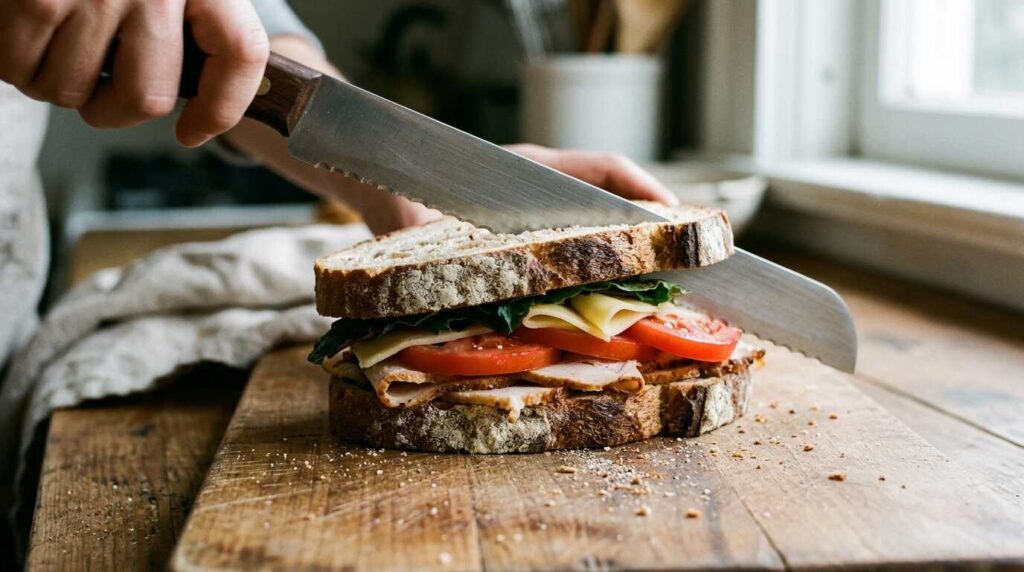
A sandwich is a poor target for a smooth blade. The outside is a crust or a toasted surface, the inside is soft crumb, and between the slices sit layers that slide: tomato, cheese, meat, spread. A serrated knife is built for exactly that mix of firm exterior and soft interior. Victorinox, which makes bread knives, says the teeth “grip the crust before cutting through the softer center”, which reduces crushing and gives more controlled cuts. What testers report about blade length, tooth shape and sharpness is more specific, and parts of it conflict.
Video: Bread Knife vs. Utility Knife: Which Type of Serrated Knife is for You? | Gear Heads | America’s Test Kitchen
What the teeth do
The mechanics start with the slicing motion. Researchers led by L. Mahadevan, an applied mathematician at Harvard, set out to compare “dicing,” a straight downward push, with slicing, in which the blade is drawn at an angle while pressing down. A Harvard news item describes the setup, a soft gel cut by a fishing line, and says that people mostly push straight down on stiff foods such as pumpkin and potato but need to slice soft foods such as tomato and persimmon. The study appeared in Physical Review Letters in December 2012. The page does not report the measured forces.
A separate post on the physics of sharp edges, from the blog Science of Sharp, works through a simple model of the same idea. Adding horizontal motion lowers the downward force required, and at a slice-to-push ratio of 3, the model gives about one tenth of the push-cut downward force while the total work stays the same, spread over a longer distance. The post says the basic model ignores serrations, which it says reduce effort by changing how the material separates at the microscopic level.
Serrations make a slicing motion easier to start. A knife maker’s blog, Seido Knives, describes them as “a tiny saw” that spreads cutting force across several contact points. The same page claims a straight chef’s knife creates compression in soft loaves and skates across tomato skin. That page promotes the company’s own knives, and several numerical claims in it carry no stated source or method, so none of its figures are used here. The general description agrees with Victorinox’s.
Tall points, short scallops
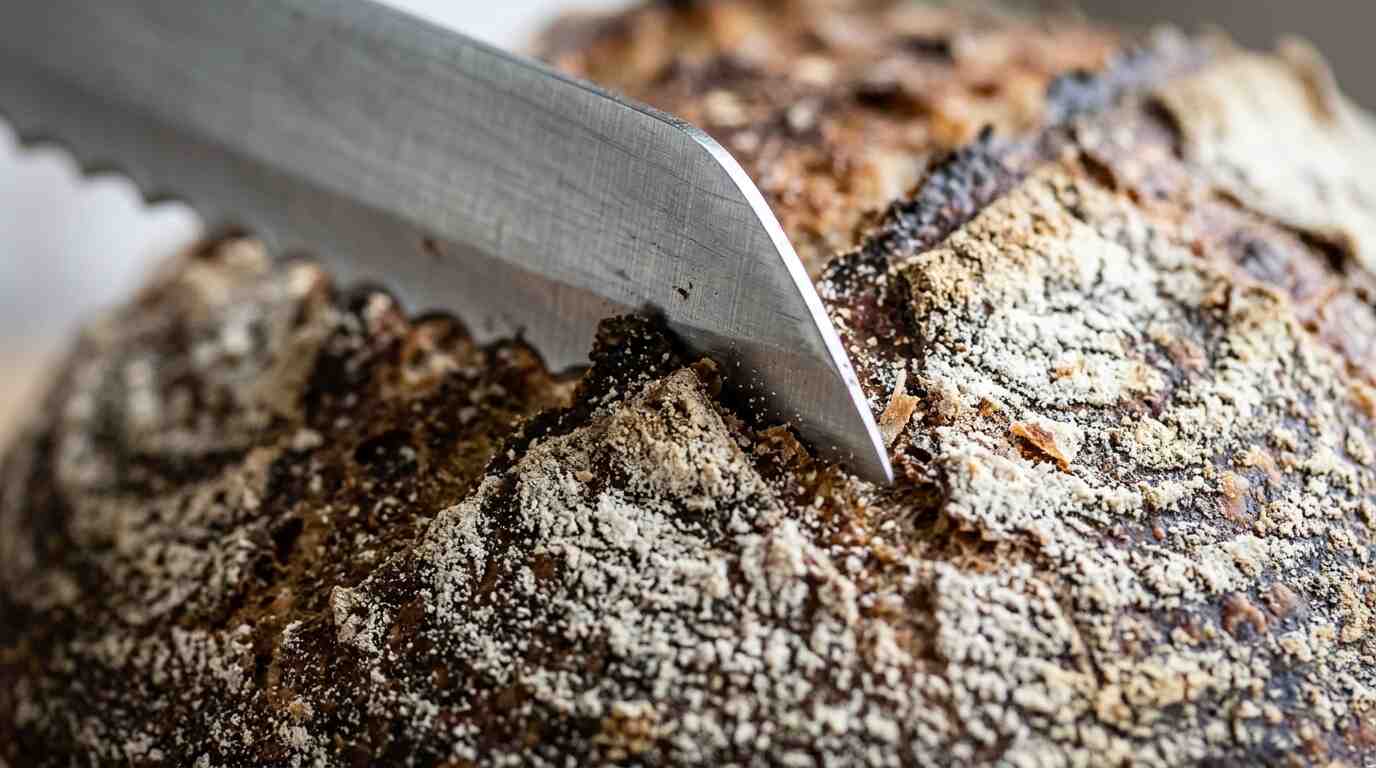
Tooth shape is where the testing gets detailed. America’s Test Kitchen’s review of serrated bread knives, by Miye Bromberg and published June 25, 2025, states that tall, pointed serrations bite into food more tenaciously than short or scalloped ones. Fewer serrations also gave each tooth more force. The highest-rated knives had 29 to 34 serrations, about 3.5 per inch, and blades with more than four per inch had trouble gripping food. On crusty bread, rounded serrations tended to skid over the crust instead of biting, and knives with too many short serrations struggled to get purchase.
A different account complicates the picture. Misen, a company that sells serrated knives, published a summary of side-by-side sourdough tests it attributes to Wirecutter, Food & Wine and Bon Appétit. According to that Misen post, the pointed-tooth knife bit into a thick, blistered crust on the first pass, while the wavy knife needed several sawing motions and could skitter across the loaf first. Once engaged, the wavy knife cut more gently with less tearing, and the post says Bon Appétit found its scalloped pick handled tomato skin and cake with minimal tearing. The post is a retailer’s summary of third-party reviews and does not give loaf counts or full methodology, so the originals would need checking.
The two accounts agree that pointed teeth engage a hard crust faster. They differ in emphasis on the soft interior, where the Misen summary credits wavy teeth with a gentler cut and the America’s Test Kitchen testers still preferred tall, pointed serrations overall. Neither tested a sandwich built with toasted bread and a wet filling.
Length, height and the layered sandwich
The review from America’s Test Kitchen reads as a buying guide for loaves, but several of its findings apply directly to sandwiches. Testers liked at least 8.5 inches of usable blade to span large sourdough loaves. Blade height mattered for control: heights above 1.3 inches handled thick loaves and layered sandwiches better, and blades under 1 inch were too flexible. Tall, wide blades kept thick BLTs under control, while narrow, short blades wobbled and cut uneven slices. One double-serrated design pulled apart the layers of a BLT when it was quartered.
Handle design counted as well. Testers preferred handles at least 5 inches long for large hands, textured materials that stayed secure when wet, and enough knuckle clearance to keep hands off the board. Blade shape came with trade-offs: curved blades gave more leverage for rocking cuts, and flat blades were easier to guide when cutting parallel to the board, as when slicing through cake layers or tomato ends.
Victorinox suggests blades in the 21 to 26 cm range, about 8.3 to 10.2 inches, for most kitchens, calling that range the best balance of versatility and control, with longer blades for larger loaves and harder crusts. The manufacturer’s figure and the testers’ 8.5-inch minimum overlap, though they come from different kinds of source.
Bread knife or serrated utility knife
A full bread knife is long for a single sandwich. America’s Test Kitchen reviewed serrated utility knives as a compact alternative for smaller jobs, including quartering loaded BLTs, slicing tomatoes, baguettes, kaiser rolls and salami, and detail work such as coring tomatoes. Eight knives priced from about $7.50 to $110 were tested, with blades typically 5 to 6 inches long.
Sharpness ranked first among the criteria. Serrated knives are hard to sharpen at home, the testers wrote, so they need to be sharp from the start, and some knives arrived dull and tore bread or left ragged tomato slices. Wedge-shaped blades, taller at the heel and narrower at the tip, were preferred, and moderately thick, rigid blades cut more evenly than thin, flexible ones. A narrow tip helped with detail work. The preferred serrated section was about 5 inches, since longer serrated sections felt oversized for baguettes and salami and shorter ones were too small for large avocados and kaiser rolls.
The utility knife review also noted that serration count and shape mattered less on small knives than on large ones, that most blades had no serrations at the tip or heel, which the testers said helps the blade resist chipping or bending, and that a mix of pointed and scalloped teeth was a winning trait. Scalloped teeth sometimes slid over tomato and avocado skins before biting in.
Sharpness appears in both reviews. The utility knife testers called it the most important factor. In the bread knife review, finely sharpened edges slipped cleanly through tomatoes and soft challah, while coarser edges required more effort and sometimes tore soft foods. Testers there judged factory edge quality more important than nominal blade angle.
Technique at the board
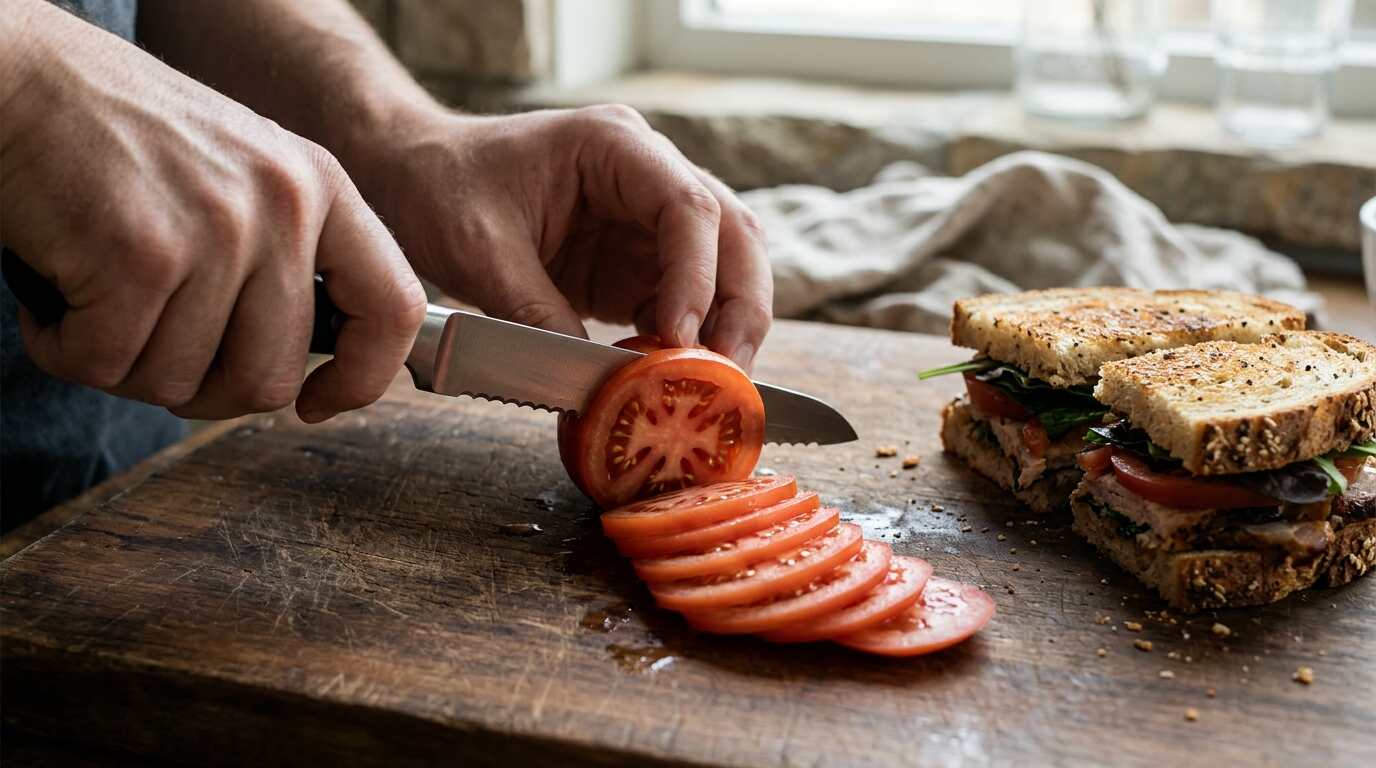
Victorinox advises light pressure and long, even strokes rather than pushing down. That advice matches the slicing mechanics described above: the work comes from the drawing motion, and added downward force is what squashes soft crumb. The company lists tomatoes, pastries, citrus fruits and layered cakes among foods suited to a serrated knife because they have a firm exterior and a softer interior.
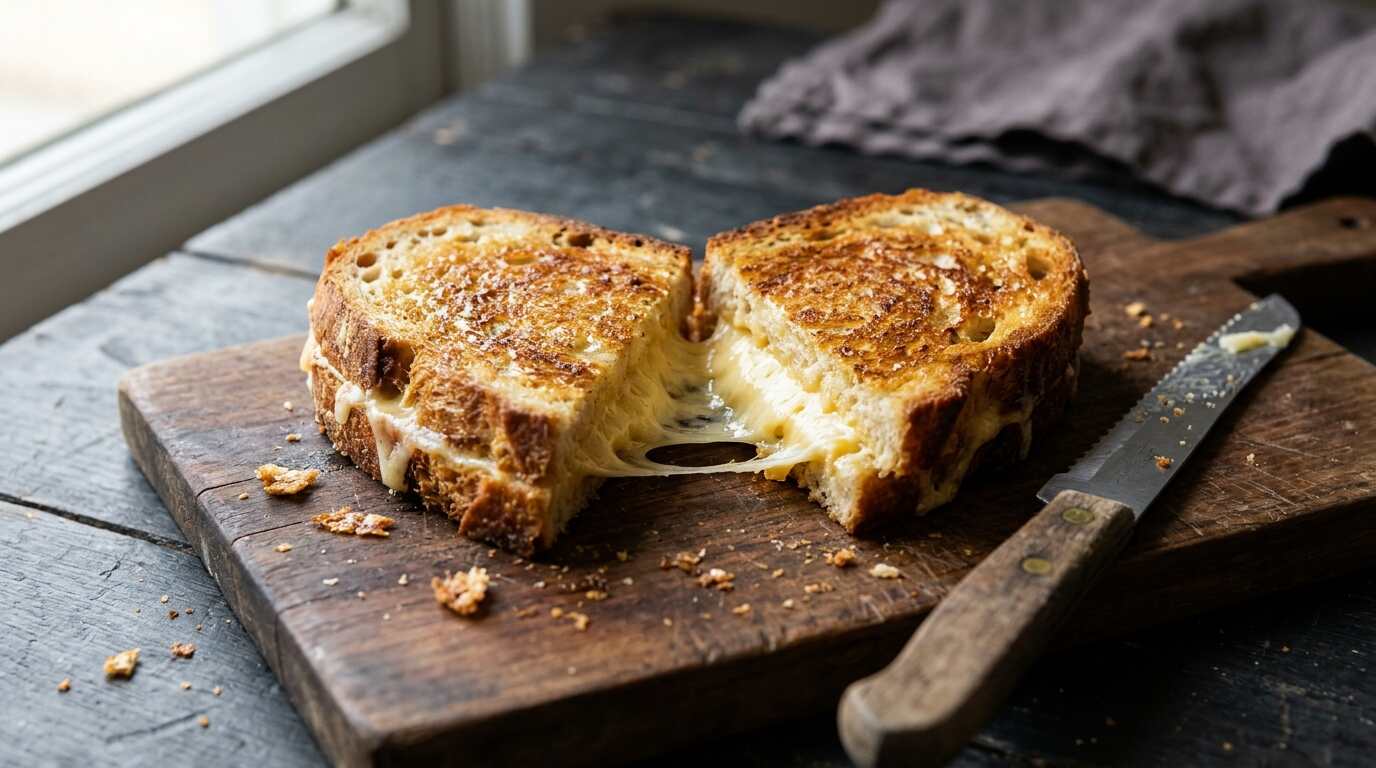
For sandwiches, the sources point to a few practical conclusions. A tall, wide blade kept thick sandwiches under control in America’s Test Kitchen’s trials, and narrow, short blades wobbled and cut unevenly. Sharp edges slipped through soft bread and tomato, while coarser ones sometimes tore them. These are testers’ observations on specific products and recipes, and none came from a controlled test of cutting force or crumb compression on a grilled cheese or similar hot sandwich.
Upkeep gets little attention in the fetched sources. America’s Test Kitchen says serrated knives are hard to sharpen at home, which is why the testers weighted factory sharpness so heavily. Misen offers mail-in sharpening, a company service that is not independent evidence. Victorinox’s page does not discuss sharpening.
Cold-sandwich trials and the missing hot test
The sources support three points. Serrations help a blade grip a firm surface before cutting soft material, and a slicing motion reduces the downward force needed. Sharpness, blade height and length affected results on loaves and sandwiches in the America’s Test Kitchen trials alongside tooth design. And pointed, scalloped and mixed teeth each have a documented use, with the choice depending on crust.
What is missing is a published test that cut hot, filled sandwiches with different knife types and measured the result. The closest available evidence is the BLT trials in America’s Test Kitchen’s reviews, which involved cold sandwiches, and the Misen post’s secondhand summary of sourdough tests. Anything beyond that would be conjecture.
Products mentioned in this article
- Victorinox Fibrox 10.25-Inch Bread Knife with Serrated Edge and Black Handle. The 10.25-inch serrated knife from the maker whose bread knife guidance is cited above. See it on Amazon (affiliate link)
As an Amazon Associate I earn from qualifying purchases. A commission may be earned if you buy through this link, at no extra cost to you.
Sources:
- Victorinox, “How to Choose a Bread Knife”: https://www.victorinox.com/en/How-to-Choose-a-Bread-Knife/cms/how-to-choose-a-bread-knife/
- America’s Test Kitchen, “The Best Serrated (Bread) Knives” (Miye Bromberg, June 25, 2025): https://www.americastestkitchen.com/equipment_reviews/2497-the-best-serrated-bread-knives
- America’s Test Kitchen, “The Best Serrated Utility Knives”: https://www.americastestkitchen.com/equipment_reviews/2145-serrated-utility-knives
- Misen, “Wavy vs Pointed Serration: Sourdough Crust Test” (retailer blog summarizing third-party tests): https://misen.com/blogs/news/wavy-vs-pointed-serration-sourdough-crust-test
- Seido Knives, “Are Bread Knives Overrated?” (manufacturer blog): https://seidoknives.com/blogs/news/are-bread-knives-overrated
- Harvard SEAS, “Math explains chef’s intuition”: https://seas.harvard.edu/news/math-explains-chefs-intuition
- Science of Sharp, “The Slice Cut”: https://scienceofsharp.com/2021/04/27/the-slice-cut/
- America’s Test Kitchen (YouTube), “Bread Knife vs. Utility Knife: Which Type of Serrated Knife is for You? | Gear Heads”: https://www.youtube.com/watch?v=0vUZXmroBfA