In this story
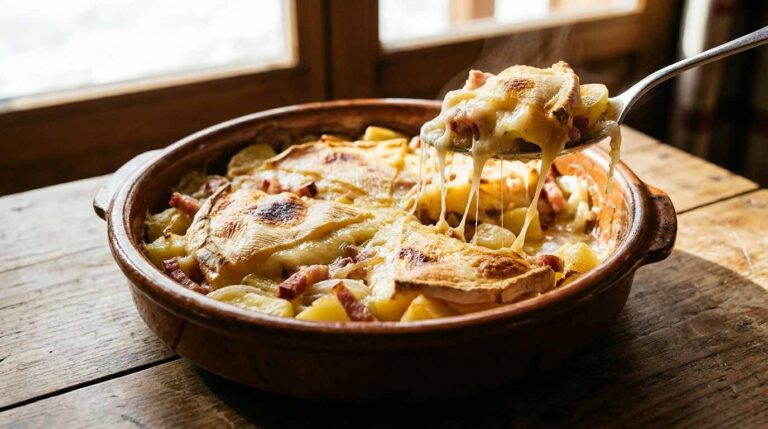
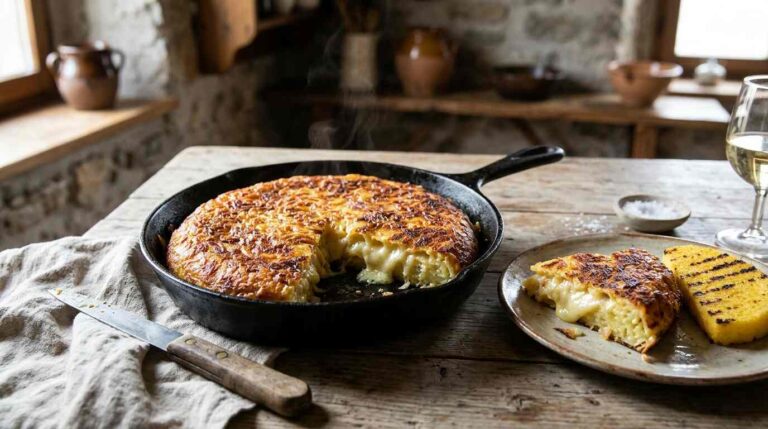
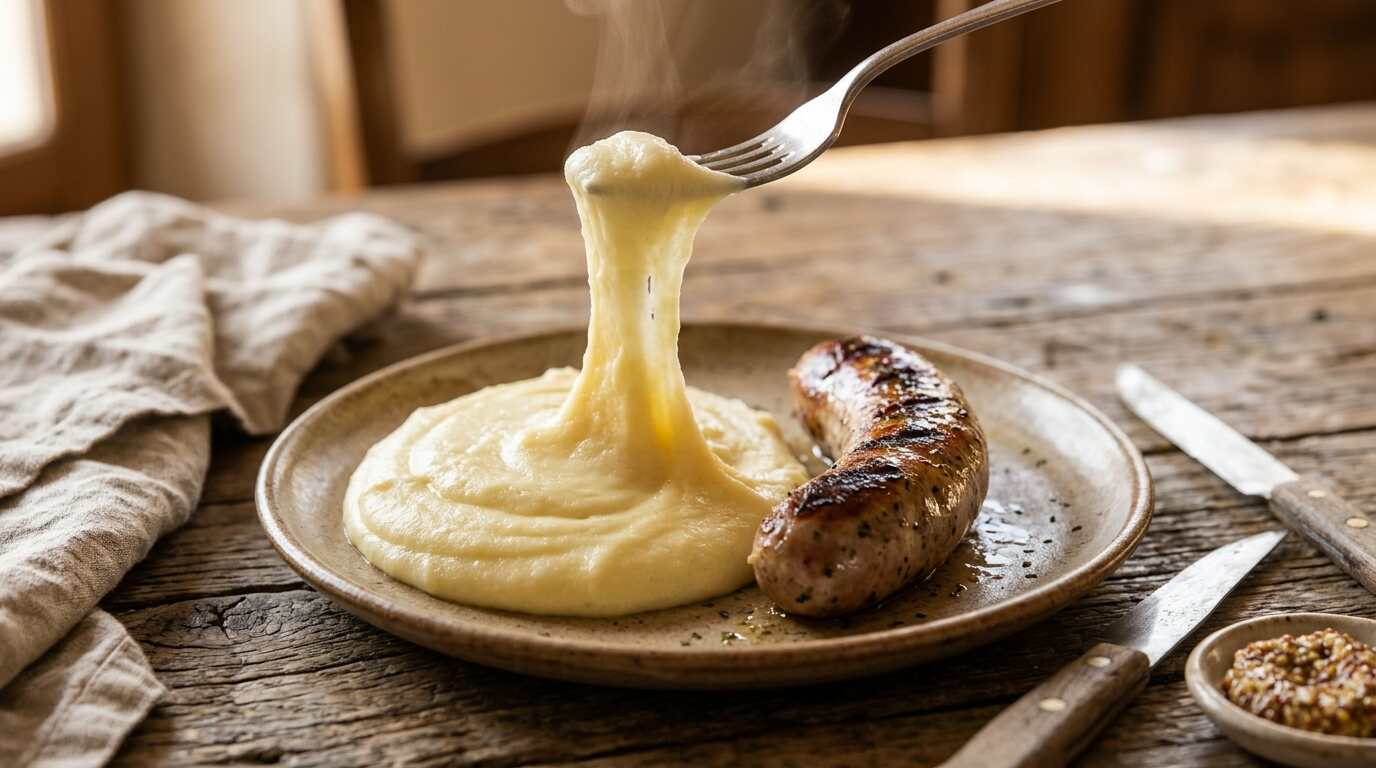
Aligot is mashed potato and fresh cheese beaten together over heat until the pot holds something closer to taffy than to mash. Lift a spoon from it and a single ribbon stretches a foot or more before it breaks. It comes from the Aubrac, a high plateau where the departments of Aveyron, Cantal and Lozère meet, and it depends on one cheese most of the world can’t buy.
Video: Aligot, the stretching regional dish of Aubrac, by Sébastien Bras, from the Michel BRAS Kitchenware Studio YouTube channel
Monks, pilgrims and a bowl of soup
The usual story begins with a monastery. The Association for the Defence and Promotion of AOP Laguiole Cheese, on its history page, says Adalard d’Eyne founded the Aubrac Dômerie around 1120 as a monastery-hospital, after nearly dying on the plateau. The Dômerie sat where two pilgrimage routes crossed, including the road from Le Puy-en-Velay to Santiago de Compostela. The monks cleared forest for summer pasture, selected the breed that became the Aubrac cow, developed Laguiole cheese, and, the association says, invented aligot.
The first aligot had no potato in it. The Connexion, in a November 2022 piece by Patrice Bertrand, describes a 12th-century broth of bread and fresh tome that monks served to pilgrims.
Where the name came from
The etymology has two versions. The Laguiole association and The Connexion both trace “aligot” to the Latin aliquid, “something,” the word pilgrims supposedly used when asking for food. A Food52 history gives the root as aliquis instead, and describes it as the Latin word for “to eat” changing through the local Occitan dialect. Food52 also passes along a legend recorded by cheese experts Daniel Brugès and Christiane Valat, in which three medieval bishops brought butter, milk and potatoes to a mountain cheesemaker, and says plainly that it isn’t historically sound.
When the potato arrived
Bread gave way to potato after the monks were gone, though the sources date the change differently. The Connexion says that after the French Revolution, herders in the mountain dairies made aligot with potatoes when a poor wheat harvest left bread scarce. The Laguiole association and Food52 put the switch in the 19th century, and Food52 quotes Jean-Baptiste Bouloc of the Jeune Montagne cooperative crediting potatoes with eventually replacing the bread.
The buron dairies
The dish stayed in the mountains with the herders who made cheese there. The Laguiole association says that by the early 20th century about 1,200 buronniers made 700 tonnes of cheese in 300 burons, stone and slate huts on the summer pastures. Food52 notes that the herders had no rights to the aged Laguiole, which went to the landowners. What they kept was tome fraîche, the young cheese a few days into the process, and that became the base of their aligot. Food52 says the dish became a meatless-Friday staple in the Aubrac, and that the railroads of the mid-1800s carried Aubrac families to Paris, where it spread through the cafés and brasseries they opened.
The cheese that won’t travel
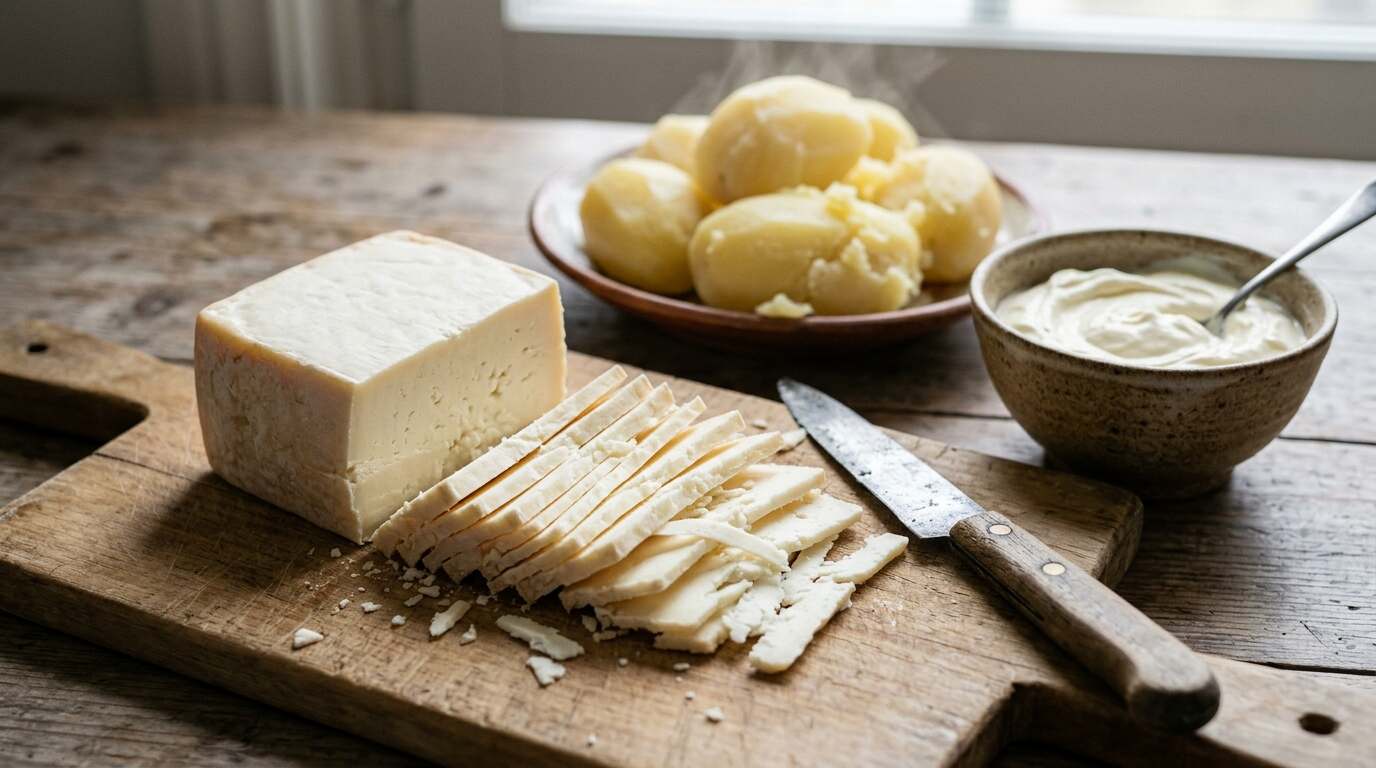
Tome fraîche de l’Aubrac is the whole trick. Bouloc told Food52 it is the “essential ingredient for aligot” and the source of its stretch and texture.
INAO, the French agency for food origin labels, describes the cheese in its summary of the protected geographical indication the European Commission registered on October 23, 2023. Tome fraîche de l’Aubrac is made from raw whole milk of French Simmental and Aubrac cows grazing at least 170 days a year on the plateau, at an average altitude of about 1,000 meters. The curd is pressed in cloth, cut, turned, stacked and pressed again; the cheese is matured but neither ripened nor salted. When heated, INAO says, it turns smooth and very stretchy. The summary counts 77 milk-producing farms and 840 tonnes a year.
Off-limits in the U.S.
That raw-milk freshness is the problem for American cooks. Food52 says raw-milk tome fraîche aged under 60 days is off-limits to home cooks in the United States. GrillCheesy’s post on why mozzarella stretches covers the chemistry of the pull that substitutes have to imitate.
Four ingredients, or more
The Jeune Montagne cooperative, which the Laguiole association says now collects nearly all the region’s milk, is strict about the recipe. Bouloc told The Connexion: “And there are only four: potatoes, salt, a little crème fraîche and fresh Aubrac Tome.” For four people, he gave 400 grams of tome, a kilo of potatoes and 250 grams of crème fraîche.
The local tourist office disagrees, at least on the details. The Bastides et Gorges de l’Aveyron recipe, also for four, uses a kilo of old potatoes, 350 grams of Laguiole tome two to three days old, 2 tablespoons of cream, 120 grams of butter and a clove of garlic. Food52’s printed version of the cooperative recipe lists garlic as optional seasoning.
Don’t overheat it
On technique, everyone agrees on one warning. Bouloc told The Connexion, “To avoid breaking the stringy structure, it’s imperative not to heat it too long.” He recommends stirring in one direction with a spatula or wooden spoon. To Food52 he put it more briefly: “If you hold it on the heat too long, the ‘strings’ break.”
The cooperative
Aligot’s modern form owes a lot to one dairy. The Connexion reports that Laguiole cheese production fell from 700 tonnes in the late 19th century to 25 tonnes by the late 1950s, and that young farmers founded the Jeune Montagne cooperative in 1960 to revive it. In 1982 the cooperative became the first dairy to sell aligot to the public, and it later launched a frozen version with chef Michel Bras. The Connexion puts its output at about a thousand tonnes of aligot a year, and notes that “aligot de l’Aubrac” is a registered trademark of the cooperative rather than an official label.
The recipe
The card below follows the Jeune Montagne cooperative’s aligot, as published by Food52 and The Connexion. It serves four, uses only potatoes, crème fraîche, tome fraîche and seasoning, and takes about 15 minutes of stirring once the cheese goes in. The amounts are the cooperative’s; the steps are summarized here.
Aligot
Ingredients
Method
- Peel the potatoes and boil them until tender. Mash until smooth.
- Stir in the crème fraîche and season with salt and pepper, and garlic if using.
- While the purée is hot, add the thin strips of cheese and stir over medium heat, ideally always in the same direction with a spatula or wooden spoon, until the cheese melts completely and the mixture turns smooth and stretchy, about 15 minutes.
- Don’t hold it on the heat any longer than needed, or the strings break. Lift and stretch it, then serve right away.
Notes
Aligot sits with France’s other potato and cheese dishes from the mountains, including Savoie’s tartiflette. GrillCheesy also covers the Alpine cheese fondue and raclette.

For the pot
The tools the method calls for: a smooth mash and a heavy pot.
- OXO Good Grips Stainless Steel Potato Ricer and Food Masher: a stainless potato ricer for a smooth, lump-free mash before the cheese goes in. See it on Amazon (affiliate link)
- Lodge Essential Enamel Cast Iron Dutch Oven, 6 Quart, Island Spice Red: a heavy 6-quart enameled pot that holds the purée over gentle heat while it is stirred. See it on Amazon (affiliate link)
As an Amazon Associate I earn from qualifying purchases. A commission may be earned if you buy through this link, at no extra cost to you.
Frequently asked questions
What is aligot?
A dish from the Aubrac plateau of southern France: mashed potatoes beaten with fresh tome cheese and crème fraîche until smooth and very stretchy.
What cheese is used in aligot?
Tome fraîche de l’Aubrac, a fresh, unsalted raw-milk cheese protected by an EU geographical indication since October 2023.
Does aligot have butter and garlic?
Recipes differ. The Jeune Montagne cooperative says only potatoes, salt, crème fraîche and tome; the local tourist office’s recipe adds butter and garlic.
Why does aligot stop stretching?
Overheating. Jean-Baptiste Bouloc warns that holding it on the heat too long breaks the strings.
Sources
- Association for the Defence and Promotion of AOP Laguiole Cheese, “History”: https://fromage-laguiole.fr/en/history/au-fil-du-temps.php
- Patrice Bertrand, The Connexion (November 2, 2022): https://connexionfrance.com/magazine/aligot-cheesy-french-comfort-food-famous-for-being-remarkably-stringy/236187
- Food52, “The History of Pommes Aligot”: https://food52.com/blog/27712-history-of-pommes-aligot
- INAO, “La Tome fraîche de l’Aubrac reconnue en IGP”: https://www.inao.gouv.fr/node/32401/printable/pdf
- Bastides et Gorges de l’Aveyron, “L’aligot recipe”: https://en.bastides-gorges-aveyron.fr/enjoy-a/local-products/aveyronnaise-recipes/laligot-recipe/