In this story
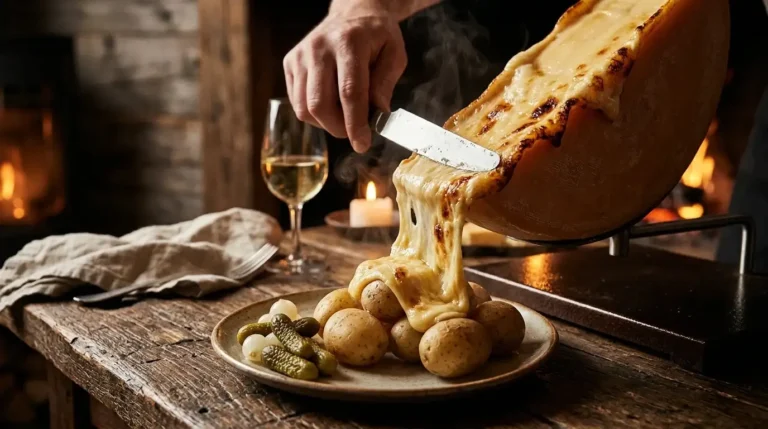
Cheese fondue is a pot of melted cheese and white wine set over a small flame, with bread speared on long forks and dragged through it at the table. It looks like the oldest food in the Alps. Its first written recipe is more than three centuries old, but its status as the dish of Switzerland is much newer, the product of a marketing campaign run by a state-backed cheese cartel. The chemistry inside the pot is newer still, at least on paper. In 2019, food engineers in Zurich published a study on why fondue holds together and why it sometimes splits into a puddle of oil.
Video: How To Make An Authentic Cheese Fondue, from the DW Food YouTube channel
The 1699 recipe
Cheese cooked with wine in a Zurich cookbook
The oldest printed Swiss recipe for cheese melted with wine and eaten with bread comes from a cookbook published in Zurich in 1699. Writing in Saveur in 2010, Sylvie Bigar cited the Swiss ethnologist Isabelle Raboud-Schule, who traced it to the Kochbuch der Anna Margherita Gessner.
That recipe was a starting point, not a national habit. The historian Peter Moser, director of the Archives of Rural History in Bern, writes in a history published by Swissinfo that fondue was largely unknown outside western Switzerland and France’s Savoy region until after the Second World War. In his words, “Until the Second World War, fondue was unheard of in most areas of Switzerland.”
The Swiss Cheese Union
How a cartel made a national dish
The organization behind the change was the Swiss Cheese Union, founded in 1914 and disbanded in 1999. Moser describes it as the body that organized cheese exports and supplied cheese to consumers across the country under uniform conditions. It also had a surplus to move.
Raboud-Schule told Saveur that the dish’s popularity only dates to the 1930s, when the union launched campaigns to sell more cheese, using slogans such as “Fondue creates a good mood.” The promoters, she said, sent caquelons, the glazed clay fondue pots, to ski clubs and to soldiers in the Swiss army, and the soldiers’ enthusiasm helped carry the dish home. Moser’s account adds that after the war, the union set out to turn a regional specialty into a national “branded product.” The best-known slogan, FIGUGEGL, abbreviates a Swiss German line that roughly means fondue is good and puts people in a good mood.
The campaign worked. A regional dish from western Switzerland became the dish of the whole country.
Fondue comes to America
A pavilion, a decade and a lot of pots
Fondue reached American dinner tables in the 1960s. Ilana Gordon, writing in The Takeout in 2019, credits Switzerland’s pavilion at the 1964 New York World’s Fair, which featured fondue and helped it catch on. She describes the union marketing fondue to Americans through the 1960s and 1970s, as rising incomes and a skiing boom made the pot and the long forks a party fixture. The same article notes that many of those pots later ended up in thrift stores.
Americans also made the dish their own. Bigar’s Saveur piece mentions James Beard praising an American cook who used cheddar and bourbon in place of Swiss cheese and kirsch, the cherry brandy that often goes into the Swiss version.
Moitié-moitié and the classic blends
Half Gruyère, half Vacherin Fribourgeois
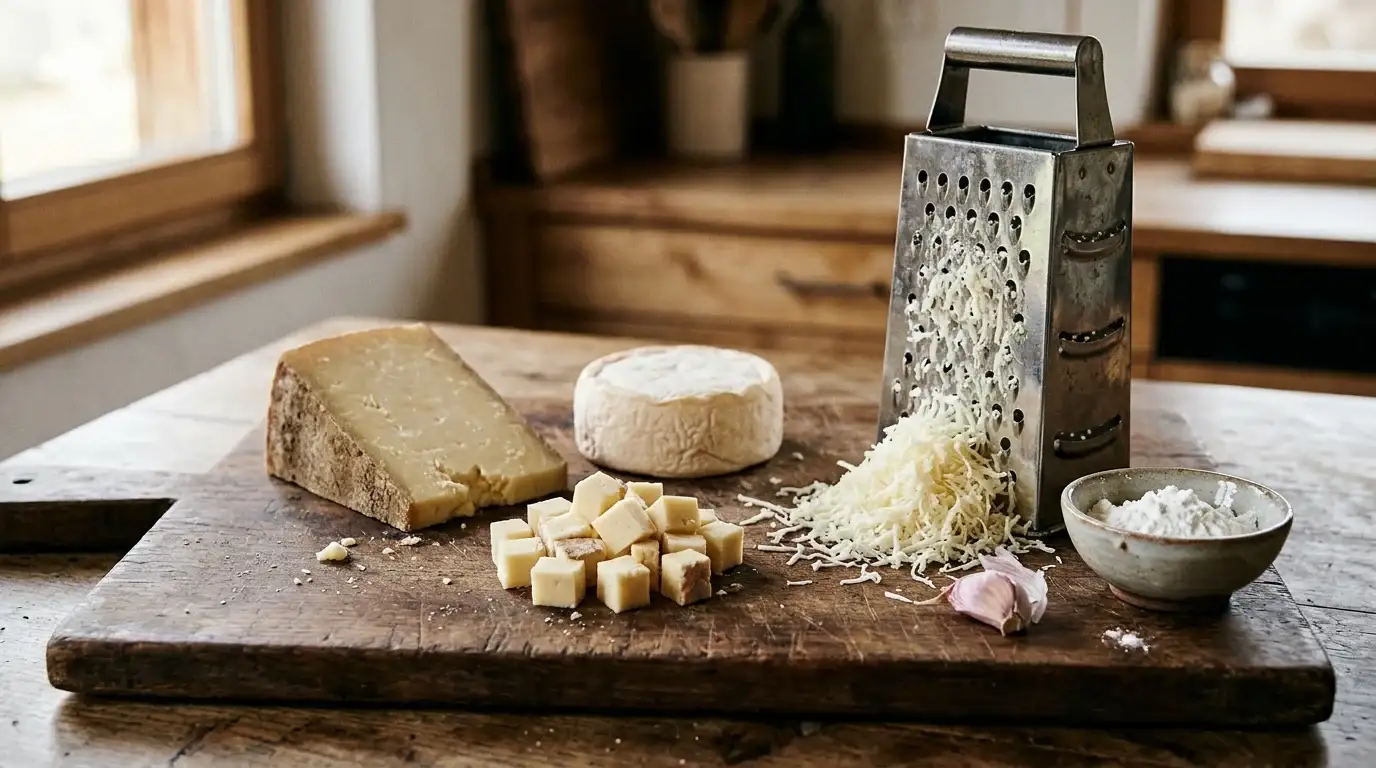
Switzerland does not have one fondue. It has regional blends, and the best known is moitié-moitié, French for “half and half.” The canton of Fribourg’s official tourism site gives the recipe for four: 400 grams of Gruyère AOP, 400 grams of Vacherin Fribourgeois AOP, a clove of garlic, 3 deciliters of white wine, 15 grams of cornstarch, kirsch and pepper to taste, served with bread or potatoes cooked in their skins.
The method is short. The Gruyère is grated, the Vacherin cut into pieces, and both are tossed with the starch. The wine is heated with the garlic in the fondue pot, the cheese goes in and is stirred until it melts and gently bubbles, and kirsch and pepper go in at the end.
The pairing has a reason behind it. Bigar explains that a moderately moist cheese like Gruyère and a fattier one like Vacherin Fribourgeois balance each other. Fontina, an Alpine cheese with its own melting tradition, is a close cousin; GrillCheesy’s guide to Fontina covers the Valle d’Aosta original.
Why fondue holds together
Casein, tartaric acid and starch
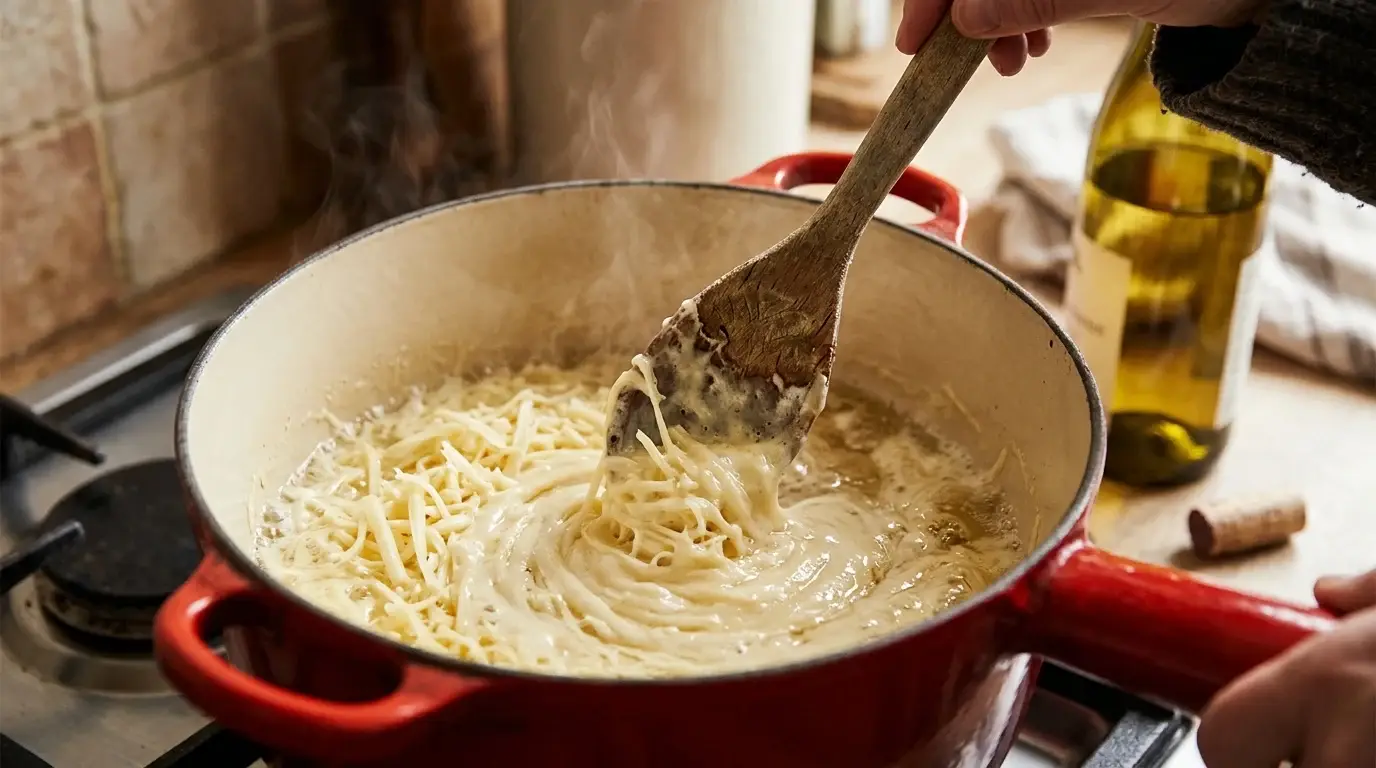
A good fondue is an emulsion, fat and water held in a stable mix. Pat Polowsky, a cheese scientist writing in Saveur in 2018, explains that melted cheese forms a network of casein protein that traps fat. White wine adds moisture and tartaric acid, which changes the casein so it holds onto that fat better. Cornstarch thickens the mix and helps keep it stable.
Age matters. Polowsky notes that casein breaks down as cheese ages, so a five-year cheddar makes an overly oily fondue because its protein can no longer form a cohesive mass. Younger cheeses such as Fontina, young Gouda and Colby work, he writes, especially paired with something stronger. For non-traditional cheeses he suggests about a teaspoon of sodium citrate per pound, dissolved in a splash of wine or water first.
The ETH Zurich study put numbers on the starch. Inside Science reported in 2019 that Pascal Bertsch and colleagues at the Laboratory of Food Process Engineering made fondues from Gruyère and Vacherin, water, potato starch and an ethanol mixture standing in for wine, and published the work in ACS Omega. They found that at least 3 percent potato starch relative to the water kept the fondue from separating, while too much made it sticky. Too much wine lowered the pH and thinned it out. Baking soda, a common Swiss addition, released carbon dioxide for airiness and may make the fondue creamier by offsetting the wine’s acidity.
Keeping the pot from breaking
Low, even heat and a steady stir
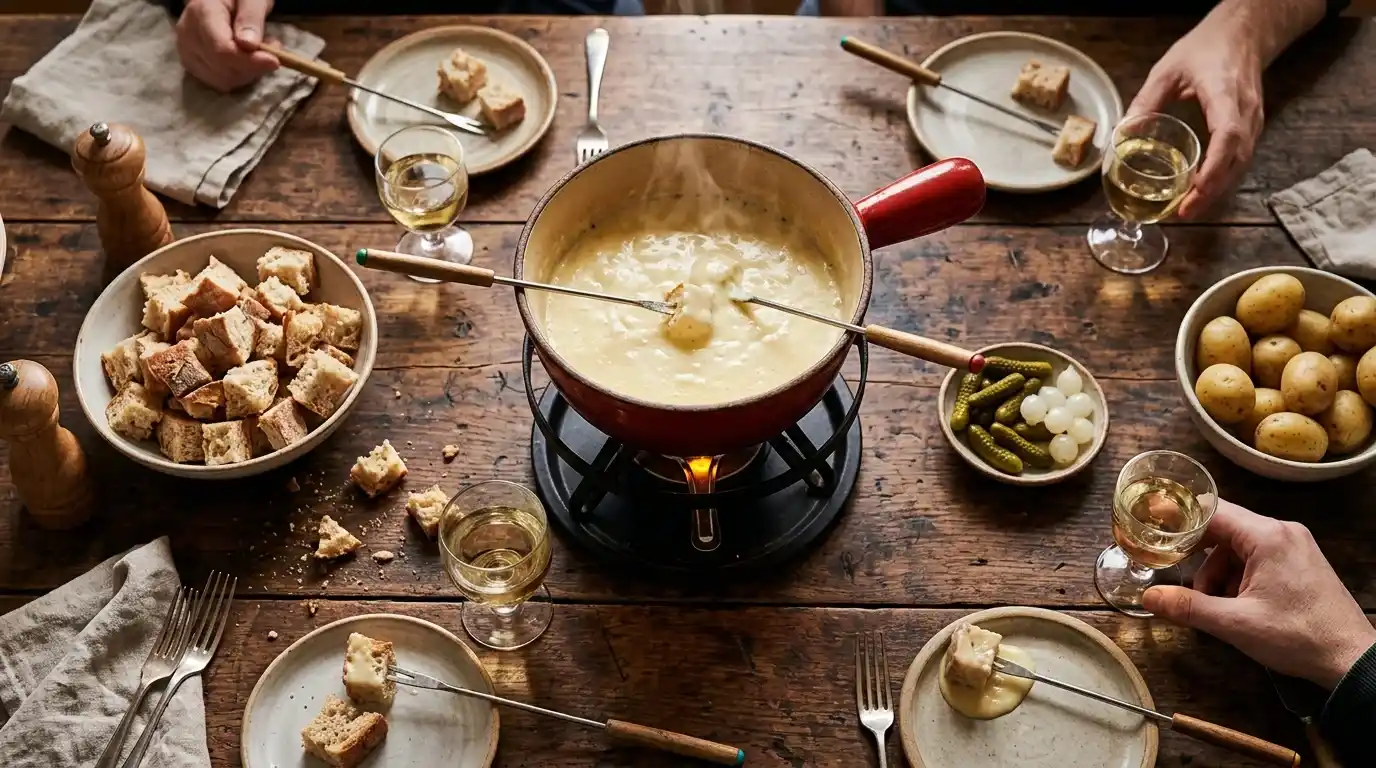
Most broken fondues are overheated fondues. Polowsky recommends making the fondue on the stove, then moving it to a tabletop alcohol burner, and using a pot that can handle the stovetop, such as enamel-coated cast iron, which heats evenly and resists scorching. Bigar stirred in a figure-eight to keep the cheese from clumping. In both accounts, the cheese should melt into the wine rather than boil hard.
The same principles run through every melted-cheese dish, from macaroni and cheese to a grilled cheese pulled off the griddle at the right moment: the right cheese, enough moisture and heat that melts without punishing.
Frequently asked questions
Where does cheese fondue come from?
Western Switzerland and France’s Savoy region. The oldest printed Swiss recipe for cheese cooked with wine dates to a 1699 Zurich cookbook.
Why is fondue the Swiss national dish?
The Swiss Cheese Union promoted it heavily from the 1930s and again after the Second World War to sell more cheese.
What cheese is used in fondue?
Gruyère is the classic base. Moitié-moitié uses equal parts Gruyère and Vacherin Fribourgeois.
Why did my fondue separate?
Usually too much heat, too little starch, or a cheese aged so long its protein can no longer hold the fat.
Sources
- Sylvie Bigar, “The Big Cheese,” Saveur (December 7, 2010): https://www.saveur.com/article/Kitchen/The-Big-Cheese
- Peter Moser, “How fondue and ‘cheese fever’ conquered the world,” Swissinfo (originally published November 13, 2019): https://www.swissinfo.ch/eng/business/how-fondue-and-cheese-fever-conquered-the-world/47601148
- Ilana Gordon, “Bring Back Fondue Dinner Parties,” The Takeout (January 16, 2019): https://thetakeout.com/bring-back-fondue-cheese-dinner-parties-1831534118
- Region of Fribourg, “Moitié-moitié Fondue”: https://fribourg.ch/en/terroir-fribourg/recipes/moitie-moitie-fondue/
- Pat Polowsky, “A Scientist’s Guide to the Ultimate Fondue,” Saveur (November 29, 2018): https://www.saveur.com/guide-to-fondue
- Catherine Meyers, “The Scientist’s Guide to the Perfect Fondue,” Inside Science (March 4, 2019): https://www.aip.org/inside-science/the-scientists-guide-to-the-perfect-fondue