
In this story
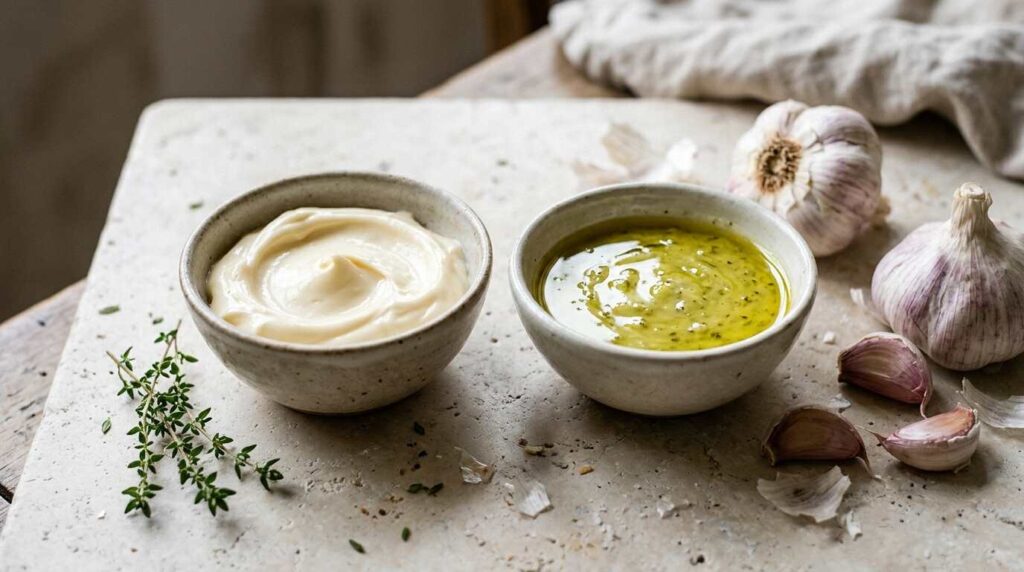
Aioli and mayonnaise are both emulsions of oil, and the line between them depends on whom is asked. Britannica defines aioli as a sauce of garlic and olive oil, with egg yolk as an optional extra, while its entry for mayonnaise calls that sauce an emulsion of raw egg yolks and vegetable oil and lists aioli among the variations built on it. Catalan cooks, Provençal cooks, food writers and American manufacturers each draw the boundary in a different place, and the sources do not agree on where it belongs.
Video: How to Make Catalan Allioli / Aioli | cocaccia
What each sauce is made of
Mayonnaise has a legal definition in the United States. Under 21 CFR 169.140, it must contain not less than 65 percent vegetable oil by weight, an acidifying ingredient (vinegar, or lemon or lime juice) and an egg-yolk-containing ingredient. Salt, sugar, spices and other items are optional. Garlic is not named in the standard, though spices are allowed as long as they do not give an egg-yolk-like color. No federal standard for aioli was found for this post, so the word on a jar is a marketing choice rather than a defined term.
Food Republic describes mayonnaise, loosely, as an emulsion of neutral-flavored oil, egg yolk, vinegar or lemon juice, sometimes with powdered mustard. Tasting Table makes the same point from the other side: garlic is not a standard component of mayonnaise, although flavored versions add it.
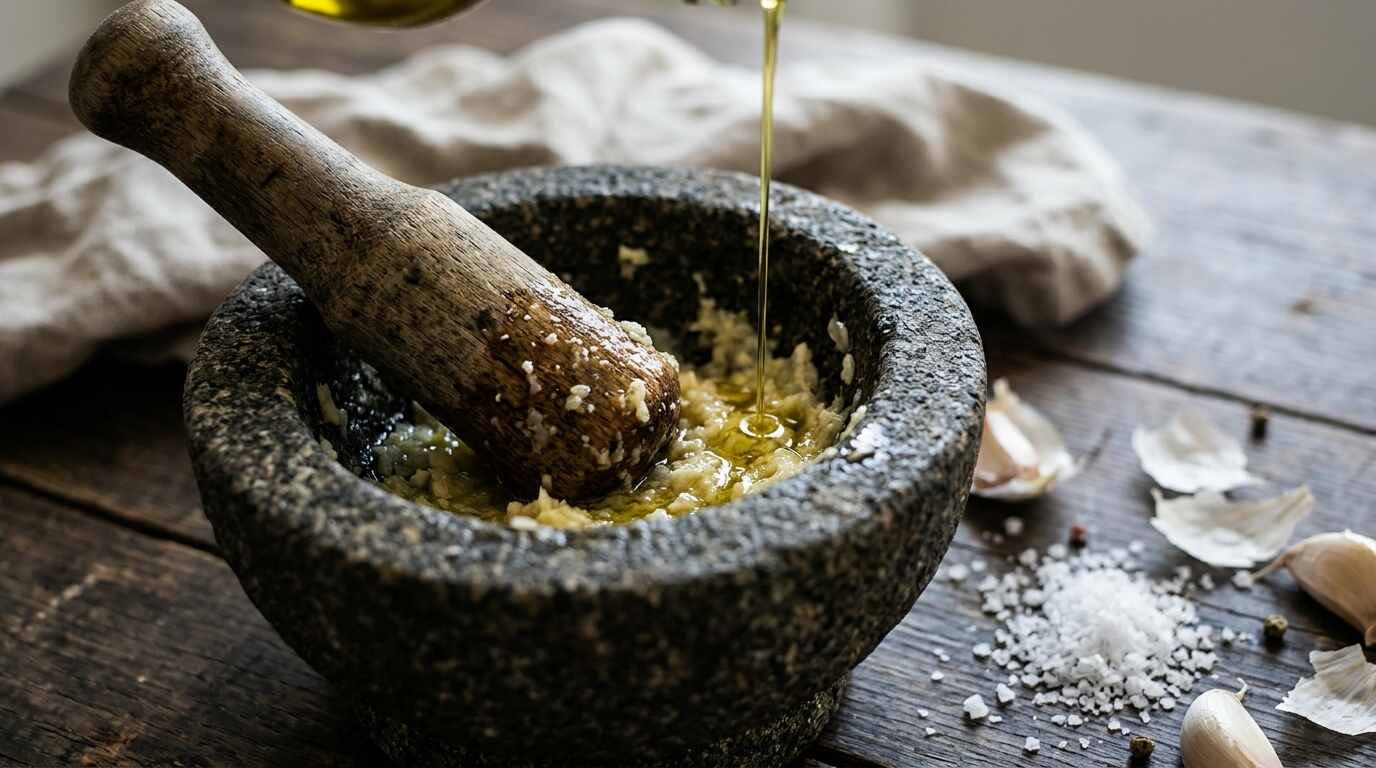
Aioli starts from garlic. Tasting Table calls garlic central to the sauce, and traditional aioli, in its account, is garlic, lemon juice and extra-virgin olive oil. The mild, eggy savoriness of mayonnaise against the pungent garlic of aioli is how The Daily Meal summarizes the flavor difference. The texture is also different, since the Daily Meal article describes traditional aioli as garlic and oil pounded together in a mortar, while mayonnaise is whisked from yolks, oil, acid, mustard and salt.
The egg question
Whether egg belongs in aioli is where the sources split most sharply. Saveur’s recipe for Catalan garlic sauce uses six garlic cloves, coarse salt, mild extra-virgin olive oil and a few drops of lemon juice, with no egg. The magazine states that allioli is traditionally made without egg, which separates it from its Provençal cousin, aioli.
Britannica’s aioli entry takes a middle position. Egg yolk is listed as optional, and the entry says a purist may argue that adding it makes the sauce more of a mayonnaise than a true aioli, though garlic mayonnaise is sometimes sold under the aioli name. The Daily Meal reports the strictest version of that view, that traditionalists hold that “any egg yolks added to aioli immediately transform the sauce into a mayonnaise.”
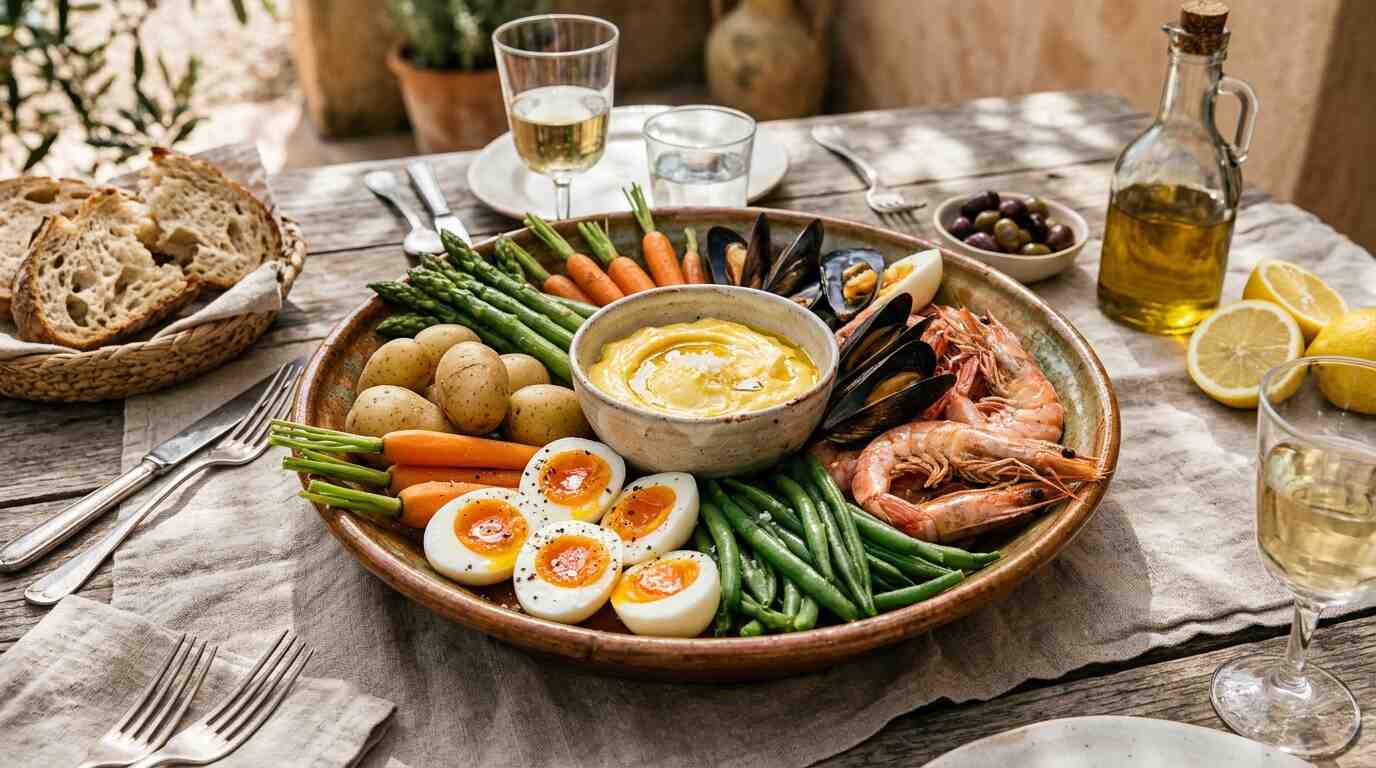
Serving habits differ along the same line. Food Republic says aioli is typically a dip for vegetables, boiled eggs and shellfish, while mayonnaise is used more widely. Tasting Table lists sandwiches, deviled eggs and cold salads among the common uses of mayonnaise, and describes it as mild enough that it rarely overpowers the dishes it supports.
Others see egg as a normal part of the Provençal sauce. Food Republic describes aioli as a garlic paste whisked together with egg yolk, lemon juice, mustard and olive oil. Mashed calls the Provençal version, known as le beurre de Provence, generally thicker because egg yolk enriches its texture.
Annie André’s article on the two sauces lists the spellings aïoli, allioli and alioli as compound words for garlic and oil in their respective languages. Her account is that modern Catalan aioli contains only garlic and oil, and that some modern recipes use eggs while purists say an authentic version has none.
Pliny and the Roman record
The earliest record of a garlic-and-oil sauce is attributed to Pliny the Elder. Britannica says he was the first to record it, in Catalonia, where it is now called allioli, and describes garlic beaten up in oil and vinegar. Mashed credits Pliny, who lived for a time in Tarragona, with favoring a pure, pungent sauce of garlic and olive oil, and says the earliest known references describe an emulsified sauce likely used on fish and vegetables.
Mashed also gives the name’s derivation, from the French words for garlic and oil, ail and huile. Annie André’s article reads the same way across languages, with all three spellings built from the words for garlic and oil.
The Roman sauce and the modern one are not necessarily the same thing. Britannica’s wording has vinegar, not lemon, and neither article describes egg in the Roman version. Annie André calls the Roman precursor a simple creamy emulsion of crushed raw garlic and olive oil. How closely that matches the sauce served today in Catalonia or Provence is not something the fetched sources establish.
Britannica places the sauce in Provence and calls it widely used in neighboring Spain and Italy. Restaurants now often serve it with fish, salt cod or bourride, the entry says, where it plays the role that rouille plays for bouillabaisse, and in winter it was traditionally eaten with vegetables.
Mayonnaise and the Mahón dispute
Mayonnaise has a younger and more argued history. The common account, repeated by Annie André, Sporked and The Daily Meal, ties the sauce to the 1756 capture of Mahón on Menorca by the Duc de Richelieu. Sporked reports the legend that his chef, finding no cream, served a sauce of oil and egg at the victory celebration, and The Daily Meal, quoting Slate, says the sauce was named for Port Mahon.
That account is contested at both ends. Sporked notes that some food historians argue the chef learned the sauce from local people, which would make it Spanish rather than French. The Daily Meal reports a rival theory, from a Frenchman who argued that the sauce came from Bayonne and was originally called “bayonnaise,” and says French and Spanish historians debated the question for years.
Menorcan researchers have gone further. The Catalan outlet Ara reports that chef and doctor Pep Pelfort has researched the sauce since 2022 and argues it originated in Menorca, citing a 1750 manuscript by Joana Caules that describes a raw fish sauce. Ara presents this as his research rather than settled fact. Ara also names earlier written references that Pelfort cites, among them a 1719 document in the Library of Catalonia describing a medicinal ointment and a recipe book by Brother Roger of the Ciutadella Franciscans that mentions “all i oli bono.” Pelfort says those recipes “weren’t good” and lacked steps. Annie André adds that the sauce Richelieu’s chef met might have been based on Catalan allioli.
The name has its own theories. Britannica says its origin is uncertain, listing the Old French moyeu, meaning egg yolk, the chef Antonin Carême’s link to manier, meaning to stir, and the Mahón theory. Sporked credits Carême with the idea of lightening mayonnaise by emulsifying the ingredients. The Daily Meal, citing Slate, says New York’s Delmonico’s served chicken mayonnaise and mayonnaise of lobster in 1838, and that Hellmann’s first jars appeared in 1920 at a New York delicatessen. Sporked dates the first commercial jars to 1907 in Philadelphia. The two pages do not reconcile their dates.
How the two emulsions hold together
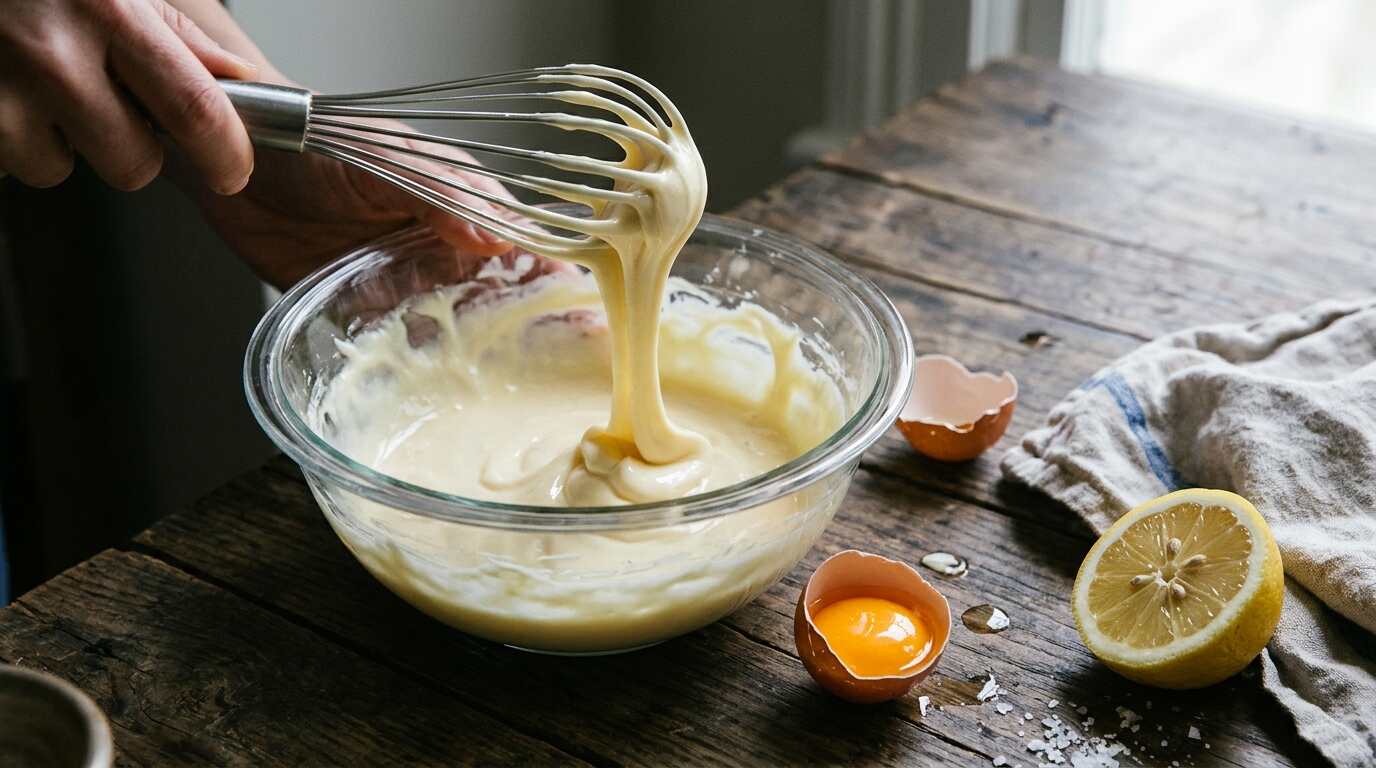
Mayonnaise works because of what egg yolk contains. America’s Test Kitchen explains that yolks carry lecithin, a compound with one end attracted to fat and one end attached to water, and that mustard adds polysaccharides that form a similar barrier around each droplet. Oil must be added slowly while whisking so that it breaks into tiny droplets with emulsifiers ready to coat them. As more droplets crowd into the small amount of water, the mixture thickens. If droplets merge, the emulsion breaks.
Commercial mayonnaise follows the same logic. The brand director of Duke’s, whose history is told in the post on Duke’s Mayonnaise, told WHRO that egg yolks give that mayonnaise its thick, creamy texture. A comparison with spoonable salad dressing is in the post on mayonnaise and Miracle Whip.
Aioli without egg is a harder case. Saveur calls the process tricky to master. The garlic and salt are crushed to a smooth paste, oil goes in a few drops at a time with vigorous stirring, and a few drops of lemon juice just before the last of the oil help keep the emulsion from breaking. It recommends keeping every ingredient, including the garlic, at room temperature. Britannica gives the same technique, drop by drop, and says the sauce should be thick enough that a spoon stands up in it. Neither source explains why crushed garlic can hold the oil without yolk, so no mechanism is claimed here.
Aioli on American menus
The word has drifted from its definition in the United States. Tasting Table says most American-made versions are far from the genuine French-style condiment, and The Daily Meal notes that aioli is starting to creep into well-known brands without discussing how they are labeled. Britannica confirms the pattern from the other direction, saying garlic mayonnaise is sometimes sold as aioli.
Whether that counts as a mistake depends on the egg. By the strict Catalan definition, a yolk-based garlic spread is mayonnaise with garlic in it. By the looser Provençal and modern one, it is aioli.
Sources:
- Britannica, “Aioli”: https://www.Britannica.Com/topic/aioli
- Britannica, “Mayonnaise”: https://www.Britannica.Com/topic/mayonnaise
- eCFR, 21 CFR 169.140, Mayonnaise: https://www.ecfr.gov/current/title-21/chapter-I/subchapter-B/part-169/subpart-B/section-169.140
- Food Republic, “What Is The Difference Between Mayonnaise And Aioli?”: https://www.foodrepublic.com/2013/06/24/what-is-the-difference-between-mayonnaise-and-aioli
- Tasting Table, “Aioli Vs Mayo: What’s The Difference”: https://www.tastingtable.com/2285839/aioli-vs-mayo-whats-the-difference/
- The Daily Meal, “What’s The Difference Between Mayo And Aioli?”: https://www.thedailymeal.com/1393221/difference-mayo-aioli/
- Saveur, “Catalan Garlic Sauce”: https://www.saveur.com/article/Recipes/Catalan-Garlic-Sauce
- Annie André, “French Mayonnaise Recipe vs French Aïoli”: https://www.annieandre.com/traditional-french-mayonnaise-recipe-france-spain/
- Mashed, “The First Known Aioli Sauce Can Be Traced Back To Roman Times”: https://mashed.com/1618417/first-aioli-sauce-roman-times
- Sporked, “Who Invented Mayonnaise, Actually?”: https://sporked.com/article/who-invented-mayonnaise/
- The Daily Meal, “The Time Mayo Was Considered A Luxury Food”: https://www.thedailymeal.com/1085471/the-time-mayo-was-considered-a-luxury-food
- WHRO Public Media, “Duke’s Mayonnaise: a food that unites Virginia”: https://www.whro.org/arts-culture/2024-12-23/dukes-mayonnaise-a-food-that-unites-virginia-and-inspires-its-fans
- Ara, “Mayonnaise: the Minorcan sauce that the French have said for years that they had invented”: https://en.ara.cat/food/mayonnaise-the-minorcan-sauce-that-the-french-have-said-for-years-that-they-had-invented_1_5333382.html
- America’s Test Kitchen / Cook’s Illustrated, “How to Make Mayonnaise”: https://www.americastestkitchen.com/cooksillustrated/articles/7391-how-to-make-mayonnaise
- cocaccia (YouTube), “How to Make Catalan Allioli / Aioli”: https://www.youtube.com/watch?v=6Dqmn9p_o60