In this story
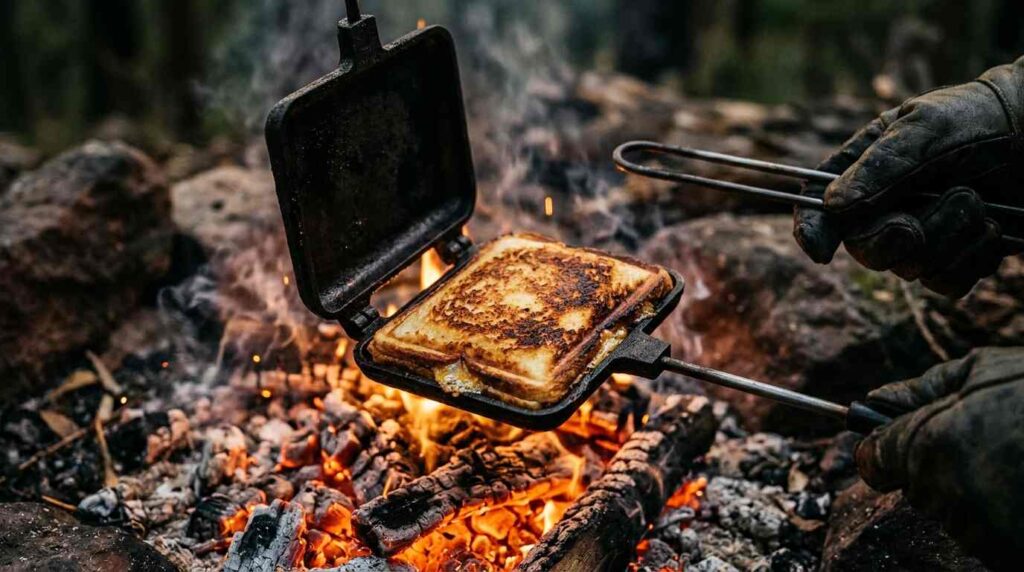
A jaffle iron is a pair of hinged metal plates that clamp a filled sandwich shut, seal its edges and toast it over a flame. The Nyngan Observer, an Australian regional paper, reports that the iron was designed, named and patented in Australia in June 1949 by Dr Ernest E. Smithers, a Bondi physician. The electric sandwich toaster that later took over many kitchens carries the same idea, and its history is claimed in more than one country.
Video: How To Use A JAFFLE IRON To Cook A Toasted Sandwich | Tim Bates 4wd Adventures
The 1949 Australian iron
The Nyngan Observer piece, a local-history column by Leonie Montgomery published in December 2019, gives the Australian design registration number as 27089 and classes the object as a “Pressure Toaster.” The word “Jaffle” is embossed on the cast iron lid. To use it, a thick sandwich is clamped inside and held over a flame, and the column says any type of heat will do. The column also draws on a 1949 Perth newspaper item and on the Australian Food History Timeline.
Wikipedia, used here as a pointer because the cited originals were not reachable, lists further sources for the Smithers story: an interview with surfboard historian John Ruffels, the Australian National Maritime Museum’s entry on the Surfoplane, a 2022 Pittwater Online News article and a Timeline entry titled “1949 Jaffle craze hits Australia”. It adds that the original sealed only the edges and did not cut the sandwich in half, leaving room for extra filling or a whole egg. Those details come second-hand and were not checked against the Timeline itself.
Pie irons and the American relatives
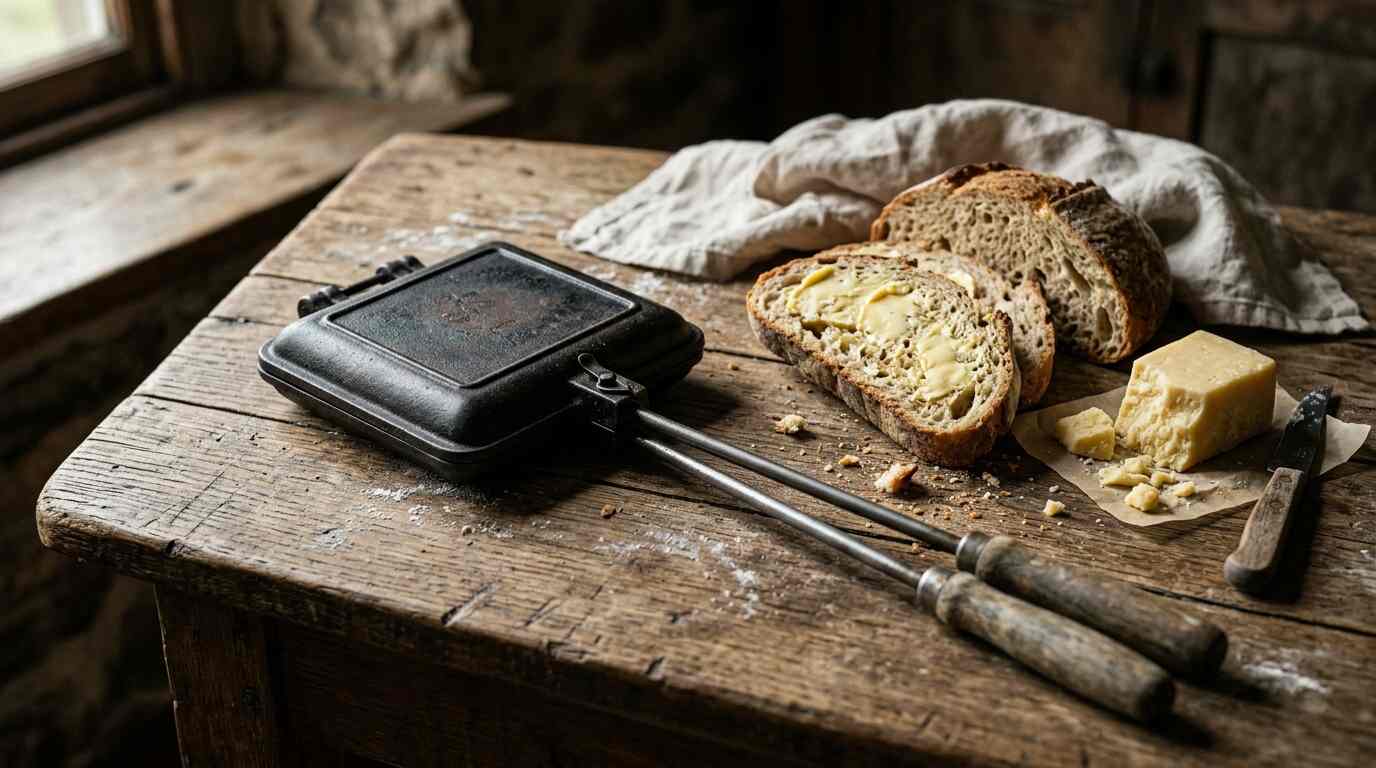
North America has its own family of the same tool. The Wikipedia article on the jaffle, again used as a pointer, describes the pie iron, also called a pudgy pie iron or sandwich toaster, as two hinged concave plates on long handles, in cast iron or aluminum. It also names the Tostwich as possibly the earliest toasted sandwich maker, credited to Charles V. Champion, with a patent granted on 3 March 1925. That claim rests on a local-history citation on Wikipedia and is unconfirmed here.
A better-documented American example is the Toas-Tite. The blog Mid-Century Menu says it was marketed by Bar-B-Buns and created in 1945, and that two sisters now reproduce it. The blogger notes that it is a single-sandwich maker that is buttered or sprayed, loaded with bread and filling, closed and heated over a flame, and that it toasts and heats food but will not cook raw meat, so fillings should already be cooked.
Campfire versions have a named maker. The Daily Meal credits Rome Industries of Madison, Wisconsin as a pioneer of the pie iron. On those dates the American Toas-Tite (1945) and the possible Tostwich (patent granted 1925) both predate the Australian iron of 1949, though no fetched source says whether any of them influenced the others. The tool was also common elsewhere. Wikipedia, citing Condé Nast Traveller and the New York Times, says open-flame toasters make the sandwiches called Bombay sandwiches in Mumbai.
Breville and the electric toaster
Electric versions arrived a generation later. According to Qantas Travel Insider, Breville launched the Snack ‘n’ Sandwich Toaster in 1974. The company was founded in Sydney in 1932 by Bill O’Brien and Harry Norville, who merged their surnames for the brand. The article reports sales of 400,000 units in the first year and a presence in about 10 percent of Australian households. It describes the design as descended from electric waffle irons and sandwich grills of the 1920s and from the hand-held jaffle iron of 1949.
The name itself traveled. Wikipedia, citing the ABC program The New Inventors, says Breville’s name is sometimes used generically in Australia for both the machine and the sealed toasted sandwich it makes, and adds that Cuisinart made an Australian electric jaffle iron in 1974 as well, per a 2024 Tasting Table piece. Those two points were not checked at the source.
Details of the cutting mechanism differ. Qantas says a “scissor action” that cut each sandwich in half was added in 1976. Home Beautiful describes the 1974 machine as sealing the edges and cutting each sandwich into two triangles at a 45-degree angle, and notes that it also sold in New Zealand and the United Kingdom, where it was often called simply “the Breville.” The two articles do not reconcile, so the year the cutting action arrived remains uncertain.
Breville’s own pages claim a different priority. The company’s recipe booklet for the Original ’74 states that Breville invented the first jaffle maker in 1974, and describes plates that “seal and cut.” That is a manufacturer’s claim about the electric jaffle maker, and it sits against the Nyngan Observer’s 1949 iron. The two can both be true only if “jaffle maker” is read as the electric appliance.
How the plates cook a sandwich
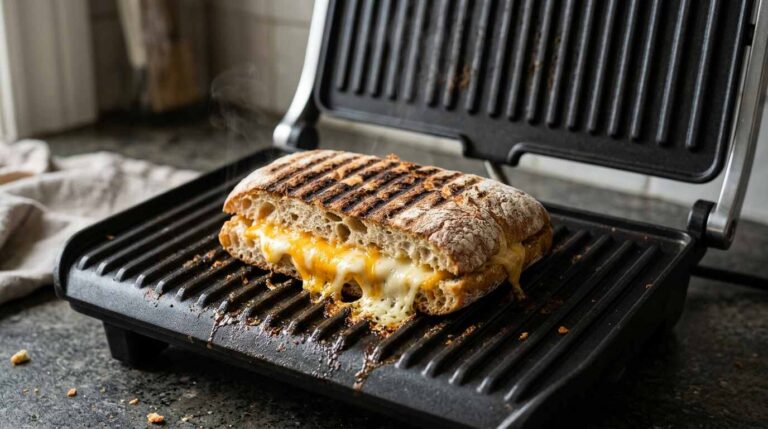
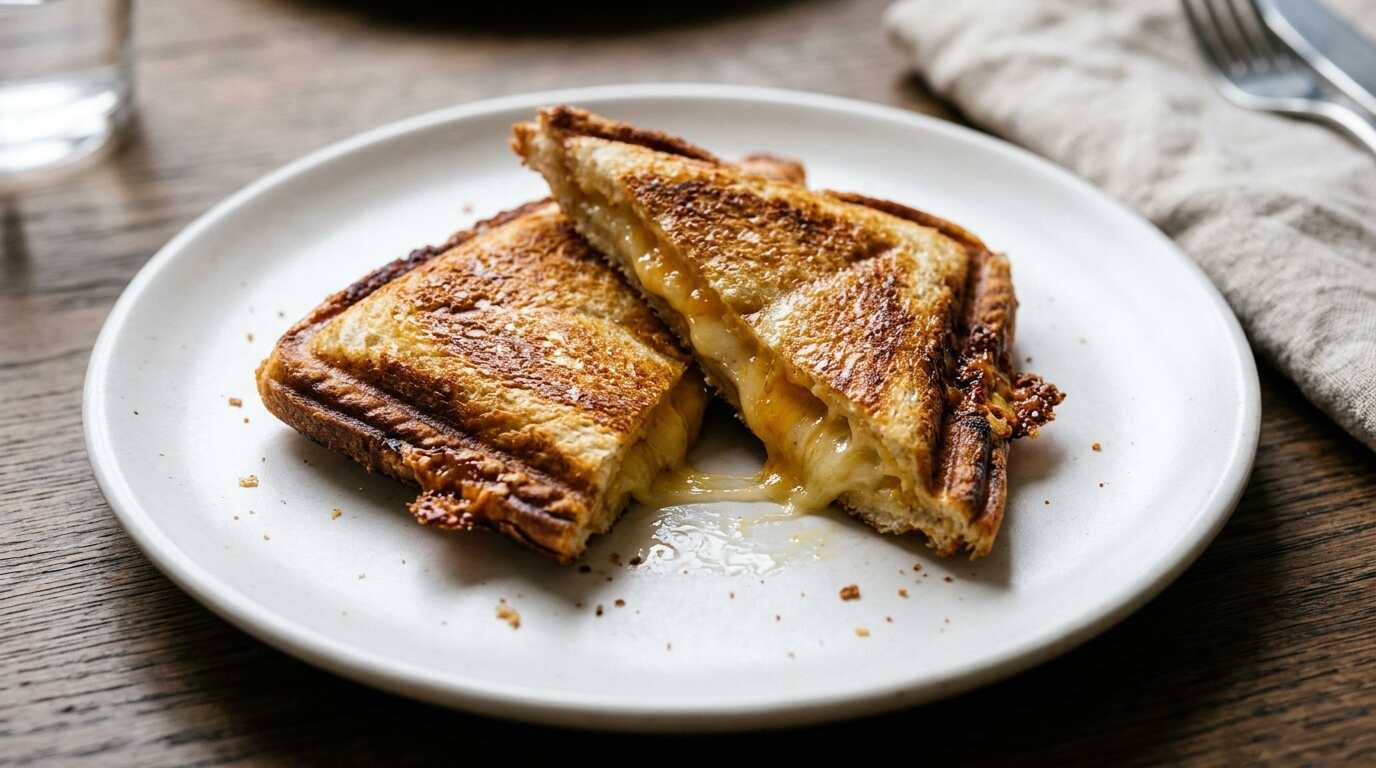
Both families work by pressure and contact heat. The clamp compresses the bread and presses the edges together, which keeps the filling inside. Home Beautiful says the pressed sandwiches turn honey to caramel and cheese to a melted layer, adds that stale bread and inexpensive cheese were considered fine and often gave better results, and cautions that the filling is extremely hot at first and sets if left too long. Breville’s design director Richard Hoare told Qantas that the appeal lies in the cheese that escapes and crisps at the edge: “There’s nothing like that caramelised cheese around the outside.”
That sealed pocket is the main difference from a skillet sandwich, where the cheese meets the pan. The cast iron skillet and the press are compared in the earlier post on panini press versus skillet.
Heat control is where the two types diverge. Rome Industries’ basic instructions, as hosted on a manual archive, call for seasoning with oil or shortening, not butter, buttering the bread, washing in hot water and drying fully, and never plunging hot castings into cold water. The Daily Meal advises against overfilling, since filling spills over the sides, and gives a toasting time of three to five minutes over hot coals, with a check after a couple of minutes. For dough, it advises stretching it thin and keeping it away from the plate edges because it expands as it cooks. It suggests oiling or foil-lining the inside before each use. It describes seasoning a new iron by coating it with a high-heat oil such as canola and baking it at moderate heat for about 15 minutes, twice.
An electric machine replaces the coals with a thermostat. Breville’s booklet says to preheat until the green light comes on and cook most recipes for about three minutes, until the bread is golden and crisp. Butter goes on one side of each slice, buttered side down on the plate and buttered side up on top, and thick slices or sturdy breads such as rye, sourdough or brioche suit the plates. Qantas notes that household fillings have included leftover bolognese and baked beans, which fits the booklet’s rule that wet or hot fillings should be cooked and cooled first, with excess juice drained. Wikipedia, citing a 2015 enthusiast forum thread, says buttering the outside of the bread gives a crunchier sandwich and less sticking, while unbuttered bread inside gives a chewier one; the forum was not consulted.
Coatings, materials and plate size
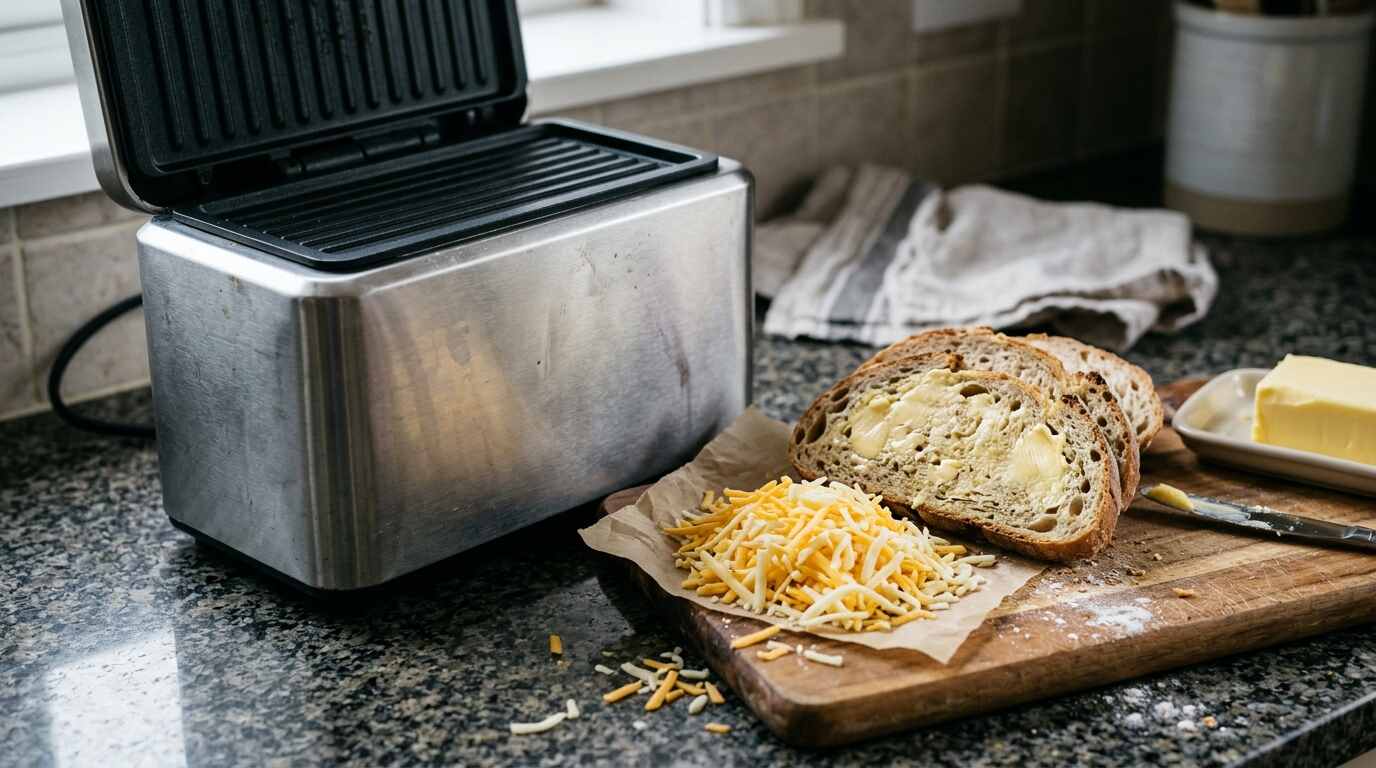
The plates differ by tradition. The same Wikipedia article says campfire models are cast iron cooked over coals, flames or a stove, while lightweight aluminum stovetop models are usually coated with PTFE nonstick. Breville says the plates on its Original ’74 have a PFOA-free nonstick coating. The same product page says the plates are oversized for large breads, puff pastry, brioche, croissants and flatbreads. These are manufacturer descriptions, not test results, and no independent test of jaffle makers was found for this post. No model or brand is ranked here.
Cast iron asks for seasoning and dry storage. A coated aluminum plate asks for no seasoning but, per Breville’s product page, a wipe-clean surface and wide sealing edges meant to keep filling out of hard-to-clean places. Capacity is the other practical limit. A round or square pie iron makes one sealed sandwich; the Toas-Tite’s Tid Bit version, Mid-Century Menu reports, makes four sealed triangles.
The jaffle’s second life
Breville’s machine fell out of favor in the 1990s, Qantas reports, then returned roughly a decade ago on retro appeal and now appears on some cafe menus. For its 40th anniversary in 2014 the company released the Original ’74 with larger plates to fit modern breads. Many Australians grew up eating jaffles after school, Qantas adds, and Hoare is quoted as saying “A lot of us grew up with them.” Home Beautiful notes that many 1970s machines are still in use, some of them wedding presents that have outlasted the marriages they marked.
Products mentioned in this article
- ROME Square Cast Iron Pie Iron Sandwich Cooker For Campfire Fire Pit and BBQ Use. A cast iron pie iron, the open-flame relative of the jaffle iron. See it on Amazon (affiliate link)
- Breville BSG520XL Panini Duo Sandwich Maker, Brushed Stainless Steel. A current Breville electric sandwich maker with plates, not the 1974 Snack ‘n’ Sandwich Toaster. See it on Amazon (affiliate link)
As an Amazon Associate I earn from qualifying purchases. A commission may be earned if you buy through this link, at no extra cost to you.
Sources:
- Nyngan Observer, “Jaffle iron is not as old as you may think”: https://www.nynganobserver.com.au/story/6517195/jaffle-iron-is-not-as-old-as-you-may-think/
- Grill Cheesy, panini press vs skillet: https://grillcheesy.com/panini-press-vs-skillet/
- Wikipedia, “Jaffle” (pointer only): https://en.wikipedia.org/wiki/Jaffle
- Mid-Century Menu, Toas-Tite: https://www.midcenturymenu.com/?p=25700
- The Daily Meal, “The Proper Way To Use A Pie Iron”: https://www.thedailymeal.com/1539906/how-properly-use-pie-iron/
- Qantas Travel Insider, “Why the Breville Jaffle Maker Is Still Resonating Today”: https://qantas.com/travelinsider/en/lifestyle/style/breville-original-jaffle-maker.html
- Home Beautiful, “Throwback Thursday: the jaffle maker”: https://www.homebeautiful.com.au/throwback-thursday-the-jaffle-maker
- Breville, Original ’74 recipe booklet: https://www.breville.com/content/dam/breville/au/assets/miscellaneous/recipe-cards/BSG197_the_original74_ebook.pdf
- Rome Pie Iron 1805 basic instructions (manual archive): https://manualmachine.com/rome/pieiron1805/20448063-basic-instructions
- Breville, Original ’74 product page: https://www.breville.com/en-au/product/bsg197
- Tim Bates 4wd Adventures (YouTube), “How To Use A JAFFLE IRON To Cook A Toasted Sandwich.”: https://www.youtube.com/watch?v=tkDV5EnZjbU