
In this story
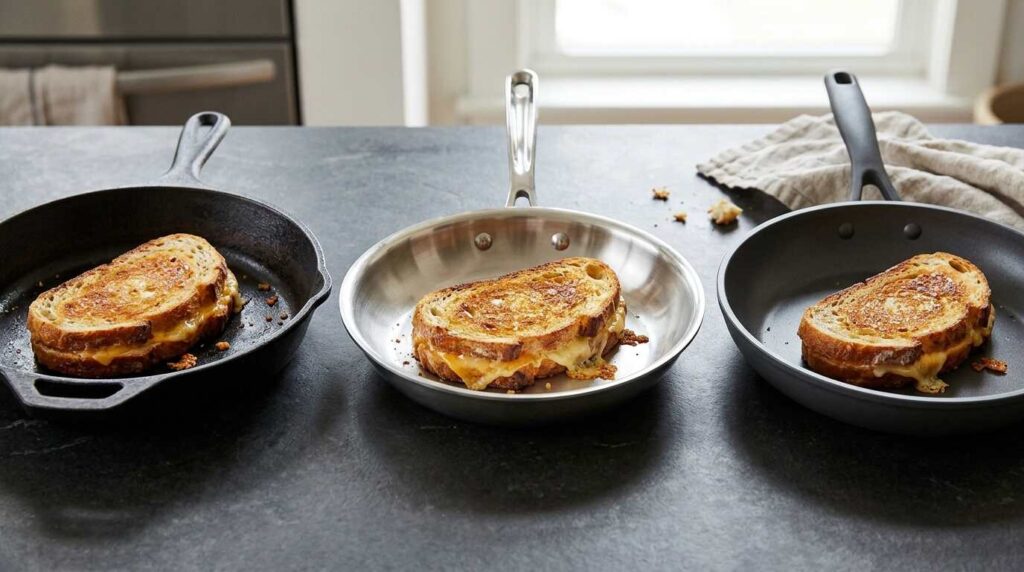
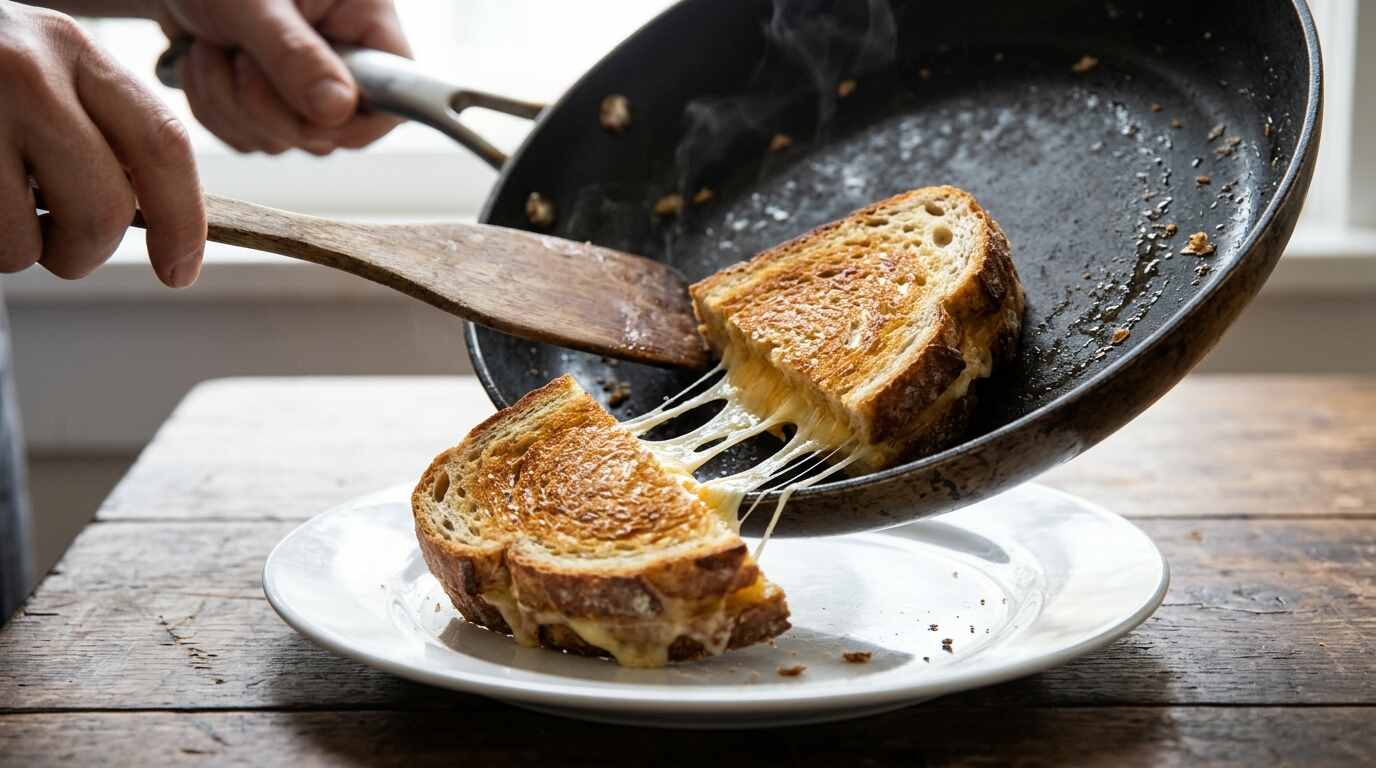
A grilled cheese asks three things of a pan: even heat across a bread slice, a surface that lets melted cheese release, and enough control at medium-low settings to brown the bread before the cheese scorches. Cast iron, stainless steel and nonstick coatings meet those demands in different ways. Published tests of grilled cheese on all three are thin, so most of what follows comes from cookware reporting, manufacturer guidance, extension-service care sheets and food-safety agencies, with the single grilled cheese test found named where it applies.
Video: Lodge Square Skillet Grilled Cheese Sandwich | Mr. Cast Iron
What the one grilled cheese test found
Mashed ran a test of eight appliances on the same sandwich: a stainless steel pan, a nonstick pan, a toaster oven, a griddle, a sheet pan in the oven, an air fryer, a waffle iron and a Foreman grill. No cast iron pan was included. The writer ranked the stovetop stainless pan first, saying “the browning was perfect, and the cheese was duly melted.” Cleanup was greasier than with the other pan, though there was less scorching.
The nonstick pan came second. It needed less butter and cleaned up easily, but the browning was lighter and the flavor less intense than from stainless. The same article rated the griddle as a good melter that needed constant watching and finished darker than the writer preferred. It is one writer’s kitchen and one sandwich recipe, so the result describes a single afternoon, not a laboratory comparison.
Other guidance leans the opposite way. Tasting Table recommends a nonstick skillet for grilled cheese, citing Southern Living, on the grounds that the sandwich will not stick, the bread browns to the desired color and flipping is easier. The same article cites Martha Stewart as saying a griddle or cast-iron skillet works just as well, provided the stove is set to medium-low. Two sources, then, agree on the burner setting and disagree on the pan.
Cast iron: heat that stays
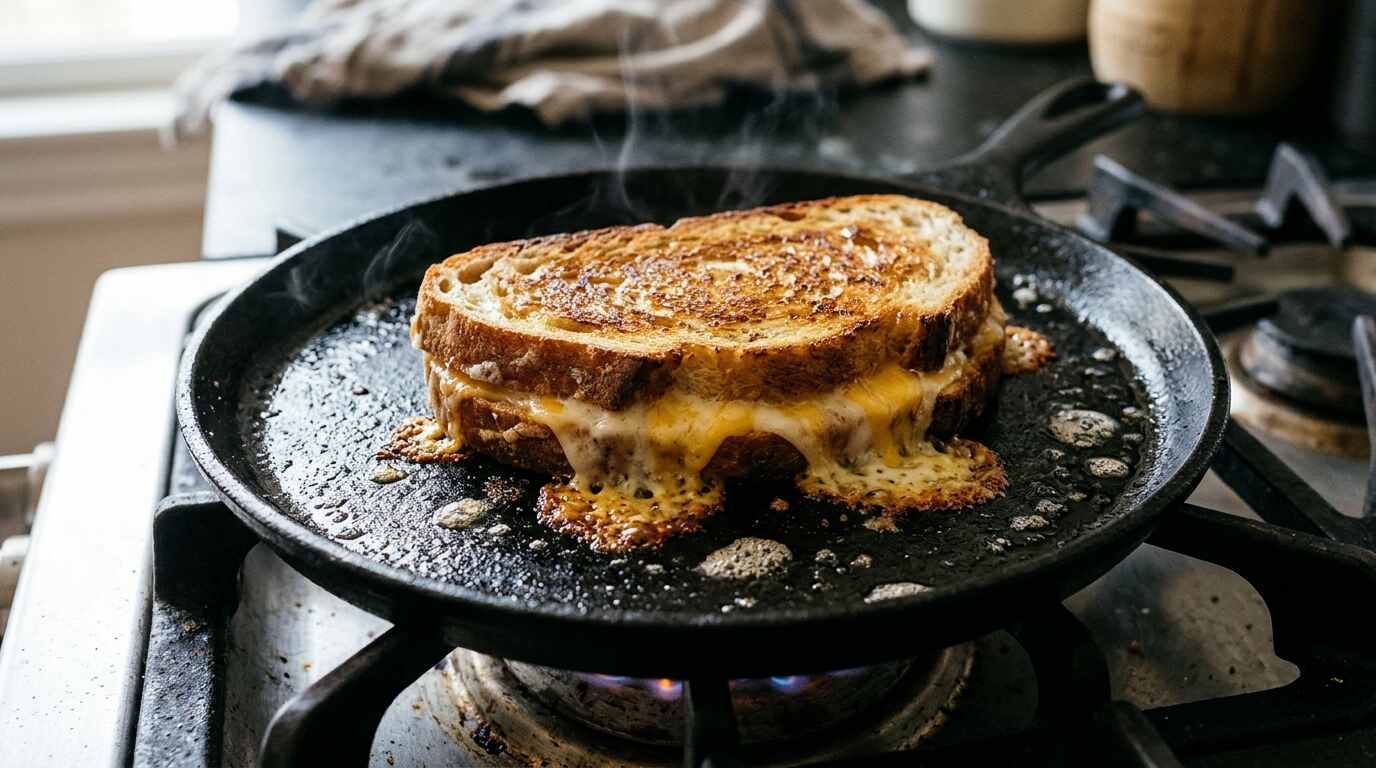
Cast iron’s reputation rests on mass. A Tasting Table article on heat retention reports that a 12-inch Lodge cast iron skillet weighs 8.22 pounds, against 4.7 pounds for an All-Clad D3 stainless fry pan, and states that a hot pan holds energy in proportion to its mass. That article gives cast iron’s thermal conductivity as about 53 W/m·K, versus about 237 for aluminum, and notes that heat spreads unevenly, running hotter over the middle of the burner. Its flour test makes the point visible: flour sprinkled on a dry cast iron pan over heat scorches over the flame and stays pale elsewhere.
The mixed picture is consistent across sources. Mashed’s comparison of cast iron and nonstick skillets says that cast iron holds heat well once hot but takes longer to preheat, suggesting three to five minutes, and can develop hot spots. Reviewed cites a heat-conductivity experiment by Kenji Lopez-Alt in which thermal images showed a 5-ply stainless pan with no cold spot while cast iron had a noticeable cold spot in the center.
For a sandwich, the appeal follows from the mass figures above: a heavier pan stores more energy, so cold bread and cheese should draw its surface temperature down less. That is an inference from the sources, not a measurement of any sandwich. The slow preheat that Mashed describes is the other side of the same property.
The surface comes with upkeep. Field Company, a maker of cast iron, says that a seasoned pan builds a naturally nonstick surface over time, though it notes this takes regular use. That is a manufacturer’s page and favors its own product. Extension offices describe the maintenance. North Carolina State Extension’s Brunswick County office says to dry the pan completely after washing and to avoid steel wool, standing water and dishwashers. It gives seasoning as a thin coat of oil baked on in repeated cycles of an hour. Mississippi State Extension gives a similar routine with a 350°F oven and 3 to 4 repetitions. The two offices disagree on temperature, with NC State saying 550°F and noting that 450°F may be enough. Both pages tell cooks to skip soap and abrasive tools.
Dairy raises one more point. America’s Test Kitchen advises against long simmers or bakes with acidic ingredients in cast iron because acid can strip seasoning and leave a metallic taste. A grilled cheese is neither a simmer nor a bake, though a sandwich built with tomato slices spends more time in contact with the metal than plain cheese does. No fetched source tests that situation.
Stainless steel: even heating and a sticking problem
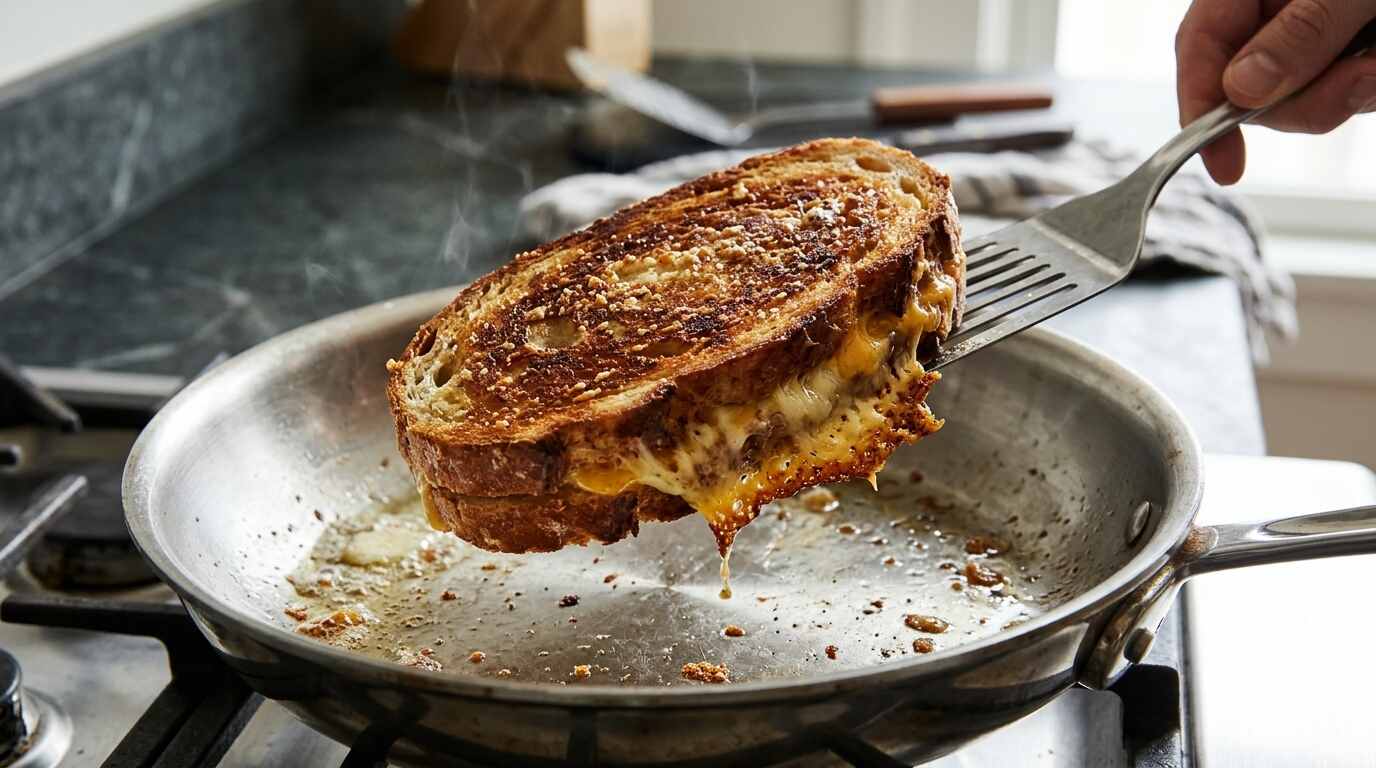
Stainless steel is a poor conductor on its own. Thermtest, a maker of thermal-conductivity instruments, lists the metal at 45 W/(m·K), against 205 for aluminum and 385 for copper, and says basic stainless pans distribute heat poorly, which is why many have an aluminum or copper core. Field Company’s page says well-made multi-layer stainless distributes heat evenly across its surface, rates its heat retention as moderate, and says it responds quickly to burner changes. The same page calls a good stainless skillet significantly lighter than comparable cast iron and lists it as “never nonstick,” saying it requires technique.
The technique is preheating. America’s Test Kitchen says sticking is addressed by preheating thoroughly, and it warns that running a hot stainless pan under cold water can warp it. Reviewed adds that stainless is fine for acidic sauces, a point that matters little for a plain sandwich.
Why stainless wins in the one test above is not explained by Mashed, and the article names no mechanism. A likely candidate is even heating combined with quick response, which fits the conductivity and clad-construction descriptions from the other sources. That remains an inference from separate sources, not a finding from any of them.
The Mashed writer’s note about greasier cleanup with stainless is the only cleanup comparison found for the sandwich itself.
Nonstick: easy release with a temperature ceiling
Nonstick heats fast and releases cheese without much fuss. Mashed’s comparison says nonstick heats quickly and fairly evenly but loses heat quickly, and that such pans usually need replacing within three to five years because coatings wear with use, abrasion and high heat.
The limits are published by makers and regulators. Cookware maker Anolon’s support page says coatings handle temperatures up to about 500°F, that the product should never be overheated, and that an empty pan on a hot burner can climb past 600°F within minutes. America’s Test Kitchen says never to exceed 500°F, to stay at or below medium-high on the stovetop and to add fat or food before heating. It also warns against cooking sprays containing lecithin, which leave a residue that is hard to remove without damaging the coating.
The Singapore Food Agency puts the margins in Celsius: fumes can start above 260 °C, which an empty pan can reach after a few minutes, and above 350 °C the coating breaks down and releases harmful gases. It advises cooking on medium or low, using wooden, silicone or plastic tools, and replacing a pan once the coating shows scratches, peeling, flaking or chipping. Tasting Table, in a separate piece, reports that Gore’s PTFE guidance warns against sustained temperatures of 500°F or higher and that overheated coatings can cause polymer fume fever, with flu-like symptoms.
Grilled cheese is a medium-low job, which sits well inside those limits. The practical risk is preheating an empty pan on a high burner, and that risk is a matter of habit, not of the sandwich.
Weight, lifespan and heat limits
Weight and lifespan separate the three more clearly than browning does. Mashed puts a 10- to 12-inch nonstick pan at 2 to 5 pounds, with cast iron of the same size at 5 to 8, and calls cast iron very durable, able to last decades. Reviewed reaches the same view of cast iron and adds that fully clad stainless costs more but is also durable, while some brands such as Lodge offer a lifetime warranty on cast iron.
Across the fetched material, a few points are stable. Cast iron holds heat the longest and heats unevenly. Clad stainless heats more evenly and cools faster. Nonstick releases easily, responds fast and has a ceiling near 500°F. Nonstick guidance caps the heat at medium-high or below, and the one source that addresses cast iron for grilled cheese sets the stove at medium-low.
The splits are about outcomes. One test favored stainless, one article favored nonstick, and a third source said cast iron performs equally well at medium-low. Each pan can produce the same sandwich, and the difference lies in how much attention it demands: stainless needs preheating, cast iron needs patience and a seasoned surface, nonstick needs a cool burner. Food52’s grilled cheese pan thread shows the same open question, with commenters suggesting lightweight oven-safe pans, small pans and small cast iron without a consensus.
No fetched source ran a controlled grilled cheese comparison across all three pans with measured surface temperatures, browning scores and release, so a ranking would go past the evidence.
Products mentioned in this article
- Lodge Pre-Seasoned Cast Iron Skillet, PFAS-Free, 12 Inches. The 12-inch cast iron skillet type discussed above, sold pre-seasoned. See it on Amazon (affiliate link)
- All-Clad D3 Stainless Steel 12″ Fry Pan, Made in the USA. The fully clad stainless pan used as the stainless comparison. See it on Amazon (affiliate link)
As an Amazon Associate I earn from qualifying purchases. A commission may be earned if you buy through this link, at no extra cost to you.
Sources:
- Mashed, “We Tested 8 Appliances To Find The Best Way To Make Grilled Cheese”: https://www.mashed.com/2278597/best-way-make-grilled-cheese-appliances-tested/
- Tasting Table, “This Type Of Pan Will Help You Make The Best Grilled Cheese”: https://tastingtable.com/982028/this-type-of-pan-will-help-you-make-the-best-grilled-cheese
- Tasting Table, “The Cookware Material That Holds Heat The Longest”: https://www.tastingtable.com/2245074/cookware-material-that-holds-heat-longest/
- Tasting Table, “The Worst Mistake You Can Make With A Nonstick Pan”: https://www.tastingtable.com/2034084/non-stick-pan-worst-mistake-high-heat
- Mashed, “Cast Iron Vs Nonstick: Which Material Is Best For Skillets?”: https://www.mashed.com/2001322/cast-iron-vs-nonstick-skillets-which-is-best
- Reviewed, “Cast iron vs. stainless steel: which should you cook with when?”: https://reviewed.com/cooking/features/cast-iron-vs-stainless-steel-which-should-you-cook-with-when
- Field Company, “Cast Iron vs Stainless Steel” (manufacturer page): https://fieldcompany.com/pages/cast-iron-vs-stainless-steel
- NC State Extension, Brunswick County, “Got a Cast Iron Skillet?”: https://brunswick.ces.ncsu.edu/2024/07/got-a-cast-iron-skillet
- Mississippi State Extension, “How to care for cast iron”: https://www.accessibility.extension.msstate.edu/blogs/extension-for-real-life/how-care-for-cast-iron
- America’s Test Kitchen, “Best Practices for Nonstick, Cast-Iron, Carbon-Steel, and Other Types of Cookware”: https://www.americastestkitchen.com/articles/8686-best-practices-cookware
- Thermtest, “The Impacts of Thermal Conductivity on Cooking Technique”: https://thermtest.com/the-impacts-of-thermal-conductivity-on-cooking-technique
- Anolon support, “Using Nonstick Product Safely” (manufacturer page): https://support.anolon.com/support/solutions/articles/65000167469-using-nonstick-product-safely
- Singapore Food Agency, “Safe practices for non-stick pans”: https://sfa.gov.sg/food-information/risk-at-a-glance/safe-practices-for-non-stick-pans
- Food52 Hotline, “Best small frying pan for grilled cheese”: https://food52.com/hotline/52799-best-small-frying-pan-for-grilled-cheese
- Mr. Cast Iron (YouTube), “Lodge Square Skillet Grilled Cheese Sandwich”: https://www.youtube.com/watch?v=2WINte3wfZ0