In this story
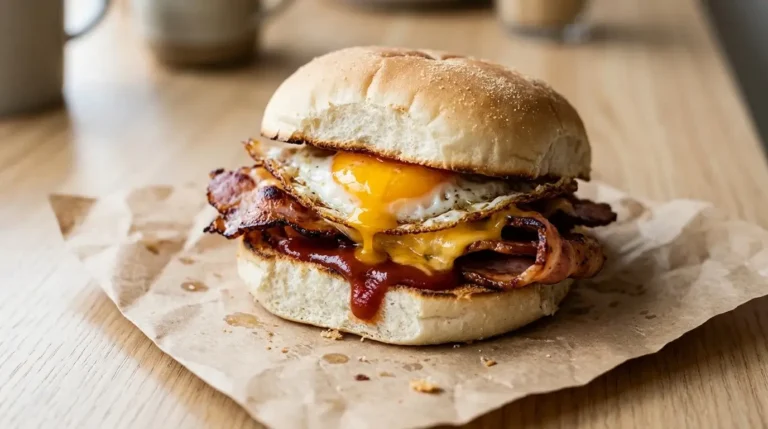
The Egg McMuffin came out of a single McDonald’s franchise in Santa Barbara, California, where owner-operator Herb Peterson wanted a handheld breakfast that a fast-food kitchen could turn out in volume. McDonald’s own corporate history credits Peterson with developing it. Almost everything else about the sandwich’s early years, from the year of Ray Kroc’s tasting to the year it went national, depends on which source is read.
Video: The Savory History Of The McMuffin | Weird History Food
A franchisee with an 11 a.m. problem
Herbert R. Peterson grew up in Chicago, served as a Marine Corps major in World War II and later went into advertising, according to the Yankee Barbareño profile. Before he owned a restaurant, that advertising work put him close to McDonald’s. The Meatingplace trade report on his 2006 Lifetime Achievement Award from McDonald’s says he wrote the company’s first national slogan, “Where Quality Starts Fresh Every Day,” while on the account in the early 1960s. QSR Magazine’s note on the biography of his life adds that he started at D’Arcy Advertising, McDonald’s first agency, and that he moved to Santa Barbara in 1968 to open his first franchise.
The problem he set out to solve was timing. Restaurants in the system opened at 11 a.m., which left the morning market to everyone else. Tasting Table’s interview with his son David Peterson says his father noticed the chain was missing the breakfast market and wanted something that kept the handheld, quick-service character of a McDonald’s product. A plate of eggs would not have fit that model. A sandwich would.
McDonald’s corporate history places the broader conversation in 1970, when a few operators began considering a breakfast menu. Peterson was one of them, and the company’s account says that by early 1971 he believed the chain needed a distinctive product to anchor the menu.
Eggs Benedict without the hollandaise
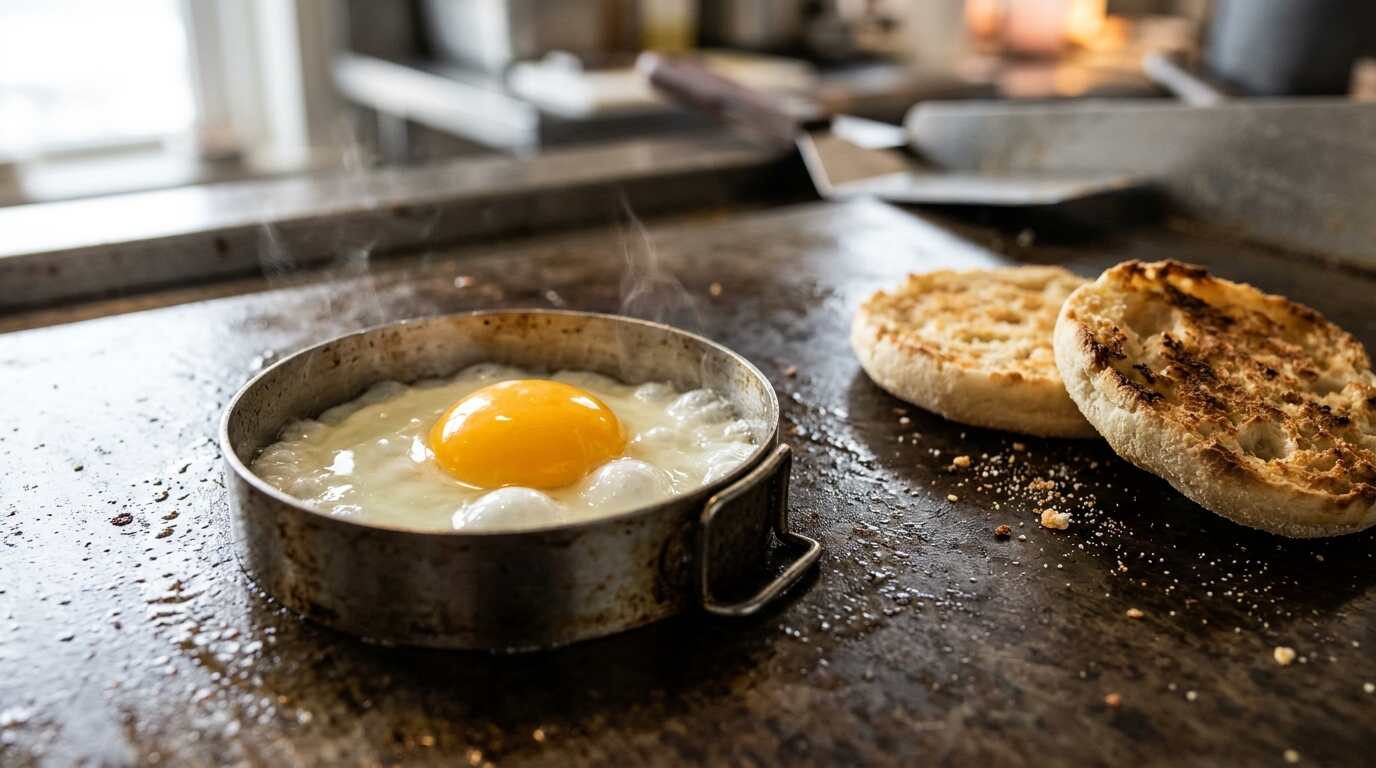
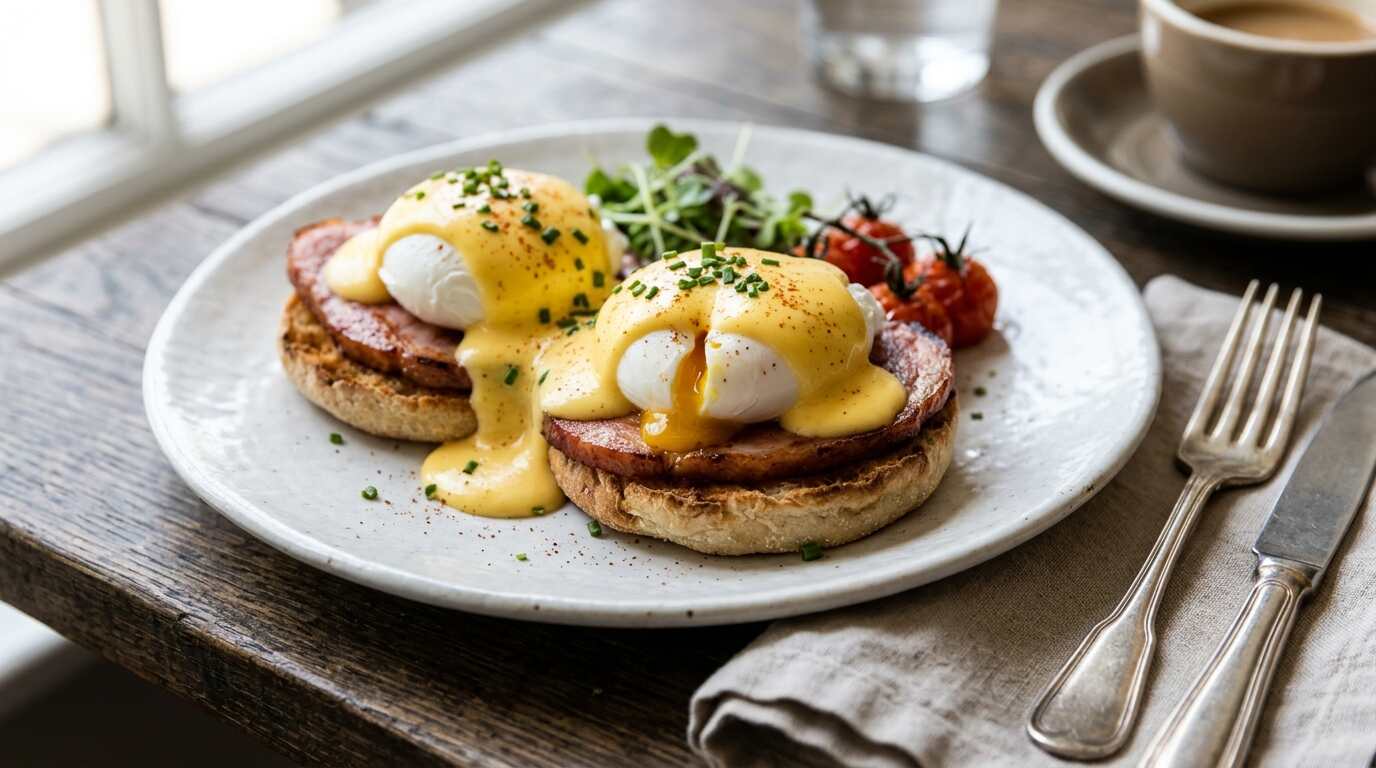
Peterson’s model was eggs Benedict, a dish of poached egg, Canadian bacon and hollandaise on an English muffin. Several sources describe his goal as a portable, inexpensive version. Tasting Table reports that he had eaten it with his friend Julia Child, and that his first experiments involved brushing hollandaise onto the sandwich before he settled on American cheese.
McDonald’s corporate account is blunter about the sauce. It says the packaged hollandaise Peterson tried was unsatisfactory, and that he swapped it for a cheese slice and added Canadian bacon. Fox News, summarizing the same story, says the hollandaise was too messy.
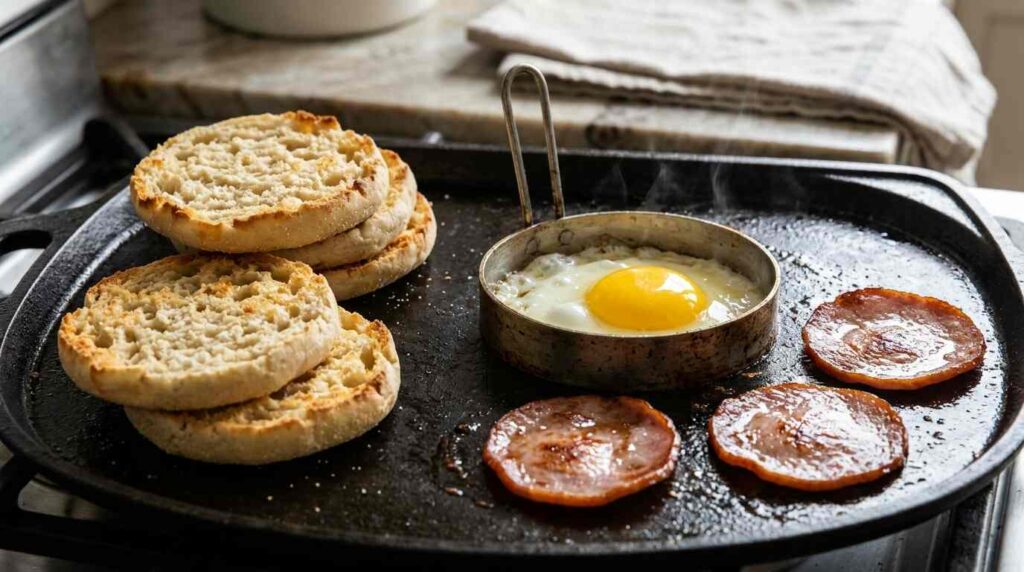
A poached egg was the second obstacle, since poaching in a restaurant rush is slow and untidy. The accounts agree on the fix: a ring that held a cracked egg in a round shape on the griddle. Saveur says a local blacksmith custom-made a grill-top Teflon mold. The Santa Barbara Independent calls it an iron ring, and Tasting Table has the blacksmith, normally a maker of horseshoes, turning out a Teflon-coated ring. The material is reported differently. The shape is not. David Peterson, quoted by Tasting Table, draws a lesson from it: “Sometimes, the biggest ideas start with the simplest ideas.”
Canadian bacon was an ingredient California distributors did not stock widely at the time. Tasting Table’s interview says Peterson imported it from Canada through a connection at Oscar Mayer and bought muffins from Bays English Muffins, an East Coast bakery. The same article puts development at about six months.
The Kroc tasting, and the dates that do not agree
The scene most often retold has Peterson inviting Ray Kroc, McDonald’s founder, to the Santa Barbara restaurant to try something he would not describe in advance. Kroc told the story himself in his 1977 autobiography, Grinding It Out, according to TIME’s Lily Rothman. Fox News quotes him describing the idea as “a crazy idea — a breakfast sandwich” before the taste won him over.
Saveur adds a detail about the pitch itself. Peterson had planned to argue the case on cost and profit, but Kroc ate two sandwiches anyway, and the magazine’s writer concludes that economics was not what sold him. That reading fits Kroc’s own recollection of a crazy idea won over by taste.
The year is where accounts split.
- McDonald’s corporate history of February 2020 puts Peterson’s development in 1971. Its 2025 anniversary article opens with “It all started one day in 1971.”
- The Daily Nexus, the University of California, Santa Barbara student paper, and Saveur both date Kroc’s visit to 1971.
- Adweek is more specific, giving December 1971 as the month Kroc visited a franchisee named Peterson.
- TIME, in contrast, says Peterson asked Kroc to visit in 1972.
- A 2012 post on the local blog Yankee Barbareño, by Jack Elliott, says the sandwich debuted in 1972 on Upper State Street, with the Kroc demonstration in 1971.
The number of sandwiches Kroc ate varies too. Saveur and the Daily Nexus say he ate two. Tasting Table reports that on a first visit to the franchise in 1971 he reportedly ate four Egg McMuffins in one day, which may describe a different occasion from the demonstration. These accounts come from the family and from journalists writing decades later, not from a contemporaneous record, and the Peterson biography The Good Egg, by David Peterson and Ann Marsh, is the closest thing to a full account.
How the name arrived
The sandwich was not yet called an Egg McMuffin when Kroc tasted it. McDonald’s corporate history says that in the development stage it had no name. Two sources attribute the name to the same person. Tasting Table says Patty Turner, the wife of former chief executive Fred Turner, coined it over dinner on the night Peterson pitched the board. TIME describes her as the wife of a McDonald’s executive and says Kroc credited the name with helping put the item over the top.
The Tasting Table version adds that Peterson made a sandwich for each board member that day. No source fetched for this post independently confirms that detail beyond the family interview.
From test market to national menu
Here the sources part again, and the disagreement is wider than a year.
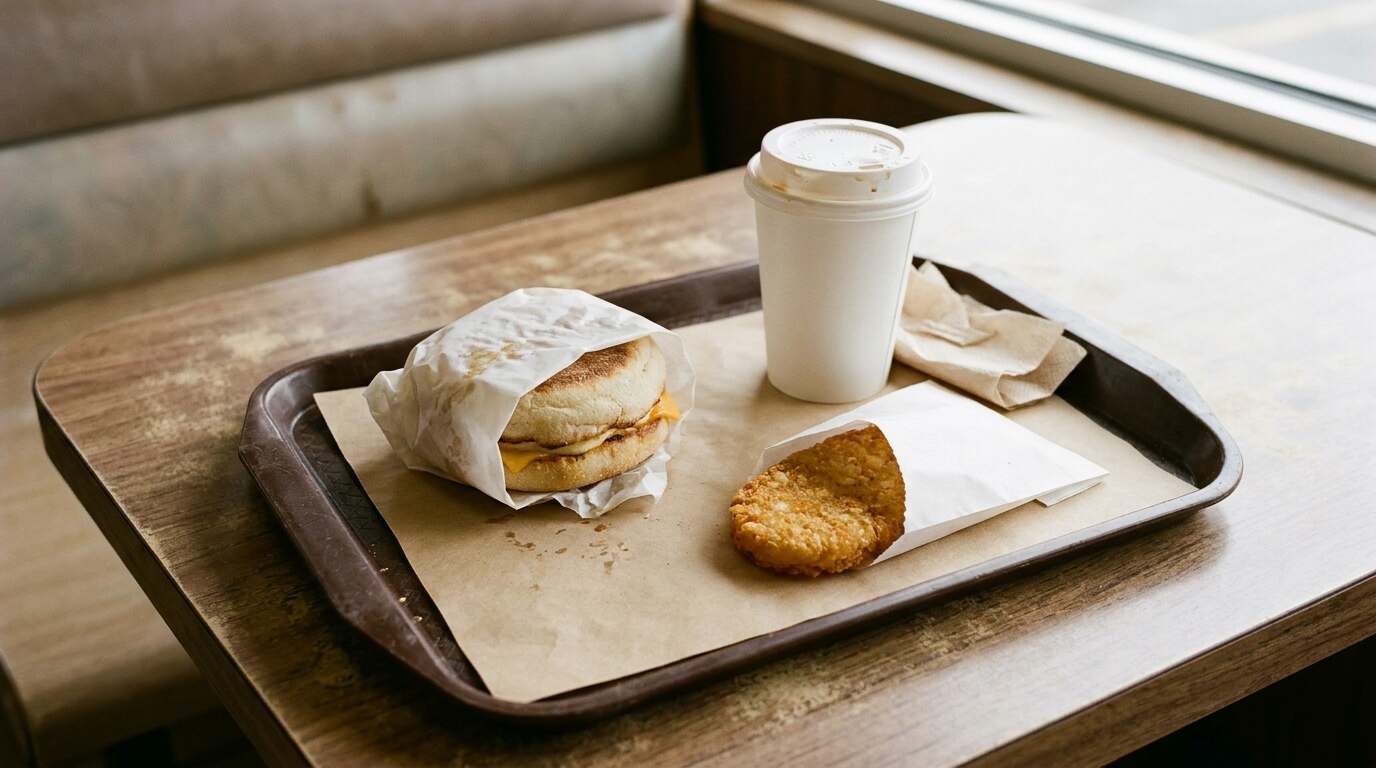
The company’s own timeline has the sandwich in test markets in 1972, served open-faced on a small tray with honey or jam and priced at 63 cents. It says the national roll-out was completed in 1975, and that McDonald’s officially added a breakfast line to the national menu in 1977 with hotcakes, scrambled eggs, sausage, hash browns and a danish. Yankee Barbareño, for its part, says the first Egg McMuffins sold for 55 cents. That is a different price from the company’s.
Others compress the schedule. The Daily Nexus reports that the Egg McMuffin was on the menu of virtually every McDonald’s by 1973, and QSR Magazine says restaurants across the country began opening earlier by 1973. Fox News, citing Kroc, says it took three years to get the item onto the national menu. TIME notes that the magazine itself was praising the sandwich by late 1973, when it cost 63 cents. A reasonable reading is that the item spread to many restaurants in the early 1970s and that the company counts “national” differently from the local press. The documents fetched here do not settle it.
The company’s own history opens by admitting how recent the change was: the article begins with the observation that the chain did not always serve breakfast.
Peterson, later honors and what the sandwich grew into
Peterson eventually owned and operated six McDonald’s in Santa Barbara and Goleta, according to the Santa Barbara Independent. He died in 2008 at age 89, according to the Daily Nexus. The Independent notes that Herb Peterson Day was first held in January 2009 on what would have been his 90th birthday, with Egg McMuffins sold for $1 at Central Coast locations. The same article reports that the Egg White Delight, a later breakfast sandwich built on egg whites and white cheddar, was also developed on the Central Coast and set for a national launch in 2013, which ties the region to the chain’s breakfast menu well beyond the original sandwich.
The sandwich’s commercial weight is a matter of record from several decades. Saveur says breakfast made up 15 percent of McDonald’s sales by 1985. TIME gives 18 percent for 1981, a number that sits on the same upward line. Adweek, writing for the sandwich’s 40th anniversary, puts breakfast at 25 percent of sales. TIME notes that competitors soon added breakfast items of their own.
The 1977 national breakfast line, according to McDonald’s, also carried hotcakes, a toasted English muffin, scrambled eggs, sausage and hash browns beside the Egg McMuffin, which made the sandwich one item among several rather than the whole program. Outside the United States, the company says Burnbrae Farms has supplied its Canadian restaurants with eggs since the early 1970s, a span that overlaps the sandwich’s first years.
The build has held steady. McDonald’s 2025 anniversary article lists an English muffin, Canadian bacon, cheese in place of hollandaise, and an egg cracked into a custom circular ring, so Peterson’s blacksmith-made shape survives in the product description half a century later.
Sources:
- McDonald’s corporate, “A brief and delicious history of the Egg McMuffin” (February 28, 2020): https://corporate.mcdonalds.com/corpmcd/our-stories/article/egg-mcmuffin-history.html
- McDonald’s corporate, “Celebrating 50 Golden Years of The McDonald’s Egg McMuffin” (November 3, 2025): https://corporate.mcdonalds.com/corpmcd/our-stories/article/celebrating50-golden-years-egg-mcmuffin.html
- Tasting Table, “The History Of McDonald’s Egg McMuffin, Straight From The Inventor’s Son”: https://www.tastingtable.com/1815778/mcdonalds-egg-mcmuffin-history-david-peterson
- Saveur, “A Sandwich for the Ages”: https://www.saveur.com/article/Kitchen/A-Sandwich-for-the-Ages
- Santa Barbara Independent, “5th Annual Herb Peterson Day Celebrates the Wholesome Egg McMuffin” (December 31, 2012): https://www.independent.com/?p=121143
- The Daily Nexus (UCSB), “McDonald’s Celebrates 44 Years of the Egg McMuffin” (January 27, 2015): https://dailynexus.com/?p=60149
- Yankee Barbareño, “McDonald’s Egg McMuffin Born In Santa Barbara” (March 13, 2012): https://yankeebarbareno.com/2012/03/13/mcdonalds-egg-mcmuffin-born-in-santa-barbara/
- Meatingplace, “Egg McMuffin originator honored by McDonald’s” (July 31, 2006): https://meatingplace.com/egg-mcmuffin-originator-honored-by-mcdonalds/
- QSR Magazine, “New book chronicles life of Egg McMuffin creator”: https://www.qsrmagazine.com/news/new-book-chronicles-life-egg-mcmuffin-creator
- TIME, “The Surprising History of the Egg McMuffin” (Lily Rothman, 2015): https://time.com/4053832/history-egg-mcmuffin-mcdonalds-breakfast/
- Adweek, “The True, Steamy Story of the Egg McMuffin”: https://www.adweek.com/brand-marketing/true-steamy-story-egg-mcmuffin-151638/
- Fox News, “Why McDonald’s didn’t want the Egg McMuffin on its menu”: https://www.foxnews.com/food-drink/why-mcdonalds-didnt-want-egg-mcmuffin-on-its-menu
- Weird History Food (YouTube), “The Savory History Of The McMuffin”: https://www.youtube.com/watch?v=u698wmXZKbU