In this story
At Katz’s Delicatessen, pastrami starts as what the deli calls “a tough, hard-to-cook piece from the underbelly of the cow”, and Katz’s owner puts the whole process at almost a solid month. Corned beef comes from the same front half of the animal and ends up in the same place, sliced thin between two pieces of rye in a Jewish-style deli. The separation happens after the brine. Pastrami gets a heavy coat of spices and a stretch in a smoker; corned beef is cooked in liquid and carries its flavor from the cure alone, as Food Network Kitchen and several other food publications describe it.
Video: What’s the Difference Between Pastrami and Corned Beef? — from the History of Simple Things YouTube channel
The cut of beef
Brisket for one, a choice of cuts for the other
Britannica defines corned beef as brisket, “taken from the lower chest of a cow or steer”. Pastrami is less settled. Writing for The Nosher, Shannon Sarna says that historically corned beef came from brisket and pastrami from the naval cut, though pastrami is now often made from brisket as well. The Kitchn says pastrami is made from one of several cuts, including brisket, navel or deckle.
Food writers who split brisket itself into its two muscles give a tidy answer: corned beef from the lean flat, pastrami from the fattier point. Food Network Kitchen takes that view, and Food Republic’s Jack Rose says the same while adding that some delis use plate, navel or deckle for pastrami. The Takeout says pastrami comes from the navel end, the belly side, while corned beef comes from a flatter, leaner piece.
No single cut defines pastrami, though Katz’s is explicit about its own: it starts with the navel. The Takeout attributes pastrami’s richness to its fat content and calls corned beef “noticeably leaner but no less delicious.”
How both are cured
A brine that does most of the work for corned beef
Both meats are brined, and the early steps look nearly identical. Britannica notes that brisket is tough, so the brining usually takes two or three weeks. Its explanation of the name is the kernel connection: a “corn” is a coarse grain of rock salt, which has nothing to do with the vegetable. Mental Floss reaches the same point, saying the term originates with corn as a method of preserving meat with salt.
Food Network Kitchen adds that both are cured with a small amount of pink curing salts, which gives each its reddish-pink color. Katz’s says the navel stays in the brine for weeks. Chowhound, citing Katz’s owner Jake Dell, puts the whole pastrami-making process at almost a solid month, with curing in pink salt for roughly two to four weeks.
For corned beef, the flavor comes mostly from the cure. Food Republic notes that it gets nearly all of its flavor from the brine, and The Kitchn says the brine contains salt and pickling spices.
The spice rub and the smoker
Where pastrami pulls away
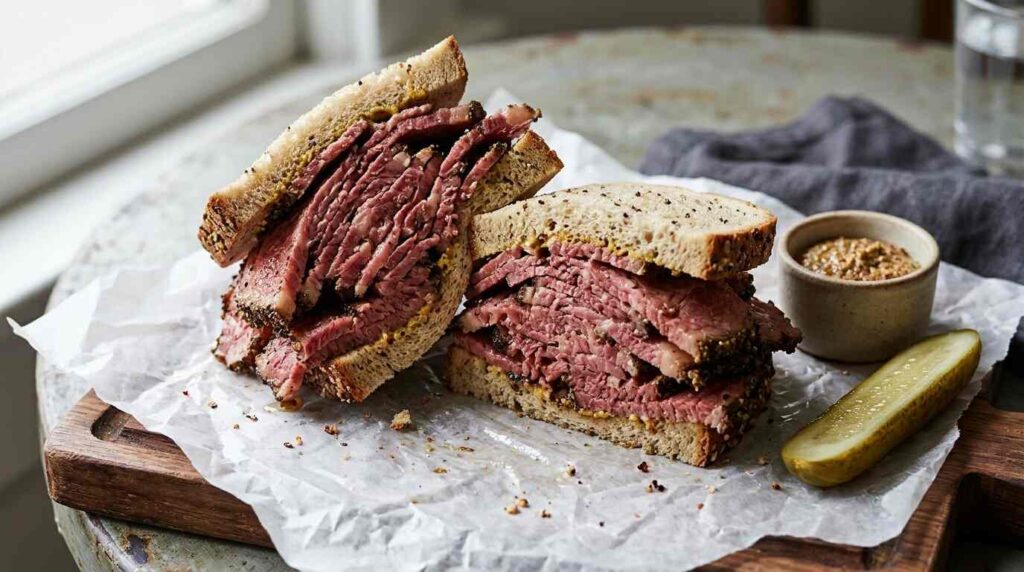
After curing, pastrami gets a second flavor step that corned beef skips. Food Network Kitchen lists the typical coating as black pepper, garlic, coriander, mustard seed and fennel seed. Fine Dining Lovers describes it as “brushed with a spicy mixture of black pepper, coriander, mustard seeds, and fennel seeds” and adds that it is then smoked over hardwood, usually with a pan of water nearby to keep the meat moist.
Smoke is the other dividing line. The Kitchn says pastrami is often smoked for a day or more and calls it “all about the smoke and spice.” Katz’s says its meat is smoked for hours in house smokers after the spice rub, which renders the fat and softens the proteins. Corned beef, in the same accounts, goes from brine to the pot without a smoker.
Mental Floss says pastrami is the spicier of the two and that corned beef gets no seasoning beyond the brine, which leaves out the pickling spices The Kitchn puts in that brine. Either way, corned beef’s seasoning lives in the brine, and pastrami wears a second layer on the outside.
Boiling, simmering and steaming
Both meats finish in moist heat
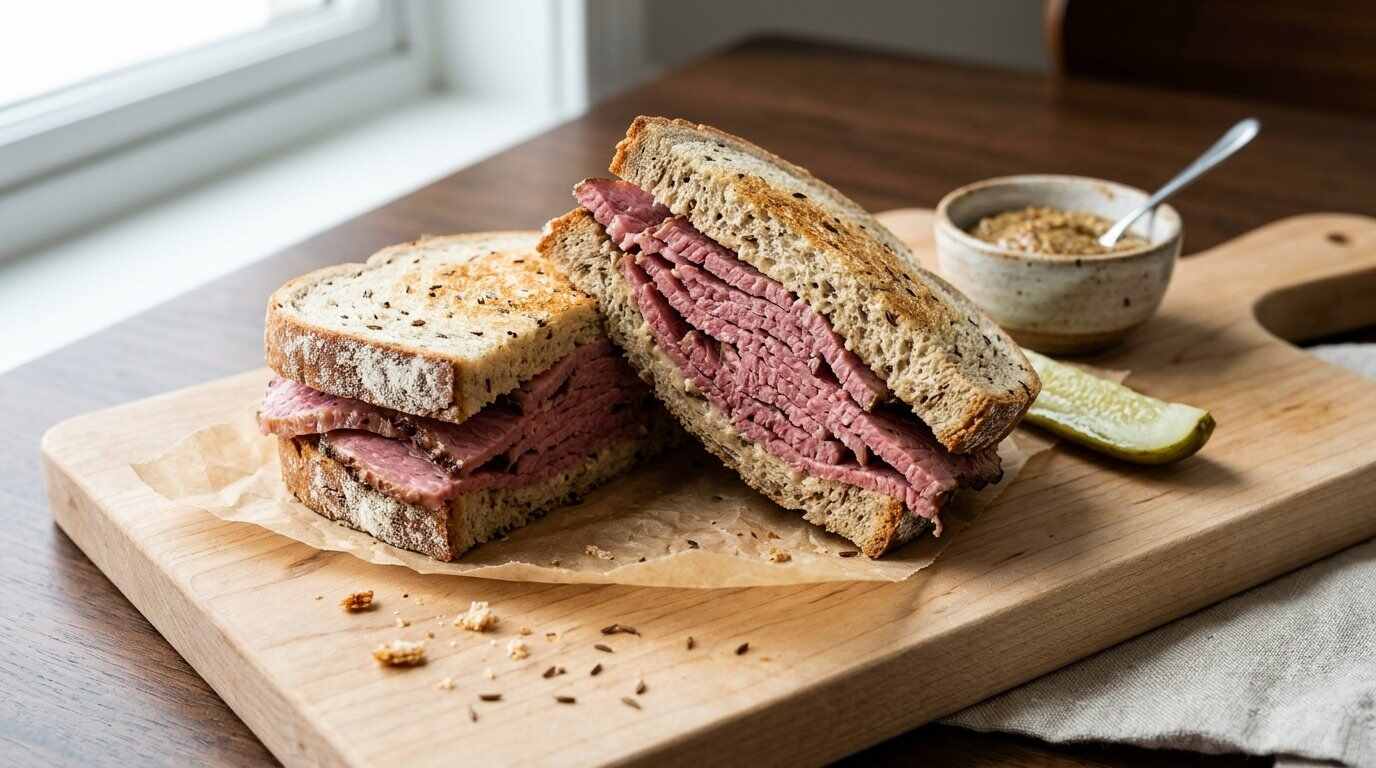
Corned beef’s finishing step is straightforward. Britannica says the washed brisket is simmered for about three hours or pressure-cooked, and the Takeout calls it boiled or steamed. Pastrami has more stages. The Kitchn says pastrami is finally steamed before serving. Katz’s gives its own sequence: its page says “our pastrami is boiled for 2–3 hours,” and the meat is then held in steam tables at the counters until it is carved.
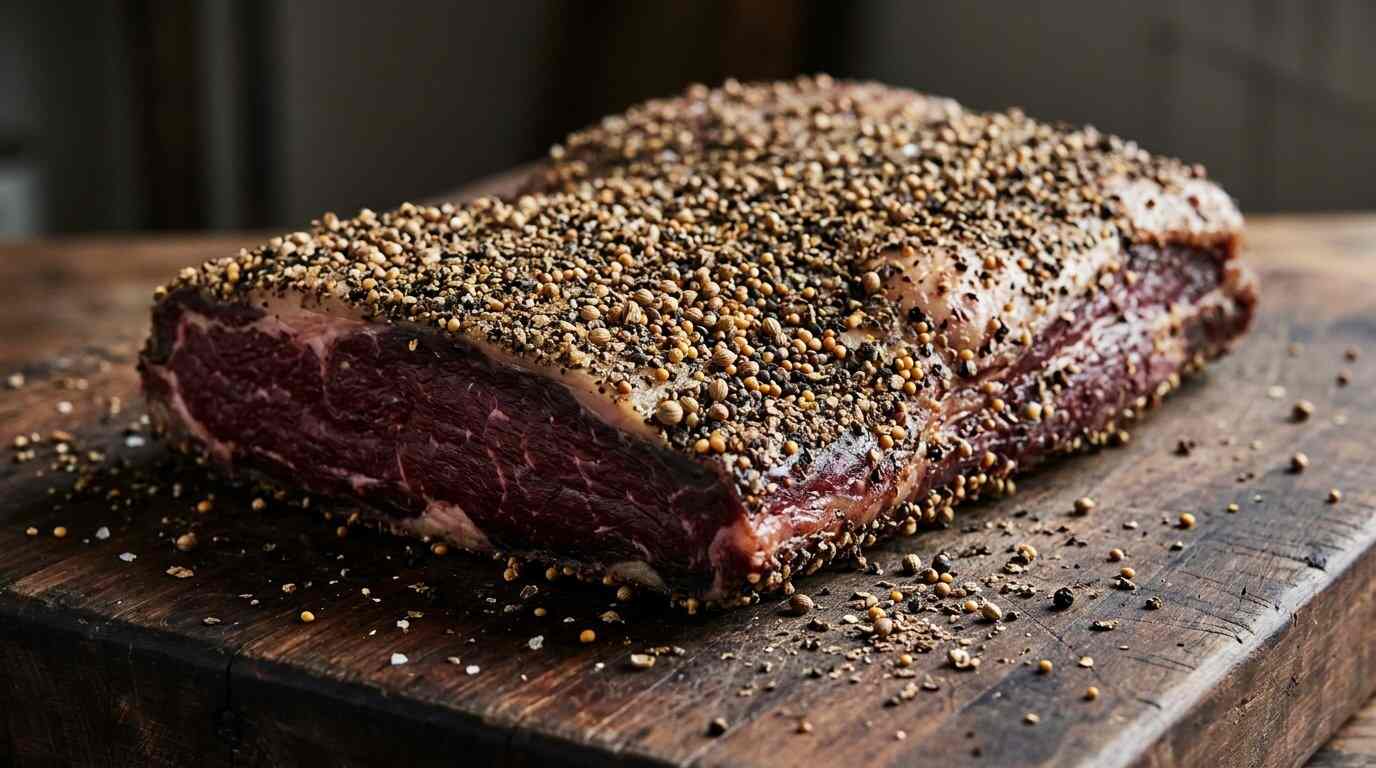
The result is two textures. Food Republic describes corned beef as leaner, shorter-cooked and firmer, and pastrami as richer, smokier and more tender. Katz’s says its sandwiches are “carved to order” by hand.
Pastrami’s Romanian and Turkish roots
From goose and dried meat to the Lower East Side
The word has an eastern European and Turkish ancestry. Food Republic says the name comes from the Turkish “pastirma,” meaning dried meat, and that the food traveled through Romania before reaching America with Jewish-Romanian immigrants. The St. Louis Jewish Light, reprinting a 2022 investigation by Andrew Silverstein, traces it to pastrama, a dried, spiced, smoked meat that Romanian Jews commonly made from goose. Ted Merwin, author of Pastrami on Rye, connects the curing method to Ottoman armies.
The article reports that beef replaced goose in New York and that refrigeration slowed the curing, giving the fatty, smoked beef version known today. Evidence for the date is advertising: Yiddish ads for “pastrama” from the sausage maker Bernhard Meier began in September 1891, and the earliest English-language ad cited, from Meier & Gerzog, appeared on March 24, 1894, for “Roumania Pastroma.”
The New York origin is contested. Tasting Table credits Sussman Volk, a Lithuanian immigrant who sold pastrami on rye on Delancey Street, with popularizing the sandwich. It adds: “Whether he was the first to serve it in the way we are more familiar with, we will never know.” The Jewish Light article records that Katz’s has claimed 1888 and Volk 1887 as first dates, and it also reports a 2015 suggestion, citing Robert Sietsema and Daniel Vaughn’s research for Texas Monthly, that Jewish butchers in Texas may have been first, based on a 1916 Corpus Christi ad for “Pastromie.” The author concludes that pastrami is from New York while admitting to no smoking gun.
Corned beef: Irish salt beef, Jewish delis
Why a salted brisket is tied to St. Patrick’s Day
Food Republic says the Irish dish originated in the 17th century. The Irish Times, in a piece by Aoife McElwain, adds that Irish corned beef, known locally as spiced beef, was produced primarily for export, with Cork a key production center in the 18th and 19th centuries. Many Irish people did not eat it because it was too expensive and favored cheaper pork such as bacon joints, usually served with cabbage.
After the Famine emigration of the 1840s, Irish immigrants in the United States found pork expensive and beef cheap. The same article says kosher cured brisket sold by Jewish butchers in New York became popular with them, and corned beef gradually replaced bacon as the St. Patrick’s Day centerpiece. The Nosher tells the story from the neighborhood side: Jewish, Italian and Irish immigrants lived near one another on the Lower East Side and in parts of Brooklyn and the Bronx. Quoting Westchester Magazine, it says “It was at Jewish delis and lunch carts that the Irish experienced corned beef.”
Sarna’s other Nosher piece puts the original Irish dish plainly: “bacon and cabbage, not corned beef and cabbage.”
How delis serve each one
Rye, mustard, and the Reuben
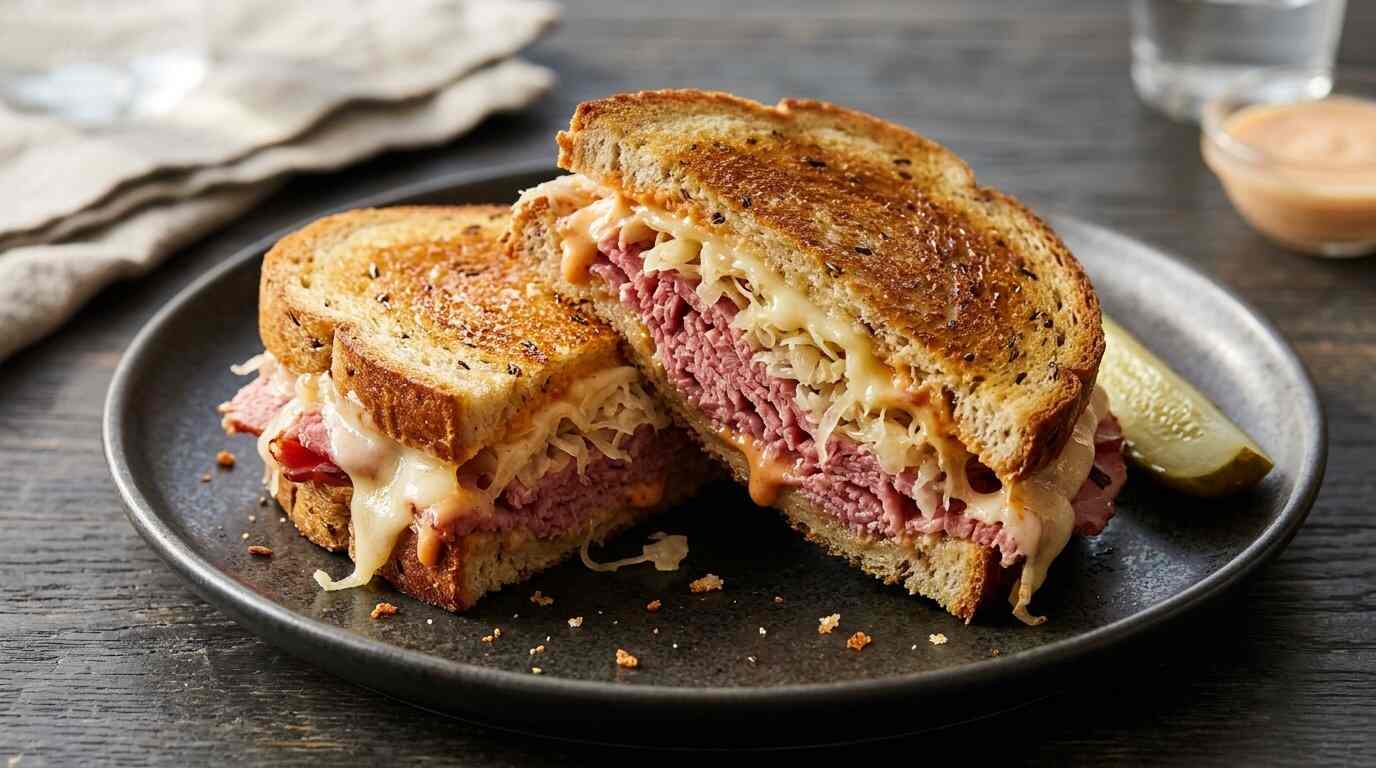
At the counter the two meats meet the same bread. Pastrami is served on rye, and The Takeout points to the mile-high sandwich at Katz’s. The Takeout also says corned beef is the basis of the Reuben and calls the two meats generally interchangeable in sandwiches. Fine Dining Lovers describes pastrami as piled high between slices of rye or on bagels. Each sandwich has its own entry on this site: pastrami on rye, the Reuben and Katz’s Delicatessen.
Modern cooks use the pastrami method on other foods. Mental Floss notes that the term is sometimes applied loosely to the smoke-and-spice process on turkey or salmon, and Tasting Table quotes Parke Ulrich of Waterbar in San Francisco on curing salmon before smoking it. A word that started as Turkish dried meat and passed through Romanian goose has reached the fish counter.
Common questions
What is the difference between pastrami and corned beef?
Both are cured beef. Pastrami gets a heavy coat of spices and a stretch in a smoker, while corned beef is cooked in liquid and carries its flavor from the cure alone, as Food Network Kitchen and several other food publications describe it.
Which cut of beef is used?
Britannica defines corned beef as brisket. Writing for The Nosher, Shannon Sarna says that historically pastrami came from the naval cut, though it is now often made from brisket as well.
Where does the word pastrami come from?
Food Republic says the name comes from the Turkish “pastirma,” meaning dried meat, and that the food traveled through Romania before reaching America with Jewish-Romanian immigrants.
Sources
- Food Network Kitchen, Corned Beef vs. Pastrami: https://www.foodnetwork.com/how-to/packages/food-network-essentials/corned-beef-vs-pastrami
- Britannica, Corned beef: https://britannica.com/topic/corned-beef
- My Jewish Learning (The Nosher), Pastrami vs. Corned Beef: https://www.myjewishlearning.com/?p=119183
- My Jewish Learning (The Nosher), The Secret Jewish History of Corned Beef and Cabbage: https://www.myjewishlearning.com/the-nosher/the-secret-jewish-history-of-corned-beef-and-cabbage/
- The Kitchn, What’s the Difference Between Pastrami and Corned Beef?: https://www.thekitchn.com/pastrami-vs-corned-beef-23515959
- Food Republic, Is There Even A Difference Between Corned Beef And Pastrami?: https://www.foodrepublic.com/1657698/difference-between-corned-beef-pastrami/
- The Takeout, Corned Beef Vs Pastrami: Is There A Difference?: https://www.thetakeout.com/1760495/corned-beef-pastrami-difference/
- Katz’s Delicatessen, Katz’s Pastrami: https://katzsdelicatessen.com/pastrami
- Mental Floss, Pastrami vs. Corned Beef: What’s the Difference?: https://www.mentalfloss.com/food/pastrami-vs-corned-beef-what-is-difference
- Chowhound, How Long Katz’s Delicatessen Takes To Make Its Pastrami: https://www.chowhound.com/2064262/how-long-katzs-delicatessen-makes-pastrami-nyc
- Fine Dining Lovers, Pastrami vs Corned Beef: All Differences: https://www.finedininglovers.com/explore/articles/pastrami-vs-corned-beef-all-differences
- St. Louis Jewish Light, Where does pastrami really come from?: https://stljewishlight.org/top-story/where-does-pastrami-really-come-from
- Tasting Table, The Origins Of NYC’s Famous Pastrami Sandwich: https://www.tastingtable.com/1089840/the-origins-of-nycs-famous-pastrami-sandwich
- The Irish Times, Why did Irish-Americans make corned beef an Irish dish?: https://www.irishtimes.com/food/2018/03/17/why-did-irish-americans-make-corned-beef-an-irish-dish-1.3418356
Keep reading
- Fluffernutter Origin: Emma Curtis, Archibald Query and Who Gets Credit for the Sandwich
- Pork Roll vs Taylor Ham: One New Jersey Meat, Two Names and a Century of Argument
- Mayonnaise vs Miracle Whip: What the Labels, the Law and the History Show
More in this section: Sandwich Debates guide.