In this story
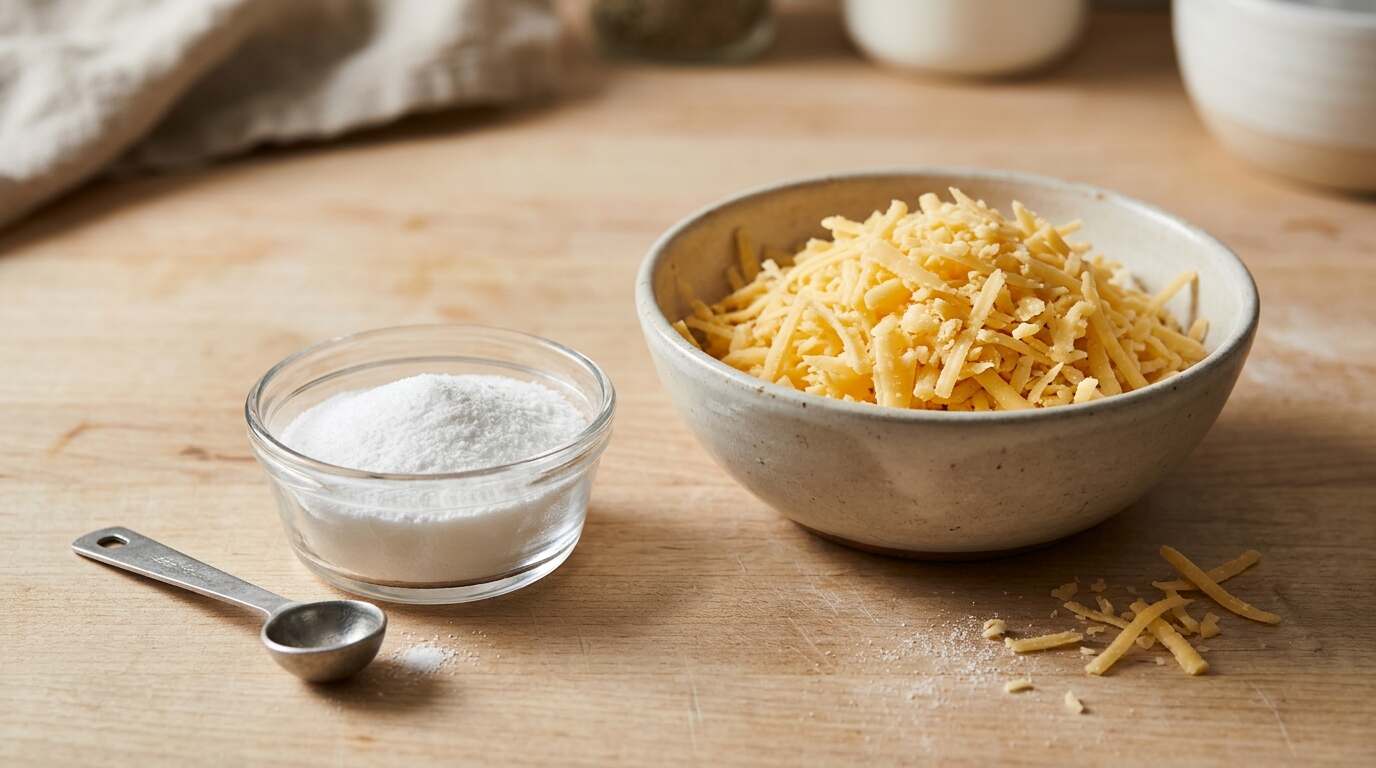
Sodium citrate is a mild salt of citric acid that lets cheese melt into a smooth sauce without separating into clumps and grease. It has been doing that job in processed cheese for more than a century, and in the 2010s it moved into home kitchens through recipes for nacho sauce and macaroni and cheese. Modernist Cuisine describes it as an emulsifying salt that holds the oil and water of cheese together, and the mechanism behind that description is now fairly well mapped in dairy-science papers.
Video: How to Make the Best Nacho Cheese | Reactions (American Chemical Society)
What goes wrong when plain cheese melts
Natural cheese is a protein network that holds fat and water. Heat loosens the network, and when the network gives way the fat and water no longer stay put. The general science of that failure, including the roles of calcium, acid and age, is covered in the earlier post on why cheese melts and turns greasy.
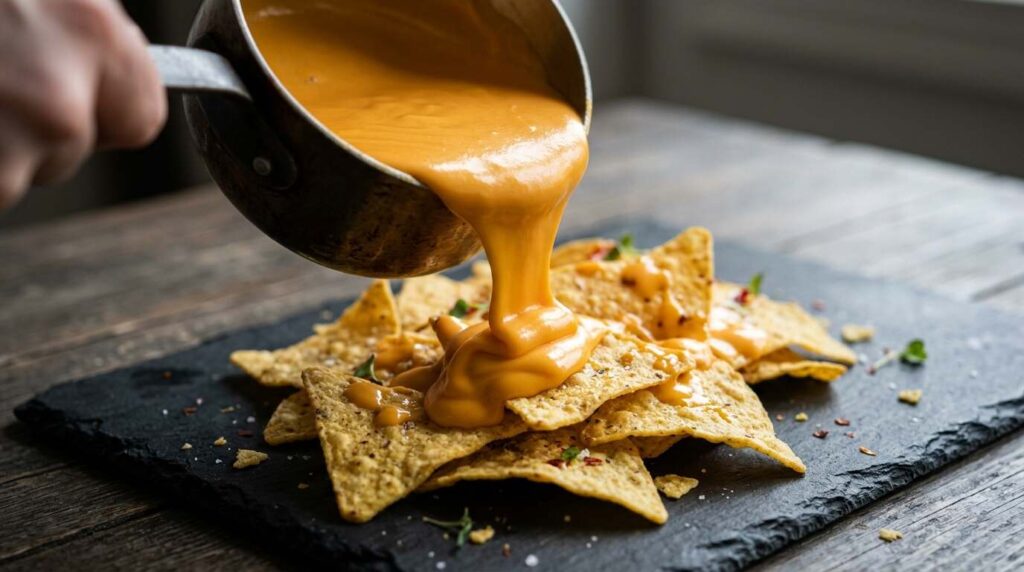
A cheese sauce asks for the opposite result, a liquid that stays one phase while hot and then holds on a chip or a noodle. Mental Floss frames the dilemma in nacho terms: plain melted cheese tends toward a charred or oily mess, while ready-made processed cheese sauce can make chips soggy. Its answer, drawn from a video by the American Chemical Society’s Reactions channel, is two teaspoons of sodium citrate dissolved in a cup of beer before the cheese goes in.
The American Chemical Society’s own announcement of that video describes nacho fans wrestling for years with a cheese that does not leave a “gritty, oily mess” on the chips. It does not name sodium citrate; the ingredient appears in the video and in the Mental Floss write-up.
Calcium holds the casein together
The proteins in cheese are caseins, and calcium is part of what ties them into particles and then into a gel. A chapter on emulsifying salts for the dairy and food industry says that in natural cheese the caseins sit in a calcium-bound matrix and cannot emulsify fat. Emulsifying salts remove calcium by exchanging it for sodium or binding it, and the result is what the chapter calls “more soluble sodium para-caseinate.”
Citrate does the binding part directly. A 2023 paper in the International Dairy Journal by Arantza Garcia, Arno Alting and Thom Huppertz tested trisodium citrate on concentrated casein suspensions. The abstract says citrate “acts through forming soluble Ca-citrate complexes” and also dissolves inorganic phosphate, two effects that together break casein particles apart. Free calcium activity dropped with both citrate and the phosphate salt sodium hexametaphosphate, though the two salts disrupted the particles by different routes.
Earlier work from Wageningen reached a compatible picture. De Kort and colleagues, writing in the International Dairy Journal in 2011, compared several calcium chelators, and their abstract ranks them by how strongly they dissociate casein micelles: “SHMP = SP > TSC > Na2HPO4 > Na2UMP.” Trisodium citrate sits in the middle. It also raised viscosity through micelle swelling, which the authors tie to lower calcium-ion activity.
Both papers used milk-protein suspensions, not melted cheddar. They show what citrate does to casein, and the step from there to a cheese sauce relies on the processed-cheese literature below.
The pH shift
Removing calcium is only part of the change. The emulsifying-salt chapter reports that a suitable salt mixture raises the pH of a cheese blend from 5.0 to 5.5 up to 5.6 to 5.9, and that the salt’s buffering keeps it there. The chapter ties the higher pH and the exchange of calcium for sodium together as the way these salts make casein disperse.
The same chapter lists sodium citrate’s strengths and weaknesses within processed cheese. It is highly soluble and dissolves protein fairly well. It suits block and sliceable cheeses and produces a long, elastic structure. On the downside, it lacks creaming power and bacteriostatic action, and it carries a risk of sandiness and mottling. A 1:2 ratio of trisodium citrate to disodium phosphate gave a high-quality processed cheese in one test the chapter describes. The chapter presents that blend as a result of testing, not as a rule.
Swiss cheesemakers and the first processed cheese
The use of citrate in cheese predates the recipes by a century. According to MEL Magazine’s history of processed cheese, the Swiss cheesemakers Fritz Stettler and Walter Gerber made the first commercially produced processed cheese in 1911, aiming to extend the shelf life of cheese shipped to warmer climates. They “heated shredded Emmentaler cheese and added sodium citrate,” and the mixture set into a smooth block as it cooled.
James L. Kraft followed with his own process. MEL reports that Kraft opened a cheese factory in 1914 and patented his method in 1916, with a patent that states its chief object as converting cheddar-type cheese into a condition in which it “may be kept indefinitely.” The article does not say which emulsifier Kraft’s 1916 process used, and no patent text was fetched for this post, so the Kraft process is left at that.
Modern American rules put numbers on the practice. The federal standard for pasteurized process cheese, 21 CFR 133.169, lists sodium citrate, potassium citrate and calcium citrate among the permitted emulsifying agents, singly or mixed, and caps their solids at 3 percent of the weight of the cheese. The standard also caps moisture, at 43 percent for most single varieties.
Home cooks got there largely through Modernist Cuisine. America’s Test Kitchen’s cheesier nacho cheese sauce calls sodium citrate an emulsifying salt that Modernist Cuisine popularized in 2011 for turning aged cheese into a gooey sauce. The Modernist Cuisine site gives the working ratio as 4 grams of sodium citrate for every 100 grams of finely grated cheese, plus 93 grams of water or milk, with the water cut to about 30 grams when using cheese slices.
Two other published recipes land at the same proportion. The ChefSteps recipe that Science Friday republished uses 12 grams of sodium citrate with 300 grams of Tillamook extra sharp cheddar, which is 4 percent of the cheese weight, together with 300 grams of milk, 4 grams of salt and 1.5 grams of sodium hexametaphosphate. The cheese, milk and salts are sealed in a bag and held in a 167 °F (75 °C) water bath for 15 minutes, then blended. Mental Floss’s two teaspoons per cup of beer is a volume measure, not a weight one, so it cannot be compared directly.
The 4 percent used in these home recipes sits above the 3 percent ceiling in the federal standard for pasteurized process cheese. The regulation governs that standardized product, not a sauce made in a kitchen, so the two figures are not in conflict, but they are not interchangeable either.
America’s Test Kitchen adds a second variable: the cheese itself. Its recipe blends in Gruyère and a little Swiss because aged cheddar, though flavorful, turns grainy when melted. The recipe quotes food technologist Dean Sommer saying Swiss is “at the top of the list for long body, intact casein, and bound insoluble calcium.” That fits the calcium picture above: a cheese with more intact casein and bound calcium has more structure for the citrate to loosen.

Dose around the world
The emulsifying-salt chapter gathers usage levels from several regulators and from dairy practice. It reports that amounts are regulated in many countries and usually do not exceed 3.0 to 4.0 percent, that India’s food safety authority sets a limit of 40,000 parts per million, equal to 4.0 percent by weight, and that for standardized cheese 3.0 percent phosphate is allowed although 1.8 to 2.5 percent is usually enough. For cheese powder, the chapter says stabilizing salts go in at about 2 percent.
Those numbers describe industrial salts in general, not citrate alone, and they come from a single teaching chapter rather than from the regulations themselves. The U.S. figure for citrate is the 3 percent cap in the eCFR text cited above.
Which cheeses the recipes use
The Modernist Cuisine page names aged sharp cheddar, blue Gorgonzola and Monterey Jack among its examples. It also describes a macaroni and cheese with goat Gouda and cheddar, and mentions feta or Stilton for grilled cheese slices, with the water cut to about 30 grams per 100 grams of cheese for slice-style use. The page does not say how thick that mixture ends up.
The two other published methods are narrower. Science Friday’s ChefSteps recipe lists only Tillamook extra sharp cheddar, which the article calls “orange cheddar,” and the Mental Floss version asks for cheddar, preferably. None of the fetched sources tested the salt across a range of cheeses side by side, so the lists reflect what recipe writers chose, not a ranking.

Where citrate stops working
Citrate does not rescue every melt. A 2003 abstract from Utah State University by A. J. Pastorino, C. L. Hansen and Donald J. McMahon, published as a supplement to the Journal of Dairy Science, reports that injecting sodium citrate into finished cheddar left pH at about 5.2 and left “the rate and extent of cheese flow” unaffected. The protein matrix expanded and the cheese grew harder. The abstract also records that soluble calcium fell from 0.34 to 0.28 millimoles per gram of protein and that citric acid in the cheese rose from 0.22 to 1.39 percent. Injecting a finished block is a different experiment from dissolving the salt in hot liquid with grated cheese, so the result says little about sauces and a good deal about how much the method of delivery matters.
The emulsifying-salt chapter makes a related point about dose, saying sodium citrate produced significant melting in its tests only at 3.0 percent. Commercial and home recipes both sit near that level.
Processed cheeses carry it already. Chowhound notes that Velveeta and American cheese commonly contain sodium citrate, which explains why they melt uniformly. A Dickinson College kitchen-chemistry page on a six-cheese macaroni says the same of Velveeta and credits the salt with keeping fats and proteins from separating.
The recipes agree on the order of work: the salt dissolves in the liquid first, and the cheese goes in afterward, a little at a time in the America’s Test Kitchen version. None of the sources above measured flavor or any health effect, so this post makes no claim about either.
Sources:
- Modernist Cuisine, “Science helps craft the perfect mac and cheese”: https://modernistcuisine.com/tag/mac-and-cheese/
- Mental Floss, “The Scientific Secret to Perfect Nachos”: https://www.mentalfloss.com/food/recipes/scientific-secret-perfect-nachos
- American Chemical Society via EurekAlert!, “Making the perfect nacho cheese (video)”: https://eurekalert.org/news-releases/794542
- Emulsifying salts for the dairy and food industry (e-book chapter): https://ebooks.inflibnet.ac.in/ftp03/chapter/emulsifying-salts-for-the-dairy-and-food-industry/
- Garcia, Alting and Huppertz, “Disruption of casein micelles by calcium sequestering salts,” International Dairy Journal, 2023: https://research.ucc.ie/en/publications/disruption-of-casein-micelles-by-calcium-sequestering-salts-from/
- de Kort et al., “Effect of calcium chelators on physical changes in casein micelles in concentrated micellar casein solutions,” International Dairy Journal, 2011: https://research.wur.nl/en/publications/effect-of-calcium-chelators-on-physical-changes-in-casein-micelle/
- MEL Magazine, “The Rise and Fall of Processed Cheese Products”: https://melmagazine.com/en-us/story/the-rise-and-fall-of-processed-cheese-products
- eCFR, 21 CFR 133.169, Pasteurized process cheese: https://www.ecfr.gov/current/title-21/chapter-I/subchapter-B/part-133/subpart-B/section-133.169
- America’s Test Kitchen, “Cheesier Nacho Cheese Sauce”: https://www.americastestkitchen.com/cooksillustrated/recipes/9526-cheesier-nacho-cheese-sauce
- Science Friday, “How to Make the Ultimate Nacho Cheese Sauce”: https://www.sciencefriday.com/articles/make-ultimate-nacho-cheese-sauce/
- Pastorino, Hansen and McMahon, “Effect of Sodium Citrate on Structure-Function Relationships in Cheddar Cheese,” Journal of Dairy Science, 2003: https://digitalcommons.usu.edu/nfs_facpub/264
- Chowhound, “The Chemistry Teacher-Approved Trick For Perfectly Melted Cheese Sauce”: https://www.chowhound.com/1759732/sodium-citrate-melted-cheese-sauce-science
- Dickinson College, Chemistry in the Kitchen, “6 Cheese Macaroni and Cheese”: https://blogs.dickinson.edu/chemistryinthekitchensp22/recipes/6-cheese-macaroni-and-cheese/
- Reactions (YouTube), “How to Make the Best Nacho Cheese”: https://www.youtube.com/watch?v=uwBq7MMY_xI
- Grill Cheesy, “Why Cheese Melts and Why Some Turns Greasy” (internal): https://grillcheesy.com/why-cheese-melts-and-turns-greasy/