In this story
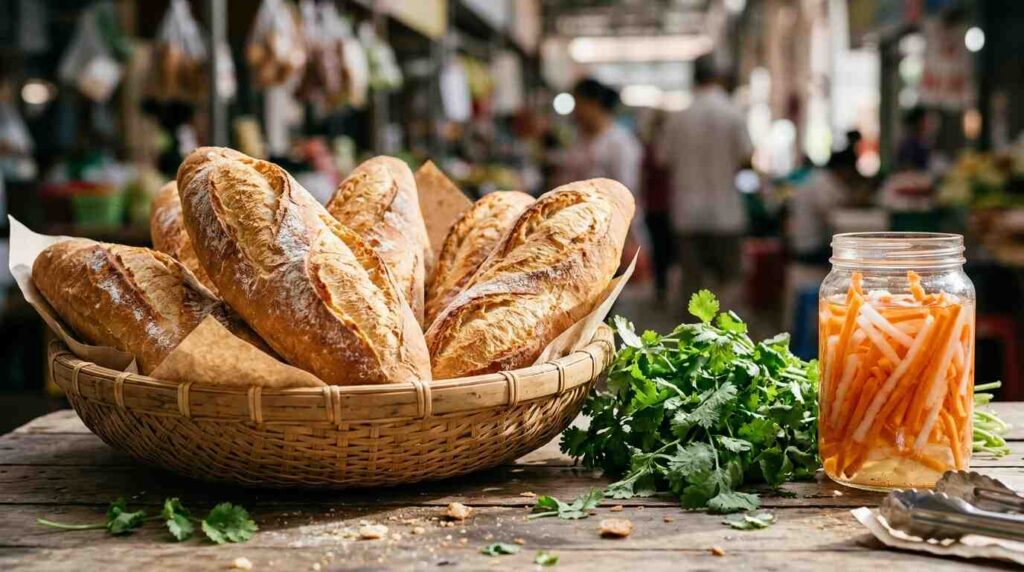
Bánh mì is Vietnamese for bread, and the same two words also name the sandwich built on a light baguette. The Oxford Word of the Month page describes it as a filled baguette, usually cold meats and pickled vegetables with pâté, mayonnaise, coriander and chilli sauce, and says it is believed to have been invented in Saigon in the 1950s. The Wikipedia article on the sandwich adds the grammar: bánh covers a wide range of baked goods and foods, mì means wheat, and on its own the phrase can mean any bread.
Video: How Vietnam’s Banh Mi Sandwich Changes from the North to South — Regions, Eater
Who made the first one is less settled than the dictionary suggests. Google’s banh mi Doodle page traces it to street stalls in Saigon in the late 1950s but says an official origin story has yet to be verified. The story below follows the sandwich place by place, and flags where the sources disagree.
Saigon under French rule
The French arrived in force in 1859, according to Roads & Kingdoms, when gunships and troops reached Saigon and began a conquest that took roughly thirty years. By 1862 France held Saigon and nearby provinces as the colony of Cochinchina, Culture Trip reports. Wheat did not grow well locally, so flour and bread arrived by ship and were affordable mainly to the French.
A loaf with a politics attached
Colonists tied bread and meat to European strength. Roads & Kingdoms quotes an adage of the period: “Bread and meat make us strong, rice and fish keep them weak.” Vietnamese diners called the imported loaf bánh tây, Western cake, and it was served as a casse-croûte, a plate of ham, cold cuts, pâté, cheese and butter.
The word for the bread itself is older than the sandwich. Wikipedia points to Jean-Louis Taberd’s 1838 Latin-Annamite dictionary as an early record of bánh mì meaning bread, and to a poem by Nguyễn Đình Chiểu, dated 1861, that mentions the baguette. The same article reports that northerners originally said bánh tây while southerners said bánh mì. Roads & Kingdoms gives a different account of the rename, linking the switch from bánh tây to bánh mì to anti-French feeling in the 1940s.
The First World War and rice flour
When the war began in 1914, France seized two German-owned import companies in Indochina, and the stock of European goods became cheap enough for ordinary Vietnamese buyers, per Roads & Kingdoms. Culture Trip describes the same seizure of German exporters’ warehouses in Saigon. Saigoneer goes further and argues that local cooks used the surplus cold cuts, cheese and bread to build their own casse-croûte, which it says broke down the line between French and Vietnamese food.
Rice flour enters the story here too. Wikipedia says wartime bakers mixed in cheaper rice flour, which made the bread fluffier. Andrea Nguyen, quoted in Roads & Kingdoms, disputes the fluffiness: rice flour lacks gluten and does not rise, and the airy crumb of the modern loaf comes mostly from dough enhancers such as ascorbic acid.
Hanoi and the northern loaf
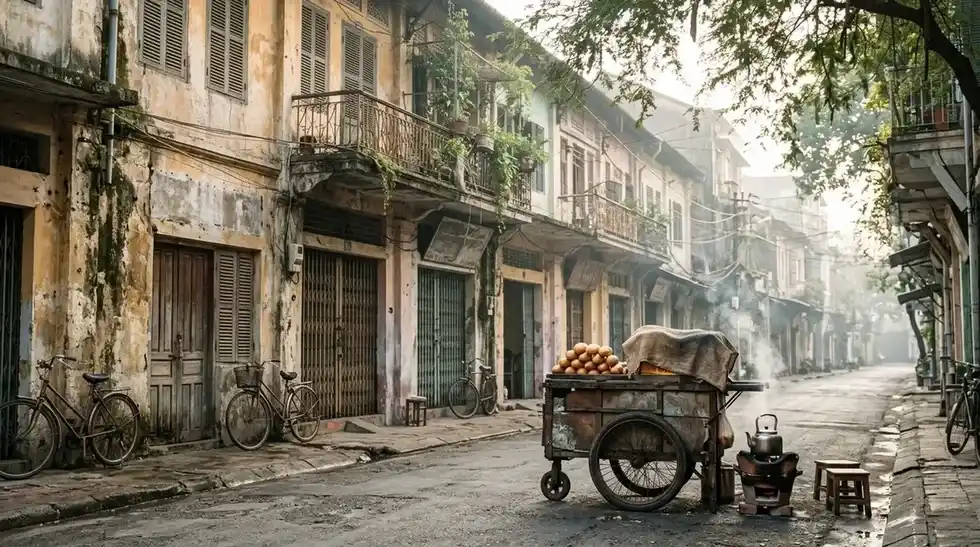
Before the 1950s, sandwiches followed French models, Wikipedia reports, such as jambon-beurre or bread with liver pâté. Andrea Nguyen’s banh mi recipe page says her mother knew exactly that in 1940s northern Vietnam: a baguette spread with liver pâté. The fuller sandwich, she writes, was popularized by southerners, especially in Saigon.
Hanoi kept a simpler habit. Hanoi Times describes bánh mì que, a narrow sandwich from the northern province of Hải Phòng, filled with only liver pâté and cilantro. The Vietnam Tourism guide lists the same breadstick type, thin and hollow, with pâté, chả lụa and a strip of cucumber, and names Hanoi’s Old Quarter as a place to find it. It also lists a Hanoi fried-egg version topped with pork floss that soaks up the yolk.
Northern bread is often compared with its southern counterpart on sauce. Tran Thi Hue, who runs a Hoi An-style shop in Hanoi, told VietNamNet: “I find banh mi Ha Noi quite dry because it has too little or no sauce at all.”
Saigon after 1954
The division of the country in 1954 sent more than a million people south, according to Wikipedia, and reshaped the food of Saigon. Several accounts place the sandwich’s modern form in the city at this point. Saigoneer states the idea plainly: private business was banned in the north, so the tradition moved to Saigon.
The Hòa Mã account
The best-known origin claim belongs to the Hòa Mã shop. Wikipedia names Lê Minh Ngọc and Nguyễn Thị Tịnh as its founders and says it was among the first to sell bánh mì thịt in 1958. Roads & Kingdoms puts the opening at 511 Nguyễn Đình Chiểu Street in District 3 in 1958, with a move in 1960 to 53 Cao Thắng Street, where it still operates. Its account of the founders is more detailed: Mrs. Le had supplied processed meats to French restaurants in Hanoi before fleeing south, and Mr. Le shrank the baguette to about twenty centimetres, cut back on meat, added vegetables and put the fillings inside the bread so customers could eat on the move.
Culture Trip credits the same couple but presents it as a claim, not documented fact. The Google Doodle page, as noted, calls the origin unverified. Other early sellers show up in the record too. Wikipedia mentions a northern migrant selling chả sandwiches from a basket on a motorbike and a stand in Gia Định that sold phá lấu sandwiches, and Roads & Kingdoms says the Vĩnh Lợi shop on Lê Lợi Street led the market earlier but served wealthier customers.
Why the sandwich changed
Culture Trip says cooks in the south swapped mayonnaise for butter and vegetables for costly meats once the French had gone. Roads & Kingdoms adds that the move to mayonnaise came with the wartime rejection of the French name. Cheaper meant a wider customer base, and the style travelled from the shop to carts and stalls.
What goes inside
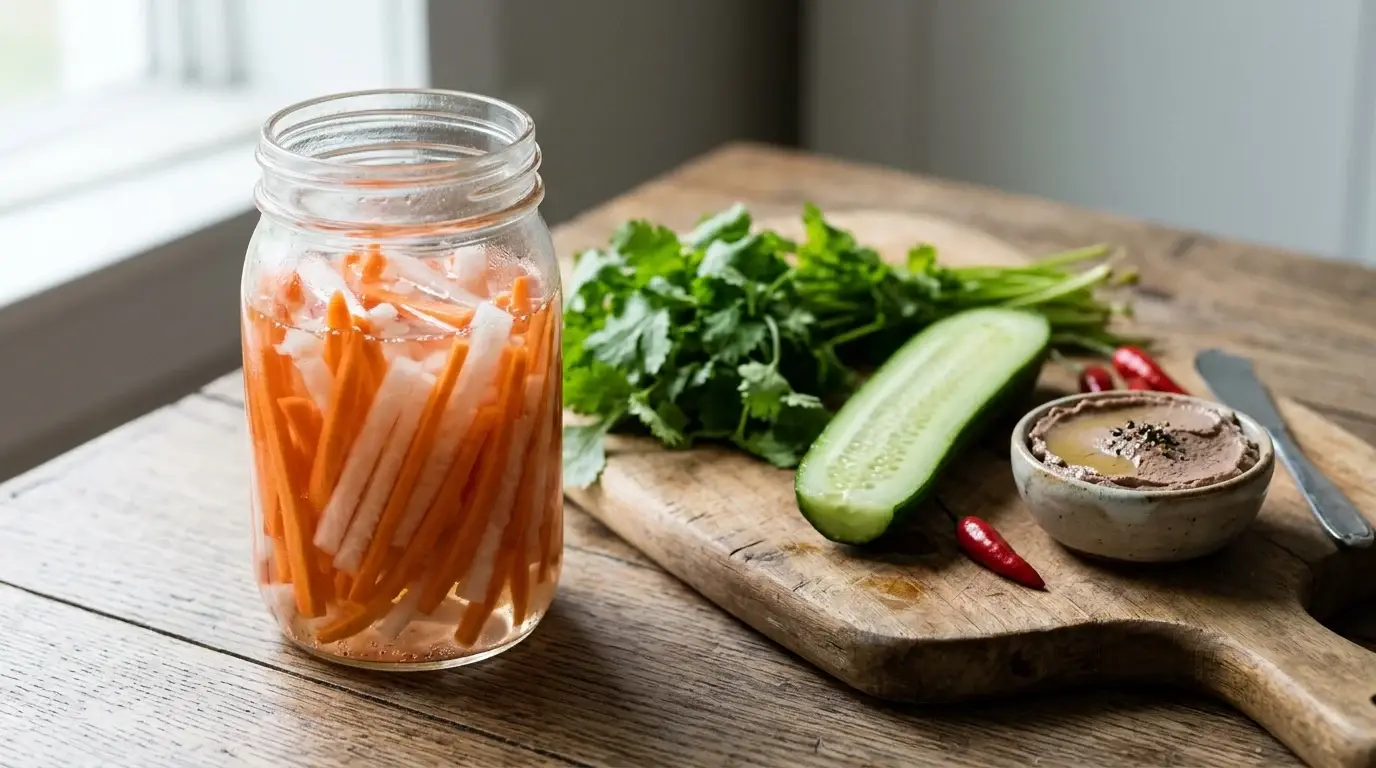
Saigon’s version became the template. Wikipedia lists the standard parts as a main meat filling, cucumber, cilantro, pickled carrot and daikon called đồ chua, chilli sauce or sliced chilies, a seasoning sauce and mayonnaise. It pairs Vietnamese elements such as chả lụa with French ones such as pâté.
The classic order is bánh mì thịt nguội, the special. According to Wikipedia it combines cold cuts, chả lụa, head cheese, liver pâté and vegetables, and is the most popular version. Andrea Nguyen’s recipe page calls the special (đặc biệt) the classic and says it pairs liver pâté with thin Vietnamese cold cuts, with roasted chicken, grilled pork, pork skin, char siu and tofu as alternatives. She prefers a light, crisp baguette to a chewy loaf, and says the pickle keeps for days in the refrigerator.
Writing in The Cairo Review, Andrew Lam lists the fillings recalled from a kiosk near Notre Dame Cathedral in Saigon as roast chicken or pork, homemade pâté, cured ham, head cheese, pickled daikon and carrot, cucumber, chilli, cilantro, Maggi sauce and mayonnaise. The essay, The Marvel of Bánh Mì, also quotes Nguyen’s summary: “Bánh mì is the perfect hybrid.”
Hoi An, Da Nang and Da Lat
Outside Saigon, the same bread carries different fillings. The Vietnam Tourism guide lists bánh mì chả cá from Da Nang and Hoi An, with sliced grilled or fried fish cakes of mackerel or tuna in a smaller, denser baguette that handles moisture better. It also describes Hoi An heo quay, roasted pork belly with five-spice and a honey glaze, served with a thin soy dipping sauce.
Hoi An is the town most often named for its sauce. VietNamNet says the Hoi An style depends on a sauce made from simmered pork juices, which Tran Thi Hue says gives the sandwich a distinct taste. Hanoi Times also credits Hoi An with deeply flavoured sauces and a wide range of ingredients, and notes that Madame Phuong’s pork roll in the town drew attention after Anthony Bourdain popularized it.
Da Lat has its own history. The Cairo Review essay reports that a Frenchman opened the Vinh Chan bakery there in the 1930s, known for a baguette with cured ham, cucumber, butter, salt and pepper. The Vietnam Tourism guide adds a Da Lat fried-egg version, with the egg cooked in pork fat and placed directly in the baguette.
For a quick comparison of the styles named in these sources:
| Place | Style named in sources | Source |
|---|---|---|
| Saigon | Cold cuts, pâté, pickles; also meatball (xíu mại) in tomato broth | Tourism guide |
| Hanoi | Little or no sauce; breadstick version with pâté | VietNamNet |
| Hoi An | Sauce from pork juices; roast pork belly | VietNamNet |
| Da Nang | Fish cake in a dense small baguette | Tourism guide |
| Da Lat | Egg fried in pork fat; mushroom pâté vegetarian version | Tourism guide |
The sources do not agree on neat regional boundaries. VietNamNet says the sandwich varies greatly across north, centre and south yet shares many common elements, and that nearly all the main fillings were created in or introduced to Saigon before reaching Hanoi.
Across the world after 1975
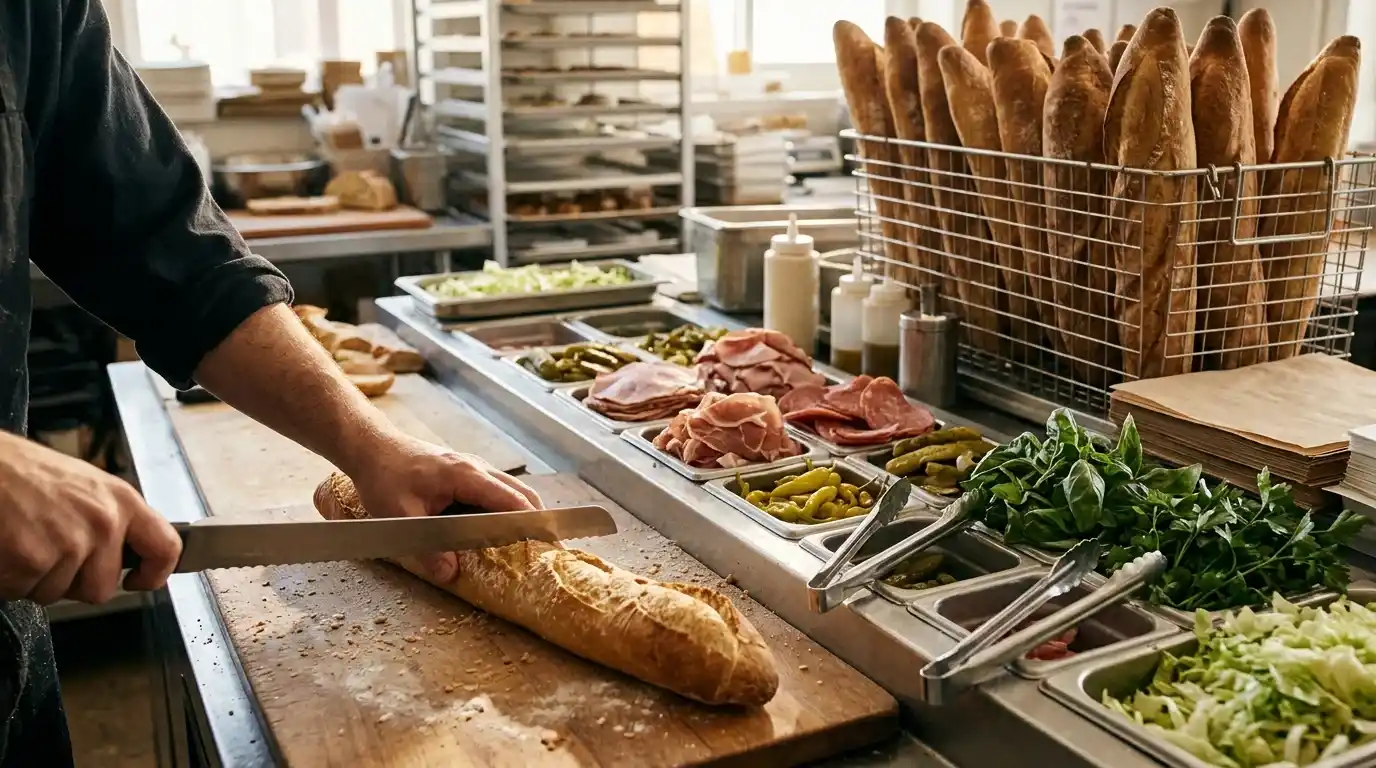
After Saigon fell in 1975, private shops such as Hòa Mã closed for a time, Roads & Kingdoms reports, and the sandwich returned as a centerpiece of the city’s food only after the Đổi Mới reforms of the late 1980s. Wikipedia notes that Bánh Mì Ba Lê was founded in the United States after 1975. The refugees carried the recipe with them.
California
The Cairo Review says Lê Văn Bá and his sons began selling sandwiches in 1980 from a food truck outside a computer plant in Silicon Valley. By 1983 his sons had formed Lee Bros. Foodservices, which now supplies more than five hundred food trucks in northern California and runs the Lee’s Sandwiches chain. Andrea Nguyen writes that Little Saigon in California saw a “sandwich war” among delis in the early 1980s, with low prices and promotions.
Australia
Wikipedia reports about 94,000 refugees arriving in Australia in the decade after the war, some of whom opened bánh mì bakeries, notably in western Melbourne and south-western Sydney. An ABC News story says Vietnamese bakeries there have sold the sandwich since the 1980s, and that demand grew in the early 2000s; one Sydney family it profiles opened a shop in Bankstown in 1988.
Paris, London and Hong Kong
Culture Trip names Paris among the places refugees opened restaurants, and VietNamNet notes the sandwich’s popularity in the city’s 13th district. Wikipedia credits refugees arriving in London from the 1970s with founding canteens in Shoreditch, where bánh mì caught on from the 1990s, and mentions a Hong Kong shop, Banh Mi Nem, opened in 2024 and recognised by Michelin.
Dictionaries recorded the result. Wikipedia and the Google Doodle page both give 24 March 2011 as the date the Oxford English Dictionary added the term; Google marked the date in 2020. The same Wikipedia article says bánh mì appeared on about two percent of American restaurant sandwich menus in 2017, close to five times the 2013 share, citing a Money magazine report.
Whether the Hòa Mã account is the origin or simply the best-documented chapter remains open, and Vietnamese-language sources linked from the Wikipedia article are the next place to look.
Sources:
- Bánh mì, Wikipedia: https://en.wikipedia.org/wiki/B%C3%A1nh_m%C3%AC
- Banh Mi, Word of the Month, Oxford Learner’s Dictionaries blog: https://learningenglishwithoxford.oup.com/2022/03/21/banh-mi-word-of-the-month
- Celebrating Banh Mi, Google Doodles: https://doodles.google/doodle/celebrating-banh-mi/
- The Sandwich That Ate the World, Roads & Kingdoms: https://roadsandkingdoms.com/2016/the-sandwich-that-ate-the-world/
- The Saga of the Bánh Mì, Saigoneer: https://www.saigoneer.com/saigon-food-culture/7336-how-the-bánh-mì-became-world-famous
- The Curious History of Vietnam’s Bánh Mì Sandwich, Culture Trip: https://theculturetrip.com/asia/vietnam/articles/the-curious-history-of-vietnams-banh-mi-sandwich
- The Marvel of Bánh Mì, The Cairo Review: https://www.thecairoreview.com/essays/the-marvel-of-banh-mi/
- Master Banh Mi Sandwich Recipe, Viet World Kitchen: https://www.vietworldkitchen.com/blog/2009/06/banh-mi-sandwich-recipe.html
- Banh mi, queen of street food, VietNamNet: https://vietnamnet.vn/en/banh-mi-queen-of-street-food-E166589.html
- Banh mi guide: the 7 best types of Vietnamese sandwich, Vietnam National Authority of Tourism: https://www.vietnamtourism.com/en/banh-mi-guide-the-7-best-types-of-vietnamese-sandwich-and-where-to-eat-them
- What makes banh mi different from worldwide sandwich, Hanoi Times: https://hanoitimes.vn/what-makes-banh-mi-different-from-worldwide-sandwich-8607.html
- Why are Australians obsessed with bánh mì, ABC News: https://www.abc.net.au/news/2025-05-11/why-australians-are-obsessed-with-banh-mi-vietnamese-roll/105265366