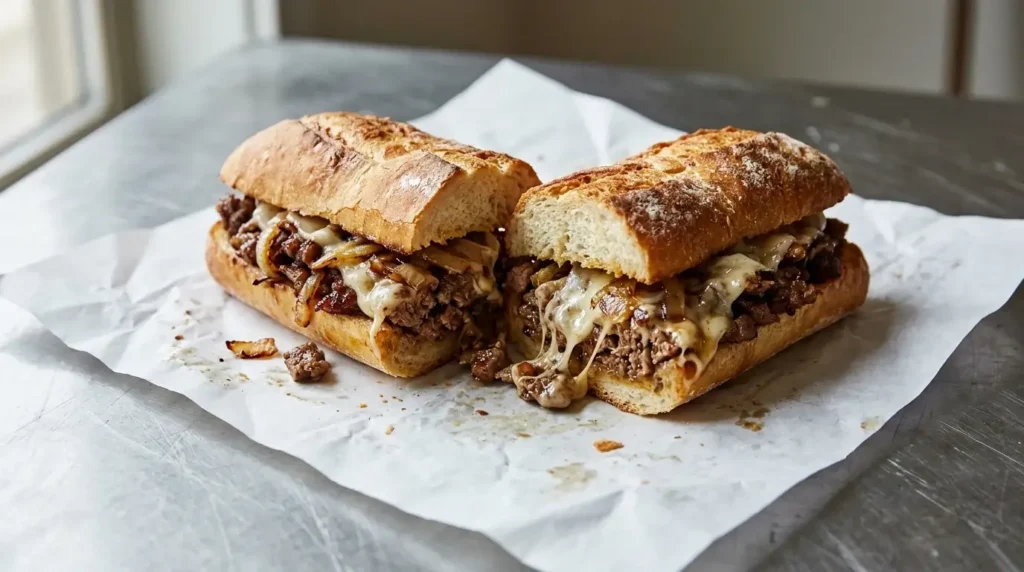
In this story
The standard answer is Pat Olivieri, a South Philadelphia hot dog vendor, in 1930. Visit Philadelphia, the city’s tourism body, dates the sandwich’s official debut to that year, after Olivieri grilled beef from a butcher and a nearby taxi driver asked for one of his own. The story is repeated everywhere. Almost none of it can be checked against a document.
Video: Philadelphia’s Pat’s King of Steaks owner shares family recipe, Good Morning America
What follows separates the parts that come from the Olivieri family, the parts that come from rivals and a cab driver’s relatives, and the parts that come from reporters who ran the numbers. The cheese came later than the sandwich, and nobody agrees on who added it.
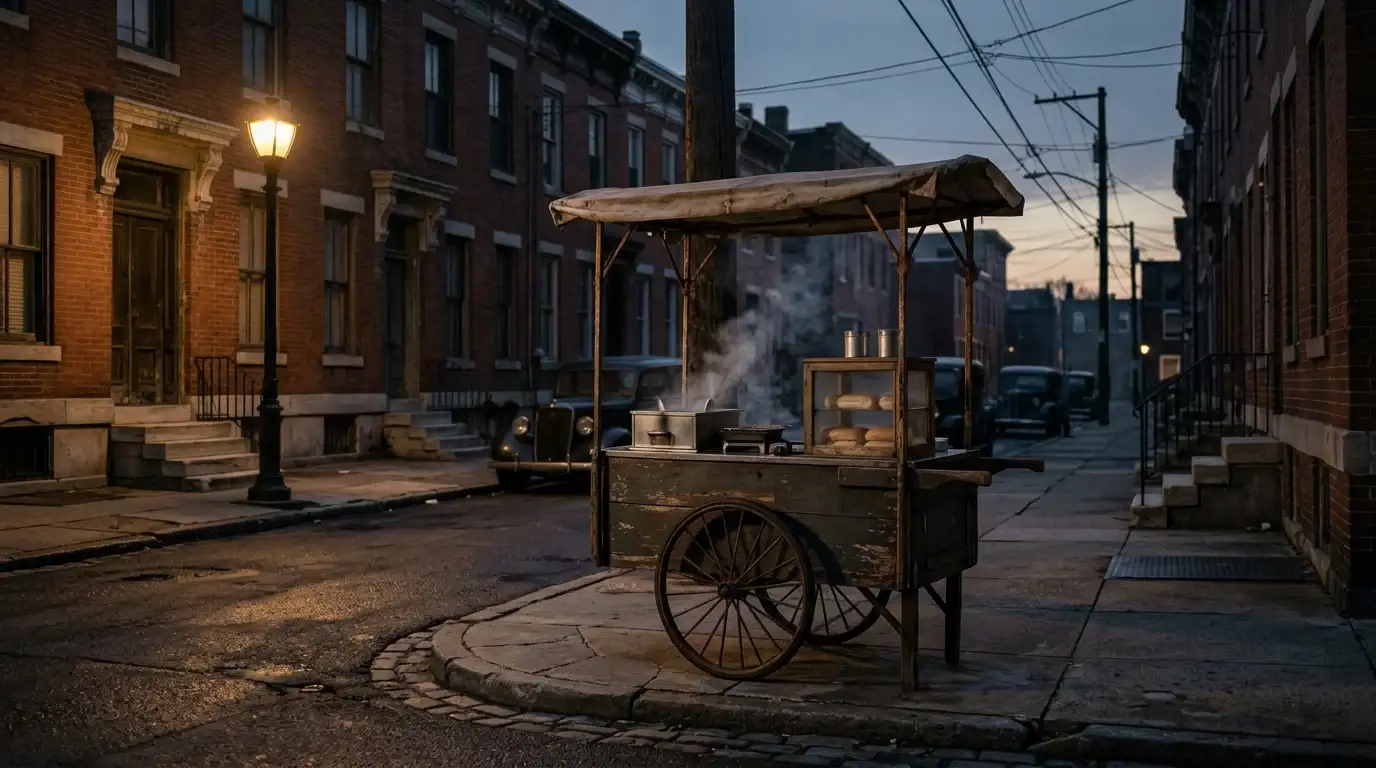
The hot dog cart, as the Olivieri family tells it
According to a Philadelphia magazine oral history, Frank Olivieri, the current owner of Pat’s King of Steaks, says his great-uncle Pat opened a hot dog stand around 1930 near what is now the Italian Market. Pat grew tired of selling only hot dogs, the family says, and asked a relative to buy scraps of meat from a butcher. He cooked them and put them on a hot dog roll.
The Philadelphia Inquirer filled in more of the setting, working from an interview with the same owner. Pat had arrived in South Philadelphia around 1920 with his parents, held a job building wooden sleds, and ran the cart near Ninth and Wharton Streets. In the founding legend his 11-year-old brother Harry fetched the meat. The reporter’s own assessment of how much of this is true was blunt: nobody knows.
Promotion came early, according to the same interview. Pat reportedly carried sandwiches to the Earle Theatre at 11th and Market Streets, photographed movie stars as they left, and hung the pictures in the shop. Frank Olivieri Jr. named a photo with Humphrey Bogart as a favorite, and said the shop later gained a second kind of fame when it appeared in the 1976 film Rocky.
Beef between bread had a longer history, though. Celeste Morello, a food historian quoted in the oral history, points out that 19th-century cookbooks already carried a “beefsteak sandwich.” The Olivieri version, she notes, used different bread and seasoning, so it was not the same thing.
The cab driver
Every version of the story needs a customer who tells Pat to quit selling hot dogs. National Geographic Traveller attributes the line to Pat’s King of Steaks itself, in which a passing cabdriver tells Pat to forget the hot dogs. The article then asks the obvious question: where was the cheese?
Billy Penn, WHYY’s local news site, found a family that says it knows who the driver was. Relatives of Dave Kohn, who died in 1992 and later rose to vice president of the Yellow Cab Company of Philadelphia, say he was a 21-year-old hack in 1930 and a near-daily customer at the stand. In the account given by his nephew Ken Frank, Olivieri grilled some meat and asked Kohn to taste it. Kohn said it was fantastic and told him to put it on a roll.
The article presents no records to back this up. It rests on family memory, and the story’s own framing is that only the man’s descendants know for sure. The same story surfaced in the Inquirer’s interview, where Frank Olivieri said a woman claiming to be the driver’s niece had told it to him as well. Two retellings that match are a pleasant coincidence, not proof.
When the cheese arrived
The first sandwich, in the family’s telling, had none: Frank Olivieri Jr. told the Inquirer in 2008 that his uncle’s original steak sandwich was cheeseless. The oral history reports Olivieri’s claim that cheese appeared in the 1940s at a Pat’s location on Ridge Avenue, with provolone first, and that a manager nicknamed “Cocky Joe” Lorenza was the first to put it on.
Details shift between tellers. The Inquirer’s version calls Lorenzo (the spelling differs) a night cook rather than a manager, and says Pat avoided cheese at the original shop so the sandwich would stay close to kosher for Jewish friends. National Geographic Traveller places the provolone about a decade after 1930 and credits the same man with creating the recognizable cheesesteak.
Two outside voices complicate the picture. Morello says she has found no evidence of cheese on the sandwich before Pat’s, which she credits with inventing the cheesesteak. And Visit Philadelphia notes that the late Joe Vento of Geno’s claimed to be the first to add cheese, which contradicts the Pat’s account directly. Both cannot be right, and neither claim comes with paperwork.
Whiz, American or provolone
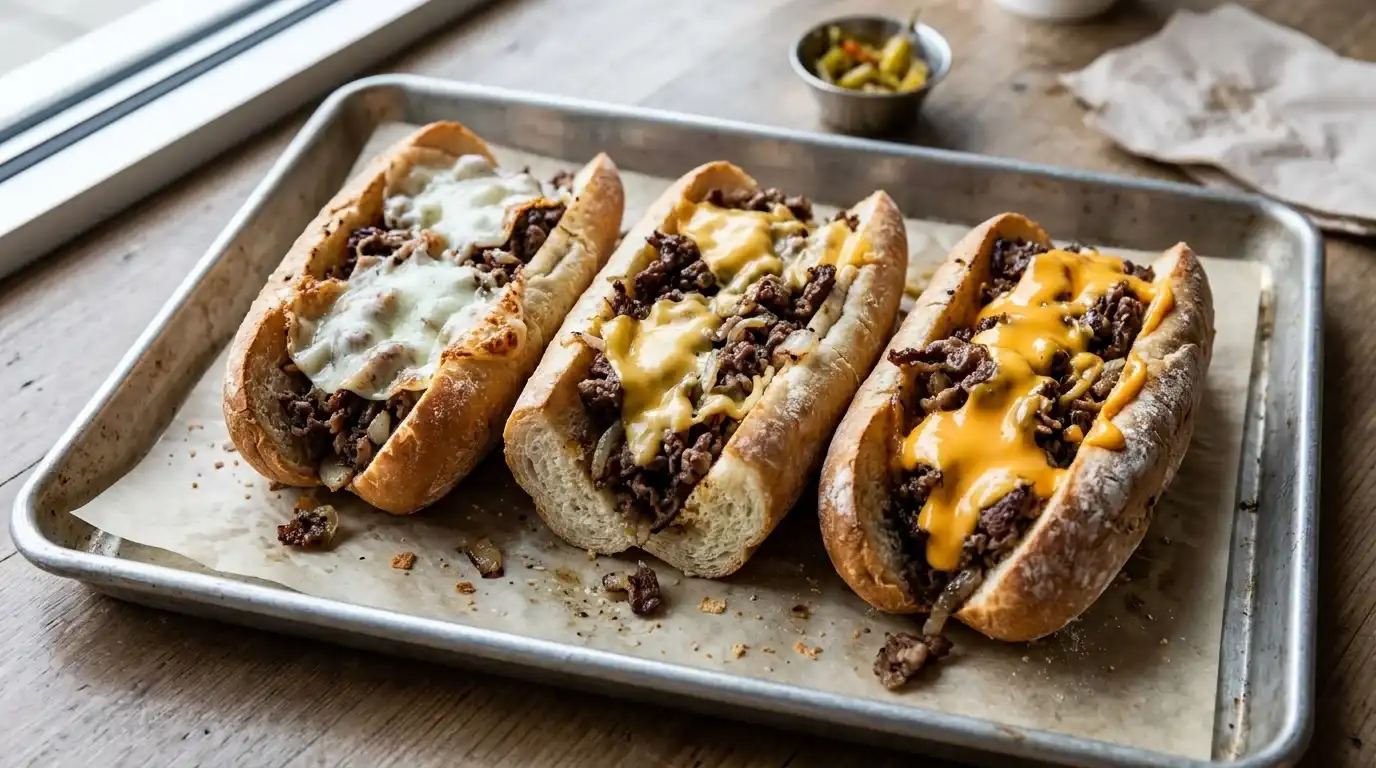
Searches for what cheese goes on a cheesesteak tend to land on the same three names. The question was tested in public in 2008, when the Inquirer surveyed shop owners and published a reader poll. The poll, with more than 5,700 votes, put American first, provolone second and Cheez Whiz third.
The owners told a different story from the poll. At Pat’s, Frank Olivieri Jr. called Whiz the overwhelming favorite, outselling American eight or ten to one, and said his father began keeping it by the grill in the mid-1950s. At Geno’s, Vento said he had never eaten the stuff and recommended provolone as “the real cheese,” while admitting that most of his customers ordered Whiz anyway. At Jim’s, Marc Proetto said customers preferred it two to one over American. At John’s Roast Pork, Vonda Bucci wouldn’t serve it, citing grease and coloring.
Outside South Philadelphia the split changes. The manager of Big John’s in Cherry Hill said American sold about six times as often as Whiz, with provolone second, and an Atlantic City sub shop offered provolone as its top seller and no Whiz at all. Tony Luke Jr. said he loved Whiz on beef but reached for American on chicken cheesesteaks. Steve Iliesecu of Steve’s Prince of Steaks described a roughly even split and a “combo” of Whiz and pourable American that he said he developed in 1980.
Politics reached the cheese question as well. According to Olivieri Jr., Sen. John Kerry asked for Swiss cheese at Pat’s in 2003, was steered to American, and a reporter overheard the exchange.
The dating of Whiz remains soft. Patent attorney Stuart Beck told the Inquirer he remembered American as the standard in the steak shops of the mid-1950s and early 1960s, and said Jim’s in West Philadelphia served American in 1955. Visit Philadelphia’s guide settles for what is now typical: Whiz is the usual choice, with American and mild or sharp provolone as common substitutes.
Why Whiz persists has a mechanical answer. Olivieri told National Geographic Traveller that it “melts all inside the nooks and crannies of the bread.” Readers weighing the same melt-versus-flavor tradeoff in a grilled sandwich can compare it with the cheeses discussed in a guide to the best cheese for grilled cheese.
The roll
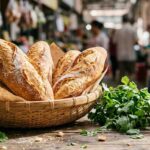
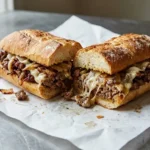
The bread gets less argument than the cheese and just as much weight. Visit Philadelphia describes it as a “long, crusty roll”, and the Inquirer’s interview records Olivieri saying Pat’s bread comes from a bakery in New Jersey. CBS News Philadelphia calls the Pat’s sandwich an Italian roll.
A bakery that gets named often is Amoroso’s. Tasting Table reports that, per the company’s website, Vincenzo Amoroso and his sons started it in Camden, New Jersey, in 1904 and moved it to Philadelphia about ten years later. The same article quotes Olivieri on the stakes: “It’s all hinged upon the bread.”
The critic’s standard is stated most plainly by Maury Z. Levy, a former editorial director of Philadelphia magazine, who says in the oral history that a cheesesteak needs “a great roll, not smushed with grease.”
Pat’s, Geno’s and the argument across the street
Geno’s opened in 1966, across the street from Pat’s. CBS News Philadelphia reports that Geno Vento says Geno’s started on a $2,000 loan from a father-in-law, and calls the rivalry friendly. His summary of the whole question was generous: “He invented it. We just perfected it.”
Frank Olivieri has said the rivalry owes a lot to the press. In the oral history he dates its start to roughly 1970 through 1973 and says the 1976 film Rocky sharpened it, because reporters kept asking what Geno’s was doing. In the Inquirer he called the competition the best thing that ever happened to both businesses and said their prices have usually matched. The numbers are claims too: he told the magazine that Pat’s sells ten times as many sandwiches as Geno’s, while Vento maintains that his own sandwich is the more authentic one.
Both shops keep the lights on around the clock. According to Visit Philadelphia, Pat’s is at 1237 E. Passyunk Avenue and Geno’s at 1219 S. 9th Street, and each is open 24 hours. Pat’s closes only on Thanksgiving and Christmas.
Ordering at the window
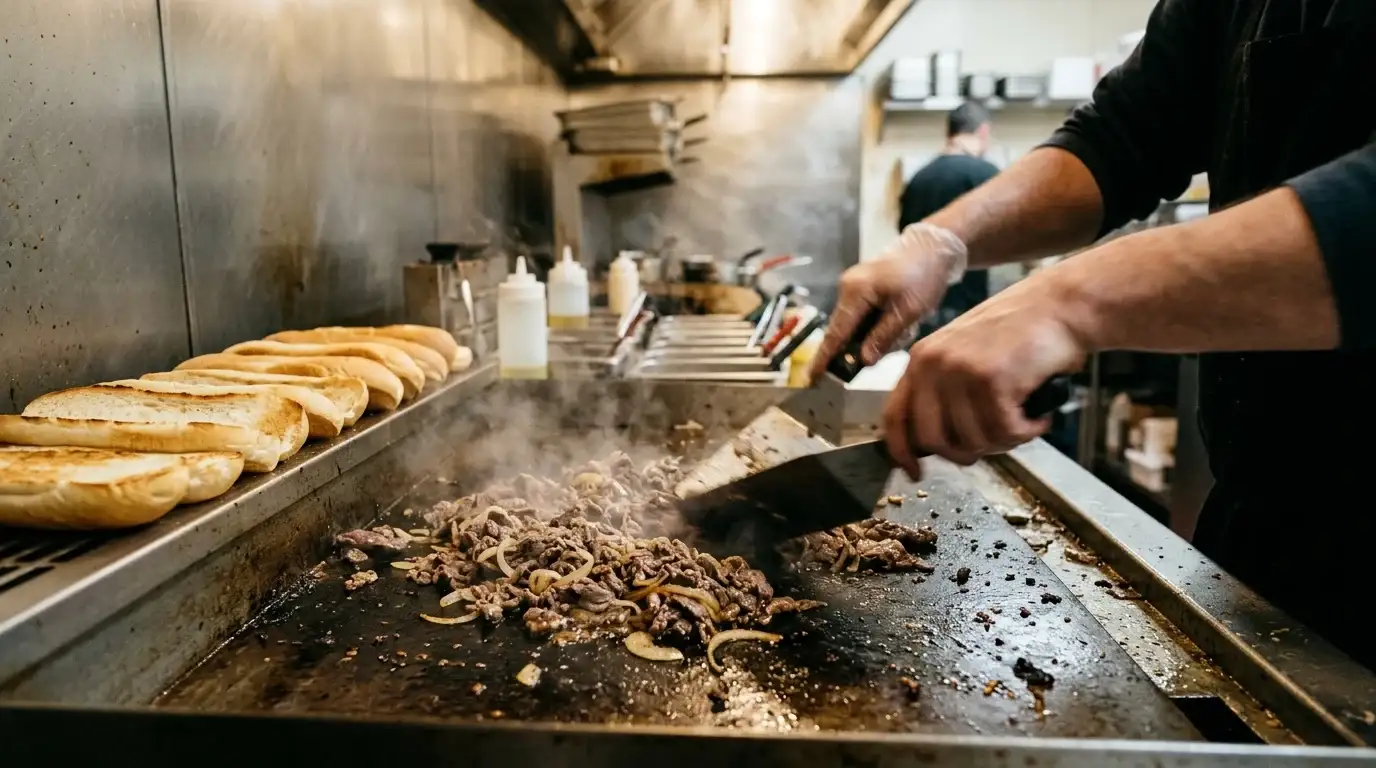
The vocabulary is part of the sandwich. Visit Philadelphia’s primer says to name the cheese first, either Whiz, provolone or American, then say “wit” for onions or “widout” for none. Cheez Whiz with onions becomes “Whiz wit.”
Other shops press their own claims. Ken Silver of Jim’s South Street, which opened its second location in 1976, told CBS News Philadelphia that his shop chops its beef because that is how it has always been done. Geno’s, by contrast, is known for thinly sliced rib-eye. Silver also had a line about the two famous names across town: he used to say Pat’s and Geno’s made cheesesteaks famous, and that Jim’s makes them great.
The founding date holds at 1930 only because no one has produced anything earlier. Pat’s closes just twice a year, on Thanksgiving and Christmas.
Sources:
- Visit Philadelphia, “Cheesesteak 101”: https://www.visitphilly.com/media-center/press-releases/cheesesteak-101-a-primer-on-the-who-what-where-whiz-of-philly-cheesesteaks/
- Philadelphia magazine, “The Cheesesteak: An Oral History”: https://www.phillymag.com/restaurants/2018/09/22/cheesesteak-history/
- The Philadelphia Inquirer, “How Pat’s staked its claim to cheesesteak fame”: https://www.inquirer.com/philly/blogs/the_spot/Pats-King-of-Steaks.html
- National Geographic Traveller, “The story behind the Philly cheesesteak”: https://www.nationalgeographic.com/travel/article/story-behind-the-philly-cheesesteak
- Billy Penn, “Revealed: The Philadelphia cabbie who first suggested selling cheesesteaks”: https://billypenn.com/2016/03/19/revealed-the-philadelphia-cabbie-who-first-suggested-selling-cheesesteaks/
- The Philadelphia Inquirer, “Whiz on a cheesesteak: Hit or myth?”: https://www.inquirer.com/philly/food/20080523_Whiz_on_a_cheesesteak__Hit_or_myth_.html
- CBS News Philadelphia, Philadelphia cheesesteak history: https://www.cbsnews.com/philadelphia/news/philadelphia-cheesesteaks-history-pats-genos-angelos-jims/
- Tasting Table, “The Roll Philly Cheesesteaks Traditionally Use”: https://www.tastingtable.com/1002323/the-roll-philly-cheesesteaks-traditionally-use
- Good Morning America (YouTube): https://www.youtube.com/watch?v=SZDXZR2bob0