
In this story
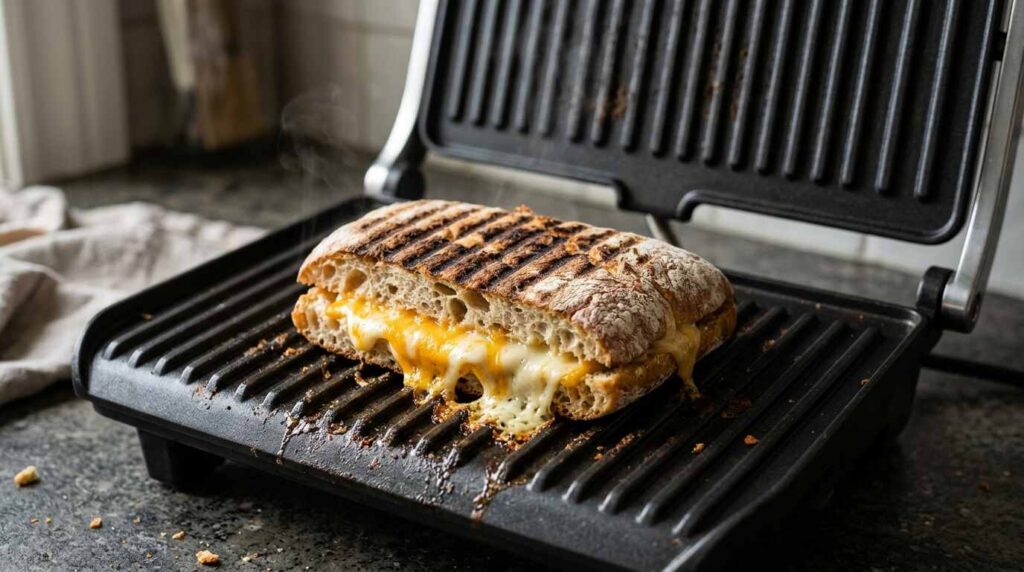
A panini press heats a sandwich from above and below at once while the lid compresses it. A skillet heats from below only, and any pressure has to come from a second pan, a lid or a weight set on top. Those two mechanisms explain most of what cooks report about the difference: the press browns both sides in a single step and flattens the sandwich in the same motion, while the skillet gives more control over each side and needs more handling. One published head-to-head test, several equipment reviews and a stack of no-press methods from test kitchens fill in the details.
Video: How To Make A Panini Without A Panini Press – Easy Recipe For A Sandwich | The Food Nut
The one head-to-head test
Kathy Strahs, who runs the Panini Happy blog, compared three ways of grilling the same cheddar-and-sourdough grilled cheese in her “Grill Method Smackdown”. The first was a Breville Ikon panini press, the second a George Foreman grill (model Champ GR10AWCAN, described as discontinued), the third an 11-inch Calphalon grill pan pressed with a 10-1/4-inch Lodge cast iron skillet on the stove.
The panini press gave an evenly crispy exterior, fully melted cheese and shallow grill marks, and it let the cook adjust grill height and heat. Its drawbacks were cost, at about $100, and the longest heating and cooking time. The Foreman grill heated in about a minute and from both sides, but squashed the sandwich so that cheese ran onto the grates, and it cooked too fast to crisp the bread as much. Its heat and height could not be adjusted. The pan pair cost little for a cook who already owned the pans, and it cooked quickly, but heating was uneven, the top half of the sandwich stuck to the skillet and cheese escaped from the sides. Strahs also reported nearly starting a fire when a potholder drifted near the flame.
Her conclusion was that all three methods can make a panini, and the right one depends on priorities: the press for quality, the Foreman for speed if one is already owned, the pans for low cost with more hassle. This is a single blogger’s test of one sandwich on three setups, and the date of the post was not visible in the fetched text.
What a panini press does mechanically
A press is two heated plates joined by a hinge, usually ridged on the cooking face. America’s Test Kitchen’s panini press review sets out what testers valued, and the criteria show the mechanics. Testers rated even heating, crispness and distinct grill marks for performance, plus ease of use and cleanup. Ridges about 0.125 to 0.25 inches tall made crisper grill marks, and ridges spaced around 0.5 inches apart were easier to clean. Low, narrow ridges marked food less distinctly and trapped debris.
Heat control mattered as much as the plate shape. Presses that stayed hot browned better and worked faster than those that cycled on and off, and long temperature cycles left food sitting without sizzling. Maximum temperatures stayed below 450°F on all but one press, which reached 473°F, and none approached the roughly 500°F point where PTFE nonstick coatings emit fumes.
The hinge decides how the press treats a thick sandwich. Floating hinges let the top plate rise to fit bulky sandwiches. Stiff ones forced testers to poke the hot lid to flatten food. A bulky sub-roll panini had to be halved to fit the smallest press, and testers pressed on the lid by hand. Fat drainage also came up: one sandwich came out slightly soggy and greasy because fat pooled without a drainage system, while presses with sloped surfaces and grease cups cut splatter, especially with bacon. One tested press with flat surfaces and no grill marks still produced sandwiches described as “golden, crispy, melty.”
Cheese behavior shows up in Strahs’s test for grilled cheese in particular. The Foreman squashed the sandwich until cheese oozed onto the grates, and the pan pair let cheese escape from the sides, while the press produced fully melted cheese without either complaint being reported.
How a skillet replaces the press
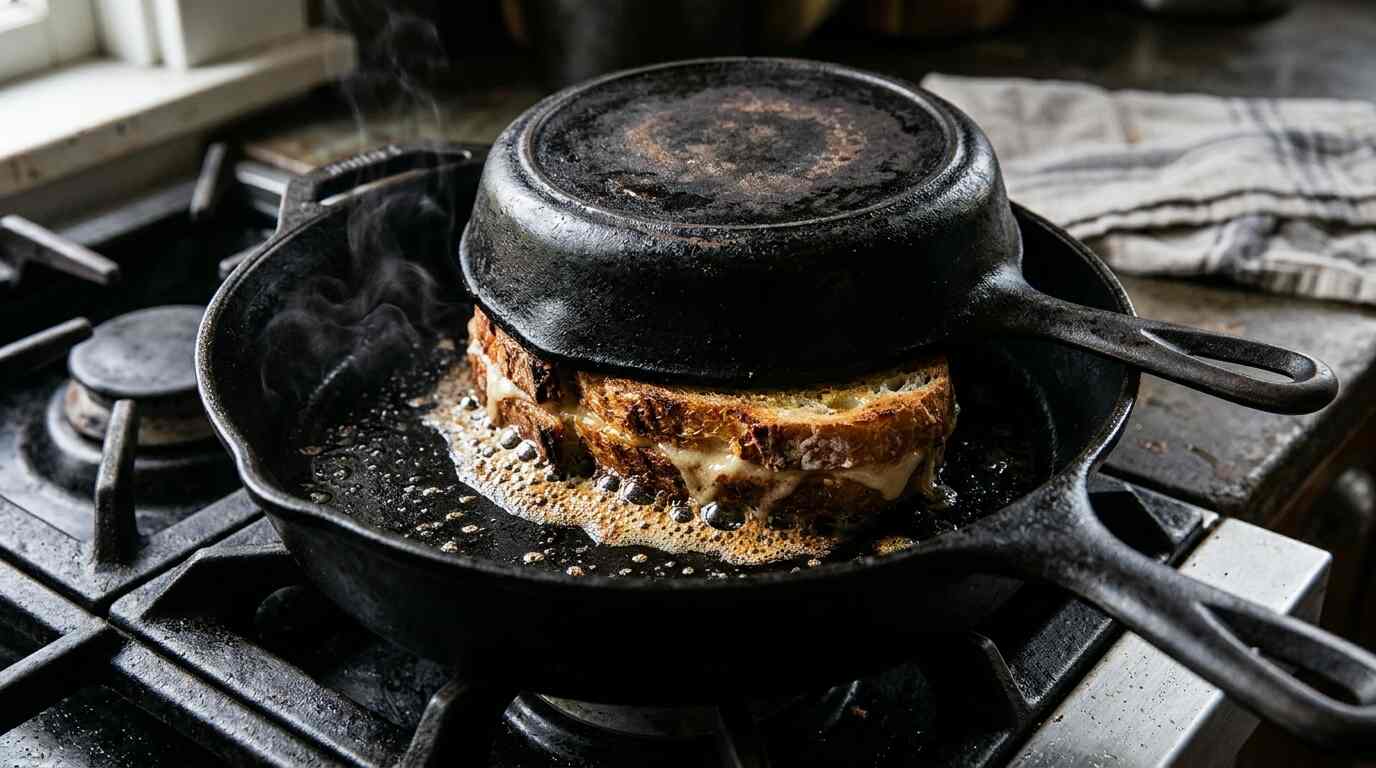
The skillet method rests on two ingredients, which one article states as “just weight and heat”. Chowhound advises a heavy, flat-bottomed pan such as cast iron on top of the sandwich, or a pot or clean brick if heavy cookware is missing, and a cast iron grill press as another option. It also describes an oven version: the sandwich goes on a baking sheet under an oven-safe press or skillet, and for several sandwiches parchment, a second baking sheet and stacked weights.
Mashed, drawing on Taste of Home, describes a stovetop version with two cast iron skillets, ideally a 10-inch and a 12-inch, preheated over medium-high. The bottom of each is oiled, the sandwich goes in the larger pan, and the smaller one presses it, with a water-filled teakettle or saucepan added for weight. The cooking time given is about four minutes, until golden brown. Ridged skillets, the article says, can produce panini grill marks.
America’s Test Kitchen’s roast beef panini recipe chooses a different pairing: a grill pan or large nonstick skillet preheated over medium heat for one minute, two sandwiches weighed down with a heavy Dutch oven, and about two minutes per side. The sandwiches are built with mayonnaise brushed on the outside of the bread. A Cuisine at Home test kitchen tip states the principle in one line: cook the sandwich on a grill and press a heavy pan on top, which flattens it, blends flavors and melts the cheese. It supplies no heat or weight figures.
The recipes disagree on heat, from medium to medium-high, and on weight, from a second skillet to a Dutch oven. They agree on the principle, and none gives a measured pressure.
Bricks, foil and other weights
Pressing does not need a second pan. Tasting Table’s page on warm Cuban sandwiches says to butter the outside of the bread, preheat a pan, set the sandwich in it and place a heavy pot or pan on top, pressing gently. A heavy pan lid works too, provided it is flat enough to distribute even weight. The page adds a grill-marks variation: wrap the sandwich tightly in foil, grill it and press it with a spatula now and then, grilling both sides before unwrapping. The page lists no author or date.
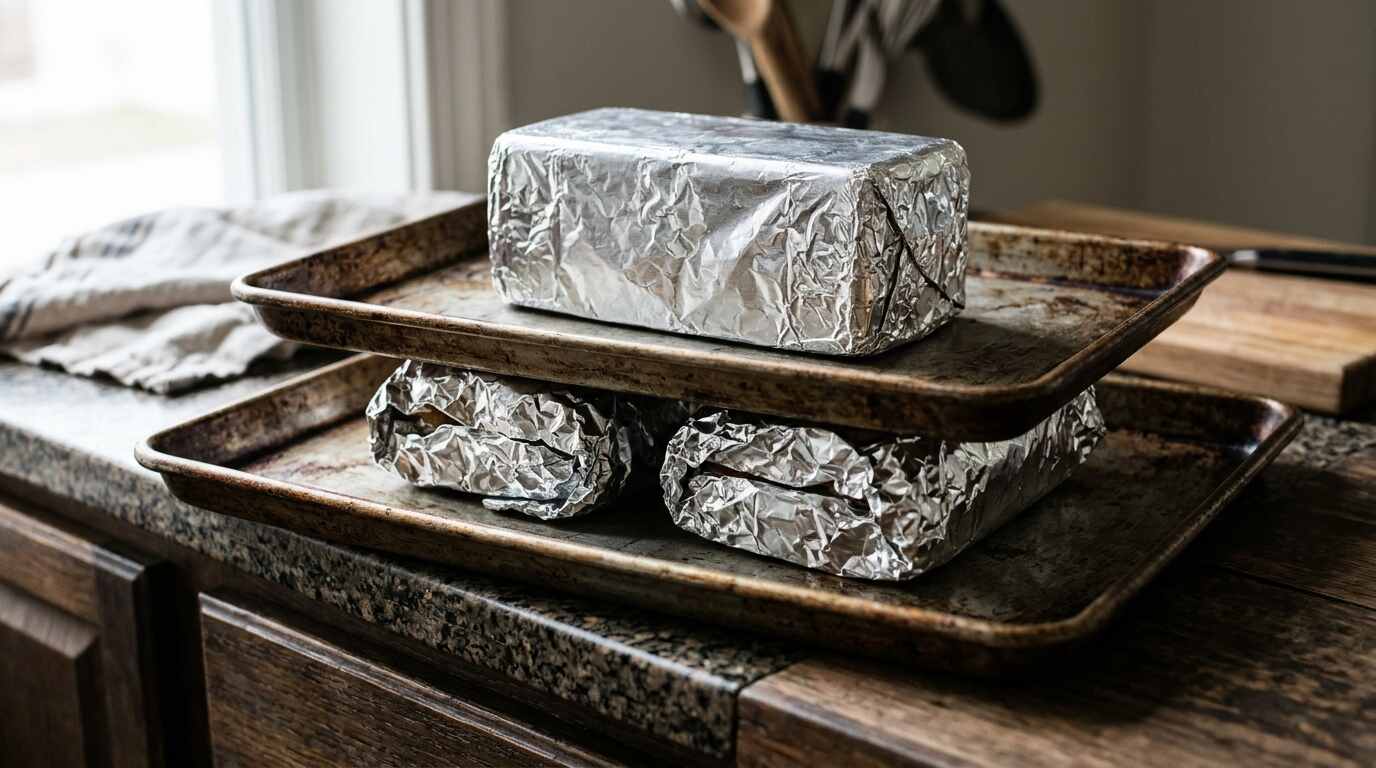
A Food Network recipe for panini under a brick wraps each sandwich of par-baked ciabatta, roast pork, ham, provolone and olive salad in foil, lays the bundles on a baking tray, sets a slightly smaller tray on top and adds a foil-wrapped brick, about 4½ pounds each by the recipe. The oven runs at 400°F for about 20 minutes, until the outside is crunchy and the middle gooey.
Strahs’s own panini-without-a-press post collects further variations, mostly from reader comments: a heavy cast iron skillet on a grill pan, a smaller skillet stacked on a larger one, the bottom of a metal mixing bowl, a waffle iron, and two baking sheets with a Dutch oven on top in the oven. Commenters advise flipping partway through so that filling does not squeeze out the bottom edge, and note that fillings which lie flat work better without a press. Her post gives no heat settings, times or weights.
Other plate-based appliances
The Mashed appliance test of grilled cheese methods included two plate-based machines. A waffle iron sealed the edges and left a cross-shaped sear that helped with cutting, but flattened the sandwich so much that it was harder to cut through. A Foreman grill made grill marks and was mess-free, but the writer judged that it took too long and left the bread not fully browned. That outcome differs from Strahs’s, where the Foreman heated within a minute and finished too quickly to crisp the exterior. The two tests used different machines and sandwiches, and neither source explains the discrepancy.
The same Mashed article ranked a stovetop stainless steel pan first among the eight methods, for browning and melt, with a nonstick pan as the low-mess alternative. It tested no panini press, so the result speaks to skillets only. How pans of different materials handle the sandwich is covered separately in the post on cast iron, stainless and nonstick.
Pressure, heat and unmeasured crispness
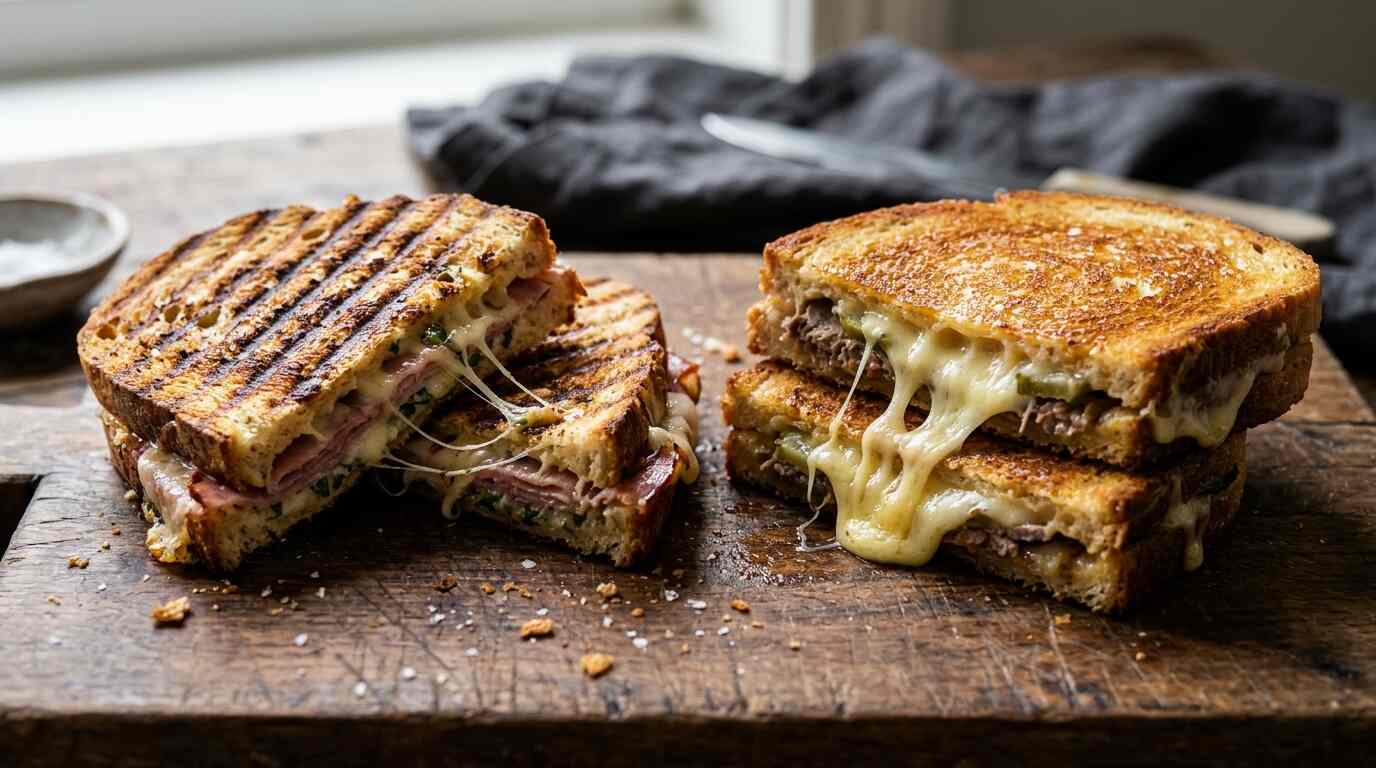
A press adds a second heat source and a set gap between plates, and cleaning depends on the ridge design. A skillet browns through direct contact on one side at a time and relies on whatever weight is placed on top. Presses differ, according to America’s Test Kitchen, in heat stability, hinge travel and fat drainage, and the pan setup in Strahs’s test heated unevenly.
No fetched source measured pressure, surface temperature or crispness with instruments across the two approaches. What exists is one blogger’s three-way test, a retail equipment review, test-kitchen recipes and reader reports, which agree that both approaches work and differ mainly in convenience, evenness and the amount of attention the cook has to give.
Products mentioned in this article
- Breville BSG520XL Panini Duo Sandwich Maker, Brushed Stainless Steel. A countertop press with top and bottom plates, the appliance category covered above. See it on Amazon (affiliate link)
- Lodge Pre-Seasoned Cast Iron Skillet, PFAS-Free, 12 Inches. A 12-inch skillet of the kind used on the stove to press a sandwich with a weight. See it on Amazon (affiliate link)
As an Amazon Associate I earn from qualifying purchases. A commission may be earned if you buy through this link, at no extra cost to you.
Sources:
- Panini Happy (Kathy Strahs), “The Grill Method Smackdown”: https://paninihappy.com/the-grill-method-smackdown/
- Panini Happy (Kathy Strahs), “How to Make Panini Without a Panini Press”: https://paninihappy.com/?p=1664
- America’s Test Kitchen, “The Best Panini Presses”: https://www.americastestkitchen.com/equipment_reviews/2743-the-best-panini-presses
- America’s Test Kitchen, “Roast Beef Panini”: https://www.americastestkitchen.com/recipes/9604-roast-beef-panini
- Chowhound, “How To Make A Perfect, Crunchy Panini Without A Panini Press”: https://www.chowhound.com/1731010/how-to-make-panini-without-press
- Mashed, “The Secret To Making A Panini Without A Panini Press”: https://www.mashed.com/184307/the-secret-to-making-a-panini-without-a-panini-press
- Cuisine at Home, “How to Make Panini Without a Panini Press”: https://cuisineathome.com/tips/test-kitchen-tip-82
- Food Network, “Panini Under a Brick”: https://www.foodnetwork.com/recipes/panini-under-a-brick-recipe-2042936.amp
- Tasting Table, “You Don’t Require A Panini Press To Make Warm Cuban Sandwiches”: https://tastingtable.com/stories/you-dont-require-a-panini-press-to-make-warm-cuban-sandwiches
- Mashed, “We Tested 8 Appliances To Find The Best Way To Make Grilled Cheese”: https://www.mashed.com/2278597/best-way-make-grilled-cheese-appliances-tested/
- The Food Nut (YouTube), “How To Make A Panini Without A Panini Press – Easy Recipe For A Sandwich”: https://www.youtube.com/watch?v=Bh9AdXst5Po