In this story
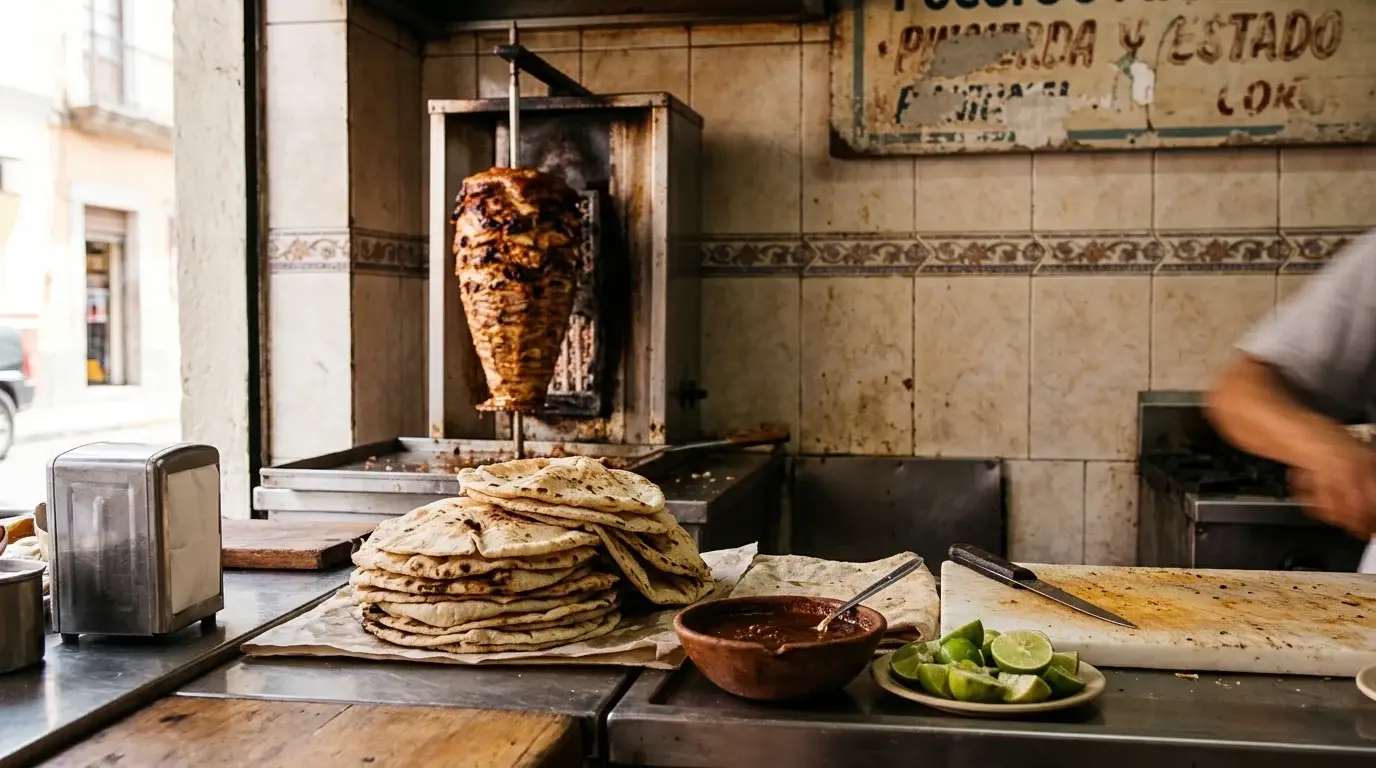
Tacos al pastor are thin shavings of marinated pork carved from a rotating vertical spit, dropped onto small corn tortillas and finished with onion, cilantro, salsa and a sliver of pineapple. The spit is called a trompo, after the spinning top it resembles. The method is not Mexican in origin. It came with immigrants from what is now Lebanon, who settled in Puebla and Mexico City and roasted meat the way it was roasted at home. Over a few decades the lamb became pork, the spices became chile and achiote, and the bread became a tortilla. What came out the other side is, by Mexico News Daily’s account, now Mexico’s most popular taco.
Video: All the Tacos: Al Pastor in Mexico City, from the Munchies YouTube channel
Lebanese immigrants and the vertical spit
A cooking method that crossed from the eastern Mediterranean to central Mexico
Mexico News Daily traces the dish to Lebanese immigration that began as early as the 19th century, when families from what was then called Greater Syria sent children abroad to avoid conscription into the Ottoman army. Immigration grew in the early 20th century. The same article reports that more than 400,000 Mexicans are of Lebanese heritage today.
The immigrants brought vertical-spit roasting, the technique behind shawarma, gyros and döner kebab. Culture Trip reports that the first trompo appeared in Puebla around 1930, and that two Puebla taquerías, Antigua Taquería La Oriental and Tacos Árabes Bagdad, both founded in 1933, claim to have created the dish that followed.
Tacos árabes, the Puebla original
Spit-roasted meat, Middle Eastern spicing and wheat bread
The first spit-roasted tacos in Puebla were not al pastor. They are still sold there as tacos árabes, Arab tacos. Mexico News Daily describes them as keeping the Middle Eastern seasoning, though the meat today is often pork rather than the original lamb. The same article notes that Taquería Bagdad had become an institution in Puebla by the 1930s, and that the corn tortilla of later al pastor replaced the pita these early tacos were wrapped in.
Tacos árabes are the clearer link to shawarma: spit-roasted meat, Middle Eastern spice and wheat bread. In Puebla they never disappeared. Mexico News Daily notes that in the city where the trompo first turned, al pastor still competes with árabe.
How lamb became pork in Mexico City
Non-Lebanese taquerías took the spit and changed everything on it
The transformation into al pastor most likely happened in Mexico City. Mexico News Daily points to the La Merced market area, where non-Lebanese taquerías adopted the trompo and adapted the recipe. The article lists the changes:
- Pork replaced lamb.
- Achiote and dried chiles replaced the Middle Eastern spice mix.
- Small corn tortillas replaced pita.
- Onion, cilantro, pineapple and salsa were added on top.
The name raises its own question. “Al pastor” means “shepherd style,” which fits lamb. Culture Trip links the name to the original lamb. Mexico News Daily points out the oddity for the modern dish: pigs are not herded like sheep, and the name has never been fully explained.
By the 1960s, according to Mexico News Daily, al pastor was established in the capital. El Universal agrees on the decade, reporting that the trade of the pastor taquero appeared in Mexico City in the 1960s, the period from which there are records of al pastor sold as it is known today. Food historian Jeffrey Pilcher, the paper reports, counts al pastor among the most important culinary innovations of the 20th century.
It did not start as everyday food. El Universal cites José Iturriaga’s 1987 book De tacos, tamales y tortas as describing al pastor as associated at first with the middle and upper classes.
The pineapple question
A sweet topping with a disputed origin
The pineapple perched on top of the trompo is now the dish’s signature, and nobody can say for certain where it came from. Mexico News Daily reports that it is unknown why pineapple was added, though some believe it helps digestion, and notes a practical effect: a pineapple jammed onto the top of the spit helps press the stacked meat together.
One taquería has a claim. Culture Trip reports that El Tizoncito, one of Mexico City’s best-known taquerías, says it invented the pineapple addition, and that nobody has managed to dispute it. Mexico City newspaper El Universal reports the story usually told: that al pastor began selling in 1966 in the Condesa neighborhood, when a woman named Conchita opened a taquería between Tamaulipas and Campeche streets. Whether El Tizoncito invented the pineapple or simply made it famous, the original tacos árabes had none of it, and neither pineapple, cilantro nor onion appeared on the first spit-roasted tacos in Puebla, according to Culture Trip.

How al pastor is made
Thin sheets of pork, a red marinade and a stack built by hand
The meat is pork, cut thin. Mexico News Daily describes cutting it into thin sheets along the grain, similar to the cutlets used for milanesa, then marinating them with slivers of onion before stacking them on the spit. The marinade is where taquerías compete, and the same article notes that many of them guard their recipes closely.
The common elements are dried chiles and achiote, the brick-red paste made from annatto seeds. Culture Trip lists achiote and red chiles as the core of today’s marinade. Stacked tightly on the trompo and topped with a pineapple, the meat roasts on its outer face. El Universal’s 2017 history of the dish opens on a Mexico City taquero at work: he presses a couple of tiny tortillas against the turning meat, slices off a little, uses the same knife to knock pieces of pineapple off the top so they land on the taco in his hand, then adds cilantro, onion and salsa.
Flavia Morán, a chef and instructor at Mexico City’s Colegio de Gastronomía, told the paper that the vertical spit is purely Arab in origin, but that al pastor has its own identity and has existed long enough to count as a classic in its own right. She singles out the charred, caramelized bits that form as the outer layer cooks.
Orders usually come in fives. Mexico News Daily says al pastor is typically served in orders of five on small corn tortillas.
Regional names vary across the country. Elsewhere in Mexico the same taco may be called tacos de trompo or tacos de adobada, the second meaning “marinated.”
Al pastor beyond the taco
The same meat fills tortas, gringas and alambres
The trompo feeds more than tacos. Mexico News Daily lists three other common uses for the meat: tortas, Mexico’s sandwiches; alambres; and gringas.
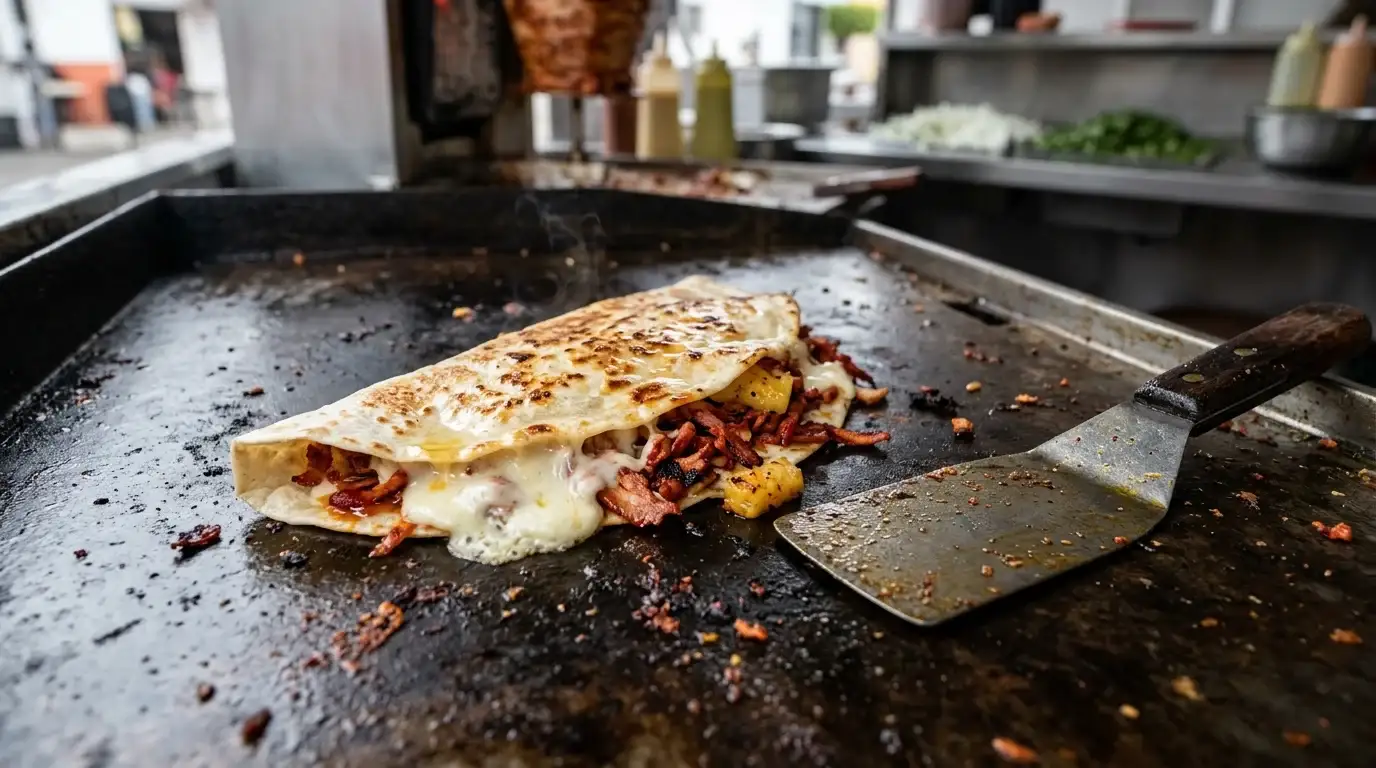
The gringa is the clearest bridge to the grilled cheese. Rick Bayless, the Chicago chef and Mexican cooking authority, writes that gringas are not really tacos but a type of quesadilla, two flour tortillas sandwiched with melted cheese and al pastor. In other words, a griddled cheese sandwich built on wheat tortillas instead of bread. That wheat also takes the dish part of the way back to its origins, since the first spit-roasted meat in Puebla was wrapped in wheat bread rather than corn.
The name comes with a story that is widely repeated and impossible to pin down. Wikipedia’s entry on the dish, citing a 2003 LA Weekly column by Jonathan Gold, ties it to a pair of young women who ate at a small taquería on Leibnitz Street in Mexico City and, not liking corn tortillas, asked for flour. Gringa is slang for a foreign woman, and the order became the dish.
Frequently asked questions
Where do tacos al pastor come from?
From Lebanese immigrants in Puebla, who introduced vertical-spit roasting. Their spit-roasted meat, still sold as tacos árabes, was adapted in Mexico City into pork with a chile and achiote marinade on corn tortillas.
What is the difference between al pastor and tacos árabes?
Tacos árabes keep Middle Eastern spicing and come on pita-style bread. Al pastor uses a chile and achiote marinade, corn tortillas, and toppings of onion, cilantro, pineapple and salsa.
Why is there pineapple on al pastor?
Its origin is unknown. Mexico City’s El Tizoncito claims it introduced the pineapple, and a pineapple on top of the trompo also helps press the meat.
What is a trompo?
The vertical rotating spit used for al pastor, named after the spinning-top toy it resembles.
Sources
- Leigh Thelmadatter, “Mexico’s favorite taco has immigrant roots,” Mexico News Daily (May 2, 2020): https://mexiconewsdaily.com/mexico-living/mexicos-favorite-taco-has-immigrant-roots
- Lydia Carey, “Why the Mexicans Can Thank the Lebanese for Tacos Al Pastor,” Culture Trip: https://theculturetrip.com/north-america/central-america/mexico/articles/why-the-mexicans-can-thank-the-lebanese-for-tacos-al-pastor
- Wikipedia, “Gringas” (pointer only, for the name story): https://en.wikipedia.org/wiki/Gringas
- Rick Bayless, “Gringas al Pastor”: https://www.rickbayless.com/recipe/gringas-al-pastor/
- Nayeli Reyes, “El platillo árabe que se volvió taco chilango,” El Universal (December 2, 2017): https://www.eluniversal.com.mx/colaboracion/mochilazo-en-el-tiempo/nacion/sociedad/el-platillo-arabe-que-se-volvio-taco-chilango/