
In this story
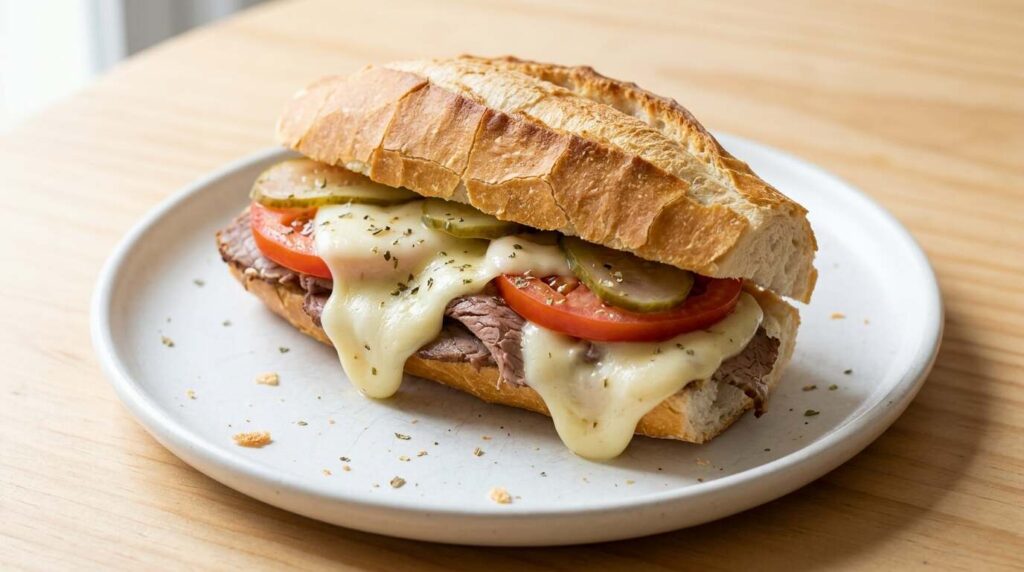
The bauru is a hot sandwich of sliced roast beef, tomato, pickled cucumber and melted cheese, packed into a pão francês, the Brazilian crusty white roll, with part of its crumb scooped out. It comes from the city of São Paulo, not from the city of Bauru that gave it a name, and it has been protected in law twice: once by the municipality of Bauru in 1998 and once by the state of São Paulo in 2018. According to the Legislative Assembly of São Paulo, the sandwich was created in 1937 by a law student named Casemiro Pinto Neto at the restaurant Ponto Chic.
Video: Sanduíche símbolo de São Paulo: o bauru não nasceu em Bauru — from the TV Brasil YouTube channel
What goes into a bauru
Beef, tomato and pickle under a blanket of cheese
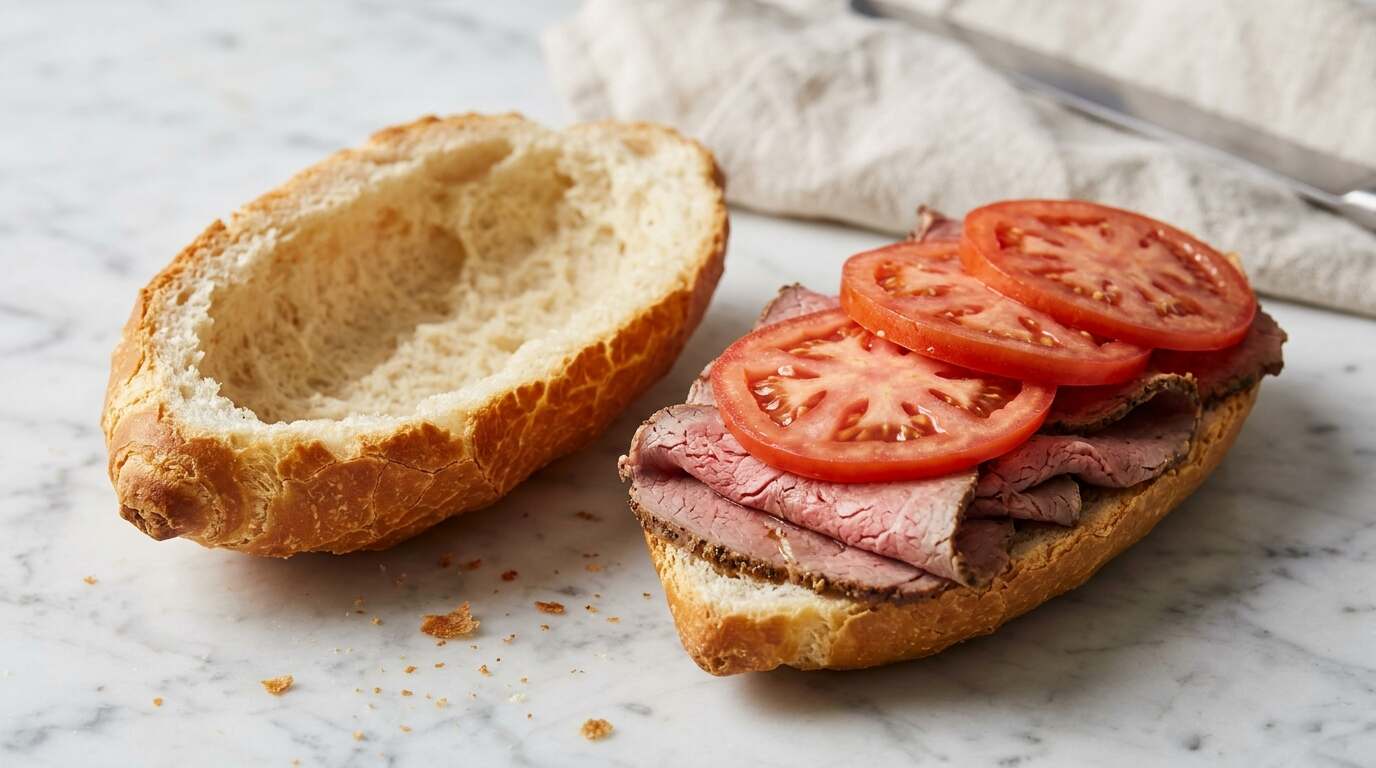
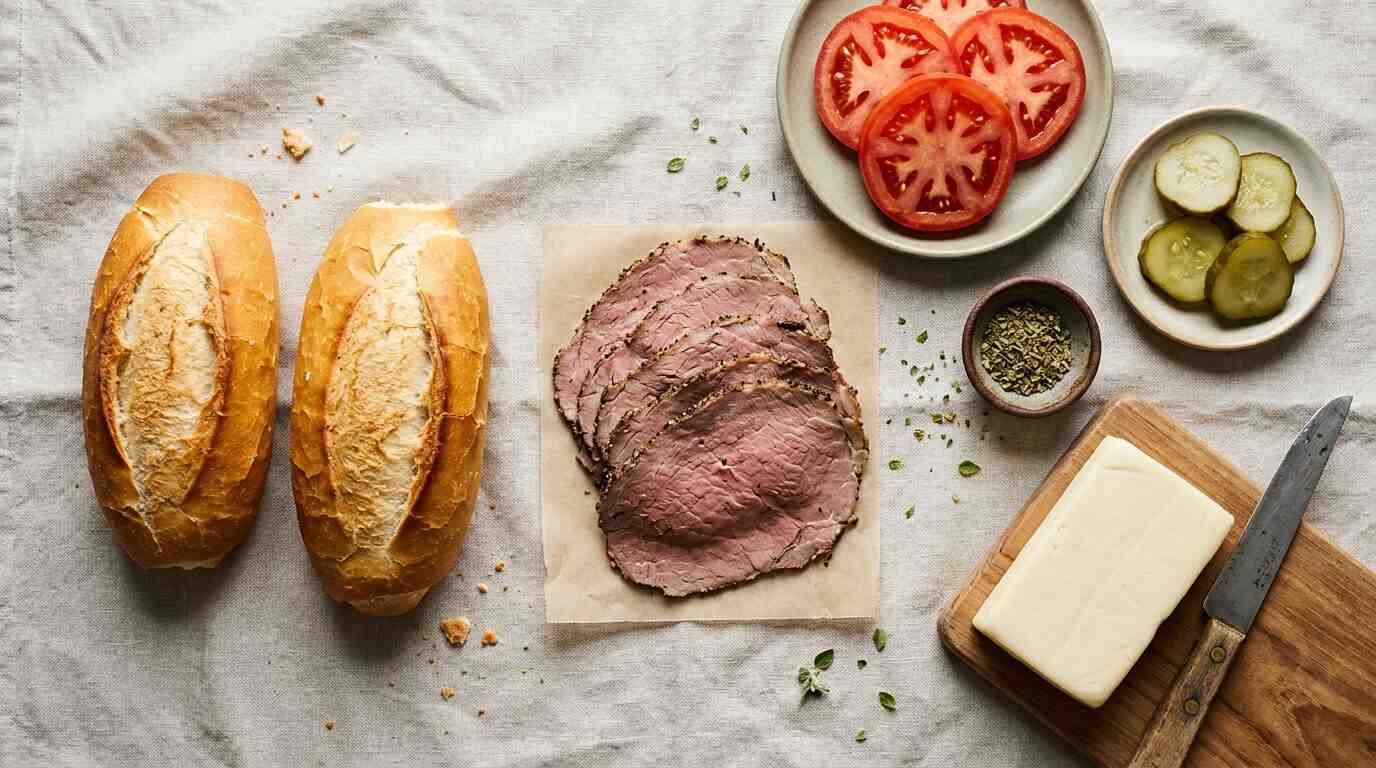
Every account agrees on the frame of the sandwich. A pão francês is split, and the crumb of the top half is removed to leave a shallow hollow. Thin slices of roast beef (rosbife in Portuguese) go in with tomato slices and sliced pickled cucumber. Cheese, melted separately, is poured or placed over the top so that its heat warms everything underneath. The text of Bauru municipal law 4.314 of 24 June 1998 lists French bread, sliced roast beef served cold, sliced tomato, sliced cucumber pickle, mozzarella, oregano, water and salt, and describes the bread as cut in half with the crumb of the top half removed to form a “canoe.”
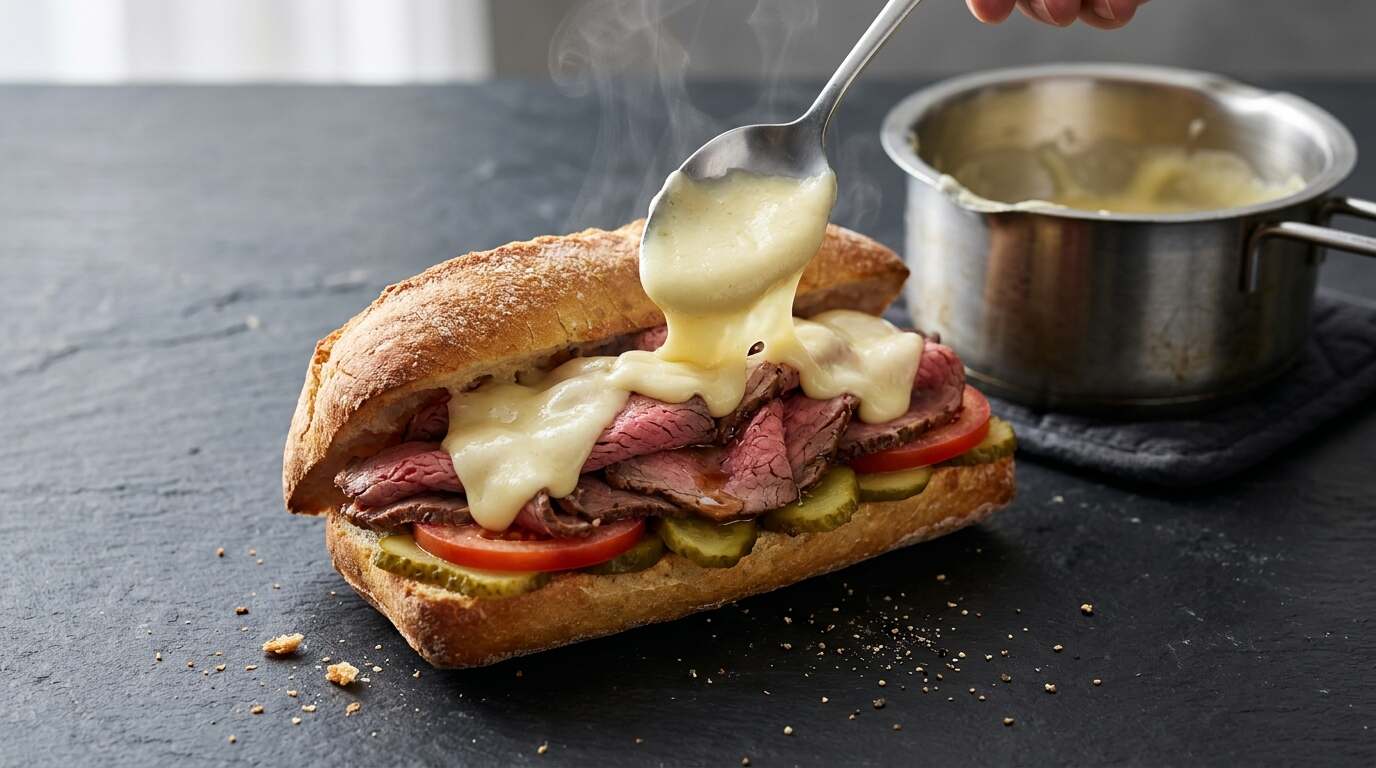
Water appears in that list because the cheese is not grilled. Per the same law, the mozzarella is melted by briefly heating it in water in a frying pan, then set in the top half of the bread, which is closed over the bottom half. The English-language Wikipedia entry) (cited here as a pointer to the sources it lists, since the material is thin elsewhere in English) describes the same method as melting in a bain-marie, the double-boiler technique used in professional kitchens.
On the cheese, the written record splits. The municipal law names mozzarella, and the Portuguese Wikipedia article) also gives melted mozzarella in its description of the original recipe. A report on the bar’s 103rd anniversary from ABC do ABC says that the Ponto Chic version uses four melted cheeses: prato, estepe, gouda and Swiss. Another source, a 2010 review in The Daily Meal, also describes a blend of four cheeses melted in a bain-marie and poured over the meat, while noting that mozzarella is often cited.
Oregano and salt are the only seasonings in the municipal text. Pickles are a point of dispute, taken up below.
Casimiro Pinto Neto and the order that named a sandwich
A law student at Largo de São Francisco asks the grill cook for something off the menu
The Legislative Assembly account is brief. Casemiro Pinto Neto, a law student at the Largo de São Francisco, frequented Ponto Chic, did not want anything on the menu one day, and told the waiter how he wanted his sandwich made. The sandwich was named Bauru after his nickname, since he came from the city of Bauru. The spelling of his first name varies between sources: Wikipedia) notes both “Casimiro” and “Casemiro.”
The details change from telling to telling. The ABC do ABC piece, which relies on his own account, says that Pinto Neto asked a sandwich maker called Carlos to add cheese, then roast beef, then tomato to a French roll, and that a customer named Antonio Boccini Jr., known as “Quico,” tried a piece and ordered one “do bauru.” That is the moment the name stuck, according to that version. The Portuguese Wikipedia article) adds that Pinto Neto took the idea from a booklet, Livro das Mamãezinhas, by Wladimir de Toledo Piza, and then guided the restaurant’s grill cook. The O Antagonista article frames it as a nickname from his classmates and a friend who asked for “um igual ao do Bauru” (“one like Bauru’s”).
None of these accounts contradicts the others outright. They differ in who, among the people in the room, is credited with the naming.
1937 or 1934
Two dates, one sandwich
The year of the first bauru is contested. The Legislative Assembly of São Paulo, O Antagonista, ABC do ABC and the Portuguese Wikipedia article all say 1937. The Daily Meal’s 2010 sandwich of the week and the English Wikipedia entry) both give 1934.
The English Wikipedia entry rests its account mainly on archived 2007 web pages from the city of Bauru’s sandwich site and from Ponto Chic itself, which are interested parties, and the later official sources cited above favor 1937. No independent archive record of the first order has turned up in the pages consulted for this article. The date therefore stays open, with 1937 the more frequently repeated one in Brazilian sources and 1934 persisting in English-language ones.
The same caution applies to the contents of the first version. The O Antagonista article says that pickles and oregano were added over the years. The municipal law, the Portuguese Wikipedia article and the Daily Meal all include them in the traditional recipe without noting a later addition. Whether the 1930s sandwich carried pickles is therefore reported by one source and not confirmed by the rest.
Ponto Chic at Largo do Paissandu
A 1922 bar that became a landmark for the sandwich it did not set out to sell
The bar behind the bauru opened in 1922 at Largo do Paissandu, the same year as São Paulo’s Semana de Arte Moderna, per ABC do ABC. The writers and artists named in that article as customers include Mário de Andrade, Anita Malfatti and Monteiro Lobato, and students from the nearby law school were regulars too. The article marked the 103rd anniversary on 24 March 2025.
By the bar’s own telling as reported there, the bauru became its most-ordered item. The figures offered for the volume differ by source. O Antagonista says the original Ponto Chic sells more than 17,000 units a month. ABC do ABC puts sales at about 146,000 units in 2023, which averages to roughly 12,000 a month. The two numbers come from different publications and different years and are not reconciled in either.
The Daily Meal’s 2010 review lists the address as Largo do Paiçandu, 27, and a price at the time of R$14.90, about $8.30 then. That price is dated November 2010 and is not a current menu price.
The same ABC do ABC article says other snack bars have sold similar sandwiches but that the original is served only at Ponto Chic, where cooks are trained to keep the flavor consistent. It also reports that the bauru ranked 38th on TasteAtlas’s list of the world’s 50 best sandwiches; the TasteAtlas page itself could not be retrieved for confirmation.
Two laws for a sandwich
From a municipal registration in 1998 to state heritage in 2018
Bauru the city moved first. Law 4.314 of 24 June 1998, in its first article, authorizes the municipal executive to take the steps needed to register the sandwich so that its original recipe stays unchanged. Its second article lists what the registration should consider: the sandwich’s origin, its recipe and preparation, and two local traditions. One is a bar owner in Bauru who kept making the sandwich to the original recipe; the other is the annual Festa do Sanduíche Bauru in Praça Rui Barbosa. The law describes the origin as a restaurant in São Paulo’s Largo do Paissandu, with the sandwich created at the suggestion of a Bauru-born law student.
Secondary sources describe the 1998 law as creating a quality seal for the original version. The Portuguese Wikipedia article) and O Antagonista both say so, and the English entry mentions an official certification program. The text of the law as retrieved does not itself mention a seal or certification mark; it authorizes registration. Whether the seal came from later regulation was not established in the pages consulted. The Portuguese article adds that few bars hold municipal authorization to sell the original bauru, among them Ponto Chic and the Bar Skinão in the city of Bauru.
The state followed 20 years later. Law 16.914/2018 declared the bauru intangible heritage of the State of São Paulo (“Patrimônio Imaterial do Estado”). Bill 1.189/2017, authored by deputy Celso Nascimento, was approved by the Assembly plenary on 13 December, and then-governor Márcio França sanctioned it; the law was published in the Official Gazette on 29 December. The deputy said of the honor: “É uma exaltação à cidade de Bauru, pois o lanche leva seu nome e é conhecido por todo o Brasil” (Alesp), which translates roughly as “It is an exaltation of the city of Bauru, since the sandwich carries its name and is known across Brazil.”
The sandwich carries the name of a city that, in the accounts above, figures in its invention only as one student’s birthplace. O Antagonista describes Bauru as a city in the interior of São Paulo state, about 326 kilometers from the capital, nicknamed the “Cidade Sem Limites” for its history as a meeting point of three railway lines.
The bauru among São Paulo’s lunch counter sandwiches
Roast beef, melted cheese and a roll that does most of the work
São Paulo has a crowded field of hot sandwiches built on the pão francês. A Culture Trip survey lists the bauru at Ponto Chic alongside the Mercado Municipal’s mortadella sandwich, made with Ceratti mortadella and about ten ounces of meat, which legend dates to the 1930s; a pork pernil sandwich; the Frevo bar’s beirute, created in 1951 by Beirut immigrant Fares Sader with roast beef, tomato, melted cheese and za’atar in Lebanese flatbread; and the buraco quente, a hollowed roll packed with filling. Like the bauru, the buraco quente is built in a hollowed roll.
Within that group, the bauru is a cheese melt of an unusual kind. Under the municipal recipe the cheese is warmed separately in water, not pressed against a griddle as in a grilled cheese or a melt, and the roast beef underneath is served cold and warmed only by the cheese and the closed roll. The behavior of cheese under heat, including why it can turn oily, is covered in a separate piece on why cheese melts and turns greasy.
Roast beef in a roll also places the bauru near the French dip in America, and the long roll with layered meat, cheese and vegetables near the hoagie, sub, hero and grinder family, though no source consulted draws a direct line between them. The Mexican torta, another filled roll, belongs to the same broad family of bread-based sandwiches.
The English Wikipedia entry notes that other eateries sell sandwiches under the bauru name with different ingredients, such as ham in place of roast beef or sliced bread in place of French bread, and the Portuguese entry says the cheese varies most from region to region. The O Antagonista piece says the sandwich is now sold in bakeries, snack bars and bars in almost every Brazilian state. The Italian site Sabor Brasil gives a home version for the Ponto Chic style in grams: a roll of 80 to 100 grams, about 80 grams of sliced roast beef and about 80 grams of semi-hard yellow cheese, with tomato, pickled cucumber, salt and oregano.
Sources
- Alesp, “Sanduíche bauru é Patrimônio Cultural e Imaterial do Estado” — https://www.al.sp.gov.br/noticia/?id=396127
- Município de Bauru, Lei nº 4.314 of 24 June 1998 (full text) — https://sapl.bauru.sp.leg.br/sapl_documentos/norma_juridica/4472_texto_integral.pdf
- ABC do ABC, “Ponto Chic completa 103 anos” — https://www.abcdoabc.com.br/ponto-chic-completa-103-anos/
- The Daily Meal (Arthur Bovino), “Sandwich Of The Week: Ponto Chic’s Bauru,” 14 November 2010 — https://www.thedailymeal.com/sandwich-week-ponto-chics-bauru
- O Antagonista, “A cidade do interior paulista que deu nome ao sanduíche mais famoso do Brasil…” — https://oantagonista.com.br/?p=1973621
- Wikipedia (English), “Bauru (sandwich)” — used only as a pointer — https://en.wikipedia.org/wiki/Bauru_(sandwich)
- Wikipedia (Portuguese), “Bauru (sanduíche)” — used only as a pointer — https://pt.wikipedia.org/wiki/Bauru_(sandu%C3%ADche)
- Culture Trip, “São Paulo’s Iconic Sandwiches Will Make Your Mouth Water” — https://theculturetrip.com/south-america/brazil/articles/sao-paulos-iconic-sandwiches-will-make-your-mouth-water
- Sabor Brasil, “Bauru do Ponto Chic” — https://www.saborbrasil.it/?p=4770
- TV Brasil on YouTube, “Sanduíche símbolo de São Paulo: o bauru não nasceu em Bauru” — https://www.youtube.com/watch?v=dGiivbixQBA